
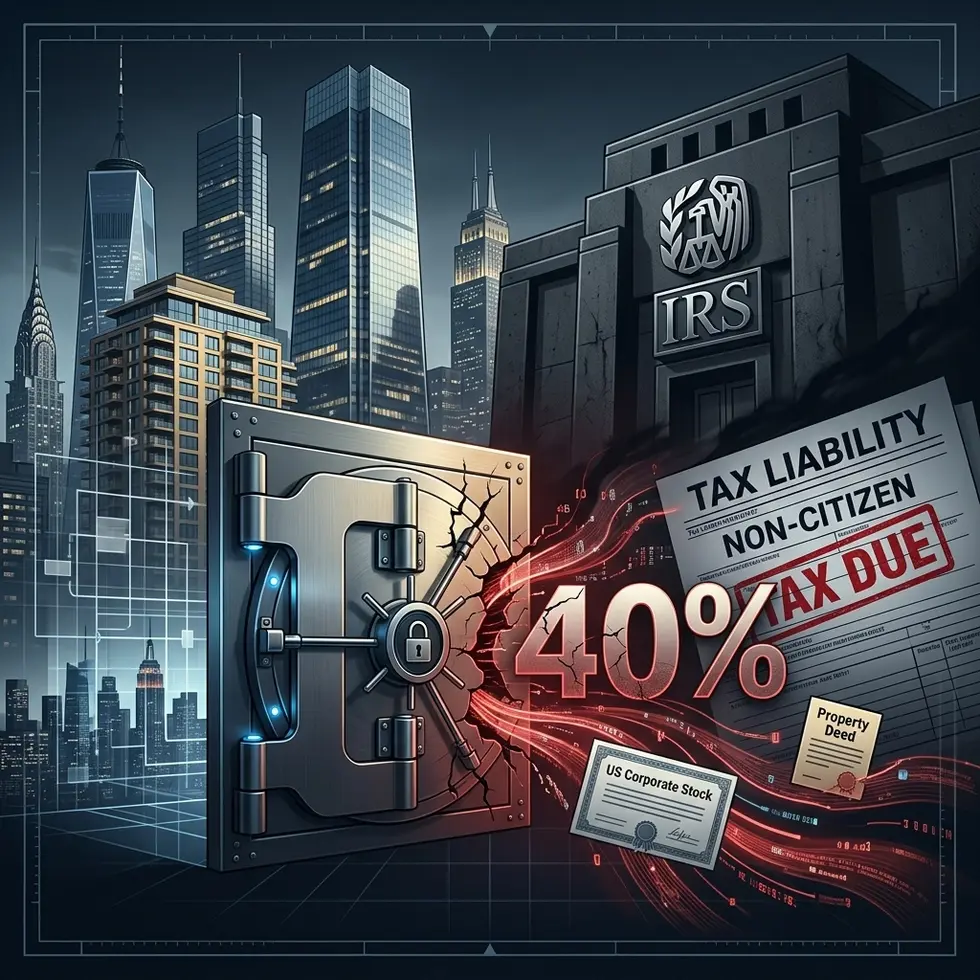
Mission Summary: Wealth Defense for the Global Investor
If you're a non-US citizen (Non-Resident Alien or NRA) holding US tech stocks, luxury real estate, or private equity in your own name, you aren't just an investor: you're a primary donor to the Internal Revenue Service. Most global investors believe that because they don't live in the States, they aren't subject to the "Death Tax." They are wrong. While US citizens enjoy a massive $13.61 million exemption (slated to sunset in 2026), foreign investors are capped at a measly $60,000 exemption. Anything above that is taxed at a staggering 40%. This dossier breaks down the "Situs" trap, the FIRPTA nightmare, and the high-level structural "wrappers" used by the world's elite to render their US portfolios invisible to the IRS.
The $60,000 Invisible Cliff (IRC § 2101)
Imagine you have a $5 million portfolio of Apple, NVIDIA, and Tesla stock held in a personal brokerage account. You aren't a US resident. You think you're safe.
Under IRC § 2101, the United States imposes an estate tax on the transfer of the taxable estate of a nonresident not a citizen of the United States. That's the starting gun. Unlike US citizens and many domiciliaries who may have access to a much larger unified credit, an NRA estate generally gets only the small credit described under the estate tax rules, which effectively shelters just $60,000 of US-situs property unless a treaty changes the result. In plain English: the code starts from the assumption that personally held US assets are exposed.
Under IRC § 2104, the IRS then determines whether the asset is considered property situated in the United States. If it is, it falls into the federal estate tax base for the NRA decedent. This is why the legal label on the asset matters less than the actual tax character of what is owned.
On a $5 million portfolio of publicly traded US corporate stock held personally, your heirs may face an estate tax bill of roughly $1.9 million to $1.98 million, depending on the exact rate stacking and deductions available. And the payment timeline is not theoretical. Federal estate tax returns and payment obligations are generally due within nine months of death unless an extension applies. That can force a family to liquidate assets at the worst possible time.
If they don't have the cash? The IRS does not care that the family wants to hold the position, preserve the portfolio, or avoid a distressed sale. Liquidity pressure becomes the real tax. This is why owning nothing and controlling everything is more than a slogan for foreign families. It's survival math.
Jargon Buster: What These Terms Actually Mean
Non-Resident Alien (NRA): A non-US citizen who is not treated as a US resident for the relevant transfer-tax analysis. For this article, it means the foreign investor who may be exposed to US estate tax on US-situs assets.
US Situs Asset: Property treated as located in the United States for federal estate tax purposes. This category can include US corporate stock, US real estate, certain tangible assets located in the US, and some debt interests, depending on the facts and statutory exceptions.
FIRPTA: The Foreign Investment in Real Property Tax Act, largely implemented through IRC § 1445. It requires withholding on certain transfers of US real property interests by foreign persons. It is a withholding regime, not a separate tax system.
Foreign Blocker: A foreign corporation used to hold US assets so the investor owns foreign corporate shares rather than the underlying US asset directly. If structured properly, that can shift the estate tax analysis because foreign stock is generally non-US situs under IRC § 2105.
PPLI Wrapper: A Private Placement Life Insurance structure in which assets are held in an insurance separate account subject to strict compliance rules. The tax result depends on policy design, investor-control limits, diversification rules, carrier independence, and how premiums are funded. It is not a magic eraser.
What Qualifies as "US Situs" (The Target List)?
Under IRC § 2104, the following are commonly "sitting ducks" for the 40% estate tax because they are generally treated as property situated in the United States for an NRA decedent:
- US Corporate Stock: Even if the certificates are held in a vault in Zurich, if the company is incorporated in the US, the shares are generally US-situs property for estate tax purposes.
- US Real Estate: Your Miami condo, Beverly Hills residence, or Manhattan penthouse.
- Tangible Personal Property: Art, jewelry, or cars physically located in the US.
- Debt Obligations: Certain bonds or debt instruments of US persons or entities, subject to statutory exceptions and planning nuances.
Just as important, IRC § 2105 identifies categories of property treated as outside the United States for this purpose. That section is where planners look for breathing room. It can exclude certain bank deposits, certain portfolio debt obligations, and most importantly for structuring, stock in a foreign corporation. That's the doorway to the blocker analysis.
Scenario/Case Study: $5M Personal Portfolio vs. Foreign Blocker
Let's put real numbers on the table.
Scenario A: $5M held personally
A foreign investor personally owns:
- $3.5 million of publicly traded US corporate stock
- $1.5 million of cash and Treasury-positioned brokerage balances tied to the account
Assume $5 million is treated as exposed US-situs value for a rough planning illustration involving personally held US stock and related taxable exposure. The investor dies unexpectedly.
- Gross exposed value: $5,000,000
- Less effective exemption/credit shelter: $60,000
- Approximate taxable base: $4,940,000
- Approximate estate tax at 40% top rate: $1,976,000
That is nearly $2 million of transfer friction before the family even talks about probate coordination, foreign succession, forced sale timing, or market volatility.
Scenario B: $5M held through a properly analyzed foreign blocker
Now change only the ownership architecture. Assume the same economic exposure is held through a foreign corporation organized and maintained with real legal substance, real records, and proper governance. The investor now owns shares of the foreign company, not the US stock directly.
Under the general rule in IRC § 2105, stock in a foreign corporation is treated as property situated outside the United States for NRA estate tax purposes. That means the taxable estate analysis may shift from US stock exposure to foreign stock exclusion.
Planning effect:
- Investor's personal asset at death: foreign corporate shares
- General estate tax situs result: non-US situs
- Approximate US estate tax exposure on that stock position: potentially reduced to $0, assuming the structure is respected and no special recharacterization issue applies
That does not mean the family pays no tax anywhere. It means the specific US federal estate tax hit tied to personally held US stock may be materially reduced or removed if the blocker is correctly designed, operated, and coordinated with the family's cross-border tax counsel.
The catch? The blocker does not make every problem disappear. Ongoing income tax, dividend leakage, branch profits considerations in other structures, anti-deferral rules for some owners, local country reporting, and eventual exit tax mechanics still matter. But for many foreign families, avoiding a near-automatic $1.976 million estate tax problem is the first mission objective.

The FIRPTA Nightmare: Losing 15% Off the Top (IRC § 1445)
Death isn't the only trigger. If you decide to sell your US real estate, you run head-first into the Foreign Investment in Real Property Tax Act (FIRPTA).
Under IRC § 1445, the buyer of your property is legally required, in many cases, to withhold 15% of the gross sales price and send it to the IRS when a foreign person disposes of a US real property interest. That rule matters because it is a collection mechanism. It does not mean the true tax is always 15%. It means the government gets paid first and asks questions later.
Note the word: Gross. If you sell a $10 million property, the IRS can receive $1.5 million immediately, regardless of whether your actual gain is far lower, whether depreciation changed the economics, or whether you even suffered a loss after financing and improvements. You then have to file a US tax return and reconcile the real tax liability to claim a refund if too much was withheld.
Here is the operational point many foreign owners miss:
- IRC § 1445 is about withholding on disposition
- It applies because the transferred asset is a US real property interest
- The withholding agent is often the buyer
- Failure to withhold can shift exposure to the buyer and related parties
- A withholding certificate may reduce or eliminate excess withholding, but that requires timing and paperwork before closing pressure takes over
So when we say FIRPTA is punitive, we mean exactly that. It can turn a perfectly profitable exit into a liquidity choke point if the transaction was not planned in advance.
The Solution Matrix: Individual Ownership vs. Strategic Wrappers
Most offshore investors are poorly advised. They hold assets in their own name or through a simple US LLC, which provides zero protection against the 40% estate tax. Here is how the "Power House" structures compare:


Important: This matrix is directional, not self-executing. A blocker can solve one problem and create another. A PPLI structure can improve tax efficiency, but only if investor-control, diversification, premium funding, and carrier independence are handled correctly. For jurisdictions like Bermuda, there is no broadly defensible one-step method for a US person to contribute appreciated assets as in-kind premium and guarantee no gain. The safer approach is usually to keep appreciated assets outside the policy, monetize with a loan where appropriate, pay cash premium, and allow the policy account to acquire exposure under strict compliance rules.
The "Foreign Blocker" Strategy
By placing your US assets inside a foreign corporation (e.g., a BVI or Cayman Co.), you shift the "situs" of the asset for estate tax analysis. When you die, you are no longer holding US corporate stock personally. Instead, you are holding shares of a foreign corporation. Under IRC § 2105, shares in a foreign corporation are generally treated as property situated outside the United States for this purpose.
That is the core logic. But don't oversimplify it.
A blocker is not just a filing cabinet in the Caribbean. It has to be respected as a real legal owner. It needs proper formation, records, governance, banking, tax reporting, and coordination with the owner's home-country tax rules. Use a fake blocker or a sloppy nominee shell and you invite a different kind of pain.
For many families, the blocker is the cleanest answer when the exposure is concentrated in public US corporate stock. For direct US real estate, the analysis gets more layered because FIRPTA, branch-level issues, corporate exit costs, and local transfer taxes can still create serious drag. That's why the right answer is often a full architecture review, not a one-line internet trick.
The Tactical Situs Audit: 5 Steps to Protect Foreign Wealth
If you are a non-citizen with more than $60,000 in US assets, you need to run this audit immediately.
- Inventory the Registry: Identify every stock ticker and deed. Are they US-domiciled? If it ends in .US or is listed on the NYSE/NASDAQ, assume it's a situs asset.
- Calculate the 40% Burn: Take your total US asset value, subtract $60,000, and multiply by 0.40. This is the check your children will write to the US government.
- Analyze the "Wrapper" Fit: Does a Foreign Blocker make sense, or do you need the tax-free growth of Private Placement Life Insurance (PPLI)? PPLI is often superior for liquid portfolios because it eliminates the ongoing 30% withholding on dividends.
- Review the "Investor Control" Rule: If using PPLI, you cannot dictate specific daily trades. You must use an Investment Advisor. Violating this collapses the tax benefits. Check the 7 compliance tripwires here.
- Deploy the Legacy Protection Trust™: Ensure your foreign entities are owned by a robust trust structure to avoid probate in multiple jurisdictions. Probate in the US is financial self-sabotage.
Private Placement Life Insurance (PPLI): The Ultimate Shield
For UHNW foreign investors, PPLI is often the most sophisticated version of the wrapper concept. By placing investment exposure inside a properly designed PPLI policy issued by an offshore carrier, the underlying assets are typically held in an insurance-dedicated account owned within the carrier structure, not personally by the investor.
- Income Tax: Inside a properly respected policy, investment growth may compound on a tax-deferred basis, and in some circumstances policy death benefits may be received with favorable tax treatment.
- Estate Tax: The planning objective is usually to keep the foreign family's transfer exposure tied to the insurance contract and beneficiary design rather than direct personal ownership of US-situs assets.
- The Caveat: You cannot simply "move" appreciated stock into a policy and assume no gain. For offshore PPLI in jurisdictions like Bermuda, there is no broadly defensible one-step method for a US person to contribute appreciated assets as in-kind premium and guarantee no gain. The safest approach is usually to keep appreciated assets outside the policy, monetize with a loan where appropriate, pay premium in cash, and allow the policy account to acquire exposure under strict investor-control and diversification rules. Learn why PPLI value exceeds the cost.

Founder Insight: James Burns
"I often see international clients who think a US LLC is enough. It's not. An LLC is often ignored for transfer-tax planning if the IRS can still trace the real ownership back to you. If you die holding a US LLC that owns a $10M home, the government may still treat you as owning the underlying US asset for estate tax purposes. That's the mistake. Don't stop at entity formation. Audit the tax character of what you actually own. We use our FortressWall™ methodology to pressure-test every layer so the structure works when the family needs it, not just when the chart looks good."
Deep Dive with Authorities: What IRC §§ 2101, 2104, 2105, and 1445 Actually Do
IRC § 2101 — The tax is imposed
This is the charging provision for federal estate tax on the transfer of the taxable estate of a nonresident not a citizen of the United States. If you are an NRA decedent, this is the section that tells you the estate tax regime applies in the first place.
Why it matters:
Don't skip this section. It answers the threshold question: Can the IRS even impose estate tax here? For NRAs with US-situs property, the answer is often yes.
IRC § 2104 — What property counts as inside the United States
This section defines major categories of property treated as situated in the United States. It is the core "targeting" rule.
Why it matters:
This is where personally held US corporate stock becomes dangerous. Many foreign investors incorrectly assume publicly traded stock is somehow too intangible to count. It counts. If the corporation is domestic, the shares are generally US-situs for estate tax purposes.
IRC § 2105 — What property is treated as outside the United States
This section provides crucial exclusions. It is one of the most important planning sections in the entire NRA estate tax framework.
Why it matters:
This is where planners find the rule that foreign corporate stock is generally non-US situs. It's also where certain bank deposits and qualifying debt positions may escape the US estate tax net. In practice, IRC § 2105 is what makes foreign blocker analysis possible.
IRC § 1445 — FIRPTA withholding on transfers of US real property interests
This section requires withholding when a foreign person disposes of a US real property interest.
Why it matters:
This is not just technical withholding language buried in the code. It affects closings, sale proceeds, timing, and negotiating leverage. Ignore it and your transaction can become operationally messy fast.
Practical read-through
Put the sections together and the pattern becomes obvious:
- IRC § 2101 says the NRA estate tax exists.
- IRC § 2104 tells you which assets get pulled into the US estate tax base.
- IRC § 2105 tells you which assets may sit outside that base.
- IRC § 1445 punishes unplanned exits from US real estate by forcing withholding on the front end.
That combination is exactly why sophisticated foreign families do not treat ownership structure as an afterthought.
The Sledgehammer Test: Audit the Structure Before the IRS Does
Run this audit before you assume your current setup is safe.
- Map the actual owner, not the marketing owner. Look through every LLC, nominee, and brokerage label. Identify the real tax owner of each asset.
- Classify each asset under the code. Mark each item as likely exposed under IRC § 2104 or potentially excluded under IRC § 2105.
- Stress-test the death event. Ask what happens if the owner dies tonight. Who files? Who pays? Where does liquidity come from?
- Stress-test the sale event. Ask whether IRC § 1445 withholding applies if US real estate is sold next quarter.
- Review treaty relief. Some estate tax treaties modify the default result. Don't assume. Verify.
- Test substance and compliance. If using a blocker or policy wrapper, confirm governance, tax reporting, bank records, valuation support, and advisor coordination.
- Coordinate the legacy plan. Align the ownership structure with trust planning, beneficiary design, and incapacity planning. Start with our asset protection architecture page, then review PPLI strategy planning, California Private Retirement Plan planning, and the firm's broader thinking on advanced wealth transfer design.
Tactical FAQ
What is the US estate tax for non-citizens?
For many non-citizens who are treated as nonresident non-citizens for transfer-tax purposes, the US can impose federal estate tax on US-situs assets. The practical exemption is often only $60,000 unless an estate tax treaty changes the result. Top rates can reach 40%.
What counts as US-situs property for a foreign investor?
Common examples include US corporate stock, US real estate, and certain tangible assets physically located in the United States. The core statutory rules are found in IRC § 2104, while IRC § 2105 provides key exclusions.
Does a foreign corporation solve the estate tax problem?
It can materially improve the estate tax result if the investor ends up owning foreign corporate shares instead of the underlying US asset directly. Under IRC § 2105, stock of a foreign corporation is generally treated as non-US situs for this purpose. But the structure has to be real, coordinated, and tax-reviewed.
Does a foreign corporation protect against FIRPTA?
Not automatically. A foreign blocker may help with estate tax situs, but IRC § 1445 can still apply if a US real property interest is sold. Estate tax planning and FIRPTA planning are related, but they are not the same problem.
How can I reduce dividend drag or tax friction on a US portfolio?
In some cases, a properly designed PPLI wrapper may improve the tax profile of an investment portfolio. But results depend on policy design, jurisdiction, investor-control compliance, diversification rules, and how the policy is funded. It is not a plug-and-play solution.
Is US cash in a bank account taxable for estate purposes?
Certain bank deposits may be excluded from US estate tax exposure for NRAs under IRC § 2105(b), assuming the facts fit the statute and the funds are not tied to a US trade or business. Classification matters. Don't guess.
Don't Let Your Legacy Become a Treasury Contribution
The rules for foreign investors are punitive by design. The US government assumes you won't plan, and they are happy to collect the 40% "ignorance tax." You've worked too hard to let a $60,000 limit dismantle your global wealth.
Defend your assets today.
Book your Wealth Defense Strategy Session with the Law Office of James Burns
Authority Resources & Legal Citations
- IRC § 2101: Tax imposed on estates of nonresidents not citizens.
- IRC § 2104: Property within the United States (situs rules for NRA estate tax analysis).
- IRC § 2105: Property without the United States (key statutory exclusions, including foreign corporate stock).
- IRC § 1445: Withholding of tax on dispositions of US real property interests (FIRPTA).
- Treas. Reg. § 20.2104-1: Property within the United States.
- Treas. Reg. § 20.2105-1: Property without the United States.
- IRS Publication 515: Withholding of Tax on Nonresident Aliens and Foreign Entities.
- IRS Instructions for Form 706-NA: US Estate (and Generation-Skipping Transfer) Tax Return for nonresident not a citizen of the United States.
- 26 CFR Part 1, FIRPTA regulations under IRC § 1445: Withholding framework and related compliance rules.
- Law Office of James Burns - Asset Protection: https://www.jamesburnslaw.com/asset-protection
- Law Office of James Burns - PPLI: https://www.jamesburnslaw.com/ppli
- Law Office of James Burns - California Private Retirement Plan: https://www.jamesburnslaw.com/private-retirement-plan
- Law Office of James Burns - Owning Nothing, Controlling Everything: https://www.jamesburnslaw.com/owning-nothing-controlling-everything-the-asset-protection-playbook-of-america-s-quiet-billionaires
- Law Office of James Burns - PPLI Compliance Tripwires: https://www.jamesburnslaw.com/if-your-ppli-pitch-sounds-too-easy-it-s-probably-wrong-the-7-compliance-tripwires-that-collapse-the-wrapper
- Law Office of James Burns - Probate Trap: https://www.jamesburnslaw.com/the-probate-trap-why-dying-in-california-without-advanced-planning-is-financial-self-sabotage
- Law Office of James Burns - Why PPLI Value Exceeds the Cost: https://www.jamesburnslaw.com/ppli-why-the-value-far-exceeds-the-cost
IP Disclosure & Proprietary Framework Notice:
Legacy Protection Trust™, FortressWall™, Wealth Defense Matrix™, and related names, slogans, frameworks, process labels, planning architecture names, and proprietary strategy descriptions used by the Law Office of James Burns are proprietary branding, service marks, trademarks, or internal methodology designations of the firm, whether or not federally registered. They are used to describe the firm's planning frameworks, legal design process, and service systems, and may not be copied, republished, adapted, or used in a confusingly similar way without prior written consent.
Tactical Legal Shield & Disclaimer:
The information provided in this dossier is for educational and informational purposes only and does not constitute legal, tax, investment, or insurance advice. Reading this article, downloading it, or responding to it does not create an attorney-client relationship with the Law Office of James Burns. International tax and estate planning are highly fact-specific. Outcomes depend on residency, domicile, treaty analysis, entity classification, source-of-income rules, insurance design, and full document implementation. You should obtain legal and tax advice from qualified counsel in all relevant jurisdictions before acting.
For offshore PPLI-related planning, including jurisdictions such as Bermuda, there is no broadly defensible one-step method for a US person to contribute appreciated assets as in-kind premium and guarantee no gain. The safer approach is usually to keep appreciated assets outside the policy, monetize with a loan where appropriate, pay cash premium, and allow the policy account to acquire exposure under strict investor-control and diversification rules. No tax result should be assumed without specialist review.

Comments
There are no comments for this post. Be the first and Add your Comment below.
Leave a Comment