

John D. Rockefeller never owned a single share of Standard Oil in his personal name. Yet he controlled an empire that reshaped the American economy and created generational wealth that endures today.
This wasn't accident. It was strategy.
The ultra-wealthy understand a fundamental truth that escapes most successful professionals: true wealth isn't about accumulation: it's about architecture. The families who preserve fortunes across generations don't just own assets. They engineer ownership structures that make their wealth invisible to predators while maintaining absolute control over every strategic decision.
Welcome to the Tao of Wealth principle that separates the quietly affluent from the publicly exposed: Own nothing that can hurt you. Control everything that matters.
The Architecture of Invisibility
Smart wealth builders operate through what asset protection attorneys call "layered entity structures." These aren't complex for complexity's sake: they're strategically designed barriers that separate personal liability from asset control.
The foundation rests on limited liability companies (LLCs) structured under favorable state statutes. Wyoming and Delaware lead the pack for asset protection, while Nevada offers superior privacy provisions. Each state's LLC statutes provide different advantages, but they all share one crucial feature: charging order protection under statutes like Wyoming's Limited Liability Company Act (W.S. §17-29-101 et seq.).
Here's how charging order protection works in practice: When creditors obtain judgments against LLC members, they can't seize LLC assets directly. Instead, they receive a "charging order": essentially a lien against the member's distribution rights. The creditor gets nothing unless the LLC makes distributions, and the LLC manager (you) controls when distributions occur.
The legal foundation: Under the Uniform Limited Liability Company Act (ULLCA), adopted by most states, creditors cannot force liquidation of properly structured LLCs to satisfy member debts. The Wyoming statute goes further, explicitly stating that charging orders provide the exclusive remedy against LLC interests (W.S. §17-29-503).

The Multi-Entity Shield Strategy
Elite families don't rely on single LLCs. They create asset segregation systems using multiple entities, each holding different asset classes:
Operating LLCs hold active business interests and income-producing activities. These entities face operational liability but contain the damage to specific business lines.
Holding LLCs own passive investments like real estate, securities portfolios, and intellectual property. These entities maintain separation from operating risk while preserving growth potential.
Management Companies provide services to other family entities, creating legitimate business expense deductions while centralizing control functions.
The key insight from the Tao of Wealth: each entity serves a specific protection purpose while the overall structure maintains unified family control through carefully drafted operating agreements and management structures.
The Rockefeller Strategy: Modern Implementation
Today's version of the historical Rockefeller approach involves domestic asset protection trusts (DAPTs) combined with LLC structures. This creates what practitioners call "trust-owned LLC" arrangements that provide multiple layers of protection.
The technical implementation works like this: A self-settled spendthrift trust established in a favorable jurisdiction (Nevada, South Dakota, Delaware) owns the membership interests in family LLCs. The trust provides creditor protection under state spendthrift statutes, while the LLC provides charging order protection against business and operational claims.
Nevada's advantages under NRS Chapter 166 include a two-year statute of limitations for creditor claims and explicit protection against claims arising from divorce proceedings. The state's "exception creditor" statute (NRS 166.170) limits which types of creditors can reach trust assets, creating additional barriers for judgment holders.

Trust-LLC Integration: Technical Requirements
Successful integration requires careful attention to economic substance doctrine requirements under IRC Section 7701. The trust and LLC must serve legitimate business purposes beyond tax avoidance, with documentation supporting business reasons for the structure.
Operating Agreement Provisions must include:
- Management authority vested in trust-appointed managers
- Distribution policies that preserve charging order protection
- Transfer restrictions that prevent creditor access to membership interests
- Dissolution protections that require unanimous consent
Trust Document Requirements include:
- Spendthrift clauses that explicitly prohibit assignment of beneficial interests
- Discretionary distribution standards using "absolute discretion" language
- Trust protector provisions allowing structural modifications
- Proper situs establishment in the chosen protective jurisdiction
Common Asset Protection Pitfalls: What Destroys Structure Integrity
The research reveals several critical mistakes that compromise even well-designed structures:
Pitfall #1: Inadequate Capitalization and Formalities
Courts apply "alter ego" analysis to determine whether LLCs deserve liability protection. Under cases like Kaycee Land and Livestock v. Flahive (Wyoming 2002), inadequate capitalization and failure to observe corporate formalities can result in "piercing the veil" determinations.
Best Practice: Maintain adequate capitalization relative to business risks, hold regular meetings documented with written resolutions, maintain separate bank accounts and accounting records, and avoid commingling personal and business assets.
Pitfall #2: Fraudulent Transfer Violations
The Uniform Fraudulent Transfer Act (UFTA) and its successor, the Uniform Voidable Transactions Act (UVTA), allow creditors to unwind asset transfers made to hinder collection efforts. Under UVTA Section 4, transfers made with actual intent to hinder creditors can be voided without time limitations.
Best Practice: Establish structures before creditor claims arise. Document legitimate business reasons for transfers. Maintain solvency after transfers. Use fair market value in all inter-entity transactions.

Pitfall #3: Tax Compliance Failures
The IRS scrutinizes multi-entity structures under the "business purpose" and "economic substance" doctrines. Structures that exist solely for tax avoidance without legitimate business substance face disregard under court decisions like Gregory v. Helvering (1935) and codified provisions in IRC Section 7701(o).
Best Practice: Document business purposes for each entity. Maintain operational substance through regular business activities. File all required tax returns and maintain proper records. Avoid circular cash flows without business substance.
The Tao of Wealth: Philosophical Integration
The ancient principle underlying successful wealth architecture isn't about hiding assets: it's about aligning control with responsibility while separating control from liability. This reflects the Tao of Wealth understanding that true security comes from systematic preparation, not reactive protection.
Flow with Natural Forces: Instead of fighting legal and tax systems, wealthy families work within established frameworks to achieve protection. LLC statutes and trust laws exist to facilitate business and wealth management: using them properly aligns with legislative intent.
Balance Through Separation: The Tao teaches that strength comes from balance. Asset protection structures balance control with protection, privacy with compliance, and growth with security. Each element serves the whole while maintaining independence.
Simplicity Within Complexity: While the technical implementation requires sophisticated legal knowledge, the underlying principles remain elegantly simple: separate different types of risk, maintain control through proper documentation, and preserve flexibility for changing circumstances.
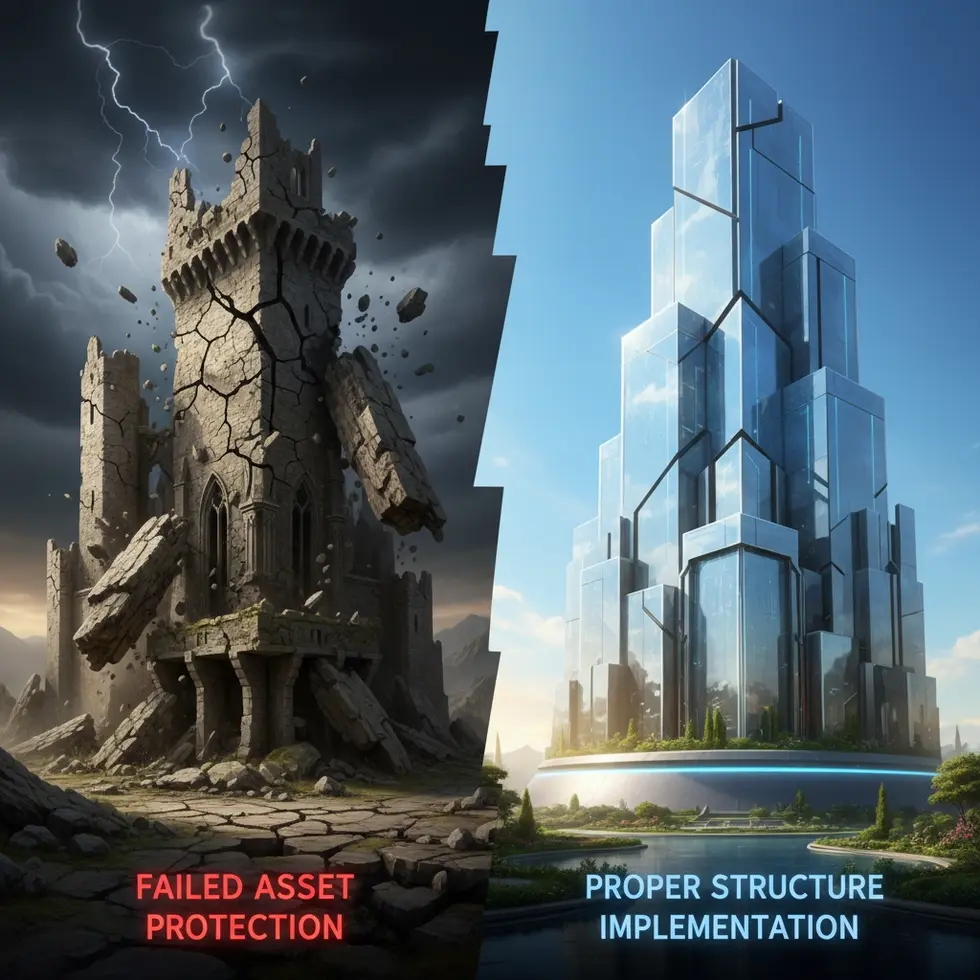
Modern Application: The Family Wealth Operating System
Elite families think of their asset protection structures as operating systems rather than isolated tactics. Like computer operating systems, these structures provide platforms that support multiple applications (businesses, investments, philanthropy) while maintaining security protocols that protect against external threats.
The Control Layer: Family members maintain control through management positions in operating entities, trustee appointments in family trusts, and decision-making authority through properly drafted governing documents.
The Protection Layer: Legal entities provide liability shields, spendthrift trusts offer creditor protection, and jurisdictional selection adds regulatory advantages.
The Growth Layer: Tax-efficient structures enable wealth accumulation, business development frameworks support entrepreneurial activities, and succession planning ensures continuity across generations.
Implementation Roadmap: Building Your Invisible Empire
Creating effective asset protection requires systematic implementation following proven methodologies:
Phase 1: Asset Analysis and Risk Assessment
Identify asset categories requiring different protection levels. Operating businesses need liability containment. Investment portfolios need creditor protection. Real estate needs title protection. Each category requires tailored solutions within the overall structure.
Phase 2: Jurisdictional Selection and Entity Formation
Choose formation states based on specific protection needs and operational requirements. File formation documents with proper initial capitalization. Draft comprehensive operating agreements and trust documents that preserve protection while maintaining flexibility.
Phase 3: Asset Transfer and Tax Optimization
Transfer assets using techniques that minimize gift and estate tax exposure while maintaining creditor protection. Use proper valuation methods for closely-held business interests. Document legitimate business reasons for all transfers to avoid fraudulent transfer challenges.
Phase 4: Operational Implementation and Compliance
Establish ongoing compliance systems including separate accounting, regular governance meetings, and professional management oversight. Create documentation systems that support business substance requirements for tax purposes.

Frequently Asked Questions
What's the minimum net worth needed for multi-entity asset protection?
Effective multi-entity structures typically require $2-5 million in assets to justify the ongoing complexity and costs. Below this threshold, simpler approaches like homestead exemptions and retirement account protections often provide better cost-benefit ratios.
How do charging order protections work in community property states?
Community property rules can complicate charging order protection, as spouses may have direct interests in LLC assets. Careful structuring using separate property contributions and spousal consent documents can preserve protections in states like California, Texas, and Arizona.
Can the IRS ignore LLC structures for tax purposes?
The IRS can disregard entities lacking economic substance under IRC Section 7701(o), but properly structured LLCs with legitimate business purposes and operational substance generally receive tax recognition. Key factors include profit motive, business activities, and arm's length transactions.
What happens to asset protection during divorce proceedings?
Divorce courts have broad equitable powers that can sometimes override asset protection structures, particularly when marital assets funded the entities. Pre-marital structures and separate property funding provide stronger protection than post-marital arrangements.
How do I maintain control while maximizing protection?
Use management agreements that separate control functions from ownership interests. Serve as manager of LLCs while trusts own membership interests. Create decision-making frameworks that preserve family control within protective legal structures.
Are offshore structures better than domestic protection?
Domestic structures often provide superior practical protection for U.S. residents due to easier administration, lower costs, and judicial familiarity with protective statutes. Offshore structures add complexity and reporting requirements that may not justify additional protection for most families.
Your Wealth Architecture Blueprint
The families who build lasting fortunes understand that wealth protection isn't about hiding: it's about building. They create legal architectures that make their assets antifragile: structures that grow stronger under pressure while maintaining the flexibility to adapt to changing circumstances.
Your asset protection blueprint starts with understanding that true wealth isn't what you own: it's what you control. The technical frameworks exist within current law. The proven strategies have decades of successful implementation. The question isn't whether protective structures work: it's whether you'll implement them before circumstances test your current exposure.
Contact the Law Office of James Burns to discuss asset protection strategies tailored to your wealth preservation objectives. We'll help you build the legal foundation that transforms assets from vulnerabilities into strengths, creating security that compounds with your success.
Disclaimer: This content is for educational purposes only and does not constitute legal or tax advice. Asset protection strategies involve complex legal considerations that vary based on individual circumstances, state laws, and federal regulations. Consult qualified legal and tax professionals before implementing any asset protection strategy.
Intellectual Property Notice: The asset protection strategies and Tao of Wealth concepts described herein are proprietary methodologies developed by James Burns and may not be reproduced without express written permission.

Comments
There are no comments for this post. Be the first and Add your Comment below.
Leave a Comment