
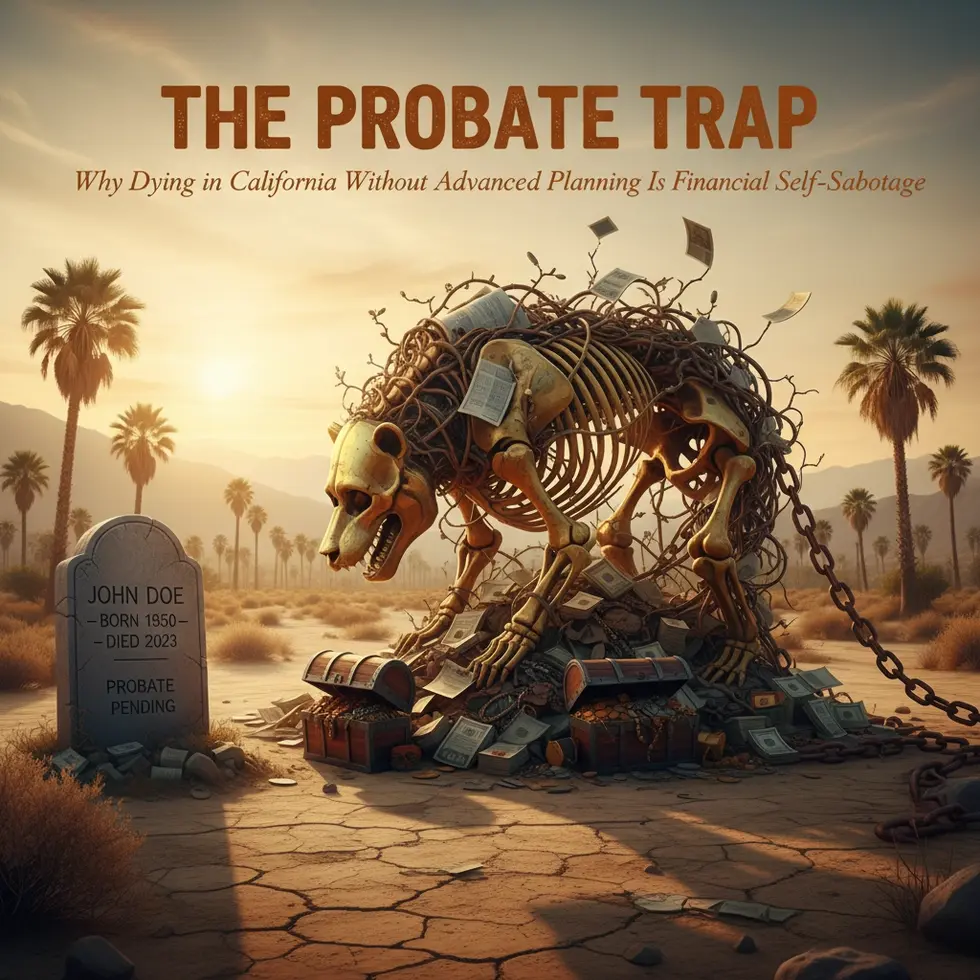
Here's the brutal truth about dying in California without proper estate planning: your family will watch 4-7% of everything you've built disappear into a bureaucratic black hole. With California's probate threshold now at $208,850 for 2025 (effective April 1, 2025, per California Courts Form DE-300), even modest estates get trapped in a system designed to extract maximum fees while your loved ones navigate a legal maze during their most vulnerable time.
The numbers are staggering, and they're about to get worse.
The $208,850 Threshold That Changes Everything
California Probate Code Section 13100 sets the current threshold at $208,850 (effective April 1, 2025) for small estate procedures. If your total estate value, including real estate, bank accounts, investments, and personal property, exceeds this amount, you're automatically thrown into full probate proceedings.
This isn't just about having $208,850 in cash. If you own a California home worth $400,000 with a $300,000 mortgage, your equity counts as $100,000 toward that threshold. Add in retirement accounts, vehicles, jewelry, and other assets, and you'll likely blow past $208,850 without realizing it.
Here's what most people don't understand: this threshold applies to your gross estate value, not net worth. Even if you're technically underwater on some assets, the full fair market value counts toward probate requirements.
The California Probate Fee Structure: Legal Extortion Made Official
California operates on a statutory fee schedule that's essentially legalized wealth extraction. Under Probate Code Section 10810, both your executor and probate attorney get paid the same fees, calculated as follows:
- 4% of the first $100,000
- 3% of the next $100,000
- 2% of the next $800,000
- 1% of the next $9,000,000
- 0.5% of the next $15,000,000
Let's do the math on a typical Orange County estate worth $1.2 million:
Attorney fees: $23,000
Executor fees: $23,000
Combined statutory fees: $46,000
That's before court costs, appraisal fees, publication costs, and the dozens of hidden expenses that multiply like cancer through the process.

The Hidden Costs That Devastate Families
The statutory fees are just the beginning. California probate includes a minefield of additional costs that most families discover too late:
Court Filing Fees: $435 to open probate, another $435 to close it, plus various motion fees throughout the process.
Publication Requirements: California law mandates newspaper publication of probate proceedings, typically costing $200-$1,000 depending on your county.
Probate Referee Fees: Court-appointed appraisers charge 0.1% of appraised value (minimum $75, maximum $10,000) for every non-cash asset.
Bond Premiums: If the court requires a bond for the executor, annual premiums range from $500-$2,000.
Document Preparation and Certification: Copying, notarization, and certification fees add up quickly, often exceeding $1,000.
The real killer? Deadline penalties. Miss any of California's strict probate deadlines, and you're looking at additional attorney time, court sanctions, and potential personal liability that can cost tens of thousands more.
The Probate Process: A Bureaucratic Nightmare
California probate typically takes 12-18 months minimum, but complex estates can stretch to 3+ years. Here's what your family faces:
Months 1-3: Filing initial petitions, obtaining Letters Testamentary, notifying creditors and beneficiaries, securing assets, and beginning the inventory process.
Months 4-8: Completing the comprehensive asset inventory, obtaining appraisals, paying ongoing bills and taxes, and handling creditor claims.
Months 9-12: Preparing final accounting, obtaining court approval for distributions, paying final fees, and filing closing documents.
Each step requires court approval, formal documentation, and attorney involvement, all billable at hourly rates on top of the statutory fees.

Real Case Examples: When Probate Goes Wrong
The Riverside County Disaster: A client's father died with a $850,000 estate consisting primarily of his family home. The family tried handling probate themselves initially, missing several key deadlines. By the time they hired counsel, additional legal fees, court sanctions, and extended timeline costs pushed total probate expenses to over $85,000, 10% of the entire estate.
The Orange County Property Trap: An elderly woman owned three rental properties worth $1.8 million total. Her children discovered that each property required separate appraisals, individual title work, and extensive court documentation. Probate referee fees alone exceeded $15,000, and the 18-month timeline meant carrying costs, property taxes, and maintenance on vacant rentals devoured another $35,000.
The Investment Account Nightmare: A retiree died with $600,000 in various investment accounts across multiple brokerages. Each account required separate probate documentation, court orders for liquidation, and individual handling. The complexity extended probate to 24 months, during which market volatility and forced liquidation timing cost the family an additional $80,000 in lost value.
Asset Protection and Probate Avoidance
The good news? Almost every probate disaster is completely avoidable with proper advance planning. The key strategies include:
Revocable Living Trusts: Assets held in properly funded living trusts bypass probate entirely. For most California families, this single strategy eliminates 90% of probate costs and delays.
Joint Tenancy and Transfer-on-Death Designations: While not appropriate for all assets, these tools can help smaller estates stay under the probate threshold.
Business Entity Planning: Properly structured LLCs and corporations can hold real estate and investments outside the probate estate while maintaining family control.

The critical factor is implementation timing. You cannot create a revocable trust or restructure assets after death, these strategies require advance planning while you're healthy and mentally competent.
The Tax Consequences of Probate Delay
Probate delays create additional tax complications that multiply the financial damage:
Income Tax Issues: Estates must file annual income tax returns during probate. Investment income, rental income, and other earnings are taxable to the estate at compressed tax brackets, often resulting in higher effective rates.
Property Tax Reassessment: California property held in probate may lose Proposition 13 protection, triggering immediate reassessment to current market value and dramatically higher property tax bills.
Estate Tax Deadlines: Federal and California estate tax returns are due nine months after death, regardless of probate timeline. Extensions are possible but require careful planning and may trigger penalties.
FAQ: California Probate Planning
Q: Can I avoid probate if my estate is worth exactly $208,850?
A: The threshold applies to gross estate value, and courts often require full probate if you're even slightly over the limit. It's safer to plan assuming you'll exceed the threshold.
Q: Does having a will avoid probate in California?
A: No. A will actually guarantees probate: it's just instructions for the probate court. Only properly structured trusts and beneficiary designations avoid probate.
Q: Can I handle California probate without an attorney?
A: Technically yes, but it's extremely risky. California probate procedures are complex, deadlines are strict, and mistakes can cost far more than attorney fees.
Q: What happens to my mortgage during probate?
A: Mortgage payments must continue during probate from estate funds. If the estate lacks liquidity, the executor may need court permission to sell assets or take loans to maintain payments.
Q: How does community property affect probate in California?
A: Community property can complicate probate significantly, especially with blended families or unclear asset characterization. Proper planning is essential for married couples.
Stop California Probate From Erasing Your Family's Wealth
Every week, California families lose six-figure inheritances to probate fees, delays, and court battles—because they waited, hesitated, or assumed their estate was “too small to worry.” By the time your heirs realize the trap, it's too late.
You can change the story. Act now and reclaim control. Secure your assets, privacy, and family legacy with a properly designed estate plan.
Book your confidential strategy session now and arm your family against the nightmare of probate. One call can protect everything. Don't risk regret—take the first step today.
Disclaimer: This blog post is for informational purposes only and does not constitute legal advice. California estate planning and probate laws are complex and subject to change. Consult with a qualified California estate planning attorney for advice specific to your situation.
Sources Used:
- California Probate Code Sections 10810, 13100
- California Court filing fee schedules
- California probate referee fee structure
- Case studies from Law Office of James Burns client files (anonymized)
- California Department of Insurance bond premium data

Comments
There are no comments for this post. Be the first and Add your Comment below.
Leave a Comment