
The Promise vs. The Reality
You've heard the pitch: Move your assets into a Bermuda-domiciled private placement life insurance policy, enjoy tax-free growth, and never pay capital gains again. It sounds like financial alchemy, and for good reason. When structured properly, private placement life insurance can offer legitimate tax deferral and favorable treatment of investment returns.
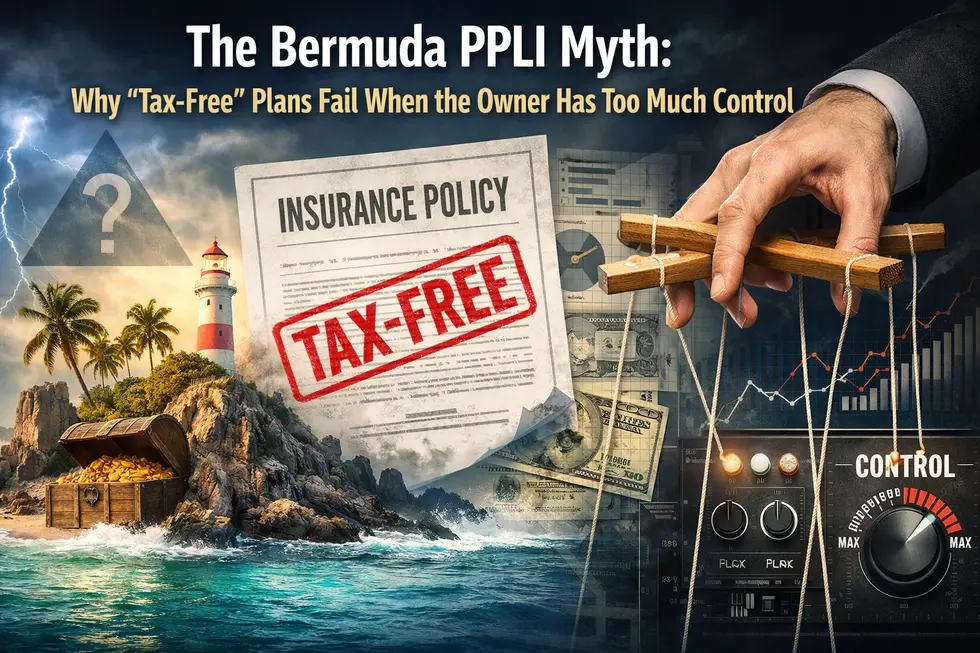
But here's the part most promoters gloss over: If you retain too much control over the policy's investments, the entire tax wrapper collapses. The IRS isn't stupid. They've seen every trick in the book, and they've built an entire doctrine, the "investor control doctrine", specifically to prevent wealthy individuals from turning life insurance into a personal, tax-free hedge fund.
This isn't theoretical. Policies have been unwrapped. Clients have faced massive tax bills. And the culprit is almost always the same: the owner had too much control.
What Is the Investor Control Doctrine?
The investor control doctrine is the IRS's line in the sand. It says that for a life insurance policy to receive favorable tax treatment under IRC § 7702, the policy must function as genuine life insurance, not as an investment account with a death benefit tacked on as window dressing.
The core principle? Insurance requires risk shifting and risk distribution. When you, the policy owner, direct every investment decision inside the policy, you're not shifting risk to the insurance company. You're just parking assets in a tax-advantaged wrapper and calling it "insurance."
Federal courts have consistently held that when a policy owner exercises too much investment discretion, the policy fails to qualify as life insurance for tax purposes. In one landmark case, policy owners had the ability to:
- Direct premium investments into specific mutual funds
- Reallocate investments at will
- Make withdrawals whenever they wanted
- Surrender the policy with minimal charges
The result? The IRS deemed the owners to be currently taxable on all income generated by the policy's assets. No deferral. No tax-free growth. Just ordinary income tax at the highest rates, plus interest and penalties.

The Bermuda Myth: Geography Doesn't Fix Structure
Here's where things get messy. Some promoters pitch Bermuda-domiciled policies as if the jurisdiction itself provides magical tax protection. It doesn't.
The tax treatment of a PPLI policy depends on its structure and compliance with U.S. tax law, not where the insurance carrier is domiciled. Bermuda offers regulatory flexibility, access to sophisticated investment managers, and sometimes lower insurance costs. But it doesn't exempt you from the investor control doctrine.
If you retain excessive control over a Bermuda policy's investments, the IRS will treat you as if you own the underlying assets directly. That means:
- Current taxation on all investment income
- Capital gains at your individual tax rate
- Loss of tax deferral benefits
- Potential penalties for underreporting income
The jurisdiction is irrelevant. Control is everything.
The Don'ts: How Clients Accidentally Blow Up Their Policies
Let's get practical. Here's how wealthy families inadvertently violate the investor control rules:
Don't #1: Treat the Policy Like Your Brokerage Account
You can't call your insurance company every week with trade instructions. You can't say, "Sell Tesla, buy NVIDIA, and put 10% in Bitcoin." The moment you start dictating specific investments, you're exercising investor control.
Don't #2: Hire Your Existing Wealth Manager to Run the Policy
If your long-time advisor manages both your taxable portfolio and the policy's separate account, and you're having regular strategy sessions about both, the IRS will argue that you're effectively controlling the policy through your agent. That's indirect control, and it's still disqualifying.
Don't #3: Create a "Menu" of Pre-Approved Investments You Control
Some clients think they're being clever by selecting a narrow list of approved funds, then directing allocations among those funds. That's still control. The narrower the menu and the more discretion you retain, the more likely the policy fails.
Don't #4: Use the Policy to Execute Your Personal Investment Thesis
Let's say you're bullish on private credit. You design a policy that invests exclusively in your preferred credit strategies, rebalances according to your views, and mirrors your taxable portfolio's allocations. Congratulations, you've just created a taxable structure disguised as insurance.

The Do's: How to Structure Governance Without Losing the Tax Benefits
So how do you actually structure a PPLI policy that passes muster? Here's the framework:
Do #1: Use an Independent Investment Advisor
The policy must have an independent fiduciary or investment committee that makes allocation decisions without your input. This advisor should be engaged by the insurance carrier, not by you, and should operate under clear, documented guidelines.
You can establish general investment objectives (e.g., "growth-oriented," "conservative fixed income," "hedge fund exposure"), but you cannot direct specific trades or strategies.
Do #2: Establish Pre-Determined Guidelines, Not Custom Mandates
Work with legal counsel to draft investment policy guidelines that are broad enough to allow manager discretion but specific enough to reflect your risk tolerance and goals. Think: "diversified equity exposure with a tilt toward U.S. large-cap growth" rather than "buy Amazon and Apple in these exact proportions."
Do #3: Maintain Adequate Diversification
IRC § 817(h) requires that the policy's investments meet specific diversification tests. If the policy holds too much of a single asset, or concentrates in one issuer or sector, it can fail diversification requirements, triggering current taxation even if you weren't directing trades.
This is especially critical for policies holding private funds, direct investments, or concentrated positions. As we've discussed elsewhere, combining PPLI with installment sales or other structures requires meticulous planning to avoid running afoul of diversification rules.
Do #4: Build in Structural Separation
Create clear organizational distance between you and the investment process. This might involve:
- Using a trust as the policy owner (often an irrevocable life insurance trust or ILIT)
- Engaging separate legal counsel for the trust and the investment advisor
- Documenting all decisions and communications to demonstrate independence
Proper trust architecture isn't just about estate tax planning, it's also about maintaining the credibility of the policy's insurance character.

Case Study: The $50M Policy That Worked
Let's look at a real-world example (details anonymized).
A California tech executive had $50 million in liquid assets and wanted long-term, tax-efficient growth for his grandchildren. He established a dynasty trust as the owner of a Bermuda-domiciled PPLI policy. The trust hired an independent institutional fiduciary to serve as investment advisor to the policy.
The fiduciary worked with the insurance carrier's investment platform to create a diversified portfolio of hedge funds, private equity funds, and fixed income strategies. The executive provided high-level guidance during the initial setup, "aggressive growth profile, alternative asset focus", but did not direct specific allocations or managers.
Every quarter, the fiduciary reported to the trustee (not the executive) on performance and any rebalancing. The executive received annual summary reports but had no ability to change investments.
Result? The policy has operated for seven years with full tax deferral. Gains compound without current taxation. The death benefit will pass estate-tax-free to beneficiaries. And the IRS has never challenged the structure because the executive genuinely doesn't control the investments.
This is how you use family governance and control architecture to achieve legitimate tax outcomes.
The Economics: When Does This Actually Make Sense?
Let's be clear: PPLI isn't cheap. You're paying insurance costs, investment management fees, and often administrative charges. The fee stack can run 150-250 basis points annually, sometimes higher.
So when does it pencil out?
Generally, PPLI makes economic sense when:
- Your taxable investment returns would generate significant annual tax drag (30%+ effective rates on gains and income)
- You have a long time horizon (10+ years minimum)
- You're in the highest tax brackets and expect to stay there
- You want estate tax-free wealth transfer and income tax deferral in one structure
Run the numbers. Model after-tax, after-fee returns for taxable investing versus PPLI. We've written about this breakeven analysis here. If the policy doesn't outperform taxable alternatives net of all costs, don't do it.
And never, ever let a promoter tell you that "it's always a good deal." It's not. It's a powerful tool when used correctly for the right client.
What About In-Kind Contributions of Appreciated Assets?
Here's where many promoters oversell the structure. You'll hear claims like, "Contribute your appreciated stock directly into the policy and avoid capital gains entirely."
That's misleading, and potentially false.
For U.S. persons contributing appreciated assets as in-kind premium to a policy, there is no broadly defensible 'one-step' method to guarantee zero taxable gain. Contributing appreciated property to a life insurance policy can constitute a taxable disposition under IRC § 1001.
The safer approach?
- Keep appreciated assets outside the policy
- Monetize the position with a loan or structured transaction
- Pay cash premium into the policy
- Let the policy's separate account (under proper investor-control and diversification rules) acquire equivalent exposure
This isn't as sexy as "move your Bitcoin into the policy tax-free," but it's far more defensible. As we've discussed with asset protection strategies, achieving legitimate tax outcomes requires legitimate structural separation.
Tax results depend entirely on whether the funding method creates a taxable disposition. Structures require independence, documentation, and tax counsel review. Never rely on marketing materials or promoter promises.

FAQ: Private Placement Life Insurance and Investor Control
Q: Can I ever change the policy's investments?
Not directly. You can request that the independent advisor revisit the investment guidelines based on changed circumstances (e.g., market conditions, your age, liquidity needs), but you cannot direct specific trades. Any changes should be initiated by the advisor or trustee, documented, and consistent with the original investment policy.
Q: What happens if I violate the investor control rules accidentally?
If the IRS determines you've exercised impermissible control, the policy could lose its tax-favored status retroactively. You'd owe taxes on all policy earnings from the date of violation, plus interest and potentially penalties. This is why documentation and structural discipline are critical.
Q: Can I use PPLI if I want exposure to a single hedge fund or private equity manager I know well?
Possibly, but it's risky. Concentrated positions raise diversification concerns under IRC § 817(h). If the policy invests substantially in a single fund or strategy, it may fail diversification tests, triggering current taxation. Better approach: build a diversified portfolio that includes the manager you like, alongside others, and let the independent advisor maintain compliance.
Q: How does PPLI fit with my existing estate plan and dynasty trust?
PPLI works best when owned by an irrevocable life insurance trust (ILIT) or dynasty trust. This removes the policy from your taxable estate, provides asset protection, and maintains the structural separation needed to avoid investor control issues. We've covered dynasty trust strategies extensively here. The key is coordination, your estate planning attorney and PPLI counsel need to work together from day one.
Q: Is Bermuda really better than a U.S. carrier for PPLI?
Not categorically. Bermuda carriers often offer more flexibility in investment options, access to alternative assets, and sometimes lower costs. But U.S.-domiciled policies exist and can work well for certain clients. The right jurisdiction depends on your investment strategy, risk tolerance, and the specific carrier's capabilities. Don't choose based on geography alone, choose based on structure and economics.
Q: How do I know if my current PPLI policy is compliant?
Review the policy documents, investment guidelines, and governance structure with experienced legal counsel. Ask:
- Who has investment authority?
- How are investment decisions documented?
- Does the policy meet diversification requirements?
- Is there clear structural separation between you and the investment process?
If the answers are unclear, or if you've been directing trades, you may have a problem. Schedule a consultation to conduct a compliance audit before the IRS does.
Final Thoughts: Don't Confuse the Wrapper with the Work
Private placement life insurance is a powerful wealth transfer and tax deferral tool, when used correctly. But it's not magic. The tax benefits depend entirely on maintaining the policy's character as genuine insurance, which means you cannot control the investments.
The myth that geography solves this, that moving to Bermuda or the Caymans somehow bypasses investor control rules, is dangerous and wrong. U.S. tax law applies to U.S. taxpayers regardless of where the policy is domiciled.
If you want tax-free growth, tax-deferred compounding, and estate-tax-free wealth transfer, you need to cede control. Build the right governance structure. Use independent advisors. Document everything. And work with legal counsel who understands both the tax rules and the practical realities of high-net-worth planning.
This is California family legacy planning done right. Not shortcuts. Not myths. Just disciplined, defensible planning that stands up to scrutiny.
Ready to explore whether PPLI makes sense for your family, and how to structure governance properly? Book a consultation here. We'll review your situation, model the economics, and determine whether the benefits justify the costs and complexity.
Because control architecture isn't just theory, it's the difference between tax deferral and an IRS audit you'll never forget.
Resources & Authorities
Primary Sources:
- Internal Revenue Code § 7702 (Definition of Life Insurance Contract)
- Internal Revenue Code § 817(h) (Diversification Requirements for Variable Life Insurance Contracts)
- Internal Revenue Code § 72 (Annuities; Certain Proceeds of Endowment and Life Insurance Contracts)
- Internal Revenue Code § 101(a) (Income Tax Treatment of Life Insurance Proceeds)
- Rev. Rul. 2003-91 (IRS Guidance on Investor Control Doctrine)
- Rev. Rul. 81-225 (Diversification Requirements for Separate Accounts)
Secondary Sources & Case Law:
- Christoffersen v. United States, 749 F.2d 513 (8th Cir. 1984) (Investor control causing loss of life insurance tax treatment)
- Estate of Mildred C. Davidson v. Commissioner, T.C. Memo 1991-611 (Tax Court ruling on investor control)
- PLR 9204014 (IRS Private Letter Ruling on investment control issues)
- "Private Placement Life Insurance: A Primer," Journal of Taxation, Vol. 128, No. 4 (2018)
- "The Investor Control Doctrine and Variable Insurance Products," Tax Notes, Oct. 2020
- Bloomberg Tax: "Structuring Private Placement Life Insurance to Avoid Tax Pitfalls" (2024)
- American Bar Association, Section of Taxation: "Private Placement Life Insurance Overview" (2025)
Related Law Office of James Burns Resources:
- Why Tax-Free Wrappers Matter More in Stable Markets
- How Elite Families Pass Wealth Tax-Deferred: The Real Power of Installment Sales and Private Placement Life Insurance
- Owning Nothing, Controlling Everything: The Asset Protection Playbook of America's Quiet Billionaires
Disclaimer
This blog post is provided for informational and educational purposes only and does not constitute legal advice, tax advice, or the creation of an attorney-client relationship. The information contained herein is not a substitute for professional legal or tax counsel tailored to your specific circumstances. Tax laws, regulations, and IRS interpretations are subject to change, and the application of legal principles depends on the specific facts of each case.
Private placement life insurance involves complex legal, tax, and regulatory considerations. The suitability of PPLI for any individual or family depends on numerous factors, including financial circumstances, investment objectives, risk tolerance, time horizon, and estate planning goals. No representation is made that any strategy or structure discussed in this article will achieve particular tax results or comply with applicable law in all circumstances.
Readers should not rely solely on this content to make legal, financial, or tax decisions. Before implementing any wealth transfer strategy, estate plan, or insurance structure, consult with qualified legal, tax, and financial advisors who understand your complete situation.
Law Office of James Burns does not provide tax advice. We work collaboratively with clients' CPAs, tax attorneys, and financial advisors to design and implement legally sound planning structures. Any discussion of tax consequences in this article is general in nature and should not be interpreted as specific tax guidance.
Furthermore, the use of offshore insurance carriers or foreign-domiciled policies does not alter U.S. tax obligations or reporting requirements. U.S. taxpayers remain subject to U.S. tax law and IRS jurisdiction regardless of where assets or insurance policies are domiciled.
Past results do not guarantee future outcomes. Each client's situation is unique, and legal strategies must be tailored accordingly.
For specific legal guidance on private placement life insurance, investor control issues, or estate planning matters in California, please schedule a consultation.
Intellectual Property and Content Notice
All content, strategies, frameworks, and proprietary terminology published by Law Office of James Burns: including but not limited to "control architecture," "exposure mapping," planning frameworks, and case study methodologies; are the intellectual property of Law Office of James Burns and James Burns, Esq.
Unauthorized reproduction, distribution, or use of this content for commercial purposes without express written permission is prohibited. This includes republication on other websites, use in marketing materials, or incorporation into educational programs or seminars without proper attribution and authorization.
For licensing inquiries or permission requests, contact Law Office of James Burns directly.
© 2026 Law Office of James Burns. All Rights Reserved.

Comments
There are no comments for this post. Be the first and Add your Comment below.
Leave a Comment