
The $5 Million Exit That Costs You $1.8 Million (Unless You Plan Differently)
You've spent decades building your business. After years of late nights, payroll stress, and reinvested profits, you finally have a buyer willing to pay $5 million cash.
You sign the documents. The wire hits your account. And then your CPA delivers the bad news: you owe approximately $1.8 million in combined federal and California capital gains taxes, due by April 15th of the following year.
That's the reality of a traditional business exit. The IRS and California Franchise Tax Board treat your entire gain as taxable income in the year of sale. For California residents, that means:
- 20% federal long-term capital gains tax
- 13.3% California state tax
- 3.8% Net Investment Income Tax (NIIT) for high earners
- Total combined rate: 37.1%

If your basis in the business is low (or zero), nearly every dollar above basis gets taxed at this rate. And because it all hits in one year, you're stuck in the highest tax brackets with limited ability to manage the damage.
But there's another way, a strategy embedded in the Internal Revenue Code since 1926 that most CPAs either don't understand or won't recommend because it requires advanced legal architecture.
Enter IRC §453: The Wealth Engineering Alternative
IRC Section 453 allows you to structure a business sale as an installment transaction, where you recognize capital gains proportionally over time as you receive payments, not all at once.
Here's how it works in practice:
Instead of receiving $5 million in cash upfront, you structure the sale so that:
- A specially designed assumption company (often an LLC or trust) purchases your business.
- The assumption company pays you in installments over a set period (commonly 10–30 years).
- Your capital gain is recognized only as each payment is received.
- The assumption company invests the deferred proceeds in a tax-deferred annuity or investment vehicle, where the funds grow without immediate taxation.
This isn't a loan-back arrangement or a risky seller-financed note. It's a pure IRC §453 structure designed to legally defer capital gains recognition while maintaining liquidity and control.
The Numbers: Traditional Sale vs. Structured Installment Sale
Let's compare two scenarios using a $5 million business sale with a $500,000 basis (for simplicity).
Scenario 1: Traditional Cash Sale
- Proceeds: $5,000,000
- Basis: $500,000
- Capital Gain: $4,500,000
- Tax Due (37.1%): $1,669,500
- Net After-Tax Proceeds Year 1: $3,330,500
You receive the full amount upfront, but you lose nearly $1.7 million to taxes immediately.
Scenario 2: IRC §453 Structured Installment Sale
- Proceeds: $5,000,000
- Basis: $500,000
- Capital Gain: $4,500,000
- Installment Period: 20 years
- Annual Payment: $250,000
- Taxable Gain Per Year: $225,000 (proportional to payment)
- Tax Due Per Year (37.1%): $83,475
- Tax Due Year 1: $11,115 (only on first partial payment)
In the first year, instead of paying $1.67 million in taxes, you pay approximately $11,115. That's a first-year tax savings of ~$66,743 compared to the traditional exit.
Over the life of the installment plan, you're still taxed on the full $4.5 million gain, but the deferral allows you to:
- Keep capital working in tax-deferred growth vehicles
- Smooth income across lower tax brackets
- Potentially benefit from future tax rate changes
- Integrate with other wealth transfer strategies
Why Deferral Beats Immediate Recognition
The magic of IRC §453 isn't just deferral, it's what you do with the deferred capital.
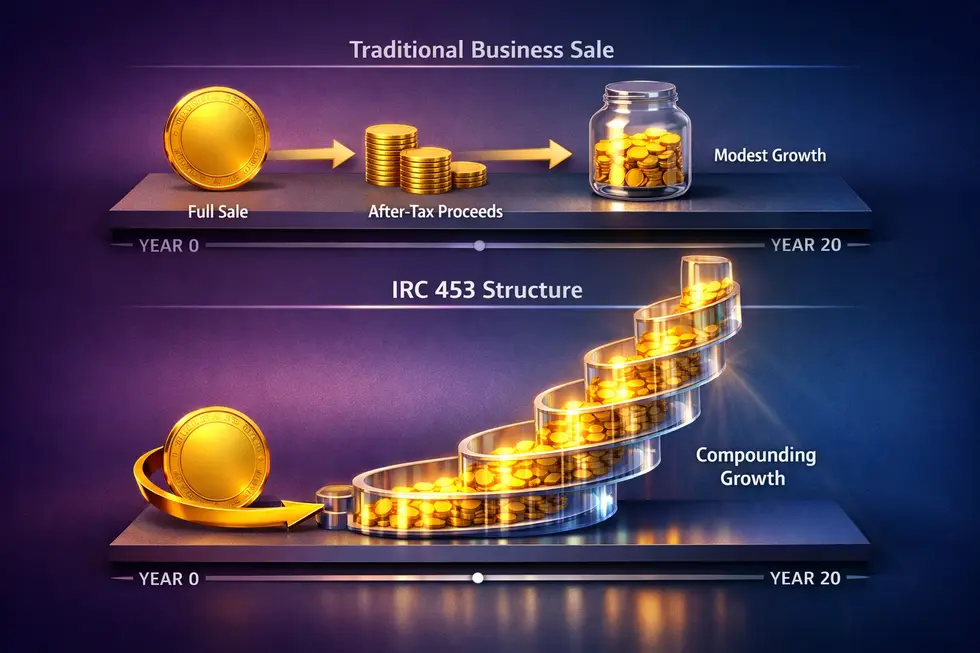
In a traditional sale, you pay $1.67 million in taxes immediately, leaving you with $3.33 million to invest. In the installment structure, you keep the full $5 million working inside a tax-deferred vehicle (like a deferred annuity) while you pay taxes only as income is recognized.
Let's assume a conservative 6% annual return:
- Traditional sale net proceeds: $3,330,500 invested at 6% = $10,679,000 after 20 years (assuming 20% tax on gains each year)
- IRC §453 structure: $5,000,000 growing tax-deferred at 6% = $16,035,000 after 20 years (taxes paid annually on installment income)
The installment structure preserves significantly more wealth because the full sale amount compounds without immediate tax erosion.
Key Benefits of IRC §453 Wealth Engineering
1. Deferred Capital Gains Recognition
You only recognize gain as you receive payments. This keeps you out of the highest tax brackets and reduces the immediate cash hit.
2. Tax-Deferred Growth
Sale proceeds grow inside a tax-deferred annuity or investment vehicle. You're not taxed on growth until distributions are made.
3. No Statutory Limits
Unlike qualified retirement plans or other tax-deferred structures, there are no contribution limits or income phase-outs for IRC §453 installment sales.
4. Integration with Advanced Strategies
You can layer IRC §453 with:
- Private Placement Life Insurance (PPLI) for tax-free growth and distributions
- Legacy Protection Trusts™ to shield assets from creditors
- Multi-generational wealth transfer frameworks
5. Liquidity Without Sacrifice
Structured installments can be designed to provide predictable income streams while preserving wealth for future generations.
What Makes This "Wealth Engineering" (Not Just Tax Planning)
Most CPAs think of IRC §453 as a basic installment sale, something used for seller-financed real estate transactions. That's not what we're talking about here.
Wealth engineering means designing the entire transaction architecture before closing to:
- Legally defer capital gains
- Maximize after-tax wealth
- Integrate asset protection and estate planning
- Create liquidity without triggering immediate taxation
This requires coordination between:
- Tax attorneys who understand IRC §453 structuring
- Wealth advisors who can deploy deferred proceeds into tax-efficient vehicles
- Estate planners who can integrate the installment structure into trusts and family governance frameworks
It's not a DIY strategy. It's a pre-sale design process that requires legal precision and advance planning.
The Assumption Company: How the Structure Actually Works
The key to a compliant IRC §453 installment sale is the assumption company, a separate legal entity (often an LLC or trust) that assumes the obligation to pay you over time.
Here's the basic architecture:
- Pre-Sale: You form or designate an assumption company.
- Sale Transaction: Your business is sold to the assumption company (or a third-party buyer with the assumption company stepping in as intermediary).
- Installment Payments: The assumption company makes periodic payments to you over the agreed term.
- Investment of Proceeds: The assumption company invests the deferred proceeds in a tax-deferred annuity or other qualified vehicle.
- Tax Recognition: You recognize capital gains proportionally as payments are received.
The assumption company structure must be carefully documented to satisfy IRS requirements. Missteps can void the deferral and trigger immediate taxation of the entire gain.
Common Pitfalls (And How to Avoid Them)
1. Constructive Receipt
If you have immediate access to the full sale proceeds (even if you choose not to take them), the IRS can argue you've constructively received the income. Proper structuring avoids this.
2. Related Party Transactions
IRC §453(g) imposes special rules for sales to related parties. If the related party resells the asset within two years, the original seller may have to recognize the full gain immediately.
3. Depreciation Recapture
If your business involves depreciable assets (equipment, buildings, etc.), depreciation recapture is taxed immediately, even in an installment sale. This needs to be planned for upfront.
4. Improper Documentation
The installment sale agreement must clearly define payment terms, interest rates, and the assumption company's obligations. Sloppy documentation can disqualify the deferral.
FAQ: IRC §453 Structured Installment Sales
Q: Can I use IRC §453 for any type of business sale?
A: Most business sales qualify, but there are exceptions. Dealer property, inventory, and publicly traded securities don't qualify. The strategy works best for closely held businesses, real estate, and certain intangible assets.
Q: What happens if I need a lump sum of cash immediately?
A: You can structure partial cash upfront and defer the rest. Alternatively, you can borrow against the installment note without triggering immediate taxation.
Q: Does IRC §453 eliminate capital gains taxes?
A: No, it defers them. You'll still pay taxes on the full gain, but you spread recognition over multiple years and benefit from tax-deferred growth in the meantime.
Q: How does this integrate with Private Placement Life Insurance (PPLI)?
A: The assumption company can invest deferred proceeds inside a PPLI policy, where future growth is tax-free (not just tax-deferred). This creates a compounding advantage. Learn more about PPLI integration here.
Q: What if tax rates increase in the future?
A: That's a risk with deferral strategies. However, the benefit of tax-deferred compounding often outweighs the risk of higher future rates, especially if you layer in strategies that convert deferred gains into tax-free distributions.
Q: Can I use this strategy in California?
A: Yes. California recognizes IRC §453 installment sales for state tax purposes. However, California's 13.3% top rate makes deferral even more valuable for high-income sellers.
Ready to Engineer Your Exit?
If you're planning to sell a business and facing a seven-figure tax bill, it's worth exploring IRC §453 wealth engineering before you sign the purchase agreement.
This isn't something you can fix after closing. The structure must be designed and documented before the sale transaction.
We help business owners in California architect compliant IRC §453 installment sales, integrate them with asset protection strategies, and layer in advanced tax-deferred vehicles like PPLI.
Schedule a confidential consultation here to discuss whether IRC §453 wealth engineering makes sense for your exit.
Resources (Primary Authority + Professional References)
Primary Legal Authority (Statutes)
- IRC §453 — Installment method (core installment sale statute)
- IRC §453A — Special rules for nondealers; interest charge; pledge rules (can accelerate gain in certain cases)
- IRC §453B — Dispositions of installment obligations (events that can trigger recognition)
- IRC §61 — Gross income (baseline definition; relevant in timing/inclusion disputes)
- IRC §1411 — Net Investment Income Tax (NIIT) (can matter depending on the year-by-year income profile)
Treasury Regulations
- Treas. Reg. §15a.453-1 — Installment method reporting rules (definitions, computations like gross profit ratio, etc.)
IRS Forms & Official IRS Guidance
-
IRS Publication 537 (Installment Sales) — Practical IRS guidance, examples, and traps (constructive receipt, pledges, related parties)
https://www.irs.gov/publications/p537 -
IRS Form 6252 (Installment Sale Income) — Reporting mechanism for installment sale income
https://www.irs.gov/forms-pubs/about-form-6252
Related Party & Timing / “Don't Cross the Line” Reading
- IRC §453(e) — Second disposition rule for sales to related persons (watch resale timing)
- IRC §453(g) — Special rules in specific related-party contexts (fact-dependent; requires careful review)
Professional Secondary Sources (Deep Dives)
- Bittker & Lokken, Federal Taxation of Income, Estates and Gifts (treatise; installment sales coverage varies by edition/update)
- Mertens Law of Federal Income Taxation (treatise; installment sale analysis and mechanics)
-
Bloomberg Tax, Tax Management Portfolios (Installment Sales) — Practitioner-oriented analysis and planning considerations
https://pro.bloombergtax.com/portfolios/installment-sales-portfolio-565/ -
ABA Section of Taxation — Practice-focused installment sale issue-spotting (planning pitfalls and drafting considerations)
https://www.americanbar.org/groups/taxation/resources/tax-times/2023-fall/four-tax-issues-you-arent-thinking-about-installment-sale-transactions/
Disclaimer: This article is for informational purposes only and does not constitute legal, tax, or financial advice. IRC §453 installment sales involve complex tax and legal issues that require advance planning and professional guidance. Results depend on individual circumstances, proper structuring, and compliance with IRS regulations. Consult with a qualified attorney and tax advisor before implementing any strategy discussed in this article.
IP Disclosure: FortressWall™, Legacy Protection Trust™, and Wealth Engineering™ are proprietary service marks of the Law Office of James Burns. Unauthorized use is prohibited.

Comments
There are no comments for this post. Be the first and Add your Comment below.
Leave a Comment