

For many successful business owners, the most valuable asset in the estate is not the home, investment portfolio, or retirement account. It is the closely held company that may still be growing rapidly.
That growth creates a planning challenge.
A company worth $8 million today may be worth $20 million, $40 million, or substantially more when the owner dies. Without advance planning, that future appreciation can remain inside the owner's taxable estate—even though much of the increase occurred after the owner had already decided who should ultimately receive the company.
A properly structured estate freeze seeks to establish the value retained by the senior generation while transferring some or all future appreciation to children, descendants, key successors, or an irrevocable trust.
The objective is not to make the business stop growing. It is to determine where that future growth will accumulate.
In 2026, the federal estate and gift tax basic exclusion amount is $15 million per individual. The federal annual gift-tax exclusion is $19,000 per recipient, and the highest federal estate and gift tax rate remains 40 percent.
California does not presently impose a separate estate or inheritance tax on transfers occurring at death, and California estate-tax returns are not required for decedents dying after December 31, 2004. California business owners must nevertheless contend with the federal estate, gift, and generation-skipping transfer tax systems, together with California income-tax, community-property, entity, and real-property rules.
For a California business owner with substantial projected growth, an estate freeze can become one component of a broader business-succession and wealth-transfer architecture.
What Is an Estate Freeze in the United States?
An estate freeze is not a single trust or statutory transaction.
It is a planning objective accomplished through one or more legal and tax strategies designed to:
-
Establish the present fair market value of the business interest retained by the owner.
-
Transfer future appreciation to another person or trust.
-
Preserve an appropriate degree of management or voting control.
-
Reduce the amount of future business growth included in the owner's taxable estate.
-
Coordinate succession, liquidity, income-tax basis, and family governance.
A freeze commonly separates the business's current value from its future growth.
The senior owner may retain a promissory note, preferred equity interest, annuity stream, voting rights, or another fixed economic position. Children, descendants, or an irrevocable trust receive the growth interest.
When the business performs well, appreciation above the retained value or required payment hurdle accumulates for the younger generation rather than remaining in the senior owner's estate.
An estate freeze does not retroactively erase value. The owner's retained note, preferred interest, annuity, or other economic right remains part of the owner's financial position and may remain in the taxable estate.
The strategy is designed to transfer future appreciation, not to pretend that present value does not exist.
Who Should Consider Freezing Business Value?
Estate-freeze planning is generally worth evaluating when several factors are present:
-
The owner's projected estate may approach or exceed the federal estate-tax exclusion.
-
The business has substantial growth potential.
-
The owner expects to retain the company for several more years.
-
A sale, recapitalization, financing event, or transfer to the next generation may occur.
-
The owner has identified appropriate successors or long-term beneficiaries.
-
The business can generate enough cash flow to satisfy notes, annuity payments, or preferred distributions.
-
The owner is willing to relinquish some economic upside in exchange for transfer-tax efficiency.
-
The family wants to separate management control from economic ownership.
The owner's age is relevant, but age alone should not determine the strategy. A 45-year-old founder whose company may increase tenfold can have a more urgent planning need than a 70-year-old owner of a stable company with limited growth.
The better question is:
How much additional value is likely to accumulate, and whose estate should ultimately own that growth?

Why California Business Owners Need a Different Analysis
California currently has no separate estate or inheritance tax, but that does not make advanced planning unnecessary.
Federal estate-tax exposure still applies
A California resident remains subject to the federal estate-tax system. In 2026, the federal basic exclusion amount is $15 million per individual. Married couples may potentially use both spouses' exclusions, but that result depends on ownership, proper planning, and applicable elections.
A rapidly growing business can move an estate above the federal threshold even when the owner is currently below it.
California community-property basis must be considered
California's community-property system can provide a powerful income-tax basis result at the first spouse's death. When the statutory requirements are satisfied, both the deceased spouse's half and the surviving spouse's half of qualifying community property may receive a basis adjustment under Internal Revenue Code §1014(b)(6).
That means estate-tax reduction cannot be analyzed in isolation.
Transferring appreciating business interests during life may move future growth outside the taxable estate, but the transferred interests may not receive the same basis adjustment at death. The plan must compare:
-
Potential estate-tax savings.
-
Future federal and California capital-gain exposure.
-
Depreciation and amortization consequences.
-
The likelihood and timing of a business sale.
-
The owner's projected life expectancy.
-
Whether the business interest is community or separate property.
For some families, estate-tax reduction dominates the analysis. For others, preserving an income-tax basis adjustment may be more valuable.
California real property can create a second tax problem
When a business or family entity owns California real estate, changes in entity control or ownership may cause property-tax reassessment. California generally reassesses real property when a change in ownership occurs, subject to specific statutory exclusions and entity rules.
Proposition 19 also substantially narrowed the former parent-child and grandparent-grandchild exclusions for direct transfers of real property. Its limited intergenerational exclusion generally focuses on qualifying family homes and family farms that satisfy continued-use and filing requirements.
A transfer of business interests therefore requires a separate review of:
-
What California real property the entity owns.
-
Whether the transaction changes entity control.
-
Whether cumulative ownership transfers create a reporting obligation.
-
Whether reassessment could materially increase carrying costs.
-
Whether a proposed property-tax exclusion actually applies.
The Principal U.S. Estate-Freeze Strategies
The appropriate structure depends on the company, family, ownership rights, cash flow, tax classification, and the owner's objectives.
1. Preferred Equity Recapitalization
A preferred equity recapitalization is the U.S. strategy most closely resembling the traditional idea of dividing present value from future growth.
The company may be recapitalized into two economic classes:
-
A senior or preferred interest representing the company's established current value.
-
A junior or common growth interest entitled to future appreciation after the preferred rights are satisfied.
The owner retains the preferred interest. Growth interests are transferred to descendants or an irrevocable trust.
For example, assume a company is independently valued at $12 million. The owner receives preferred equity with an appropriately designed $12 million economic value. New growth equity is transferred to a trust for descendants.
If the company later grows to $30 million, the preferred interest may remain tied to its established economics while much of the additional value accrues to the growth interest.
However, Internal Revenue Code §2701 imposes special valuation rules when a person transfers an equity interest in a corporation or partnership to a family member while retaining certain rights in the entity. Some retained distribution rights may be valued at zero unless they satisfy the qualified-payment rules.
A qualified payment generally involves a cumulative preferred dividend or distribution payable periodically at a fixed rate or fixed amount. The regulations are exacting, and the retained rights cannot simply be labeled “preferred” and assumed to have full value.
A poorly designed recapitalization can create a much larger taxable gift than the owner intended.
2. Grantor Retained Annuity Trust
A Grantor Retained Annuity Trust, commonly called a GRAT, allows the owner to transfer business interests to an irrevocable trust while retaining the right to receive fixed annuity payments for a stated term.
The taxable gift is generally based on the value transferred to the trust minus the actuarial value of the retained qualified annuity interest.
Internal Revenue Code §2702 governs the valuation of retained interests in trusts for family members. A retained interest that does not qualify under the statute may be valued at zero, potentially producing a much larger gift.
A qualifying GRAT annuity must provide an irrevocable right to receive a fixed amount, payable at least annually, and must satisfy the detailed regulatory requirements.
The IRS publishes a monthly §7520 rate used to value annuities and remainder interests. To the extent the transferred business interests appreciate at a rate greater than the applicable statutory hurdle—and the transaction performs as designed—the excess value can pass to the remainder beneficiaries with limited additional gift-tax use.
GRATs can be particularly effective when:
-
A valuation event temporarily depresses the company's value.
-
A liquidity event is anticipated.
-
The owner expects growth above the §7520 hurdle.
-
The company can make distributions sufficient to fund the annuity.
-
The owner is comfortable with the mortality and administration risks.
If the grantor dies during the GRAT term, some or all of the trust property may be pulled back into the taxable estate under the retained-interest rules. Internal Revenue Code §2036 generally includes transferred property when the decedent retained specified possession, enjoyment, income, or control for life or for a period tied to death.
3. Sale to an Intentionally Defective Grantor Trust
A sale to an intentionally defective grantor trust—often abbreviated as an IDGT—is another widely used growth-transfer strategy.
The trust is designed so that:
-
The transfer is intended to be complete for federal estate and gift-tax purposes.
-
The grantor remains treated as the owner for federal income-tax purposes under the grantor-trust rules.
The owner usually makes an initial gift to capitalize the trust and then sells additional business interests to the trust for a promissory note bearing an appropriate interest rate.
Under Revenue Ruling 85-13, a grantor who is treated as the owner of a trust is generally treated as owning the trust's assets for federal income-tax purposes. Transactions between the grantor and the grantor trust are generally disregarded for federal income-tax purposes while grantor-trust status continues.
The economic concept is straightforward:
-
The trust acquires a properly valued business interest.
-
The owner receives a promissory note representing the sale price.
-
The trust pays the note from distributions, earnings, or eventual sale proceeds.
-
Appreciation above the note balance and required interest accumulates in the trust.
The note remains an asset of the owner. The growth above the note obligation may escape inclusion in the owner's estate if the transaction is respected and the trust is properly structured and administered.
There is no universal statutory “seed gift percentage” that automatically validates every transaction. The trust must have credible economic substance, adequate capitalization, and a realistic ability to satisfy the note.
The sale price, interest rate, payment structure, security, cash-flow assumptions, and valuation must be defensible.
4. Direct Gifts of Nonvoting or Minority Business Interests
An owner may also transfer nonvoting, minority, or restricted equity interests directly to descendants or irrevocable trusts.
This approach is conceptually simpler, but it uses the owner's federal gift and estate-tax exclusion based on the fair market value of the transferred interest.
The federal gift-tax rules treat a transfer for less than adequate and full consideration as a gift to the extent the property's value exceeds the consideration received.
Properly structured minority or noncontrolling interests may have a lower fair market value than a proportionate slice of the entire company because of actual restrictions, lack of control, lack of marketability, and the specific rights attached to the interest.
Those adjustments are not automatic.
They must be supported by:
-
The governing agreements.
-
Actual voting and distribution rights.
-
Transfer restrictions.
-
Market evidence.
-
Company financial information.
-
A qualified independent appraisal.
The regulations define fair market value as the amount a willing buyer would pay a willing seller when neither is under compulsion and both have reasonable knowledge of the relevant facts. They also expect complete financial and expert data to support the valuation of a business interest.
Business Valuation Is the Foundation of the Freeze
The transaction cannot be more reliable than the valuation supporting it.
A business owner should not establish value by intuition, a balance-sheet estimate, a multiple found online, or the value used during an unrelated financing discussion.
A qualified appraisal should consider the company's:
-
Historical and normalized earnings.
-
Cash flow.
-
Customer concentration.
-
Industry conditions.
-
Management depth.
-
Intellectual property.
-
Debt and contingent liabilities.
-
Comparable transactions.
-
Market multiples.
-
Expected growth.
-
Voting and distribution rights.
-
Transfer restrictions.
-
Dependence on the owner.
-
Pending offers or anticipated transactions.
The appraiser should understand the exact interest being transferred—not merely the enterprise as a whole.
A 20 percent nonvoting interest is not necessarily worth exactly 20 percent of the company's total enterprise value. Conversely, restrictions that exist only on paper, are ignored in practice, or are imposed primarily to suppress value may not produce the anticipated result.
The legal documents, appraisal, tax return, financial records, and economic conduct must tell the same story.
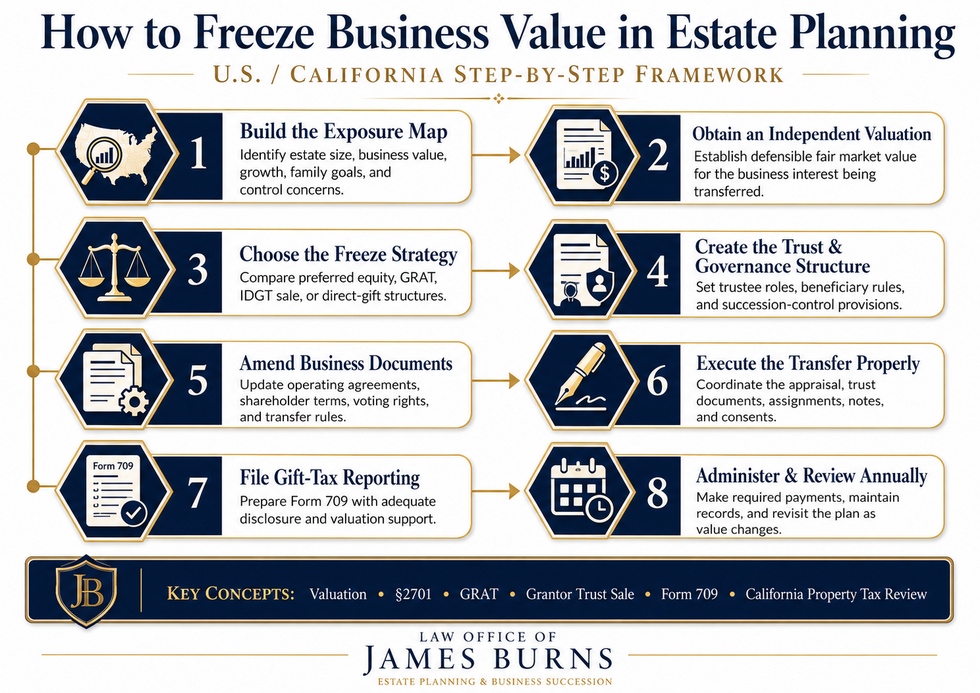
A Step-by-Step Estate-Freeze Process
Step 1: Build the complete exposure map
Before selecting a trust or transaction, identify:
-
The owner's entire projected estate.
-
The current business value.
-
Anticipated growth.
-
Community-property and separate-property characterization.
-
Existing shareholder or operating agreements.
-
Personal guarantees.
-
Key-person dependencies.
-
Expected sale or succession timing.
-
Family members who may receive ownership.
-
The owner's required retirement income.
-
California real property held inside the business.
-
Existing lifetime gifts and exemption use.
-
Generation-skipping objectives.
The transaction should solve a defined problem. It should not begin with a fashionable document.
Step 2: Obtain an independent valuation
The valuation date should align with the actual transaction date as closely as practicable.
If significant events occur—such as a major contract, financing, acquisition offer, lawsuit, loss of a customer, or signed letter of intent—the valuation may need to account for what was known or reasonably knowable on the transfer date.
Step 3: Select the appropriate freeze architecture
Counsel, the CPA, and valuation professional should compare:
-
Preferred equity recapitalization.
-
GRAT.
-
Sale to a grantor trust.
-
Direct gift.
-
Voting and nonvoting equity division.
-
Partnership or LLC restructuring.
-
Life-insurance liquidity.
-
Charitable planning.
-
Deferral options for estate-tax liquidity.
The strategy should be selected only after modeling transfer-tax, income-tax, basis, liquidity, governance, and California property-tax consequences.
Step 4: Establish the trust and governance structure
The plan may require:
-
An irrevocable trust.
-
Independent or directed trustees.
-
Trust-protector provisions.
-
Distribution standards.
-
Business-advisor or investment-advisor roles.
-
Voting-control provisions.
-
Buy-sell restrictions.
-
Successor-management rules.
-
Spousal-access provisions where appropriate.
-
Generation-skipping transfer tax allocation.
-
Creditor and divorce planning for beneficiaries.
A trust does not create automatic protection merely because it is irrevocable. Protection depends on who created the trust, retained powers, governing law, beneficiary rights, timing, and the absence of fraudulent-transfer concerns.
Step 5: Amend the business documents
The transaction may require amendments to:
-
Articles of incorporation.
-
Bylaws.
-
Operating agreements.
-
Partnership agreements.
-
Shareholder agreements.
-
Buy-sell agreements.
-
Voting agreements.
-
Distribution provisions.
-
Transfer restrictions.
-
Redemption rights.
-
Employment agreements.
The entity's tax status must also be reviewed. A recapitalization that works economically may create unintended income-tax consequences or conflict with the company's existing tax election.
Step 6: Execute the transfer contemporaneously
The following should be coordinated and consistently dated:
-
Appraisal.
-
Trust agreement.
-
Sale or assignment agreement.
-
Promissory note.
-
Security agreement.
-
Equity certificates or ledger entries.
-
Manager, director, member, or shareholder consents.
-
Entity amendments.
-
Spousal consents.
-
Tax elections.
-
Closing memorandum.
Backdated or reconstructed documents undermine credibility.
Step 7: File a complete federal gift-tax return
A transaction involving a gift, bargain sale, trust transfer, or Chapter 14 valuation issue may require a federal gift-tax return even when no immediate gift tax is payable.
The IRS instructions state that adequate disclosure should include the transferred property, consideration received, relationships of the parties, relevant trust information, and either a qualified appraisal or a detailed explanation of the valuation method. Adequate disclosure is important because it begins the limitations period for IRS examination of the reported gift.
A vague attachment stating “gift of LLC interest” is not a substitute for a properly prepared disclosure package.
Step 8: Administer the structure every year
The plan must be operated as an actual legal and economic arrangement.
That may include:
-
Paying note interest and principal when due.
-
Making required GRAT annuity payments.
-
Paying cumulative preferred distributions.
-
Maintaining separate accounts.
-
Issuing tax reporting documents.
-
Holding required meetings.
-
Updating company records.
-
Following distribution restrictions.
-
Monitoring insurance and liquidity.
-
Reviewing trustee performance.
-
Tracking GST exemption allocations.
-
Revaluing interests before additional transfers.
An estate freeze is not complete when the documents are signed. It succeeds or fails through administration.
An Illustrative California Estate-Freeze Example
Assume a married California business owner holds a closely held company independently valued at $12 million.
The company is expected to grow significantly over the next decade. The owner wants to retain management control and adequate retirement income but ultimately wants the children to receive the enterprise.
After modeling the alternatives, the planning team establishes an irrevocable grantor trust and capitalizes it with an initial gift. The owner then sells a noncontrolling business interest to the trust for a properly documented promissory note based on an independent appraisal.
The owner retains:
-
Voting or management rights appropriate to the structure.
-
The promissory note.
-
The right to receive scheduled principal and interest payments.
-
Other assets needed for personal financial independence.
The trust receives the transferred business interest and its future appreciation.
If the transferred interest grows substantially faster than the note's interest obligation, the excess value may accumulate for the trust beneficiaries rather than in the owner's estate.
However, the result depends on the transaction being genuine.
If the business was undervalued, the difference may be treated as a taxable gift. If the owner continues treating the transferred property as personally owned, retained-benefit rules may apply. If the trust cannot realistically service the note, the transaction may be challenged. If the business is sold shortly after the transfer, the facts existing before the transfer may affect valuation and tax treatment.
The structure is not a loophole. It is a carefully documented transfer of economic rights.
Common Estate-Freeze Mistakes
Using an unsupported valuation
A thin appraisal can turn a sophisticated plan into an avoidable controversy.
The appraisal must address the actual interest transferred, the company's facts, and material events known at the valuation date.
Ignoring §2701 or §2702
Preferred equity and retained trust interests are governed by specialized valuation rules. A retained right that does not satisfy the statutory requirements may be assigned little or no value for gift-tax purposes.
Retaining too much control or enjoyment
An owner cannot make a completed transfer while continuing to use the property as though nothing changed.
Internal Revenue Code §2036 can bring transferred property back into the estate when the owner retains prohibited possession, enjoyment, income, or control.
Ignoring cash-flow requirements
A GRAT must pay its annuity. A trust purchasing business interests must service its note. Preferred payments may need to be made as required.
A structure that cannot perform economically is not ready to be implemented.
Focusing only on estate tax
Removing appreciation from the estate may sacrifice future basis adjustment.
For California families, the analysis must include federal and California capital-gain exposure, community-property basis, and the anticipated timing of a sale.
Overlooking California property-tax reassessment
When the entity owns California real estate, an equity transfer may create a change-in-control or change-in-ownership issue. The property-tax analysis should be completed before—not after—the ownership transfer.
Failing to coordinate the professional team
The attorney, CPA, financial advisor, valuation professional, insurance professional, and corporate counsel must work from the same facts and transaction sequence.
Misalignment creates inconsistent documents, returns, valuations, and financial records.
What Family Trusts Add to an Estate Freeze
A properly designed irrevocable trust can provide more than transfer-tax efficiency.
It can establish:
-
Long-term management of business interests.
-
Standards for distributions.
-
Protection against premature beneficiary control.
-
Succession rules if a child is unable or unwilling to participate.
-
Separate-property planning for married beneficiaries.
-
Creditor and divorce-risk safeguards, subject to applicable law.
-
Multi-generational governance.
-
Generation-skipping transfer tax planning.
-
Flexibility through trustees, trust protectors, and limited powers of appointment.
The 2026 federal generation-skipping transfer tax exemption is tied to the $15 million basic exclusion amount. Proper allocation is important because the estate-tax portability rules should not be assumed to solve generation-skipping planning.
The beneficiary class, trustee structure, situs, income-tax treatment, distribution standards, and duration of the trust should all be designed intentionally.
A trust should not merely receive the growth shares. It should explain how those interests will be managed for decades.
What I Have Learned From Advising Business Owners
The best time to evaluate an estate freeze is usually before the value becomes obvious to everyone else.
Once a binding sale agreement has been signed, a major liquidity event is imminent, or a buyer has established the value, the planning options may become narrower and the valuation evidence more difficult to overcome.
The most successful planning generally begins while there is still uncertainty—and while the owner still has time to:
-
Decide which family members should benefit.
-
Identify who should control the company.
-
Establish independent governance.
-
Obtain a defensible appraisal.
-
Separate voting rights from economic growth.
-
Build liquidity outside the company.
-
Coordinate the transaction with the owner's retirement needs.
-
Plan for California income and property taxes.
-
Document legitimate business and succession objectives.
A freeze should not impoverish the owner, destabilize the company, or force children into ownership they do not want.
It should create a controlled transition from one generation to the next while preserving the business's ability to operate.
The documents are not the strategy.
They are the instruments used to hold the strategy together.
— James G. Burns, Esq.
Key Takeaways
-
A U.S. estate freeze is designed to transfer future appreciation, not conceal current value.
-
California currently has no separate estate or inheritance tax, but federal estate, gift, and GST taxes still apply.
-
The federal basic exclusion amount is $15 million per individual in 2026.
-
Preferred equity freezes may implicate Internal Revenue Code §2701.
-
GRATs are governed by §2702 and the §7520 valuation rules.
-
Sales to grantor trusts require credible valuation, capitalization, documentation, and note administration.
-
Independent business valuation is central to every freeze strategy.
-
California community-property basis may materially affect the analysis.
-
California real-property ownership can create reassessment concerns.
-
Gift-tax reporting and adequate disclosure should be planned at the beginning, not after closing.
-
The structure must be administered consistently every year.
Frequently Asked Questions
What does it mean to freeze the value of a business?
Freezing business value generally means establishing the economic value retained by the current owner while transferring some or all future appreciation to another person or trust. The owner may retain a promissory note, preferred interest, annuity, or other fixed economic right.
Does an estate freeze stop the company from increasing in value?
No. The company can continue growing. The strategy determines who owns the future appreciation.
Does California have an estate tax?
California does not presently require a California estate-tax return for decedents dying after December 31, 2004, and it does not currently impose a separate inheritance tax. Federal estate-tax law still applies to California residents.
What is the federal estate-tax exemption in 2026?
The federal estate and gift tax basic exclusion amount is $15 million per individual in 2026.
What is a preferred equity estate freeze?
The company is recapitalized so that the senior generation retains preferred economic rights while growth interests are transferred to descendants or trusts. The transaction must be carefully structured under Internal Revenue Code §2701.
What is a GRAT?
A Grantor Retained Annuity Trust is an irrevocable trust in which the grantor transfers assets while retaining a fixed annuity for a specified term. Appreciation above the applicable hurdle may pass to the remainder beneficiaries.
What is an intentionally defective grantor trust?
It is an irrevocable trust intended to be outside the grantor's estate while the grantor remains responsible for its federal income taxes. Business interests may be sold to the trust for a promissory note, subject to careful structuring.
Is a sale to a grantor trust income-tax free?
While the trust is treated as wholly owned by the grantor for federal income-tax purposes, Revenue Ruling 85-13 generally treats transactions between the grantor and the trust as disregarded. Other federal and California tax issues must still be evaluated.
Can I retain control of the company?
It may be possible to retain appropriate voting or management authority while transferring economic growth. The retained powers must be designed carefully so they do not cause estate inclusion or undermine the completed transfer.
Can the business interests be discounted?
A transferred noncontrolling or nonmarketable interest may be worth less than a proportionate share of the company's enterprise value, depending on its actual legal and economic rights. Any valuation adjustment must be supported by governing documents, market evidence, and a qualified appraisal.
Will the transferred business interests receive a basis adjustment when I die?
Assets removed from the taxable estate may not receive the same basis adjustment that estate-included assets receive. This tradeoff is especially important for California community property and businesses likely to be sold.
What happens if my business owns California real estate?
A transfer of entity interests may create California change-in-control, change-in-ownership, reporting, and reassessment issues. The property-tax consequences should be reviewed before the transfer.
When should a business owner consider an estate freeze?
The strategy is best evaluated before a major increase in value, financing, binding sale agreement, recapitalization, or succession event. The appropriate timing depends on projected growth, estate size, cash flow, ownership objectives, and family readiness.
How often should an estate-freeze structure be reviewed?
The structure should be reviewed regularly and after major events, including a sale offer, refinancing, ownership change, death, divorce, change in tax law, substantial increase in value, or change in the owner's family or financial circumstances.
Resources and Authorities
The following federal and California authorities provide the statutory, regulatory, tax, valuation, and property-tax framework discussed in this article.
Federal Estate, Gift, and Valuation Authorities
Internal Revenue Service, “What's New—Estate and Gift Tax.”
Current federal estate and gift tax exclusion amounts and annual gift-tax exclusions, including the $15 million basic exclusion amount and $19,000 annual exclusion for 2026.
https://www.irs.gov/businesses/small-businesses-self-employed/whats-new-estate-and-gift-tax
Internal Revenue Code §2701—Transfers of Certain Interests in Corporations or Partnerships.
Special gift-tax valuation rules that may apply when a business owner transfers equity to family members while retaining preferred, distribution, liquidation, or control rights.
https://uscode.house.gov/view.xhtml?edition=prelim&f=treesort&jumpTo=true&num=0&req=%28title%3A26+section%3A2701+edition%3Aprelim%29+OR+%28granuleid%3AUSC-prelim-title26-section2701%29
Treasury Regulation §25.2701-1—Application of §2701.
Explains when the special valuation rules apply to transfers of interests in corporations and partnerships.
https://www.ecfr.gov/current/title-26/chapter-I/subchapter-B/part-25/subject-group-ECFR3366d7ded015702/section-25.2701-1
Treasury Regulation §25.2701-2—Applicable Retained Interests and Qualified Payments.
Defines retained distribution rights, qualified-payment rights, and rights that may be assigned a zero value under the special valuation rules.
https://www.ecfr.gov/current/title-26/chapter-I/subchapter-B/part-25/subject-group-ECFR3366d7ded015702/section-25.2701-2
Treasury Regulation §25.2701-3—Determination of the Taxable Gift.
Describes the subtraction method used to calculate the taxable gift in a §2701 transaction.
https://www.ecfr.gov/current/title-26/chapter-I/subchapter-B/part-25/subject-group-ECFR3366d7ded015702/section-25.2701-3
Internal Revenue Code §2702—Transfers of Interests in Trusts.
Special valuation rules applicable when a person transfers property to a trust for family members while retaining an annuity, income, or other trust interest.
https://uscode.house.gov/view.xhtml?edition=prelim&num=0&req=granuleid%3AUSC-prelim-title26-section2702
Treasury Regulation §25.2702-3—Qualified Annuity and Unitrust Interests.
Provides the principal regulatory requirements for Grantor Retained Annuity Trusts and other qualified retained interests.
https://www.ecfr.gov/current/title-26/chapter-I/subchapter-B/part-25/subject-group-ECFR3366d7ded015702/section-25.2702-3
Internal Revenue Code §7520—Valuation of Annuities and Remainder Interests.
Establishes the statutory interest-rate methodology used to value annuities, life interests, terms of years, remainders, and reversions, including GRAT interests.
https://uscode.house.gov/view.xhtml?edition=prelim&num=0&req=granuleid%3AUSC-prelim-title26-section7520
Internal Revenue Code §2036—Transfers With Retained Life Interests.
Addresses estate inclusion when a transferor retains possession, enjoyment, income, control, or certain rights over transferred property.
https://uscode.house.gov/view.xhtml?edition=prelim&num=0&req=granuleid%3AUSC-prelim-title26-section2036
Internal Revenue Code §2512—Valuation of Gifts.
Provides the general fair-market-value rules for gifts and transfers made for less than adequate and full consideration.
https://uscode.house.gov/view.xhtml?edition=prelim&num=0&req=granuleid%3AUSC-prelim-title26-section2512
Internal Revenue Code §1014—Basis of Property Acquired From a Decedent.
Provides the general basis-adjustment rules for property acquired from a decedent, including the important community-property provision under §1014(b)(6).
https://uscode.house.gov/view.xhtml?req=%28title%3A26+section%3A1014+edition%3Aprelim%29
Revenue Ruling 59-60, 1959-1 C.B. 237.
Foundational federal guidance for valuing closely held corporate stock and business interests. The IRS valuation job aid below reproduces the ruling and discusses its factors.
https://www.irs.gov/pub/irs-lbi/S%20Corporation%20Valuation%20Job%20Aid%20for%20IRS%20Valuation%20Professionals.pdf
Revenue Ruling 85-13, 1985-1 C.B. 184.
Principal authority for treating a grantor as the owner of grantor-trust assets for federal income-tax purposes and generally disregarding transactions between the grantor and a wholly owned grantor trust.
https://www.irs.gov/irb/2026-05_IRB
IRS Instructions for Form 709—United States Gift and Generation-Skipping Transfer Tax Return.
Gift-tax reporting, appraisal attachments, adequate-disclosure requirements, and information necessary to begin the statute of limitations for examination of a reported gift.
https://www.irs.gov/instructions/i709
These authorities establish the central federal framework for preferred-equity freezes, GRATs, grantor-trust sales, gift valuation, retained-interest concerns, basis planning, and gift-tax reporting.
California Authorities
California Revenue and Taxation Code §13301.
California's statutory provision addressing state gift, inheritance, succession, legacy, and estate taxes imposed on transfers occurring by reason of death.
https://leginfo.legislature.ca.gov/faces/codes_displaySection.xhtml?lawCode=RTC§ionNum=13301
California State Board of Equalization, “Change in Ownership—Frequently Asked Questions.”
General California property-tax guidance concerning changes in ownership and reassessment.
https://www.boe.ca.gov/proptaxes/faqs/changeinownership.htm
California State Board of Equalization, Legal Entity Ownership Program.
Guidance concerning transfers involving corporations, partnerships, limited liability companies, and other legal entities that own California real property.
https://www.boe.ca.gov/proptaxes/leopcio.htm
California State Board of Equalization, Proposition 19.
Official guidance regarding parent-child and grandparent-grandchild exclusions, family homes, family farms, and base-year-value transfers.
https://www.boe.ca.gov/prop19/
California State Board of Equalization, Proposition 19 Fact Sheet.
Summary of Proposition 19 eligibility requirements, value limitations, filing rules, and reassessment consequences.
https://www.boe.ca.gov/pdf/pub801.pdf
These authorities are particularly important when the business owns California real property or the planning transaction changes control, beneficial ownership, or entity ownership.
Related Articles and Internal Resources
Business Succession Planning Attorney—Orange County
https://www.jamesburnslaw.com/business-succession
Mastering Business Succession in Aliso Viejo
https://www.jamesburnslaw.com/mastering-business-succession-in-aliso-viejo-essential-strategies-for-orange-county-businesses-in-california
Irrevocable Trusts in California
https://www.jamesburnslaw.com/irrevocable-trusts
Grantor Retained Annuity Trusts: An Introduction
https://www.jamesburnslaw.com/eliminate-estate-taxes-with-grantor-retained-annuity-trusts-grats-an-introduction
SLAT vs. GRAT: Choosing the Right Irrevocable Trust
https://www.jamesburnslaw.com/slat-vs-grat-choosing-the-right-irrevocable-trust-for-the-2026-exemption-cliff
The $15 Million Mirage: Estate-Tax Exemption and IDGT Planning
https://www.jamesburnslaw.com/the-15-million-mirage-why-a-permanent-exemption-isn-t-a-wealth-defense-strategy
Estate Planning for Estates Exceeding $10 Million
https://www.jamesburnslaw.com/estate-plan-for-10m-assets-your-2026-strategy-guide
California Estate-Tax Planning Checklist for 2026
https://www.jamesburnslaw.com/california-estate-tax-planning-checklist-for-2026
Proposition 19 in California: Realistic Planning Moves for Families
https://www.jamesburnslaw.com/prop-19-in-california-realistic-planning-moves-for-families
Business Sale Planning in Orange County
https://www.jamesburnslaw.com/buying-or-selling-a-small-business
These internal resources connect the article to the firm's current business-succession, irrevocable-trust, GRAT, IDGT, estate-tax, Proposition 19, and business-sale content.
Begin With a Situation Readiness Briefing™
Business-value planning cannot be designed from a company valuation alone.
It requires a complete review of the owner's estate, family, control objectives, income needs, business agreements, tax exposure, real-property holdings, succession plan, and existing trust architecture.
The Law Office of James Burns begins with a Situation Readiness Briefing™ and Risk Exposure Mapping process to identify:
-
Where value is currently concentrated.
-
Which assets are likely to appreciate.
-
Where control should remain.
-
Where future growth should accumulate.
-
What tax, creditor, liquidity, and succession friction exists.
-
Which professional disciplines must be coordinated.
-
Whether a foundational or advanced planning structure is appropriate.

To begin the process, contact the Law Office of James Burns through JamesBurnsLaw.com and request a Situation Readiness Briefing™ concerning business succession and advanced wealth-transfer planning.
About James G. Burns, Esq.
James G. Burns is an Orange County estate-planning, asset-protection, business-succession, and wealth-transfer attorney with more than two decades of experience advising California families, professionals, business owners, and high-net-worth clients.
He holds a Juris Doctor and an LL.M. focused on taxation and estate planning and is affiliated with the Society of Trust and Estate Practitioners. Over the course of his practice, he has assisted thousands of families and has developed planning systems addressing control, probate avoidance, business succession, asset protection, tax exposure, special-needs concerns, and multi-generational wealth transfer.
James is the author of The Three Secret Pillars of Wealth and the creator of the FortressWall Methodology™, a proprietary planning process that begins with risk-exposure mapping rather than document selection.
His planning philosophy is straightforward:
A trust is not the plan. It is one instrument within a larger control architecture.
Legal, Tax, and Professional Disclaimer
This article is provided solely for general educational and informational purposes. It does not constitute legal, tax, accounting, investment, valuation, insurance, or financial advice.
Estate-freeze strategies are highly fact-specific and may involve federal estate, gift, income, and generation-skipping transfer taxes; California income and property taxes; corporate, partnership, trust, securities, and fiduciary laws; valuation standards; and contractual restrictions.
No reader should implement or rely upon any strategy described in this article without obtaining individualized advice from appropriately qualified legal, tax, accounting, valuation, and financial professionals.
Reading this article, visiting the Law Office of James Burns website, submitting an inquiry, or communicating with the firm does not create an attorney-client relationship. An attorney-client relationship is created only through a written engagement agreement signed by the attorney and client.
Tax laws, exemption amounts, administrative guidance, interest rates, and judicial interpretations may change. The information in this article is based on authorities available as of the publication or revision date. No particular outcome is promised or guaranteed.
Prior results, professional experience, and examples do not guarantee a similar result in another matter.
This material may constitute attorney advertising.
Intellectual Property and Content-Use Notice
© 2026 Law Office of James Burns. All rights reserved.
The original language, organization, planning sequences, diagrams, explanations, frameworks, risk-mapping concepts, and presentation contained in this article are proprietary content of the Law Office of James Burns, except for statutes, regulations, government materials, and other third-party authorities expressly identified or cited.
FortressWall Methodology™, Situation Readiness Briefing™, and related planning terminology are proprietary identifiers and intellectual-property assets used by the Law Office of James Burns.
No portion of this article may be copied, reproduced, republished, modified, distributed, commercially exploited, incorporated into competing professional materials, scraped, or used to create derivative works without prior written authorization, except as permitted by applicable law.
No license is granted for the use of this content in commercial databases, automated content systems, large language model training datasets, machine-learning systems, or generative artificial-intelligence products without express written consent.
Permitted quotations must be limited, accurately attributed, and accompanied by a clear reference to the Law Office of James Burns and the original published article.
Unauthorized use is expressly prohibited, and all available intellectual-property rights and remedies are reserved.

Comments
There are no comments for this post. Be the first and Add your Comment below.
Leave a Comment