

An estate plan for $10M+ assets is a comprehensive strategy combining tax efficiency, trust architecture, probate avoidance, and multigenerational governance to preserve and transfer wealth with minimal loss. At this level, standard wills and basic beneficiary designations are not enough. The 2026 federal estate tax exemption sits at $15 million per individual, meaning estates above that threshold face a 40% marginal tax rate on every dollar over the limit. Families with $10M+ in assets need integrated planning that addresses taxes, trust structures, and administration simultaneously.
What are the essential components of a $10M+ estate plan?
A well-built estate plan for large assets goes far beyond a will. It requires coordinated legal, tax, and financial instruments working together as a single system.
The core components include:
- Revocable living trust. Controls asset distribution, avoids probate, and maintains privacy. Every major asset must be retitled into the trust to function correctly.
- Irrevocable trusts. Remove assets from your taxable estate permanently. Spousal Lifetime Access Trusts (SLATs), Grantor Retained Annuity Trusts (GRATs), and Intentionally Defective Grantor Trusts (IDGTs) each serve distinct tax and transfer goals.
- Durable power of attorney and healthcare directive. Protect decision-making authority if you become incapacitated. Without these, courts appoint a conservator, which is slow and expensive.
- Liquidity planning. Concentrated positions in private businesses or real estate create a tax-time cash problem. Life insurance held inside an Irrevocable Life Insurance Trust (ILIT) funds estate tax obligations without forcing asset sales.
- Family governance documents. A family mission statement, trustee succession plan, and distribution standards prevent disputes and guide trustees across generations.
Family governance supports multigenerational wealth management in ways that legal documents alone cannot. Clear governance reduces litigation risk and keeps wealth intact across family transitions.
Pro Tip: Review beneficiary designations on retirement accounts and life insurance every two years. These designations override your trust and will, and outdated designations are one of the most common causes of unintended wealth transfers.

How do 2026 federal estate and gift tax rules impact $10M+ estates?
The federal estate and gift tax system uses a unified exemption schedule. Timing when you use your exemption directly affects your tax outcome.
The key rules for 2026:
- Individual exemption is $15 million. Each person can transfer up to $15 million during life or at death before federal estate tax applies.
- Married couples can shelter $30 million. Portability allows a surviving spouse to use the deceased spouse's unused exemption (DSUE), but only if the executor files a timely and complete IRS Form 706.
- The top marginal rate is 40%. Every dollar above the exemption threshold is taxed at 40%. On a $20 million estate, that is $2 million in federal tax on the excess $5 million.
- Portability is not automatic. The executor must file Form 706 even when no estate tax is owed, solely to preserve the DSUE for the surviving spouse.
"Executors of $10M+ estates must file complete asset-level valuations on Form 706 to preserve DSUE for surviving spouses, avoiding multimillion-dollar losses." — Estate Tax Portability Tax Court
The consequences of incomplete filing are severe. In one Tax Court case, the court disallowed $3.7 million of unused exemption because the executor failed to provide meaningful, asset-specific valuations. That single administrative failure cost the estate millions in avoidable tax. Portability is a powerful tool, but it demands precise execution.
The estate and gift tax unified schedule means lifetime gifts reduce your available death-time exemption dollar for dollar. Families who make large gifts early in life preserve more appreciation outside the taxable estate, since future growth on gifted assets escapes estate tax entirely.
What trust structures reduce taxes and preserve wealth at $10M+?
Specialized irrevocable trusts are the primary tool for shifting appreciation out of a taxable estate. Each structure targets a different planning goal.
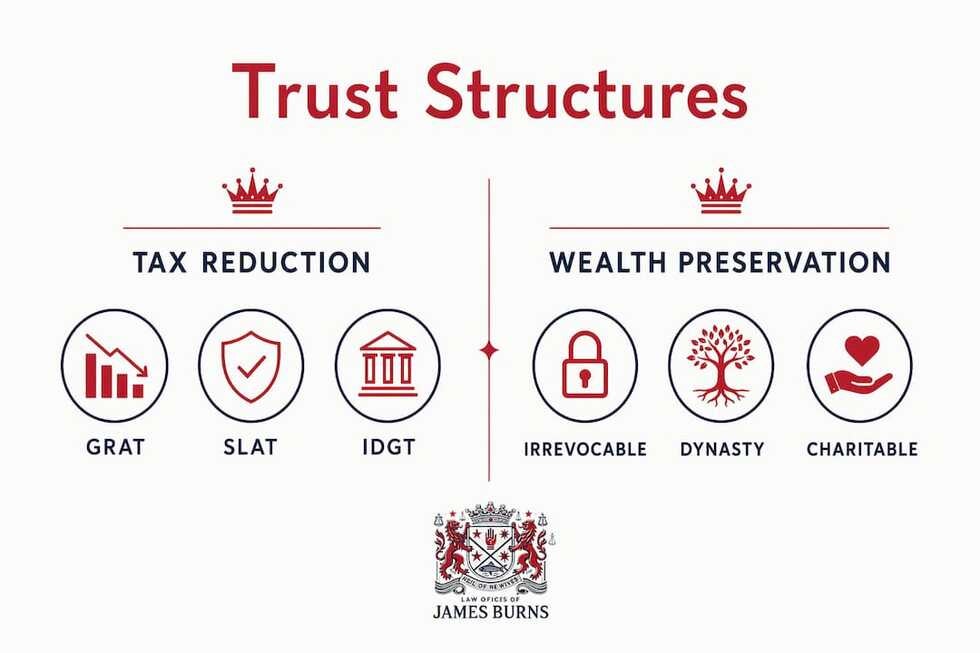
| Trust Type | Primary Purpose | Key Mechanism |
|---|---|---|
|
GRAT (Grantor Retained Annuity Trust) |
Shift asset appreciation to heirs |
Annuity payments return value to grantor; growth above IRS hurdle rate passes tax-free |
|
SLAT (Spousal Lifetime Access Trust) |
Remove assets from estate while retaining indirect access |
Irrevocable gift to trust benefits spouse during lifetime |
|
IDGT (Intentionally Defective Grantor Trust) |
Sell assets to trust without capital gains |
Grantor pays income tax on trust earnings, further reducing taxable estate |
|
Dynasty Trust |
Multigenerational wealth transfer |
Uses GST exemption to skip estate tax across multiple generations |
GRATs reduce taxable gift value by paying annuity payments back to the grantor while retaining the upside. The strategy works when asset growth exceeds the IRS hurdle rate (the Section 7520 rate). A business interest or investment portfolio growing at 12% annually inside a GRAT, against a 5% hurdle rate, transfers the 7% excess to heirs with zero gift tax.
GST tax planning adds another layer of complexity. GRATs alone may not sufficiently address generation-skipping exposure in $10M+ estates. Families with assets intended for grandchildren or beyond need combined techniques, including direct GST exemption allocations and dynasty trust structures.
Pro Tip: Fund a GRAT with a concentrated position in a private company before a liquidity event. The pre-sale appreciation transfers to heirs at a fraction of the gift tax cost compared to transferring cash after the sale.
How does probate avoidance fit into large estate plans in California?
Probate avoidance and estate tax planning are separate concerns. Families often confuse the two, which leads to gaps in their plan.
Probate avoidance is distinct from estate tax planning. Estate tax requires specialized irrevocable trusts. Probate avoidance handles court processes, delays, and public disclosure. California imposes no state estate tax, but its probate process is expensive and slow.
California probate fees are formula-based. Probate costs scale with estate size using statutory compensation formulas, making the process particularly expensive for $10M+ estates. Attorney and executor fees on a $10 million estate can reach six figures before accounting for court costs and delays that often stretch 12 to 18 months.
The primary tools for probate avoidance:
- Revocable living trust. Assets held in trust pass directly to beneficiaries without court involvement.
- Beneficiary designations. Retirement accounts, IRAs, and life insurance pass outside the estate entirely when designations are current and correct.
- Joint tenancy with right of survivorship. Transfers property automatically at death, though this approach can create unintended gift tax consequences.
- Transfer-on-death deeds. California allows real property to transfer directly to named beneficiaries without probate.
The most common failure is a trust that was never properly funded. Families create a revocable trust, then leave real estate, brokerage accounts, or business interests titled in their personal names. Those assets go through probate anyway, defeating the purpose entirely.
How to coordinate complex estate administration and avoid common pitfalls
Estate administration failures at the $10M+ level almost always trace back to coordination breakdowns, not wrong strategy choices. Improper funding, titling, or coordination causes large estate plans to underperform or fail outright.
The critical administrative steps include:
- Retitle every asset into the correct entity. Real estate, brokerage accounts, and business interests must be formally transferred to the trust or correct ownership structure. Verbal agreements and intentions do not count.
- Coordinate the advisory team. Attorneys, CPAs, trustees, and investment managers must share a unified understanding of the plan. Siloed advisors create gaps. A CPA who does not know about a GRAT may inadvertently trigger tax consequences through a poorly timed sale.
- File Form 706 on time and completely. The portability election deadline is nine months from the date of death, with a six-month extension available. Missing this window permanently forfeits the DSUE.
- Document all valuations at the asset level. The IRS requires meaningful, asset-specific valuations. A summary balance sheet is not sufficient. Business interests, real estate, and illiquid assets each need independent appraisals.
- Review the plan after major life events. Marriage, divorce, a business sale, or a significant inheritance each changes the planning picture. A plan built for a $12 million estate may be dangerously inadequate after a business exit doubles net worth.
Concentrated positions like private business shares require liquidity planning to pay tax and seize valuation opportunities before death. Families who wait until after a liquidity event lose the most powerful transfer window.
Key takeaways
A successful estate plan for $10M+ assets requires integrated tax, trust, and probate strategies executed with precision, not just the right documents on paper.
| Point | Details |
|---|---|
|
Federal exemption is $15M per person |
Estates above this threshold face a 40% marginal rate; portability can double the shelter for married couples. |
|
Portability requires a complete Form 706 |
Incomplete filings have cost estates millions; file even when no tax is owed to preserve the DSUE. |
|
Irrevocable trusts shift appreciation |
GRATs, SLATs, and IDGTs each remove future growth from the taxable estate using different mechanisms. |
|
California probate is costly and public |
Formula-based fees on $10M+ estates reach six figures; a funded living trust avoids the process entirely. |
|
Administration failures sink good plans |
Improper asset titling and siloed advisors are the leading causes of estate plan failure at this level. |
What I have learned from building $10M+ estate plans
After working with high-net-worth families in California for years, the pattern I see most often is not a bad strategy. It is a good strategy that was never fully implemented. A family spends months designing a sophisticated trust structure, then the business interest never gets transferred, the brokerage account stays in the wrong name, and the CPA was never told about the GRAT. The plan looks perfect on paper and fails in practice.
The second thing I have learned is that the 2026 exemption landscape creates urgency that many families underestimate. The $15 million individual exemption is historically generous. Legislative changes can reduce it, and gifts made under today's rules are generally protected even if future law lowers the threshold. Families who wait for certainty often pay the price in lost transfer opportunities.
Family governance is the piece most advisors skip. A dynasty trust without a trustee succession plan and distribution standards is a future lawsuit waiting to happen. The families I have seen preserve wealth across three generations all had clear written guidance for trustees, not just legal documents.
The FortressWall Methodology™ that Jamesburnslaw uses addresses all of this through exposure mapping and a control architecture that coordinates every moving part. The goal is not just a plan. It is a plan that actually works when the moment arrives.
— James
How Jamesburnslaw supports your $10M+ estate plan
Jamesburnslaw specializes in elite estate planning, asset protection, and tax optimization for high-net-worth families in California. The firm's FortressWall Methodology™ covers the full picture: federal and California tax planning, trust design and funding, probate avoidance, and coordination across your entire advisory team.

Families with estates ranging from $5M to over $100M work with Jamesburnslaw to build plans that hold up under IRS scrutiny, California probate rules, and real-world family transitions. If your estate has grown past the point where standard planning is enough, schedule a planning review to see where your current structure leaves you exposed.
FAQ
What is the federal estate tax exemption in 2026?
The federal estate tax exemption is $15 million per individual in 2026, or $30 million for married couples using portability. The top marginal rate on amounts above the exemption is 40%.
Is portability of the estate tax exemption automatic?
Portability is not automatic. The executor must file a complete and timely IRS Form 706 to preserve the deceased spouse's unused exemption, even when no estate tax is owed.
What trusts are most effective for $10M+ estates?
GRATs, SLATs, and IDGTs are the most commonly used irrevocable trusts for large estates. Each removes future appreciation from the taxable estate using a different legal and tax mechanism.
Does California have a state estate tax?
California imposes no state estate tax. However, California probate is expensive and public, with formula-based fees that scale with estate size, making probate avoidance a priority for large estates.
What is the biggest mistake in large estate administration?
The most common failure is improper asset titling. Assets left outside a trust or in the wrong ownership structure go through probate or miss tax benefits, regardless of how well the plan was designed.

Comments
There are no comments for this post. Be the first and Add your Comment below.
Leave a Comment