
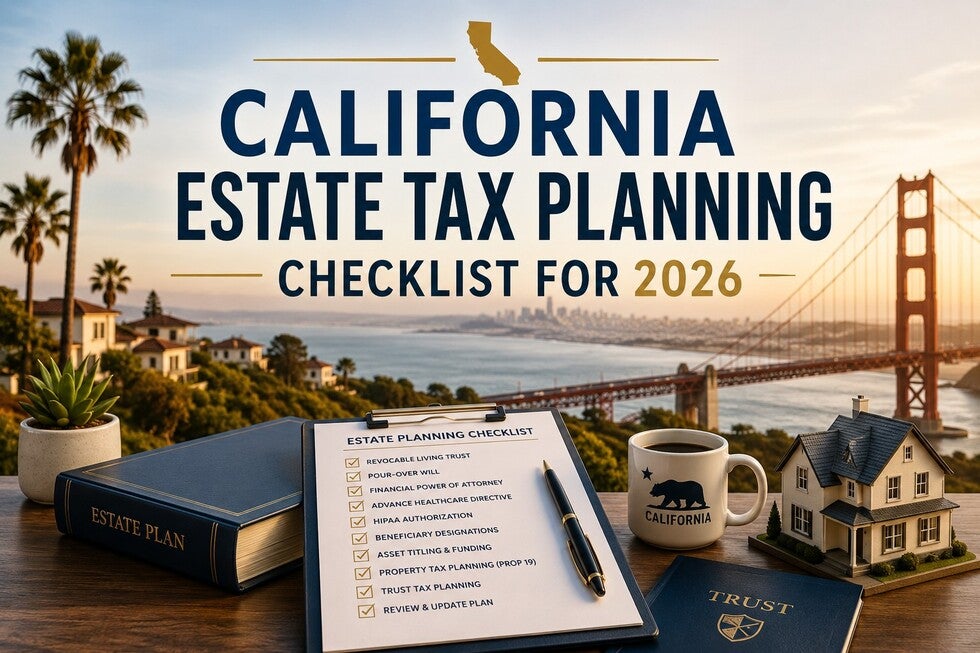
A comprehensive California estate tax planning checklist for 2026 is defined as a coordinated set of legal documents, tax elections, and fiduciary actions designed to transfer wealth with minimal tax exposure and zero probate delay. California imposes no state estate tax, but federal estate tax, Proposition 19 property reassessment rules, and compressed trust income tax brackets create serious financial risk for high-net-worth families. The five foundational documents every California estate plan requires are a revocable living trust, a pour-over will, an advance healthcare directive, a durable power of attorney, and a HIPAA authorization. Coordinating these documents with a California-licensed estate attorney and a CPA who specializes in trust taxation is not optional. It is the difference between a plan that holds and one that collapses under audit.
1. What are the must-have estate planning documents for Californians in 2026?
A well-funded revocable living trust is the cornerstone of every California estate plan. It holds your assets during your lifetime, transfers them to beneficiaries without probate, and gives your successor trustee clear authority to act. Without proper funding, the trust is a shell.

The pour-over will catches any asset that was never transferred into the trust. At death, it directs those stray assets into the trust so they pass according to your plan rather than California's default intestacy rules. Every revocable trust needs one.
An advance healthcare directive names the medical decisions you want made and who makes them if you cannot. A durable power of attorney covers financial decisions when you are incapacitated. A HIPAA authorization allows your named agents to access your medical records, which is a step most families skip until a crisis forces the issue.
- Revocable living trust: Avoids probate and controls asset distribution
- Pour-over will: Captures unfunded assets at death
- Advance healthcare directive: Governs medical decisions during incapacity
- Durable power of attorney: Authorizes financial management
- HIPAA authorization: Grants access to medical records for named agents
Pro Tip: Review all five documents every three years or after any major life event, including marriage, divorce, a new child, or a significant asset acquisition.
2. How do 2026 California tax laws impact estate planning strategies?
California has no separate state estate tax, but that does not mean California families have no estate tax exposure. For 2026, the federal estate and gift tax exemption is $15 million per individual under the One Big Beautiful Bill Act, eliminating the prior 2025 sunset concern. However, families with significant real estate, business interests, investment portfolios, life insurance, or rapidly appreciating assets still need coordinated planning for federal estate tax, GST tax, portability, valuation, liquidity, trust income tax, and future legislative changes.
Proposition 19 limits the parent-to-child property tax reassessment exclusion. To qualify, the heir must use the transferred property as their primary residence. The exclusion caps the value increase at $1 million, and the heir has a three-year filing deadline to claim it. Miss that window and the property reassesses to full market value, which can add tens of thousands of dollars in annual property taxes.
Estates exceeding $184,500 must go through California probate unless assets are held in trust or pass by beneficiary designation. Probate is public, slow, and expensive. A properly funded trust eliminates this exposure entirely.
California trusts file Form 541 with a top income tax rate of 13.3%, plus a mental health surcharge on income exceeding $1 million. That rate applies to retained trust income, which is why distributing income to beneficiaries in lower tax brackets is a core planning strategy.
- Federal estate tax: The 2026 exemption is $15 million per person, but high-net-worth families still need planning for taxable estates, portability, GST allocation (Generation Skipping Tax), asset growth, valuation, trust income tax, and future legislative risk.
- Proposition 19: Three-year deadline and residency requirement for property tax exclusion
- Probate threshold: $184,500 triggers full probate without trust protection
- California trust income tax: 13.3% top rate plus surcharge on retained income
Pro Tip: Engage a CPA who specializes in trust taxation alongside your estate attorney. The intersection of federal estate tax, California income tax, and Proposition 19 requires coordinated expertise, not sequential advice.
3. What practical steps should high-net-worth Californians follow in their 2026 estate plan?
The following checklist reflects the sequence that produces the fewest gaps and the greatest tax efficiency for California families with estates above $5 million.
- Inventory all assets. List every real property, brokerage account, business interest, retirement account, and digital asset. Include account numbers, current values, and how each asset is titled.
- Audit asset titling. Assets titled in your individual name bypass the trust and trigger probate. Retitle real estate, bank accounts, and investment accounts into the trust's name.
- Review beneficiary designations. Retirement accounts and life insurance pass by beneficiary designation, not through the trust. Confirm designations are current and aligned with your overall plan.
- Fund the trust properly. Transfer real property by recording a new deed. Transfer financial accounts by updating account registration. An unfunded trust is legally valid but practically useless.
- Name successor trustees and agents. Your successor trustee manages the trust after your death or incapacity. Name at least one backup. Do the same for your healthcare and financial agents.
- Address Proposition 19 deadlines. If you plan to transfer California real property to a child, document the child's intent to use the property as a primary residence and file the exclusion claim within three years of transfer.
- Coordinate healthcare and financial powers of attorney. Both documents must be executed with proper notarization and witness signatures under California law. Outdated versions from prior decades may not be accepted by financial institutions.
- Schedule an annual plan review. Tax law changes, asset value shifts, and family changes all affect your plan. A yearly review with your attorney and CPA catches gaps before they become costly.
4. How do fiduciary duties and trust taxation influence California estate plans?
Trustees carry personal financial liability for tax errors. Form 1041 and California Form 541 are required for any estate or trust with $600 or more in gross income. Most Bay Area estates file Form 1041 annually, but only estates exceeding the federal exemption file Form 706. Failing to file on time or filing incorrectly exposes the trustee personally.
Trust income is taxed at compressed brackets, with the top federal rate applying at just $14,450 of retained income. That compression makes retaining income inside a trust extraordinarily expensive. Distributable Net Income, or DNI, allows the trustee to shift taxable income to beneficiaries who are in lower brackets, reducing the overall family tax burden.
Incorrect DNI allocations can cause personal financial liability for trustees. This is not a theoretical risk. Trustees who distribute income without proper accounting for DNI have faced IRS assessments and state penalties that came directly out of their personal assets.
Step-up-in-basis planning and generation-skipping transfer tax elections are advanced strategies often missed by unsophisticated trustees yet critical for tax efficiency. A stepped-up basis at death eliminates capital gains on appreciated assets. Missing this election costs beneficiaries real money.
Pro Tip: Select a trustee who understands that trust administration is a tax job as much as a legal one. If your named trustee is not comfortable with Form 1041 and DNI calculations, pair them with a professional fiduciary or a CPA from day one.
5. What are common pitfalls and best practices to avoid estate planning mistakes?
The most expensive estate planning mistakes in California are not dramatic. They are procedural failures that compound quietly until a death or incapacity makes them impossible to fix.
Missing the Proposition 19 filing deadline is the most common and most costly error for families with California real estate. The three-year window sounds generous. Families in grief, dealing with probate, and managing asset transfers routinely miss it. The result is a permanent property tax reassessment that can cost hundreds of thousands of dollars over a property's holding period.
The California Franchise Tax Board collects over $50 billion annually in personal income taxes and enforces compliance with trust and estate income tax filings. The FTB does not overlook unfiled Form 541 returns. Trustees who assume a trust with modest income falls below the radar face penalties and interest that accumulate quickly.
| Common Error | Recommended Solution |
|---|---|
|
Missing Proposition 19 filing deadline |
Calendar the three-year deadline at time of transfer and assign a responsible party |
|
Unfunded trust |
Conduct a trust funding audit immediately after signing and annually thereafter |
|
Incorrect DNI allocation |
Retain a CPA specializing in fiduciary taxation to prepare Form 541 annually |
|
Outdated beneficiary designations |
Review all designations at every annual plan review |
|
Trustee acting without legal counsel |
Engage estate and trust legal professionals at from the start |
Updating beneficiary designations after a divorce is the most overlooked step in California estate planning. An ex-spouse named on a retirement account or life insurance policy will receive those assets regardless of what your trust or will says.
Key Takeaways
Effective California estate planning in 2026 requires coordinated legal documents, properly funded trusts, and proactive tax management to protect wealth from federal estate tax, probate, and Proposition 19 reassessment.
| Point | Details |
|---|---|
|
No California estate tax, but federal risk exists |
Federal exemption sunset after 2025 creates real exposure for estates above $7 million. |
|
Proposition 19 requires fast action |
Heirs must file the reassessment exclusion within three years and establish primary residency. |
|
Probate triggers at $184,500 |
A funded revocable living trust is the most direct way to avoid California probate. |
|
Trust income tax rates compress fast |
Distributing DNI to beneficiaries in lower brackets reduces the family's total tax burden. |
|
Trustee errors carry personal liability |
Incorrect Form 541 filings and DNI miscalculations expose trustees to direct financial penalties. |
What I've learned after years of California estate planning
The families who come to me after a planning failure share one thing in common. They had documents. What they lacked was coordination. A trust that was never funded, a Proposition 19 deadline that slipped by, a trustee who filed Form 541 without understanding DNI. These are not failures of intention. They are failures of execution.
Proposition 19 has genuinely changed the calculus for California real estate owners. The old assumption that you could transfer a family home to your children with the property tax base intact is gone. Families now need to decide whether a child will actually live in the property before the transfer, not after. That is a harder conversation, and most families avoid it until it is too late.
The trust income tax compression issue is the one that surprises even financially sophisticated clients. A trust hits the top federal bracket at $14,450 of retained income. Most of my clients assume trusts are tax-advantaged vehicles. They are, but only when administered correctly. Retaining income inside the trust without distributing it to beneficiaries is one of the most expensive mistakes a trustee can make.
My strongest advice is this: treat your estate plan as a living system, not a signed document. The law changes. Your assets change. Your family changes. A plan that was correct in 2022 may be dangerously wrong in 2026. Build in annual reviews the same way you build in annual tax filings. The cost of a review is trivial compared to the cost of a gap.
— James
How Jamesburnslaw protects California families in 2026
High-net-worth families in California face a planning environment that is more complex in 2026 than it has been in decades. Federal exemption uncertainty, Proposition 19 deadlines, and compressed trust tax brackets all demand coordinated legal and tax expertise.

Jamesburnslaw applies the FortressWall Methodology™ to estates ranging from $5 million to over $100 million, mapping every exposure point before building a control architecture that holds under audit, litigation, and generational transfer. Services include trust formation, fiduciary tax coordination, Proposition 19 planning, and step-up-in-basis elections. Families who want a plan built for 2026 realities, not 2015 assumptions, can start with a consultation at Jamesburnslaw.
FAQ
Does California have its own estate tax in 2026?
California has no state estate tax. However, federal estate tax applies to estates exceeding the federal exemption, which is scheduled to decrease significantly after 2025.
What is the California probate threshold in 2026?
Estates with assets exceeding $184,500 must go through California probate unless those assets are held in a funded trust or pass by beneficiary designation.
How does Proposition 19 affect property transfers to children?
Proposition 19 limits the parent-to-child property tax reassessment exclusion to properties the heir uses as a primary residence, with a $1 million cap on value increase and a three-year filing deadline.
What forms do California trustees file for trust income taxes?
Trustees file federal Form 1041 and California Form 541 for any trust or estate with $600 or more in gross income. California's top trust income tax rate is 13.3%.
What is Distributable Net Income and why does it matter?
Distributable Net Income, or DNI, is the amount of trust income that can be distributed to beneficiaries and deducted from the trust's taxable income. Proper DNI allocation shifts tax liability to beneficiaries in lower brackets, reducing the family's total tax burden.
Resources and Authorities
The following authorities and resources were used or are relevant to this California Estate Tax Planning Checklist for 2026:
Federal Estate Tax and Gift Tax Resources
IRS — What's New: Estate and Gift Tax
https://www.irs.gov/businesses/small-businesses-self-employed/whats-new-estate-and-gift-tax
IRS — Estate and Gift Tax FAQs
https://www.irs.gov/newsroom/estate-and-gift-tax-faqs
IRS — About Form 706, United States Estate and Generation-Skipping Transfer Tax Return
https://www.irs.gov/forms-pubs/about-form-706
IRS — About Form 709, United States Gift and Generation-Skipping Transfer Tax Return
https://www.irs.gov/forms-pubs/about-form-709
Fiduciary Income Tax and Trust Tax Resources
IRS — About Form 1041, U.S. Income Tax Return for Estates and Trusts
https://www.irs.gov/forms-pubs/about-form-1041
IRS — Instructions for Form 1041
https://www.irs.gov/instructions/i1041
IRS — File an Estate Income Tax Return
https://www.irs.gov/individuals/file-an-estate-tax-income-tax-return
California Franchise Tax Board — 2025 Fiduciary Income Tax Booklet, Form 541
https://www.ftb.ca.gov/forms/2025/2025-541-booklet.html
California Franchise Tax Board — 2025 Form 541, California Fiduciary Income Tax Return
https://www.ftb.ca.gov/forms/2025/2025-541.pdf
California Revenue and Taxation Code § 17731 — Taxation of Estates and Trusts
https://leginfo.legislature.ca.gov/faces/codes_displaySection.xhtml?lawCode=RTC§ionNum=17731
California Probate and Trust Administration Resources
California Courts — Simple Transfer of Property After Death
https://selfhelp.courts.ca.gov/probate/simple-transfer
California Courts — Small Estate Affidavit to Transfer Personal Property
https://selfhelp.courts.ca.gov/probate/small-estate
California Probate Code § 10800 — Statutory Compensation for Personal Representatives
https://leginfo.legislature.ca.gov/faces/codes_displaySection.xhtml?lawCode=PROB§ionNum=10800
California Probate Code § 16000 — Trustee Duty to Administer the Trust
https://leginfo.legislature.ca.gov/faces/codes_displaySection.xhtml?lawCode=PROB§ionNum=16000
California Probate Code § 16002 — Trustee Duty of Loyalty
https://leginfo.legislature.ca.gov/faces/codes_displaySection.xhtml?lawCode=PROB§ionNum=16002
California Probate Code § 16003 — Trustee Duty of Impartiality
https://leginfo.legislature.ca.gov/faces/codes_displaySection.xhtml?lawCode=PROB§ionNum=16003
California Probate Code § 13100 — Small Estate Affidavit Procedure
https://leginfo.legislature.ca.gov/faces/codes_displaySection.xhtml?lawCode=PROB§ionNum=13100
California Probate Code § 13151 — Petition to Determine Succession to Real Property
https://leginfo.legislature.ca.gov/faces/codes_displaySection.xhtml?lawCode=PROB§ionNum=13151
Proposition 19 and California Real Property Tax Resources
California State Board of Equalization — Proposition 19
https://www.boe.ca.gov/prop19/
California State Board of Equalization — Proposition 19 Fact Sheet
https://www.boe.ca.gov/pdf/pub801.pdf
California Revenue and Taxation Code § 63.2 — Intergenerational Transfer Exclusion
https://leginfo.legislature.ca.gov/faces/codes_displaySection.xhtml?lawCode=RTC§ionNum=63.2
California Revenue and Taxation Code § 69.6 — Base Year Value Transfer Rules
https://leginfo.legislature.ca.gov/faces/codes_displaySection.xhtml?lawCode=RTC§ionNum=69.6
Related James Burns Law Articles
California Estate Planning 101: From Basic Paperwork to Wealth Fortress
https://www.jamesburnslaw.com/california-estate-planning-101-from-basic-paperwork-to-wealth-fortress
Why One Family Avoids Probate Friction and Another Walks Straight Into It
https://www.jamesburnslaw.com/why-one-family-avoids-probate-friction-and-another-walks-straight-into-it
Why Families With “Complete” Trusts Still End Up in Probate
https://www.jamesburnslaw.com/why-families-with-complete-trusts-still-end-up-in-probate-the-local-mistake-most-planners-miss
Time Bomb Assets: California Property, Prop 19, and the Downfall of Badly Managed Trusts
https://www.jamesburnslaw.com/time-bomb-assets-california-property-prop-19-and-the-downfall-of-badly-managed-trusts
Prop 19 in California: Realistic Planning Moves for Families
https://www.jamesburnslaw.com/prop-19-in-california-realistic-planning-moves-for-families
Understanding California's Proposition 19: What Homeowners Need to Know
https://www.jamesburnslaw.com/understanding-california-s-proposition-19-what-homeowners-need-to-know-4-years-later
The Successor Trustee's 90-Day Checklist
https://www.jamesburnslaw.com/the-successor-trustee-s-90-day-checklist-the-emergency-manual-for-california-probate-code-compliance
The Trust Failure Checklist: Why Your 2018 Plan Is a Liability in 2026
https://www.jamesburnslaw.com/the-trust-failure-checklist-why-your-2018-plan-is-a-liability-in-2026
SLAT vs. GRAT: Choosing the Right Irrevocable Trust for 2026
https://www.jamesburnslaw.com/slat-vs-grat-choosing-the-right-irrevocable-trust-for-the-2026-exemption-cliff
OBBBA Demystified: What the One Big Beautiful Bill Act Means for HNW Families
https://www.jamesburnslaw.com/obbba-demystified-what-the-one-big-beautiful-bill-act-actually-means-for-hnw-families
Estate Plan Upgrades California
https://www.jamesburnslaw.com/estate-plan-upgrades-california
Strategic Estate Planning for Orange County Families
https://www.jamesburnslaw.com/estate-planning
Estate Planning and Asset Protection Blog
https://www.jamesburnslaw.com/blog
Disclaimer
This article is provided for general educational and informational purposes only. It is attorney advertising and does not constitute legal advice, tax advice, financial advice, investment advice, or a recommendation to implement any specific estate planning, tax planning, trust administration, or asset protection strategy.
Reading this article, downloading any material, clicking any link, submitting an online form, or contacting the Law Office of James Burns through this website does not create an attorney-client relationship. An attorney-client relationship is created only after the firm agrees in writing to represent you and you sign an engagement agreement.
Estate planning, estate tax planning, trust funding, Proposition 19 planning, fiduciary income tax reporting, and trustee administration are highly fact-specific. The correct strategy depends on your assets, family structure, residency, tax status, real estate ownership, beneficiary designations, trust terms, and long-term wealth transfer goals. You should consult with a qualified California estate planning attorney, CPA, and other appropriate professional advisors before acting on any information contained in this article.
Tax laws, probate thresholds, estate tax exemptions, Proposition 19 rules, fiduciary income tax requirements, and administrative procedures may change. No guarantee is made that this article reflects every legal or tax development after its publication date.
Intellectual Property Disclosure
© 2026 Law Office of James Burns. All rights reserved.
This article, including its structure, commentary, original analysis, phrasing, strategic organization, and planning frameworks, is the intellectual property of the Law Office of James Burns unless otherwise indicated. Proprietary or branded planning concepts referenced by the firm, including but not limited to FortressWall Methodology™, Legacy Protection Trust™, Wealth Fortress planning architecture, control architecture, and risk exposure mapping, are used as part of the firm's original educational and strategic communication system.
No portion of this article may be copied, republished, scraped, distributed, modified, or used for commercial purposes without written permission from the Law Office of James Burns, except for brief quotations with proper attribution and a link back to the original article.
Third-party statutes, government resources, tax forms, agency publications, and public legal authorities cited in this article remain the property of their respective governmental or institutional sources. Links are provided for reader convenience and independent verification.

Comments
There are no comments for this post. Be the first and Add your Comment below.
Leave a Comment