

The Prop 19 Property Tax Trap: What Changed Everything
Before Proposition 19, California's parent-child exclusion allowed unlimited property tax savings when real estate passed between generations. Parents could transfer a $10 million Malibu estate to their children while maintaining the property tax assessment from when they originally bought it for $500,000 in 1985.
Prop 19 shattered this system. Now, the parent-child exclusion applies only to the first $1 million of assessed value, plus any amount if the property remains the child's primary residence. Everything above that threshold gets reassessed at current market value, triggering massive property tax increases.
Here's the brutal math: A $5 million inherited home previously assessed at $200,000 now faces reassessment on $4 million of value. At California's average property tax rate of 0.75%, that's an additional $30,000 annually in property taxes, forever.
But here's where poorly managed trusts become financial disasters.

Trust Management Failures That Trigger Tax Catastrophes
The "Set It and Forget It" Disaster
Most families create trusts during their 40s or 50s, then ignore them for decades. By the time assets transfer, the trust language reflects outdated tax law, contains drafting errors, or lacks the sophisticated provisions needed to navigate Prop 19's complexities.
Real Scenario: A Silicon Valley executive established a revocable living trust in 2005, transferring his Palo Alto home (then worth $1.2 million) into the trust. The trust contained standard boilerplate language but no specific Prop 19 planning provisions. When he died in 2023, his three children inherited a $4.8 million property.
The trust's generic distribution language triggered full Prop 19 reassessment because it didn't structure the inheritance to qualify for available exemptions. Result: $28,000 in additional annual property taxes that proper trust amendments could have avoided.
The Funding Failure Time Bomb
California probate courts see this pattern constantly: families spend $15,000 creating sophisticated trust documents, then never properly transfer assets into the trust. When the parents die, the "trust-planned" assets go through probate anyway, losing all Prop 19 protections.
The Technical Problem: Property held in individual names (not trust names) at death doesn't benefit from trust-level tax planning strategies. The California Franchise Tax Board treats these transfers as direct inheritances subject to full Prop 19 reassessment.
Uncoordinated Advisory Teams
The most expensive trust disasters occur when estate attorneys, tax advisors, and financial planners don't communicate. One advisor updates the trust structure while another maintains outdated beneficiary designations or asset titling.
Real Scenario:
An Orange County business owner worked with multiple advisors over a 15-year period. In 2022, his estate planning attorney updated his trust documents in response to Proposition 19. However, no corresponding asset-level implementation occurred, and several California rental properties remained titled in the owner's individual name.
When the business owner died in 2024, approximately $8 million of California rental real estate passed through his estate without any ownership-continuity structure in place. Because Proposition 19 eliminated the former parent-to-child exclusion for non-primary residences, the properties were reassessed at fair market value upon death.
The result was a substantial increase in annual property taxes—on the order of roughly $80,000 to $100,000 per year, depending on county rates and assessments—driven not by defective trust language, but by the absence of coordinated titling, entity, and succession planning during life.
Planning Lesson
This outcome was not caused by a failure to “comply” with Proposition 19—no trust structure can preserve pre-death property tax bases for rental property under current California law. Rather, the exposure arose from fragmented planning:
• Trust documents were updated, but assets were never aligned with the planning framework
• No entity or ownership-continuity strategy was used to manage control transitions during life
• Advisors operated in silos, without exposure mapping or implementation discipline
Properly coordinated planning may not have avoided reassessment entirely, but it could have materially altered timing, liquidity preparedness, and downstream tax shock—particularly for heirs forced to absorb increased carrying costs immediately after death.
Key Clarification
Proposition 19 does not allow rental property to retain a parent's property tax base through inheritance. Any example suggesting that reassessment could have been “eliminated” would be incorrect. The real risk is not misunderstanding the statute—but assuming that document updates alone solve asset-level exposure.

The California Franchise Tax Board Enforcement Machine
The FTB doesn't just passively collect taxes, it actively audits trust structures that appear designed to circumvent Prop 19. Their audit triggers include:
- Unusual timing patterns: Trusts amended shortly before death or property transfers
- Complex beneficiary structures: Multiple trusts, LLCs, or partnerships without clear economic substance
- Valuation discrepancies: Significant differences between claimed property values and county assessments
During FTB audits, poorly documented trust management becomes expensive evidence against families. Missing trust amendments, unclear beneficiary designations, and sloppy asset titling create audit vulnerabilities that competent trust administration prevents.
The California tax audit process can take 2-4 years, during which families face mounting professional fees, document production costs, and potential penalties that often exceed the original tax savings.
Advanced Strategies That Actually Work
Step-Up Trust Structures
Sophisticated trust planning uses California's community property laws to maximize basis step-up opportunities while maintaining Prop 19 compliance. These structures involve:
- QTIP trusts that preserve marital deduction benefits while controlling ultimate distribution timing
- Clayton elections that optimize between marital and bypass trust funding based on actual estate values at death
- Defined value gifts that protect against valuation challenges during FTB audits
Legacy Protection Through Entity Structuring
High-net-worth families frequently hold California real estate through limited liability companies or family limited partnerships, with trusts owning the entity interests rather than holding title to the real property directly. When properly structured, this approach can provide meaningful governance, liability, and succession advantages—but it must be described accurately within California's property tax framework.
Properly implemented, entity-based ownership can offer:
• Centralized management and administrative flexibility
– Day-to-day property operations can be managed through entity governance rather than repeated deed transfers
– Changes in trustees, managers, or internal administrative roles generally do not constitute a change in ownership of the real property itself
– This reduces inadvertent reassessment risk caused by poor execution, not by eliminating reassessment exposure altogether
• Creditor and liability containment
– Entity ownership creates a liability firewall between the real estate and individual beneficiaries
– Trust-owned entity interests are more difficult for a beneficiary's creditor to reach than directly owned real property
– Charging-order protections and layered ownership can significantly reduce outside leverage risk
• Estate, gift, and generational planning advantages (not Prop 19 avoidance)
– Minority and lack-of-marketability valuation discounts may be available for federal estate and gift tax purposes when transferring entity interests
– These discounts do not reduce California property tax reassessment under Proposition 19
– Prop 19 reassessment is driven by changes in beneficial ownership of real property, not appraised value of entity interests
Critical Clarification on Proposition 19
Holding California real estate in an LLC or FLP does not, by itself, prevent or reduce Proposition 19 reassessment. California looks through entities to determine whether a change in control or cumulative ownership has occurred. Transfers of entity interests—particularly those crossing 50% thresholds or resulting in a change in control—can still trigger full property tax reassessment.
Accordingly:
• Valuation discounts apply to transfer taxes, not property taxes
• Prop 19 exposure is governed by ownership change rules, not entity form
• Entity structuring is a risk-management and control tool, not a property tax loophole
Bottom Line
Entity-based ownership remains a powerful legacy protection strategy when used for liability isolation, governance continuity, and generational transfer planning. However, any suggestion that LLCs or FLPs reduce Proposition 19 reassessment exposure through valuation discounts is incorrect and should be avoided.
Multi-State Trust Planning (Post-NING / DING Reality)
California's tax regime has materially narrowed—if not effectively neutralized—the usefulness of traditional NING, DING, and SDING strategies for California residents. Through a combination of statutory amendments, Franchise Tax Board (FTB) enforcement positions, and sourcing rules, California now asserts taxing jurisdiction over trust income in many structures previously thought to be insulated by out-of-state situs.
As a result, multi-state trust planning for California families has shifted away from “pure” income-tax avoidance constructs and toward hybrid control-and-governance architectures that prioritize asset protection, long-term wealth transfer, and selective tax efficiency rather than categorical state income tax exclusion.
Modern California-compliant multi-state trust planning typically focuses on:
• Directed trust structures that bifurcate functions
– California-based trustees or agents handle California real estate operations, leasing, and compliance
– Out-of-state trustees (e.g., South Dakota, Nevada) retain discretionary distribution authority and long-term governance
– Investment direction, trust protectors, and administrative trustees are carefully separated to avoid grantor-trust recharacterization
• Post-NING non-grantor trust design with realistic expectations
– California law now looks through incomplete-gift non-grantor trusts where the settlor retains powers, benefits, or California residency connections
– Income derived from California sources (including California real estate and pass-through entities) is generally taxable to California regardless of trust situs
– Modern planning uses non-grantor trusts primarily for asset protection, estate tax, and long-term control—not guaranteed California income tax avoidance
• Dynasty and multi-generational trust planning (where California still yields ground)
– South Dakota and similar jurisdictions remain highly effective for perpetual or long-duration trusts
– Dynasty trusts can still provide:
▪ Long-term creditor protection
▪ Divorce protection
▪ Generation-skipping transfer (GST) tax optimization
▪ Flexible control architecture through trust protectors and directed powers
– Property tax benefits are governed by California law (e.g., Prop 19), not trust situs, but dynasty trusts remain powerful for preserving family control and preventing forced liquidation across generations
Key Planning Reality
For California residents, NING/DING strategies are no longer “plug-and-play” tax solutions. Any trust structure marketed as eliminating California income tax without addressing California residency, retained powers, source income, and FTB audit posture should be treated as high risk.
Effective multi-state trust planning now requires:
• Precise exposure mapping of California contacts
• Clean separation of control, benefit, and administration
• Acceptance that California-source income is generally taxable
• Use of out-of-state trusts for protection, governance, and transfer—not tax mythology
In short, the strategy has evolved from “escaping California tax” to building durable control architecture that survives scrutiny, audits, litigation, and generational transition.
The Price of Procrastination
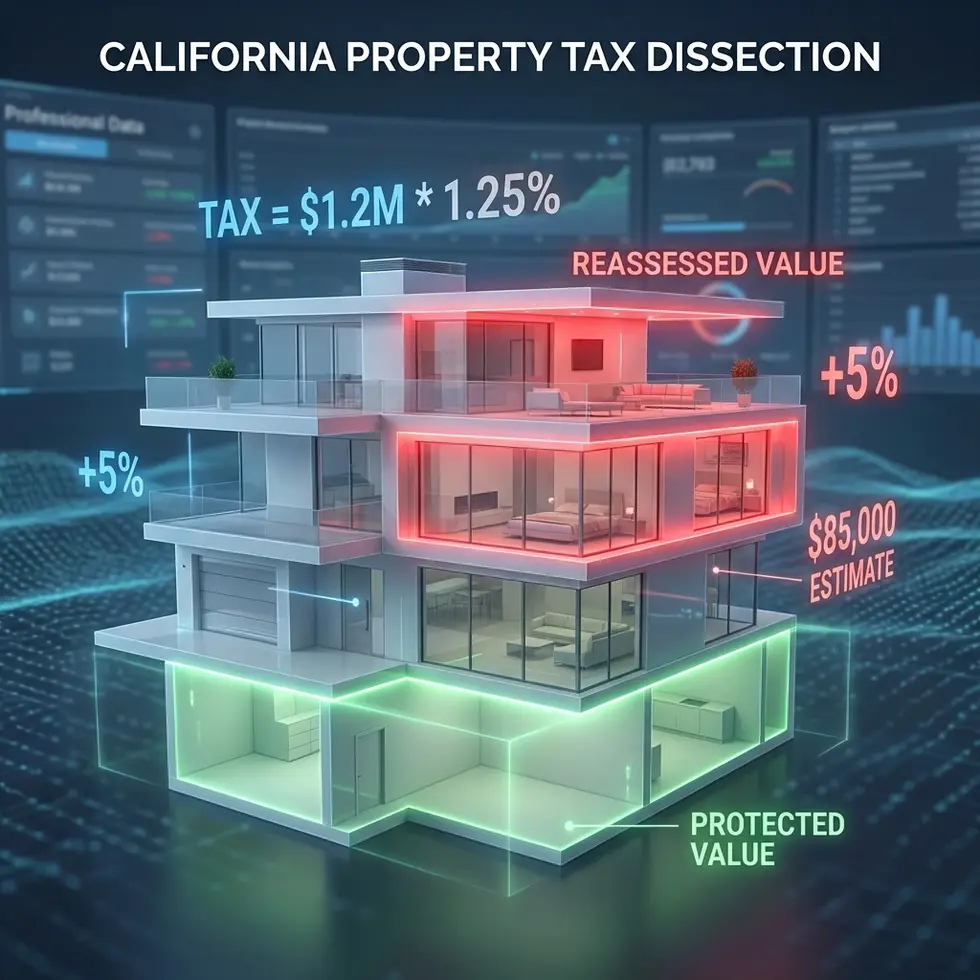
Every month families delay updating their trust structures, they face increasing Prop 19 exposure. California property values continue rising while trust documents reflect outdated assumptions about tax law and family circumstances.
The financial impact compounds: A family avoiding $50,000 in annual property tax increases through proper trust planning saves $500,000 over ten years, $1 million over twenty years. The cost of sophisticated trust updates typically ranges from $15,000-50,000, a fraction of long-term tax savings.
But timing matters critically. Trust amendments made too close to death face heightened FTB scrutiny, while changes made during periods of declining health may trigger capacity challenges that invalidate the planning.
Red Flags That Demand Immediate Attention
Your trust needs immediate professional review if:
- Last updated before 2021: Prop 19 fundamentally changed California property tax planning
- Properties held in individual names: Assets outside the trust lose planning opportunities
- Boilerplate distribution language: Generic trust provisions can't navigate Prop 19's complexities
- No entity structures: Direct property ownership maximizes tax exposure
- Uncoordinated advisors: Different professionals working without communication create planning gaps
The Path Forward: Strategic Trust Management
Successful Prop 19 planning requires ongoing trust management, not one-time document creation. This involves:
- Annual trust reviews that adapt to changing tax law and family circumstances
- Coordinated advisory teams with clear communication protocols and shared planning objectives
- Proactive asset restructuring that positions properties for optimal tax treatment before transfers occur
- Documentation systems that support planning positions during potential FTB audits
Families who treat trust planning as ongoing wealth management rather than static legal documents consistently achieve superior tax outcomes while avoiding the enforcement risks that destroy poorly managed structures.
Frequently Asked Questions
Q: Can existing trusts be amended to address Prop 19 issues?
A: Yes, most revocable trusts can be amended during the grantor's lifetime to include Prop 19 planning provisions. However, the amendments must be made while the grantor has legal capacity and should be completed well before any anticipated property transfers to avoid FTB scrutiny.
Q: How does Prop 19 affect properties held in LLCs or family partnerships?
A: Entity-held properties face different Prop 19 analysis based on ownership transfer percentages and control changes. Properly structured entities can provide more flexibility for managing Prop 19 exposure compared to direct property ownership.
Q: What happens if my trust wasn't properly funded before death?
A: Unfunded trust assets typically go through probate and lose most tax planning benefits. However, California allows certain post-death trust funding procedures that may preserve some planning opportunities if implemented quickly and correctly.
Q: Do out-of-state trusts help with California property tax issues?
A: Out-of-state trusts can provide benefits for California property ownership, but they must be structured carefully to avoid California tax jurisdiction while maintaining desired control and distribution features. This requires specialized legal and tax expertise.
Q: How often should trusts be reviewed for Prop 19 compliance?
A: Trust structures should be reviewed annually, with more frequent reviews when family circumstances change significantly (deaths, marriages, births, major asset acquisitions). California's rapidly changing tax environment makes regular professional review essential.
The window for protecting your family's California real estate from Prop 19's devastating impact is closing rapidly. Each day of delay increases your tax exposure while limiting available planning strategies.
Schedule your confidential trust review consultation today to discover how advanced trust planning can save your family hundreds of thousands in unnecessary property taxes.
Resources and Related Reading
For deeper insights into California trust taxation and property planning strategies, explore these comprehensive resources:
- The Inheritance Collapse: Why Wealthy Families Lose Everything Without Governance - Essential reading on family wealth preservation and trust governance structures that prevent multi-generational asset loss.
- Navigating Trust Amendments in California: Strategic Insights and Legal Expertise - Comprehensive guide to updating trust structures for current California tax law and family circumstances.
- Spendthrift Trust California vs Regular Trust: Which Better Protects Your $10M+ Estate - Advanced comparison of trust structures for asset protection and tax optimization in California's challenging legal environment.
- Six Secrets of How Wealthy Landowners Protect Themselves from Lawsuits - Strategic asset protection techniques for California real estate holdings and entity structuring.
California Legislative Resources:
- California Revenue and Taxation Code Section 63.1 (Proposition 19 implementation)
- California Probate Code Sections 15800-15801 (Trust administration requirements)
- California Revenue and Taxation Code Section 480 (Property tax assessment procedures)
Professional Tax Resources:
- California Franchise Tax Board Publication 1005A (Trust Tax Guidelines)
- California Board of Equalization Property Tax Rules and Regulations
- California Estate Planning, Probate and Trust Law (CEB Practice Guide)
Important Legal Disclaimer
This blog post is provided for informational purposes only and does not constitute legal advice. California trust and tax law is complex and changes frequently. Property tax planning strategies must be tailored to individual circumstances and implemented with qualified legal and tax professionals. The Law Office of James Burns does not guarantee specific tax outcomes and recommends comprehensive professional analysis before implementing any strategies discussed in this post.
Intellectual Property Notice
This content is proprietary to the Law Office of James Burns and is protected by copyright law. Reproduction or distribution without express written permission is prohibited. The strategies and insights presented reflect the firm's specialized expertise in California trust taxation and wealth preservation planning.
Sources Used:
- California Revenue and Taxation Code Section 63.1 (Proposition 19)
- California Probate Code Trust Administration Provisions
- California Franchise Tax Board Trust Taxation Guidelines
- California Board of Equalization Property Tax Assessment Rules
- California Estate Planning and Probate Law Resources

Comments
There are no comments for this post. Be the first and Add your Comment below.
Leave a Comment