

The Evolution of Wealth Defense
Estate planning isn't a "set it and forget it" task. It's a dynamic defense strategy that must grow as your balance sheet does. If you're still relying on a document you signed ten years ago when your net worth was half of what it is today, your "fortress" likely has a wide-open front door.
In California, the stakes are higher than almost anywhere else. Between the high cost of real estate, aggressive tax authorities, and a probate system that moves at the speed of a glacier, "basic paperwork" is often worse than no paperwork at all because it gives a false sense of security.
Level 1: The Basic Paperwork Trap
Many families start with a Simple Will. While a will is better than dying "intestate" (without a plan), in California, a will is essentially a ticket to probate court.
Under California Probate Code § 10800, attorney and executor fees are set by statute based on the gross value of the estate. If you own a $2M home in Los Angeles with a $1.5M mortgage, the court calculates fees based on the $2M value, not your $500k equity. That's tens of thousands of dollars leaving your family's pockets before they see a dime.
Foundational Requirements:
- Pour-Over Will: Acts as a safety net for assets not titled in your trust.
- Durable Power of Attorney: Appoints someone to handle your finances if you're incapacitated.
- Advance Health Care Directive: Ensures your medical wishes are followed.

Level 2: The Tactical Living Trust (Probate Avoidance)
The first real step toward a Wealth Fortress is the Revocable Living Trust. This is the cornerstone of avoiding probate friction. When you fund a trust, you technically "own nothing but control everything."
By moving your California real estate and accounts into a trust, you bypass the court entirely. Distribution happens privately, quickly, and without the mandatory statutory fees. However, a living trust is only as good as its funding. If you forget to retitle that new brokerage account, you're back in court.
Level 3: The Wealth Fortress ($15M+ Estates)
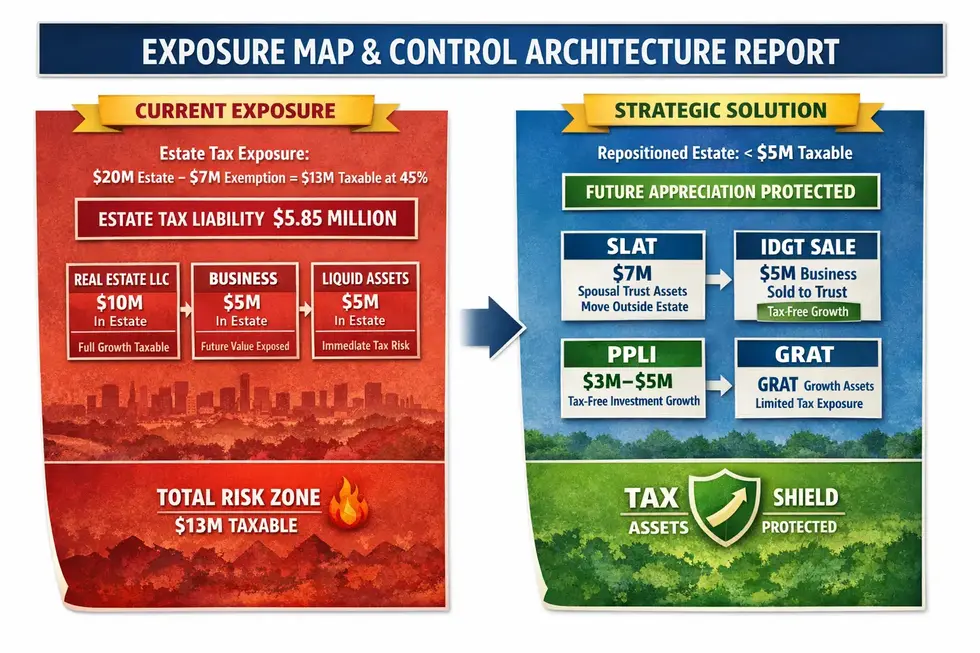
For high-net-worth individuals (HNWIs), a standard living trust isn't enough. With the potential 2026 estate tax reset, the federal exemption is set to drop significantly. If your estate is $15M or more, you are looking at a 40% tax on every dollar over the exemption limit.
A Wealth Fortress utilizes advanced "Wealth Defense" strategies:
- Irrevocable Trusts (SLATs & IDGTs): Moving future appreciation out of your taxable estate now.
- Asset Protection Structures: Using entities like the CPRP Shield to move surplus profits into lawsuit-proof vaults.
- Global Portfolio Neutrality: For the truly elite, integrating structures like the Bermuda-California Corridor allows for global portfolio tax neutrality.
Note on PPLI (Private Placement Life Insurance): For jurisdictions like Bermuda, there is no broadly defensible "one-step" method for a U.S. person to contribute appreciated assets as in-kind premium and guarantee "no gain." The safest approach is to keep appreciated assets outside the policy, monetize them with a loan, pay a cash premium, and use the policy account under strict investor-control and diversification rules to acquire exposure.
Case Study: The Two-Year Probate Disaster vs. The Tactical Success
A family in Newport Beach recently came to us after the patriarch passed away. He had a "Simple Will" prepared by a general practice attorney in the 90s. Despite having a clear plan on paper, the $8M estate: mostly comprised of Orange County real estate: was forced into probate. It took 26 months to settle, cost over $180,000 in statutory fees, and the family had to sell one property just to cover the taxes and legal costs.
Contrast this with another client who implemented a tactical trust structure and a Wealth Fortress strategy. When the principal passed, the successor trustee took control within 48 hours. There was zero court involvement, zero public record of the assets, and the family saved nearly $400k in unnecessary costs.
Tactical Legal Shield & Disclaimer
The information provided in this article is for educational and informational purposes only and does not constitute legal advice. No attorney-client relationship is formed by reading this content. Estate planning and tax laws are subject to change, especially with the upcoming 2026 sunset provisions. Always consult with a qualified legal professional regarding your specific situation.
IP Disclosure
This blog post references proprietary frameworks developed by the Law Office of James Burns, including the Legacy Protection Trust™, FortressWall™, and the CPRP Shield™. These methodologies represent a unique synthesis of California law and high-level asset protection strategies.
Tactical FAQ
1. Does a Will avoid probate in California?
No. In California, a will is a roadmap for the probate court. If your estate exceeds $184,500 in value, it likely must go through probate unless those assets are held in a trust or have specific beneficiary designations.
2. What is the "Wealth Fortress" approach?
The Wealth Fortress approach moves beyond mere distribution. it focuses on Wealth Defense, utilizing irrevocable structures, jurisdictional arbitrage, and tax optimization to protect estates from the 40% federal "death tax" and predatory litigation.
3. How does the 2026 tax reset affect me?
Currently, the estate tax exemption is at record highs (over $13M per individual). In 2026, this is scheduled to "sunset" back to approximately $7M (adjusted for inflation). If your estate is currently worth $10M+, you have a massive bullseye on your back that requires immediate tactical planning. Read more about the 3.5M estate tax reset here.
4. Can I move my business profits into an asset-protection structure?
Yes. Using the CPRP Shield, business owners can often move surplus profits into a protected vault that is shielded from business-related lawsuits and creditors.
5. Why is a Living Trust better than a Will?
Privacy and speed. A trust is a private contract. A will is a public document filed in court. A trust allows for immediate management if you become incapacitated; a will only "speaks" after you die.
Secure Your Legacy
Don't wait for a crisis to find out your paperwork is insufficient. Build your fortress now.
Book Your Estate Planning Strategy Meeting Here
Resources and Sources List
- California Probate Code § 10800-10805: Statutory Compensation for Attorney and Representative.
- Internal Revenue Code (IRC) § 2031-2046: Federal Estate Tax Regulations.
- IRS Bulletin on 2026 Sunset Provisions: Tax Cuts and Jobs Act (TCJA) impact on wealth transfer.
- California Probate Code § 16000-16015: Duties of Trustees.
- Estate of Heggstad (1993) 16 Cal.App.4th 943: Regarding trust funding and "Heggstad Petitions."
- Law Office of James Burns - Service Page: What Actually is Probate?
- Tax Optimization Dossier: PPLI and the Value Exceeding Cost
Legal Disclaimer
This article is for educational purposes only. It is not legal advice, tax advice, or investment advice, and reading it does not create an attorney-client relationship with the Law Office of James Burns. Estate planning, asset protection, and tax optimization strategies are intensely fact-specific. Small drafting errors, missing beneficiary updates, or improperly funded trusts can create expensive problems for families with substantial wealth. Get your plan reviewed before you assume you're covered.
IP Disclosure
This article references proprietary frameworks and naming conventions used by the Law Office of James Burns, including Legacy Protection Trust™, FortressWall™, CPRP Shield™, and Wealth Fortress planning architecture. These frameworks reflect James Burns's strategic approach to #WealthDefense, #TaxOptimization, and #AssetProtection for high-net-worth families and business owners.

Comments
There are no comments for this post. Be the first and Add your Comment below.
Leave a Comment