

The Home Improvement Trap
Let's be honest about what happens when most people decide they need an estate plan.
They Google "estate planning attorney near me." They call a few offices. They ask about prices. They compare.
Sound familiar? It should. It's exactly how you'd approach getting your bathroom remodeled or your roof replaced.
Here's the problem: estate planning isn't a commodity. Treating it like one is the single most expensive mistake high-net-worth families make: and they usually don't realize it until it's too late.
When someone says, "I want to talk to a few lawyers first," they think they're being smart. They believe they're comparing products, reducing risk, and avoiding being overcharged.
But what's actually happening? They're responding to uncertainty and a fear of being taken advantage of.
This behavior only shows up when three conditions exist:
- The service looks like a commodity
- The outcome feels abstract or delayed
- The buyer can't tell the difference between providers
Estate planning, as traditionally marketed, checks all three boxes. And that's a problem: because the stakes couldn't be higher.

Why Price-Shopping Creates False Security
When you shop based on cost, you typically end up with one of two things: a DIY online document or a basic will from a volume-focused firm.
Both create the illusion of protection while leaving your family exposed.
A basic will doesn't prevent your assets from going through probate. It doesn't protect against creditor claims. It offers zero tax advantages. And it definitely doesn't address what happens if you become incapacitated, if your children divorce, or if your family business needs succession planning.
The "savings" from choosing the cheapest option evaporate when your family faces:
- Costly probate proceedings that drag on for years
- Unintended distribution imbalances that spark litigation
- Ambiguous instructions that pit siblings against each other
- Tax exposure that could have been legally minimized
According to estate planning research, budget-focused plans routinely omit critical protections: proper trust structures, asset categorization strategies, conflict analysis, and: most importantly: the ongoing management that keeps plans effective as laws and lives change.
The Commodity Illusion
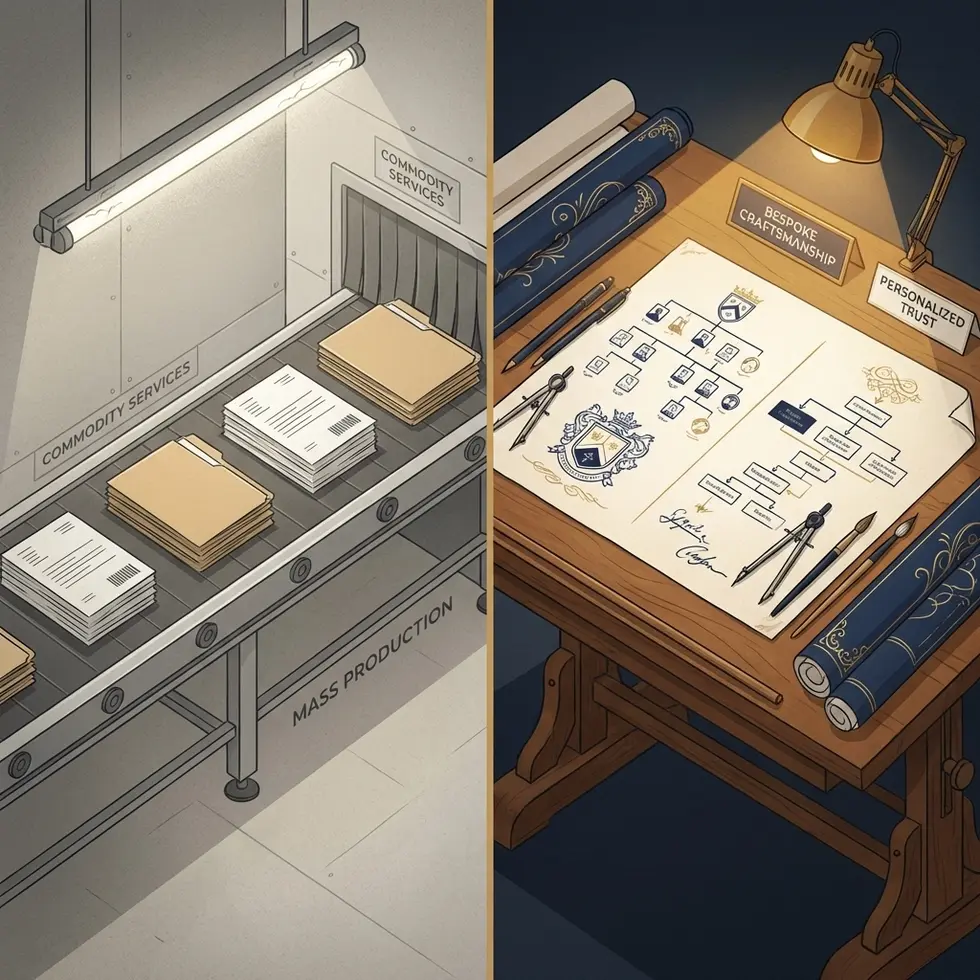
Here's what most people don't understand: the documents aren't the product.
When estate planning is marketed like a product: "Get your trust for $X": it trains consumers to think they're buying a thing. A deliverable. Something they can hold in their hands and check off their list.
But documents are just paper. What you're actually buying (or should be buying) is judgment.
The judgment to know which structure fits your specific situation. The judgment to anticipate problems you haven't thought of. The judgment to build something that adapts as your life changes.
You can't comparison-shop judgment. You can't get three quotes on wisdom.
This is why families with significant assets: those who understand what's actually at stake: don't shop for estate planning the way they shop for contractors. They recognize that the last advantage the wealthy still control isn't a document. It's architecture.
What "Getting Multiple Quotes" Actually Signals
When a prospective client tells me they're "talking to a few lawyers first," I understand what's really happening.
They're uncertain. They don't know what questions to ask. They can't evaluate what they're being told. And they're trying to create some sense of control in a situation where they feel vulnerable.
That's completely human. But it's also a sign that the traditional estate planning industry has failed them.
Because here's the truth: if you can't tell the difference between providers, you're probably being offered commodity services. And commodity services don't protect complex families.
The attorney who quotes you $1,500 for a "basic estate plan" isn't offering the same thing as the attorney who wants to understand your family dynamics, your business structure, your tax situation, and your long-term goals before discussing price.
They're not even in the same category: even though, on the surface, both might say they do "estate planning."
What Actually Protects Your Family
Real protection requires three elements that price-shopping will never reveal:
1. Personalization
Your estate plan should start with your actual situation: not a template. What are your assets? What are your family dynamics? What keeps you up at night? A professional plan addresses realistic scenarios based on your life, not generic what-ifs.
2. Professional Judgment
Tax strategies, trust structures, asset protection, family governance: these aren't checkboxes. They're decisions that require deep expertise and the ability to see around corners. The right structure for a tech founder with concentrated stock is completely different from what a real estate investor needs.
3. Ongoing Management
Life changes. Laws change. A plan that worked five years ago might be counterproductive today. Professional estate planning includes guidance on when and how to update documents, ensuring your wishes remain aligned with current law and personal circumstances.

The Real Question You Should Be Asking
Instead of "How much do you charge for a trust?": which is like asking "How much for a surgery?" without mentioning what's wrong: try this:
"How will you determine what my family actually needs?"
The answer to that question tells you everything. An attorney focused on volume will give you a vague response about "reviewing your situation." An attorney focused on outcomes will describe a process: discovery, analysis, design, implementation, and maintenance.
The latter costs more upfront. It saves exponentially more over time.
For families with complex assets, business interests, or multi-generational wealth transfer goals, the difference between commodity estate planning and bespoke legacy architecture isn't marginal. It's the difference between a plan that works and a plan that fails when your family needs it most.
Breaking Out of the Commodity Trap
If you've been approaching estate planning like a home improvement project, you're not alone. The industry has trained consumers to think this way.
But you can break out of it.
Stop asking about price first. Start asking about process. Look for attorneys who want to understand your situation before quoting fees. Be suspicious of anyone who offers a flat rate without knowing anything about you.
And recognize that the discomfort you feel: the uncertainty, the fear of making the wrong choice: is exactly why you need guidance, not just documents.
Frequently Asked Questions
Why shouldn't I compare estate planning quotes like other services?
Estate planning isn't a standardized product. The "same" documents from different attorneys can have vastly different quality and effectiveness based on how well they're tailored to your situation. Price comparison only works when you're comparing identical items.
What's wrong with DIY estate planning for high-net-worth families?
DIY tools use generic templates that miss critical protections: tax strategies, proper trust structures, asset categorization, and conflict analysis. For families with significant assets, these omissions can cost far more than professional planning would have.
How do I know if an estate planning attorney offers commodity services?
Red flags include: quoting prices before understanding your situation, offering "packages" without customization, and focusing primarily on documents rather than outcomes and ongoing management.
What should I look for in an estate planning attorney?
Look for a defined discovery process, questions about your family dynamics and goals (not just assets), discussion of ongoing maintenance, and a willingness to explain why certain structures fit your situation.
How often should estate plans be updated?
At minimum, review your plan every 3-5 years or after major life events: marriage, divorce, births, deaths, significant asset changes, or business transitions. Laws change too: your plan should evolve with them.
Ready to Move Beyond Commodity Planning?
If you're a California family with significant assets and you're ready to stop shopping and start building real protection, schedule a consultation with James Burns to discuss what legacy architecture looks like for your specific situation.
Further Reading & Authoritative Sources
- Creative Planning – Costly Estate Planning Mistakes: Explains common errors that can undermine even well-intentioned estate plans, especially when cost-cutting or quick solutions are prioritized.
- Kiplinger – Everyone Needs an Estate Plan, Even You: Highlights why thorough estate planning is essential for everyone, not just the ultra-wealthy, and the risks of delaying or minimizing the process.
- YouTube: Why Estate Plan Shopping Doesn't Work: Short video discussion about the problems families face when they shop for estate planning based on cost and quick comparisons.
Disclaimer: This article provides general information and does not constitute legal advice. Estate planning outcomes depend on individual circumstances. Consult a qualified attorney for guidance specific to your situation.
IP Disclosure: © Law Office of James Burns. All rights reserved.
Sources Used: Estate planning industry research on DIY planning risks, probate statistics, and comprehensive planning frameworks.

Comments
There are no comments for this post. Be the first and Add your Comment below.
Leave a Comment