MISSION BRIEFING: THE SILENT THREAT OF SAFETY
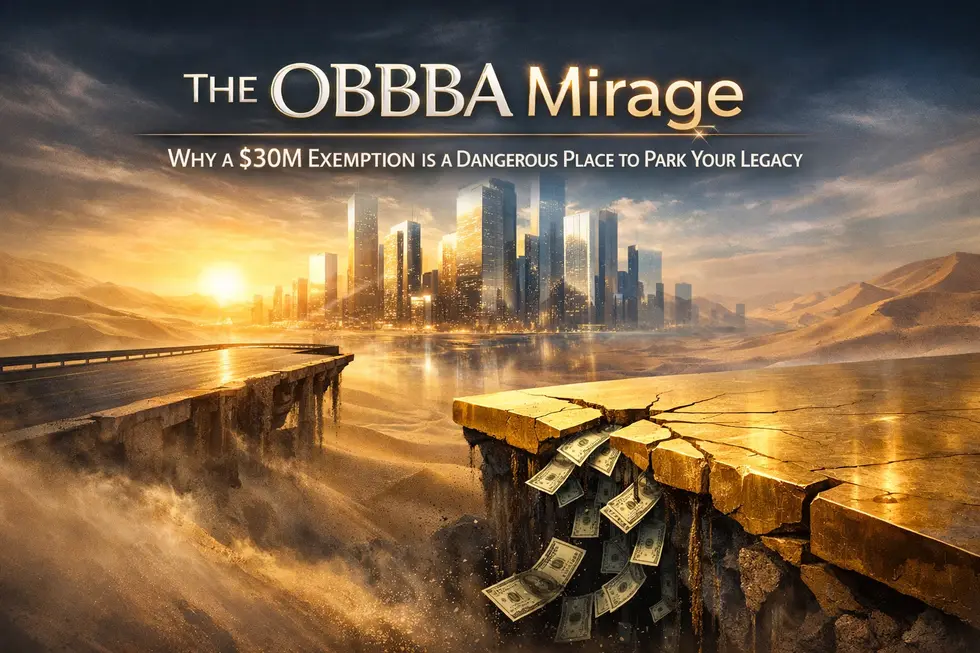
For years, the "2026 Sunset" was the bogeyman of the estate planning world. We all sat on the edge of our seats, waiting for the Tax Cuts and Jobs Act (TCJA) exemptions to drop off a cliff, potentially slashing your ability to pass down wealth by half. Then came July 2025. The One Big Beautiful Bill Act (OBBBA) arrived like a rescue helicopter, making the high exemptions permanent and effectively killing the "Tax Cliff" forever.
Today, on March 14, 2026, the federal exemption sits at a staggering $15 million for individuals and $30 million for married couples. For many UHNW families, the panic has been replaced by a deep, comfortable sigh of relief.
That sigh of relief is exactly what the tax man is counting on.
The OBBBA didn't eliminate the need for California family legacy planning; it just changed the battlefield. The greatest threat to your wealth in 2026 isn't a federal tax hike, it's planning complacency. When you feel safe under a $30 million umbrella, you stop looking at the leaks in the roof.
In this briefing, we're deconstructing the "OBBBA Mirage" and why parking your legacy in a "simple" plan just because you're under the federal limit is a high-stakes gamble you're likely to lose.
The OBBBA: What Actually Happened?
The OBBBA was the legislative equivalent of a "get out of jail free" card for federal estate taxes. By making the $15M/$30M limits permanent (and indexed for inflation), it removed the immediate "use it or lose it" pressure that drove massive gifting strategies in 2024 and 2025.
But here's the kicker: the federal government is only one player at the table. While the IRS might be backing off, other predators are circling. If you've hit the "pause" button on your multi-generational wealth transfer because you think you're "safe," you're ignoring three critical realities: state-level aggression, the basis trap, and the volatility of the law.
1. The Sacramento Shadow: State-Level Estate Taxes
The federal government may have raised the white flag with the OBBBA, but California is looking at a massive budget deficit. There has been persistent chatter in Sacramento about a state-level estate or wealth tax. Even without a formal "death tax," the Franchise Tax Board (FTB) is becoming increasingly creative in how they classify income and audits.
If you rely solely on federal exemptions, you're leaving your flank exposed to state-level maneuvers that don't care about the OBBBA. Proper family trust structures aren't just about avoiding the IRS; they are about creating a jurisdictional shield against state-level overreach.
2. The Basis Trap: Why 0% Tax Can Still Cost You Millions
This is where most families get tripped up. Let's say you have $25 million. Under the OBBBA, you owe $0 in federal estate tax. Great, right?
So, you decide to keep everything in your own name or a simple revocable trust. But what about the Step-Up in Basis? Under Internal Revenue Code § 1014, your heirs get a "step-up" to fair market value upon your death, potentially saving them millions in capital gains taxes when they sell the family business or real estate.
However, if you don't structure your legacy with precision, especially if you're using older, "clunky" irrevocable trusts designed for the pre-OBBBA era, you might actually be trapping assets at a low basis. We see this all the time: families who "won" the estate tax game but "lost" the capital gains game, handing over 20-30% of their wealth to the government anyway because their family governance was focused on the wrong tax.
3. The "Permanent" Myth
In Washington D.C., "permanent" is a word used by people who haven't checked the polls lately. The OBBBA is the law of the land today, but a change in the White House or a shift in Congress in the next election cycle could see it repealed or "reformed" in a weekend.
Building a legacy based on the current political mood is like building a house on a sandbar. You need a structure that is adaptable, using "kill switches," Trust Protectors, and decanting provisions, so you can pivot when the OBBBA is inevitably replaced by the "Next Big Bill."

Beyond Taxes: The Real Purpose of a Trust
If the federal estate tax is no longer the primary "monster under the bed" for those under $30 million, why bother with advanced family trust structures?
Because taxes were never the only threat.
- Asset Protection: A simple "I love you" will or a basic revocable trust offers exactly zero protection against a predatory lawsuit or a disgruntled creditor. If your daughter inherits $5 million directly and then gets sued or goes through a divorce, that money is on the table.
- Privacy: Without a robust trust structure, your family's private business becomes a matter of public record in the California Probate Court.
- Spendthrift Controls: Let's be honest, not every heir is ready for a multi-million dollar windfall at age 25. Advanced planning allows you to release wealth in stages, ensuring the legacy lasts for generations rather than being spent on a "Mid-life Crisis World Tour."
Tactical Scenario: The "Safe" $20M Estate
Imagine the Miller family. They have $20 million in real estate and tech stock. In late 2025, their CPA told them, "Don't worry about the OBBBA; you're under the $30M limit. You don't need that complicated trust stuff."
Fast forward to 2028:
- The Lawsuit: Mr. Miller is involved in a multi-car accident. The judgment exceeds his insurance. Because his assets were in a simple revocable trust (which provides no asset protection), his "safe" $20M is now $12M.
- The Divorce: Their son, who inherited a portion of the estate, goes through a messy divorce. Since the inheritance wasn't protected in a legacy trust, his ex-spouse walks away with a massive chunk of the Miller family's hard-earned wealth.
- The State Hit: Sacramento passes a "Wealth Contribution Fee" on estates over $10M. The Millers have no structures in place to mitigate this "non-tax" tax.
The Millers didn't lose their wealth to the federal estate tax. They lost it to complacency.
MISSION OBJECTIVE: ACTION PLAN
Don't let the OBBBA's high limits lull you into a false sense of security. Wealth defense is about more than just checking a box on a tax return.
- Audit Your Current Plan: Is it a "tax-only" plan? If so, it's obsolete.
- Optimize for Basis: Ensure your structure allows for the maximum step-up in basis to protect against future capital gains.
- Build a Fortress: Move beyond simple probate avoidance and into true asset protection and family governance.
The Mirage is beautiful, but the desert is still dangerous.
If you're ready to move past "simple" and start building a legacy that can survive Sacramento, lawsuits, and the next flip-flop in D.C., let's talk.
Schedule your Wealth Defense Audit here.
FAQ: The OBBBA and Your Legacy
Q: Does the OBBBA mean I don't need a trust if I have less than $15 million?
A: Absolutely not. A trust is about control, privacy, and protection. Even if you owe $0 in taxes, a trust keeps you out of probate court and protects your heirs from creditors and divorce.
Q: What is the "Basis Trap"?
A: It's when you focus so much on avoiding estate taxes that you accidentally trigger massive capital gains taxes for your heirs. Proper planning ensures they get a "step-up" in basis, effectively erasing the tax on the growth of your assets during your lifetime.
Q: Can the OBBBA be repealed?
A: Yes. Any act of Congress can be changed by a future Congress. "Permanent" in the tax code usually lasts until the next budget crisis.
Q: Is there a California Estate Tax?
A: Currently, no. However, there are frequent legislative proposals (like the "Billionaire Tax" and various wealth tax bills) that aim to claw back wealth at the state level.
Resources & Technical References
- Internal Revenue Code § 1014: Basis of Property Acquired from a Decedent
- OBBBA (One Big Beautiful Bill Act) Summary: Legislative Tracker (July 2025 Revision)
- California Probate Code § 15000-19530: Trust Law Guidelines
- IRS Publication 559: Survivors, Executors, and Administrators
Disclaimer and IP Disclosure:
This blog post provides general information and a casual discussion about legal and tax topics. It does not constitute legal, tax, or financial advice. The "OBBBA" and dates mentioned are part of a hypothetical 2026 scenario for illustrative purposes. Estate laws vary by state and are subject to change. Always consult with a qualified attorney at the Law Office of James Burns or your own tax professional before making any decisions regarding your estate plan. All content is the intellectual property of the Law Office of James Burns.
Ready to secure your legacy?
Book your session with James Burns today.

Comments
There are no comments for this post. Be the first and Add your Comment below.
Leave a Comment