
Mission Brief: The $300 Illusion
You paid $300 to file your California LLC. You think you're protected. Your personal assets are "separate" from your business liabilities. You sleep well at night.
You're carrying a paper shield into a knife fight.
The dirty secret of the asset protection industry is this: a "bare" LLC, the kind you set up online in 20 minutes, offers roughly the same protection as writing "Please Don't Sue Me" on your front door. It's compliance theater. It's a checkbox. And in California, it's borderline malpractice to rely on it alone.
This isn't about scaring you. It's about Risk Exposure Mapping versus "Dime Store" compliance. Let's dismantle the myth, show you where California courts tear these structures apart, and rebuild the architecture that actually works.
The Asset Protection Myth: How the Industry Sold You a Half-Truth
Here's the pitch you've heard a thousand times:
> "Form an LLC. Separate your personal assets from business liabilities. You're protected."
It sounds clean. It sounds legal. And it's technically true, in a vacuum, under perfect conditions, with zero operational mistakes.
The problem? You don't operate in a vacuum. You operate in California, where courts are notoriously creditor-friendly, and judges have spent the last 15 years systematically dismantling the legal theory that makes LLCs attractive in the first place.
The cornerstone of LLC asset protection is something called Charging Order Protection. The idea is simple: if you get sued, a creditor can't seize your LLC membership interest or liquidate the LLC. They can only get a "charging order", the right to receive distributions if and when you choose to make them.
Sounds great, right?
Except California courts don't care.

The California Exception: Why Your State is the Worst Place to Rely on a Bare LLC
Case Study #1: Hellman v. Anderson (2010) + Corp. Code § 17705.03 (Foreclosure)
In 2010, the California Court of Appeal torpedoed the entire charging order mythology. In Hellman v. Anderson, the court held that creditors can foreclose on LLC membership interests, not just sit around waiting for distributions.[1]
Translation: if you get sued and lose, the creditor doesn't just get a “pay me if you feel like it” order. Under California Corporations Code § 17705.03, if a charging order won't satisfy the judgment, a court can authorize foreclosure of the membership interest—meaning the creditor can force a sale of the LLC interest. They can end up owning what you thought you “protected.”
This wasn't a fluke. It was a direct rejection of the asset protection industry's core sales pitch. In other words, the “wall” between your personal liability and your LLC? In California, it can be paper-thin.
Mission Add-On: Investment Properties (Where People Get Hurt First)
If you're using an LLC mainly to hold rental real estate (single-family rentals, small multifamily, short-term rentals, or commercial), this foreclosure point matters even more.
Here's why investment property LLCs are a magnet for two different threat types:
- Inside liability (property risk): tenant injuries, habitability claims, contractor disputes, premises liability.
- Outside liability (owner risk): a personal lawsuit (car accident, professional liability, business claim) where the creditor targets your ownership interests.
A “bare” LLC doesn't fix outside liability in California if foreclosure is on the table. And if the creditor forecloses on your LLC interest, you can lose control of the entity that holds the building—at exactly the wrong time.
If this sounds like the stuff those $699 “asset protection seminars” conveniently skip, that's because it is. (Related reading: #24: The ‘Simple Plan' Lie and The $699 Seminar Scam.)
Case Study #2: In re Albright – The Single-Member LLC Massacre
Here's where it gets worse. Most small business owners don't have partners. They form single-member LLCs, one owner, one entity.
In In re Albright, a U.S. Bankruptcy Court ruled that single-member LLCs receive zero charging order protection because there are no innocent co-members to protect.[1] The legal justification for charging orders, shielding non-debtor partners from interference, doesn't apply when you're the only member.
Result: The bankruptcy trustee seized the debtor's entire interest in the single-member LLC, liquidated the assets, and paid the creditors. No hearing. No negotiation. Total capitulation.
If you're sitting on a California single-member LLC right now, you're holding a liability, not an asset.
The 'Piercing the Veil' Problem: Why Courts Ignore Your LLC Entirely
Even if you dodge the charging order problem, you still have to survive the Piercing the Corporate Veil test. This is where courts decide your LLC is a sham and hold you personally liable for business debts.
Reverse Veil Piercing: The Single-Member LLC Problem Nobody Advertises (Curci Investments, LLC v. Baldwin)
Traditional veil piercing is “plaintiff reaches through the LLC to get to you.”
Reverse veil piercing is the opposite: a creditor reaches through you to grab assets sitting inside your LLC.
California courts have recognized this risk in the single-member context. In Curci Investments, LLC v. Baldwin, the court allowed a judgment creditor to pursue outside reverse veil piercing against an LLC that was effectively treated like the debtor's personal piggy bank.[2]
Practical takeaway: if you own a single-member LLC (especially one holding valuable assets) and you run it casually—commingling funds, paying personal expenses, treating the LLC as “just me”—you're building a paper trail that invites a creditor to argue the LLC should be treated as your alter ego.
If you want the covert-ops version of “owning nothing, controlling everything,” read: ShadowOps Wealth Protection.
California courts pierce the veil when:
- You commingle funds – Using the LLC account to pay personal expenses or vice versa.
- You undercapitalize the entity – Starting an LLC with $100 in the bank and exposing it to $1M in liabilities.
- You ignore formalities – No operating agreement, no meeting minutes, no resolutions, no separation between "you" and "the business."
- You commit fraud – Using the LLC to hide assets, evade taxes, or perpetrate a scam.
The threshold is lower than you think. One year of sloppy bookkeeping can undo the entire structure.
Out-of-State LLCs: The Nevada Fantasy
Every few months, someone tries to pitch this:
> "Form your LLC in Nevada (or Wyoming or Delaware). Those states have better asset protection laws."
It doesn't work.
If you're a California resident doing business in California, California law applies. Period. You can file your LLC in Timbuktu, and California courts will still apply California statutes and California case law when you get sued.
The only thing you accomplish by forming an out-of-state LLC is:
- Paying two sets of filing fees (California + the foreign state).
- Registering as a foreign LLC in California anyway.
- Confusing your accountant.
California Corporations Code § 17708.03 explicitly requires out-of-state LLCs doing business here to register and comply with California law. There's no escape hatch.
And don't even think about Series LLCs, California doesn't recognize them under Revenue and Taxation Code § 23038.3. They're DOA.
The Fortress Architecture: What Actually Works
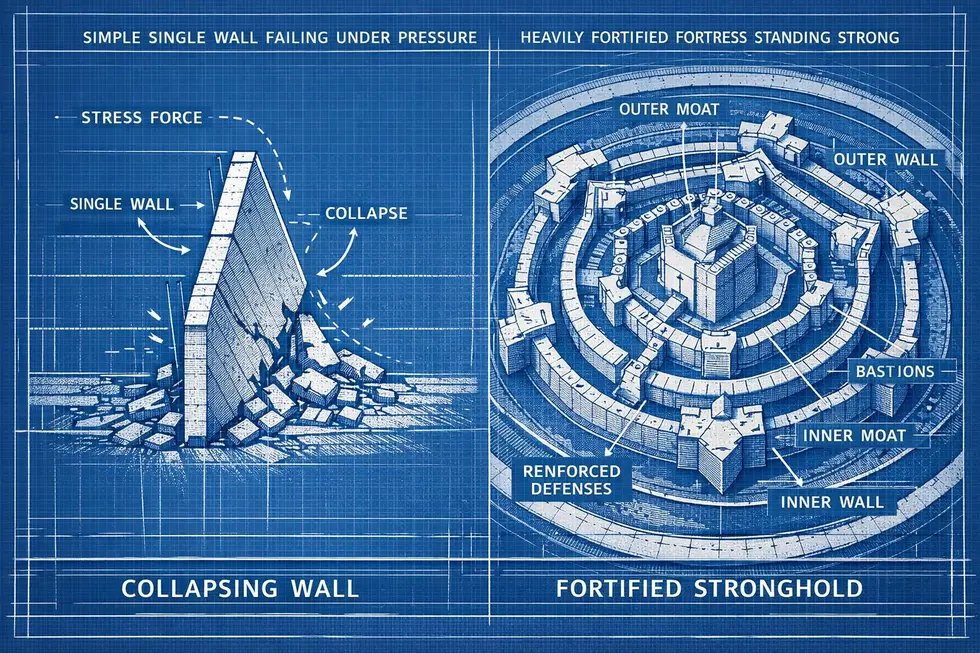
Here's the uncomfortable truth: a single LLC is not an asset protection strategy. It's a starting point. The real work begins when you architect a multi-layered structure designed to survive creditor attacks, litigation, and California's uniquely hostile legal environment.
Layer 1: Entity Segregation
Never hold multiple asset classes in one LLC. Each property, each business line, each high-risk venture gets its own isolated entity. If one fails, the others remain untouchable.
Example:
- LLC #1: Rental Property A
- LLC #2: Rental Property B
- LLC #3: Operating Business
- LLC #4: Equipment/IP Holding Company
This isn't paranoia. It's containment architecture. One lawsuit, one fire, one tenant injury, isolated to a single entity.
Layer 2: Manager-Managed Structure
Convert your member-managed LLC to a manager-managed LLC, and appoint a separate entity (or trust) as the manager. This creates a firewall between ownership and control.
If a creditor gets a charging order against you personally, they receive distributions, but they don't get voting rights or management authority. They're a silent passenger, not a decision-maker.
Layer 3: Integration with Irrevocable Trusts
Here's where the ShadowOps architecture becomes critical. You don't own the LLC directly. An irrevocable trust owns the LLC.
If someone sues you, they can't reach what you don't own. The trust is the legal owner. You're just the beneficiary, or better yet, the advisor to an independent trustee who makes all final decisions.
This is the structure courts can't pierce, because there's no "you" to attack. The asset exists in a separate legal universe.
For the bigger picture on how we build these structures for high-net-worth families, start here:
Layer 4: Governance as Ammunition
This is where most people fail. They build the structure, then ignore the formalities. Fatal mistake.
You need:
- Annual meeting minutes (even if it's just you).
- Resolutions for major decisions (property purchases, loans, distributions).
- Separate bank accounts (zero commingling).
- Arms-length transactions (no sweetheart deals between your entities).
These aren't paperwork. They're litigation defense. When a creditor tries to pierce the veil, you produce a three-ring binder of meeting minutes, resolutions, and clean financial records. The case falls apart.

The Insurance Layer: Your First Line of Defense
Before you even think about LLCs or trusts, you need insurance. Umbrella policies, professional liability, commercial general liability, errors and omissions, stacked deep.
Why? Because insurance companies have lawyers on retainer. If someone sues you, the carrier defends the case and pays the settlement. You never touch your assets.
LLCs and trusts are the second line of defense, not the first. Insurance is cheaper, faster, and more effective in 90% of litigation scenarios.
Bare LLC vs. Fortress Architecture: The Contrast
|
Bare LLC |
Fortress Architecture |
||
|---|---|---|---|
|
Single-member, member-managed |
Multi-entity, manager-managed |
||
|
Personal ownership |
Trust ownership |
||
|
No operating agreement |
Detailed operating agreement + governance docs |
||
|
Commingled accounts |
Strict financial separation |
||
|
Zero meeting minutes |
Annual minutes + resolutions |
||
|
No insurance |
Deep insurance stack |
||
|
Result: Paper shield |
Result: Litigation-resistant fortress |
||
|
|
|
The bare LLC costs $300. The fortress costs $15K–$50K to build, depending on complexity.
But the bare LLC fails the first time it's tested. The fortress withstands years of creditor attacks, audits, and litigation.
FAQ: The LLC Asset Protection Reality Check
Q: Can I convert my existing single-member LLC into a multi-member LLC for better protection?
Yes, but the conversion needs to be legitimate. Adding your spouse or a family trust as a co-member can improve the argument for charging order limits, but only if the transaction is properly documented and the new member has a real economic interest. Courts scrutinize retroactive planning, so do this before creditor issues arise.
Q: I hold investment properties in an LLC—am I safe?
You're safer from inside liability (property-related claims) if the LLC is properly run and properly insured. But a California “bare LLC” can still be weak against outside liability (a personal creditor attacking your LLC interest). Under Corp. Code § 17705.03 and cases like Hellman v. Anderson, foreclosure can be on the table if a charging order won't satisfy the judgment.
The real play is usually: one-property-per-entity (or smart segmentation), strong insurance, clean books, and ownership/control designed to be hard to disrupt.
Q: What's the “reverse veil piercing” threat for single-member LLCs?
It's when a creditor tries to reach into your LLC because the LLC is basically you in disguise. In Curci Investments, LLC v. Baldwin, the court allowed a creditor to pursue outside reverse veil piercing in a situation where the LLC functioned like the debtor's alter ego. If you treat the LLC like your personal wallet, you're handing the creditor the argument.
Q: What if my spouse and I “own the LLC together”—does that create extra risk? (Community property trap)
It can. California community property rules can turn “my membership interest” into “our membership interest” depending on how it was funded/titled and what happened during the marriage. In In re Brace, the California Supreme Court reinforced that property acquired during marriage is presumed community property unless that presumption is properly rebutted.[3]
Translation: if spouses casually fund an LLC with marital earnings and don't paper the characterization correctly, you may have community property exposure you didn't plan for—especially in creditor, divorce, or bankruptcy contexts. This is where coordinated estate planning + asset protection matters, not just entity filing.
Want the “don't get sold the simple plan” version? Read #24: The ‘Simple Plan' Lie and The $699 Seminar Scam.
Q: What if I already have a judgment against me: can I still move assets into an LLC?
No. Transferring assets after a lawsuit is filed or a judgment is entered is a fraudulent conveyance under California Civil Code § 3439.04. Courts will reverse the transfer and impose sanctions. Asset protection planning must happen before the threat appears.
Q: Do I need a separate LLC for each rental property, or can I hold multiple properties in one entity?
One property per LLC is the gold standard. If you hold three rentals in one LLC and a tenant sues over Property A, the creditor can reach the equity in Properties B and C to satisfy the judgment. Segregation = protection.
Q: Can I use a Nevada or Delaware LLC if I live in California but do business in other states?
Only if the business operations genuinely occur in the other state. If you're a California resident managing a California-based business, California law applies regardless of where you filed. The exception is if you own out-of-state property: then a local LLC in that state makes sense, often owned by a California trust or holding company.
Q: How often do I need to update meeting minutes and resolutions?
At least annually, and anytime you make a significant decision (property purchase, loan, major distribution). The goal is to create a paper trail proving the LLC operates as a separate legal entity, not an extension of your personal finances.
Final Intel: The Fortress Isn't Optional Anymore
California is the most litigious, tax-aggressive, creditor-friendly state in the nation. A bare LLC here is like locking your front door but leaving the windows open.
If you're sitting on $2M+ in equity, operating a business with meaningful liability exposure, or holding multiple properties, you don't need a document: you need architecture.
The LLC filing fee was step one. Now it's time to build the walls, install the moats, and integrate the governance infrastructure that courts can't dismantle.
Ready to move from paper shields to fortress structures? Book a strategy session here and we'll map your exposure before the creditors do.
Legal Recon: Resource List
Cases
- Hellman v. Anderson (California Court of Appeal, 2010) — charging order limits and foreclosure of LLC interests
- Curci Investments, LLC v. Baldwin (California Court of Appeal, 2017) — outside reverse veil piercing (single-member LLC risk)
- In re Brace (California Supreme Court, 2020) — community property presumption and title/characterization risk
- In re Albright (U.S. Bankruptcy Court) — single-member LLC control seized in bankruptcy context
Statutes
- California Corporations Code § 17705.03 — charging order and foreclosure mechanics
- California Corporations Code § 17708.03 — foreign LLC registration/compliance (California operations)
- California Civil Code § 3439.04 — fraudulent transfer (avoid “after-the-lawsuit” moves)
- California Revenue and Taxation Code § 23038.3 — California and series LLC tax treatment
Sources Used:
- California Court of Appeal, Hellman v. Anderson (2010)
- California Court of Appeal, Curci Investments, LLC v. Baldwin (2017)
- California Supreme Court, In re Brace (2020)
- U.S. Bankruptcy Court, In re Albright
- California Corporations Code § 17705.03
- California Corporations Code § 17708.03
- California Civil Code § 3439.04 (Fraudulent Conveyance)
- California Revenue and Taxation Code § 23038.3
Disclaimer: This article is for informational purposes only and does not constitute legal advice. Asset protection planning must be tailored to your specific situation and implemented before creditor threats arise. Consult with a qualified attorney before making any structural changes to your business entities.
© 2026 Law Office of James Burns. All Rights Reserved.

Comments
There are no comments for this post. Be the first and Add your Comment below.
Leave a Comment