

For years, the "staking" of digital assets felt like a financial frontier where the old rules didn't quite apply. High-net-worth investors looked at Cardano, Ethereum, and Solana rewards as a form of "found wealth", new property that, much like a crop growing in a field or a book being written by an author, shouldn't be taxed until it's actually sold. It was a clean, logical theory. But in the high-stakes world of wealth defense, "logical" and "legal" are often two different things.
The IRS just fired a massive warning shot. If you're holding millions in crypto and letting a custodial exchange handle your staking, your digital legacy just became a prime target for a liquidity-crushing tax bill.
Staking 101: The Mechanics of the Yield
Before you can understand why the IRS is so focused on "receipt" of staking rewards, you need the basic mechanics.
Bitcoin runs on Proof-of-Work. That means miners use computing power and electricity to compete for the right to add new blocks to the blockchain. Ethereum, Cardano, Solana, and many other modern networks use Proof-of-Stake instead. Instead of mining, these networks rely on validators. A validator commits tokens as collateral to help secure the network, validate transactions, and keep the chain honest. Think of it less like running a drilling rig and more like posting a performance bond.
Here's where the economics kick in. In a Proof-of-Stake system, validators are selected through a protocol-driven process to verify transaction batches and propose new blocks. It's not a casino, but it does function a bit like a validation lottery. The more stake committed, and depending on the network's rules, the better the odds of being chosen to participate. When a validator is selected and performs correctly, rewards are generated. Those rewards are usually paid in additional tokens.
Most high-net-worth investors do not run their own validator hardware, monitor uptime, manage slashing risk, or maintain the technical infrastructure themselves. They usually delegate their tokens to a validator or use a centralized exchange that handles the staking process behind the scenes. In exchange, they receive a share of the rewards after fees. That convenience is exactly why the tax issue gets sharper. If rewards are being credited to your account regularly, the IRS sees a recurring accession to wealth and starts asking when you had control, when you could sell, and when income was realized.
That's the setup. Once rewards hit an account you control, or an exchange account where you can liquidate them, the government's position gets much more aggressive.
The Hidden Risk: The IRS Weaponizes "Dominion and Control"
The core of the IRS's attack strategy is a concept known as "dominion and control." In simple terms, the government argues that if you have the power to click a button and turn those staking rewards into cash, you've realized income. It doesn't matter if the tokens are locked in a wallet or if the exchange restricts you from moving them to another platform. If you can sell them, the IRS wants their cut, immediately.
The risk here isn't just about paying income tax; it's about the timing and the valuation. In a volatile market, you could be taxed on the fair market value (FMV) of a reward the moment it hits your account. If the market crashes 50% by the time you actually want to sell, you're still on the hook for the tax at the higher valuation. For a family office or a high-net-worth estate, this creates a "tax leak" that can drain millions in liquidity before the next generation even takes control.
The Paschall Warning: A Real-World Failure in Crypto Defense
Look at the recent case of Paschall v. Commissioner (T.C. Memo. 2026-46). Alvie Paschall held Cardano (ADA) on the eToro platform. Like many investors, he didn't operate his own validator node or manage complex infrastructure. eToro did the heavy lifting, credited his account monthly, and took a small fee.
Paschall tried to argue that these rewards were "self-created property", like a baker making a cake. He argued that because eToro restricted his ability to move the ADA to another wallet, he didn't have true control. The Tax Court disagreed. They pointed out that as long as he could sell the ADA for cash, he had "dominion." The court's message was blunt: custodial staking rewards are taxable gross income the moment they are credited to your account.
This isn't just a win for the IRS; it's a blueprint for how they will come after HNWIs who have excluded these rewards from their tax filings.

The Consequences: A Liquidity Nightmare for Your Heirs
The Paschall decision creates a domino effect that could collapse an outdated estate plan. If your digital assets are a significant part of your $10M+ or $30M+ net worth, the intersection of income tax and estate tax becomes a death trap.
Imagine an estate where the principal crypto assets have generated $2M in staking rewards over several years, which were never reported as income. Upon death, the estate faces:
- Back Taxes and Penalties: The IRS uses Paschall to demand unpaid income tax on those rewards at the highest marginal rate.
- The 40% Estate Tax Hit: Under the One Big Beautiful Bill Act (OBBBA), while the exemption is a generous $15M per person, anything above that is hit with a 40% marginal rate.
- The Liquidity Crunch: If the market is down, the estate may be forced to liquidate principal assets at the bottom of the market just to pay the tax bill on rewards that have already lost half their value.
This is how a $50M legacy turns into a $25M fire sale. Standard estate planning simply isn't designed to handle the velocity and technical nuance of digital asset taxation.
The Strategic Solution: Hardening Your Digital Architecture
Defending your wealth in the post-Paschall era requires moving beyond simple "wallet management." You need a legal structure that creates a "Protection Dome" around your digital assets, and you need operational discipline that keeps legal, tax, and custody risk from piling up in the same place.
Start with ownership. Don't leave significant digital assets sitting in your individual name on a retail exchange and assume a revocable trust fixes everything. It usually doesn't. For many HNW families, the better play is to coordinate advanced asset protection structures, such as Domestic Asset Protection Trusts (DAPTs), Spousal Lifetime Access Trusts (SLATs), or other purpose-built trust architecture, with clean custody procedures and documented tax reporting. By properly structuring ownership, access rights, succession authority, and the "dominion" profile of the assets, you may create better creditor resistance, cleaner administration, and more defensible planning than a simple individually titled account can provide.
Next, fix the administrative gap. Most crypto estate plans fail because the documents and the actual custody setup don't match. The trust says one thing. The exchange account says another. The seed phrase is on a note in a desk drawer. No one knows who can access the assets during incapacity. No one knows whether rewards were reported correctly. That's where plans break. Build an inventory. Document wallet locations, access protocols, device control, trusted fiduciaries, and tax reporting history. Make your estate planning documents talk to your custody reality.
Then address creditor defense the right way. Offshore Asset Protection Trusts (OAPTs), particularly in jurisdictions like the Cook Islands or Nevis, are often used because they can create a serious litigation firewall against future creditors and lawsuit pressure. That doesn't mean secrecy, tax games, or disappearing assets from the U.S. tax system. It means harder-to-penetrate trust law, shorter statutes of limitation in some jurisdictions, and more practical settlement leverage in the right case. Keep the line bright: OAPTs are asset-protection tools, not tax-evasion tools. If income is taxable, it still must be reported. If foreign reporting applies, it still must be handled correctly.
For California business owners, don't ignore domestic shields either. A California Private Retirement Plan (CPRP) can provide a statutory protection dome under CCP § 704.115 for qualifying retirement assets. That won't solve crypto income-tax treatment by itself, and it should never be pitched as a tax-deferral play, but it can be part of a broader creditor-defense system when used correctly.
Off-Grid Asset Protection: Reduce Platform Risk Without Playing Games
There's another layer here that sophisticated digital-asset families are starting to take seriously: getting wealth off fragile platforms and into hardened custody.
Begin with the obvious distinction. "Hot wallet" exposure usually means assets are held on an exchange or internet-connected platform. That setup is convenient, but convenience is expensive when the platform is hacked, freezes withdrawals, changes terms, or delists an asset. "Cold wallet" custody means private keys are held on hardware devices that are not sitting live on an exchange account. In plain English: you move from platform dependency to direct control.
That transition matters. The Paschall fact pattern involved a custodial platform, and it highlights a broader operational weakness: centralized exchanges can become a single point of failure. If a platform suspends transfers, goes insolvent, gets hit with a regulatory action, or simply changes internal policy, your family's access and timing can get wrecked overnight. We've seen versions of this problem across the crypto industry, and the eToro delisting issue in Paschall is a reminder that platform risk is not theoretical.
The more defensive model is what I'd call an "off-grid" custody system. That usually means high-net-worth families move substantial digital wealth into air-gapped, vault-stored cold storage, with layered authorization procedures, geographic separation, and documented succession controls. In practice, that can include:
- Hardware wallets or similar cold-storage devices kept offline
- Air-gapped setup and signing procedures designed to reduce online attack surfaces
- Secure vault storage rather than home-desk improvisation
- Segregated backups and controlled access logs
- Clear fiduciary instructions for incapacity or death
Done right, this kind of structure can eliminate a lot of platform risk. It reduces the chance that a centralized exchange becomes the single choke point for your liquidity, your access, and your family's inheritance process. It also improves the physical integrity of the asset base because the private keys are not sitting inside someone else's ecosystem waiting for a policy change, insolvency event, or cybersecurity failure.
But keep this straight: "off-grid" does not mean off the books. It does not mean hidden from the IRS. It does not mean unreported. The right approach is compliance first. These are defensive tactical moves designed to protect the physical and legal integrity of wealth while remaining fully transparent with the IRS and fully aligned with applicable tax, information-reporting, and trust-reporting rules. If the structure involves offshore trusts, foreign accounts, or reporting obligations, handle them directly and correctly. Don't improvise. Don't cosplay secrecy. Build resilient custody and stay clean on compliance.
The "Self-Created" Mirage
Many clients come to me believing the Jarrett case (where a taxpayer is fighting the IRS on similar grounds) will save them. Here is the reality: Jarrett involves a taxpayer who ran their own server and participated directly in the network. If you are using Coinbase, Kraken, or eToro, you are in the Paschall boat, not the Jarrett boat. You are a passive recipient of income, not a digital farmer. You need to plan accordingly. , James Burns
Comparison: The Staking Risk Matrix

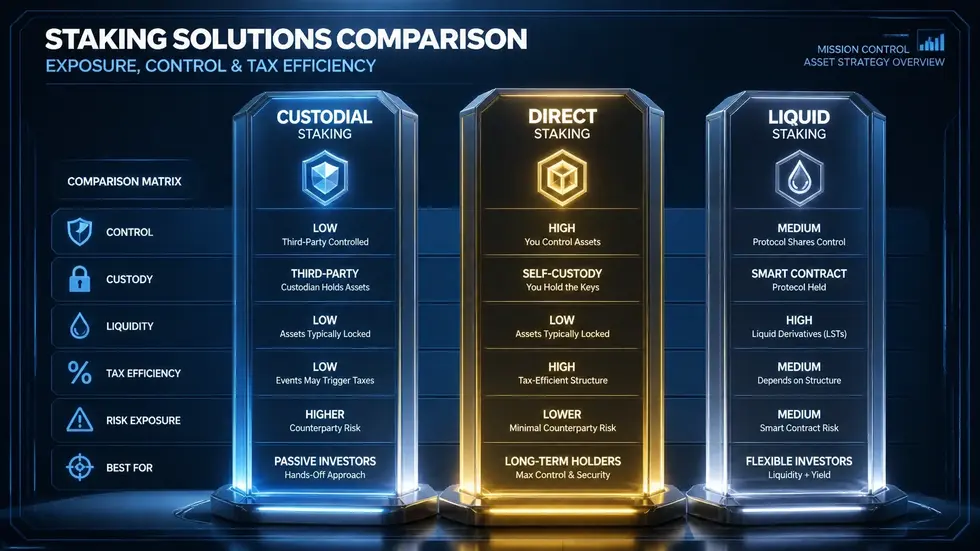
The Sledgehammer Test: Audit Your Crypto Exposure
If you hold more than $1M in digital assets, you need to run this tactical audit immediately:
- The Custody Check: Are your tokens on a centralized exchange that issues a 1099-MISC? If yes, the IRS already has your "dominion and control" profile on file.
- The Reward History: Have you excluded staking rewards from your gross income for more than three years? You may be sitting on a "tax bomb" that could trigger an audit.
- The Liquidity Analysis: If you had to pay 37% income tax on all your rewards today, plus a 40% estate tax at death, does your estate have the cash to survive without selling the tokens?
- The Documentation Trail: Do you have professional tax counsel or legal opinion letters justifying your non-inclusion position? "I saw it on Reddit" is not a defense.
- The Structural Shield: Is your crypto held in your individual name or a basic revocable trust? If so, it is exposed to probate and has zero asset protection.
Request a Situation Readiness Briefing (SRB)
The Paschall decision is just the beginning of a coordinated IRS effort to harvest wealth from the crypto ecosystem. If you have built a significant digital fortune, don't let a lack of structural defense be your undoing.
We help HNW families and business owners map out their exposures and build the architecture necessary to defend their legacies. Request a Situation Readiness Briefing (SRB) today, and we will map the control, tax, and family-transition exposures in your current structure.

Tactical FAQ
What exactly did the Paschall case decide?
The Tax Court held that Cardano staking rewards received through a custodial exchange (eToro) are taxable as gross income at the time of receipt because the taxpayer had "dominion and control", specifically the ability to sell the tokens for cash.
Does this apply to Ethereum staking?
Yes. The principles of Paschall and Rev. Rul. 2023-14 are designed to cover all proof-of-stake networks where a taxpayer receives rewards, especially through a platform or exchange.
What if my rewards are "locked" and I can't sell them?
The IRS argues that income is realized when the "dominion and control" is established. If the rewards are truly locked by the protocol (not just the exchange), the tax event may be deferred until they are unlocked. However, Paschall showed that exchange-level restrictions on transfers do not prevent taxation if selling is still possible.
Is there any legislative relief coming?
The Digital Asset PARITY Act, introduced in May 2026, proposes an elective five-year deferral for staking rewards. However, this is not yet law, and the IRS is currently operating under the aggressive "income upon receipt" standard.
How does this affect my estate tax?
Staking rewards increase the total value of your estate. If you haven't paid the income tax on those rewards, the IRS can claim the back taxes plus interest and penalties from the estate, while simultaneously charging a 40% estate tax on the remaining value.
Resources & Authorities
- Paschall v. Commissioner, T.C. Memo. 2026-46.
- Revenue Ruling 2023-14, 2023-33 I.R.B. 484 (IRS position on staking).
- I.R.C. § 61 (Definition of Gross Income).
- Jarrett v. United States, 79 F.4th 675 (6th Cir. 2023).
- Helvering v. Horst, 311 U.S. 112 (1940) (Dominion and control principles).
- Eisner v. Macomber, 252 U.S. 189 (1920) (Stock dividend analogy - rejected in Paschall).
- California Code of Civil Procedure § 704.115 (Private Retirement Plan exemptions).
Disclaimer and IP Disclosure
This content is for informational purposes only and does not constitute legal or tax advice. No attorney-client relationship is formed by reading this article. Digital asset taxation is a rapidly evolving field; always consult with a qualified legal professional regarding your specific situation. The "Wealth Defense" and "Situation Readiness Briefing" frameworks are proprietary intellectual property of the Law Office of James Burns.

Comments
There are no comments for this post. Be the first and Add your Comment below.
Leave a Comment