

Most wealth destruction happens quietly, invisibly, and relentlessly. While you're focused on growing your business or picking winning investments, tax drag is steadily consuming your future wealth: not just this year, but for decades to come.
Tax drag isn't just an annual expense. It's a compounding predator that feeds on your investment principal, removing capital that should be working for you and growing exponentially over time.
What Is Tax Drag?
Tax drag is the reduction in investment returns caused by taxes on capital gains, dividends, interest, and other investment income. Unlike management fees or market volatility, tax drag permanently removes money from your investment portfolio: money that can never compound again.
Here's a simple example: You have $1 million in Apple stock that gains 10% annually. Without taxes, you'd have $1.1 million after year one. But California's 13.3% capital gains tax means you'll pay $13,300, leaving you with $1,086,700. That missing $13,300 doesn't just disappear: it represents decades of lost compounding.
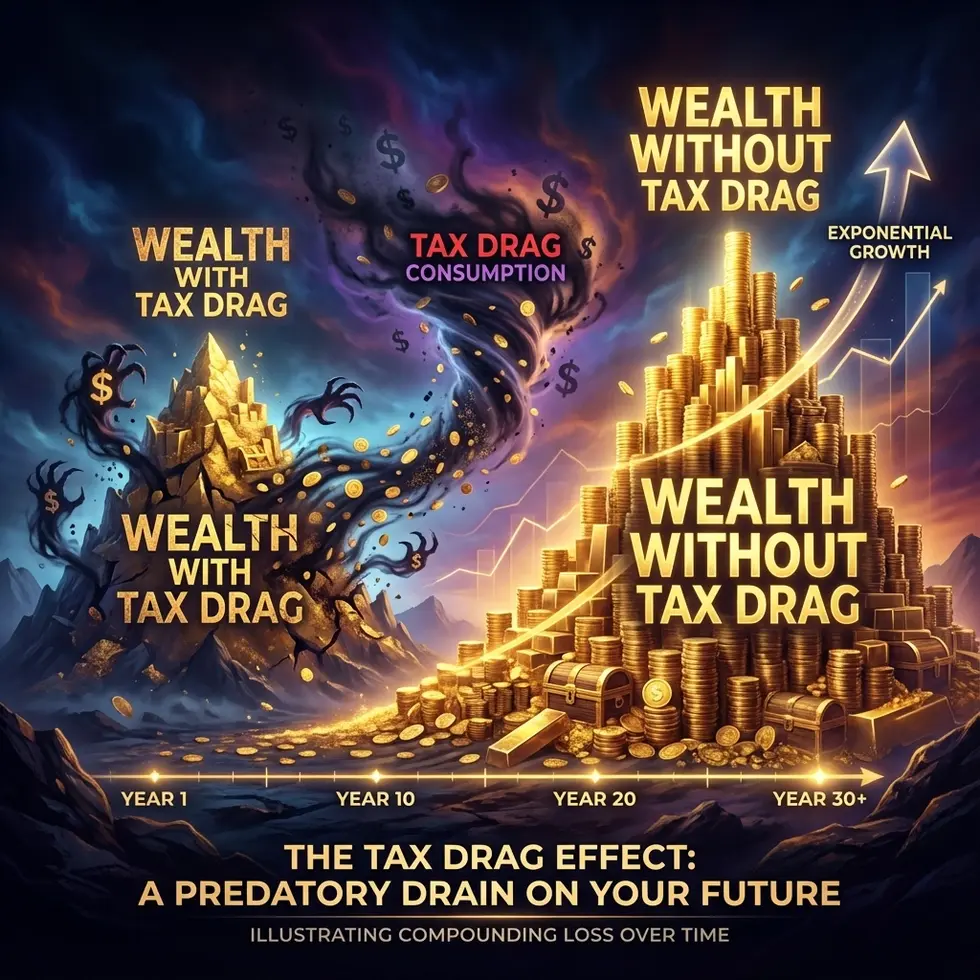
Over 20 years at 10% annual returns, that $13,300 would have grown to $89,678. The tax drag isn't just $13,300: it's nearly $90,000 in lost wealth.
Why Tax Drag Is a "Compounding Predator"
The predatory nature of tax drag lies in its timing and mathematics. When you pay taxes on investment gains, you're not just losing current income: you're sacrificing all future growth on that capital.
Consider two California executives, both starting with $2 million portfolios:
Executive A pays taxes annually on all gains and dividends. With California's combined federal and state rates reaching 37% + 13.3% = 50.3%, half of all investment income disappears immediately.
Executive B defers taxes through strategic structures, keeping that capital working.
After 25 years at 8% average returns:
- Executive A ends with approximately $8.9 million
- Executive B ends with approximately $13.7 million
The $4.8 million difference isn't from better investment returns: it's purely from tax drag's compounding destruction.
California's Tax Drag Amplifiers
California creates multiple sources of compounding tax drag that many wealthy residents underestimate:
Capital Gains Tax Acceleration
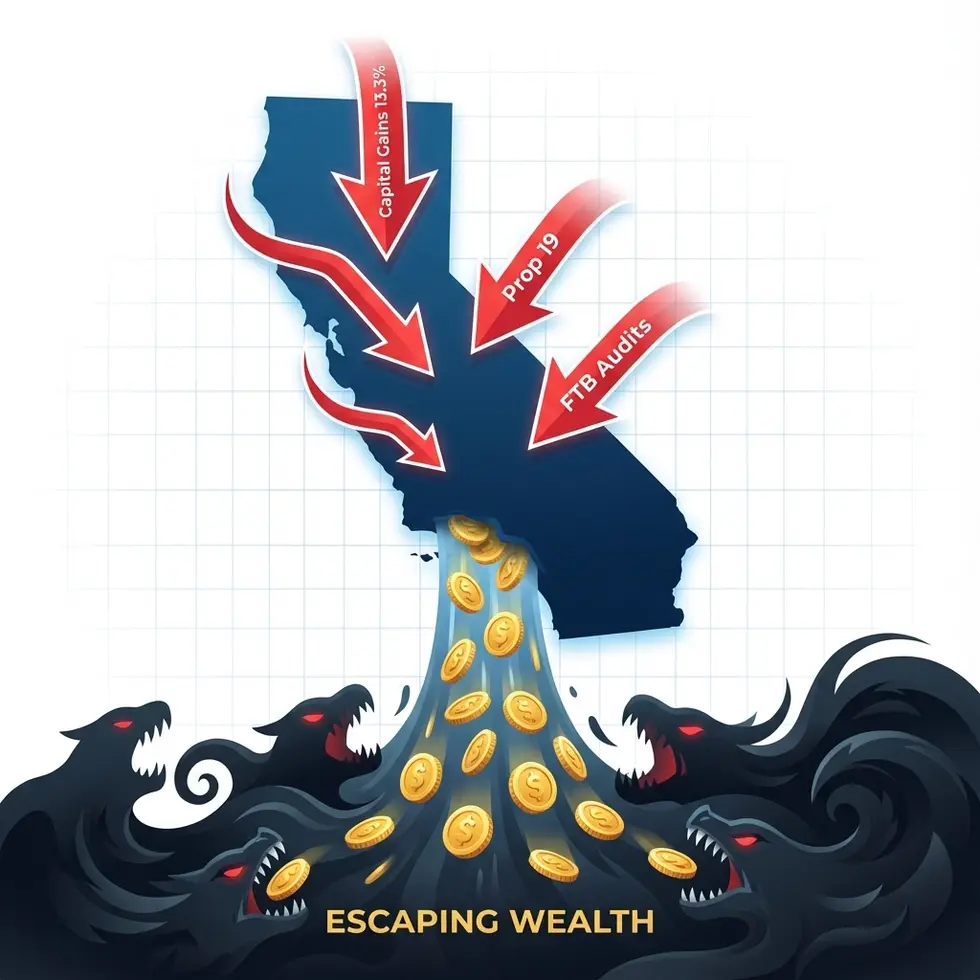
California taxes capital gains as ordinary income, with no preferential rates. For high earners, this means 13.3% state tax plus up to 37% federal tax. Every time you rebalance, take profits, or face forced distributions, you're feeding the predator.
Prop 19 Property Tax Resets
Since 2021, inherited California properties over $1 million in assessed value face immediate property tax resets to market value. A $3 million inherited home that previously carried $12,000 annual property taxes might jump to $36,000: creating $24,000 in annual tax drag that compounds every year your family holds the property.
Franchise Tax Board Audit Risks
The FTB's aggressive audit tactics often force unnecessary tax settlements and penalties. Even winning an audit costs substantial legal fees and time: resources that could have been compounding in your portfolio.
Trust Income Tax Compression
California trusts hit the top 13.3% rate at just $13,050 of annual income. This compressed bracket structure means trust investments face maximum tax drag almost immediately, severely limiting the effectiveness of traditional trust strategies.
The Mathematics of Destruction
Research from leading investment firms shows taxable accounts typically lose 1-2% in annual returns to tax drag. This might sound manageable, but compound that over 30 years:
- A 1% annual tax drag reduces final wealth by approximately 26%
- A 2% annual tax drag reduces final wealth by approximately 45%
For a California executive with $10 million in taxable investments, a 2% tax drag costs roughly $4.5 million in lifetime wealth destruction.
The predator becomes more vicious with larger portfolios. A $50 million family portfolio losing 2% annually to tax drag surrenders approximately $22.5 million over three decades: enough to fully fund the next generation's financial independence.
Common Tax Drag Blind Spots
Many successful Californians unknowingly accelerate tax drag through:
Frequent Rebalancing: Portfolio management requires periodic rebalancing, but each transaction in taxable accounts triggers immediate tax drag. High-net-worth families often pay hundreds of thousands in unnecessary capital gains taxes through inefficient rebalancing strategies.
Dividend-Heavy Investments: Dividend stocks and REITs generate annual taxable income at ordinary rates. While these investments appear conservative, they create steady tax drag that compounds against you.
Inadequate Loss Harvesting: Failing to systematically harvest tax losses means missing opportunities to offset gains. Even worse, some advisors harvest losses inefficiently, triggering wash sale rules that disallow the deductions.
Business Sale Timing: Entrepreneurs often sell businesses without considering installment sale structures or other tax deferral strategies, paying massive immediate taxes instead of spreading the burden over time.
Advanced Strategies to Starve the Predator
Sophisticated wealth preservation requires systematic approaches to minimize tax drag:
Installment Sales Structures
For business owners facing large liquidity events, installment sales can defer capital gains taxes over multiple years, keeping more capital invested and compounding. A properly structured installment sale might defer 80-90% of capital gains taxes for a decade or more.
Private Placement Life Insurance (PPLI)
PPLI strategies allow tax-free growth and distribution of investment returns. For ultra-high-net-worth families, PPLI can eliminate tax drag entirely on substantial portfolios while providing death benefit protection.
Dynasty Trust Structures
Multi-generational trusts can hold appreciating assets indefinitely, avoiding capital gains taxes through step-up basis at each generation. Dynasty trust strategies combined with annual gifting can remove significant wealth from taxable estates while preserving family control.
Asset Location Optimization
Strategic placement of different asset types in taxable versus tax-advantaged accounts can minimize overall tax drag. High-growth, low-dividend assets work best in taxable accounts, while income-producing investments belong in IRAs and 401(k)s.

Charitable Remainder Trusts
CRTs allow you to "sell" highly appreciated assets to a trust, receive income for life, and eliminate immediate capital gains taxes. The trust eventually benefits charity, but you maintain income and remove the asset from your taxable estate.
The California Advantage: Legitimate Tax Minimization
Despite California's aggressive tax environment, sophisticated strategies remain available for legitimate tax minimization:
Nevada Trust Structures: Properly established Nevada trusts can eliminate California state income tax on trust distributions, while maintaining California residence for the grantor.
Opportunity Zone Investments: Qualified opportunity zone funds can defer capital gains taxes and potentially eliminate taxes on zone investment appreciation.
1031 Exchanges: Real estate investors can defer capital gains indefinitely through like-kind exchanges, keeping appreciation working within the portfolio.
Measuring Your Tax Drag Impact
Calculate your current tax drag by tracking:
- Annual taxes paid on investment income and gains
- Percentage of portfolio returns lost to taxes
- Compounding value of tax payments over time
Many families discover they're losing 15-25% of potential long-term wealth to preventable tax drag.
FAQ: Tax Drag and Wealth Preservation
Q: How much tax drag is normal for high-net-worth California investors?
A: Well-managed taxable portfolios typically experience 1-2% annual tax drag. Poorly managed accounts or those with frequent trading can lose 3-4% annually: devastating over long time periods.
Q: Can tax drag strategies trigger IRS audits?
A: Legitimate tax minimization strategies are specifically authorized by tax law. However, aggressive positions or poor documentation can increase audit risk. Professional structuring and compliance are essential.
Q: Do these strategies work for business owners facing large liquidity events?
A: Absolutely. Business sales represent the highest-leverage opportunities for tax drag minimization. Installment sales, charitable strategies, and opportunity zone investments can defer or eliminate substantial capital gains taxes.
Q: How does Prop 19 affect inherited property tax drag?
A: Prop 19 creates massive tax drag for many inherited California properties. However, strategic gifting before death, qualified personal residence trusts, or conservation easements can minimize this impact.
Q: What's the minimum portfolio size where tax drag strategies make sense?
A: Basic tax-loss harvesting and asset location optimization benefit portfolios over $500,000. Advanced strategies like PPLI or dynasty trusts typically require $5 million or more to justify costs.
Q: Can these strategies be reversed if tax laws change?
A: Most sophisticated structures include flexibility provisions allowing modifications as tax laws evolve. However, some strategies like charitable remainder trusts are irrevocable, requiring careful planning.
Take Action Against Tax Drag
Tax drag is destroying your wealth systematically, year after year. The longer you wait to address it, the more future wealth you sacrifice to this compounding predator.
Every month of delay represents thousands: or hundreds of thousands: in lost compounding opportunities. For California's high-net-worth families, immediate action on tax drag minimization often represents the highest-return "investment" available.
Schedule your planning analysis today. Book your strategic consultation to discover exactly how much wealth tax drag is costing your family and implement proven strategies to stop the bleeding.
Sources
- Franchise Tax Board: Capital gains and losses
- FTB: 2024 California Tax Rate Schedules (Form 540)
- FTB: Estates and trusts (Form 541) filing information
- FTB: 2024 Fiduciary Income Tax Booklet (Form 541)
- California State Board of Equalization: Proposition 19
- IRS Publication 537: Installment Sales
- IRS: Opportunity Zones FAQs
- IRS: Like-kind exchanges (Section 1031)
- IRS: Charitable remainder trusts
- 26 U.S. Code § 1014 – Basis of property acquired from a decedent
- 26 U.S. Code § 7702 – Life insurance contract defined
Disclaimer: This content is for informational purposes only and does not constitute legal or tax advice. Tax drag minimization strategies involve complex legal and tax considerations that vary significantly based on individual circumstances. Consult qualified legal and tax professionals before implementing any strategies discussed.
Intellectual Property Notice: This analysis and strategic framework are proprietary to Law Office of James Burns. Unauthorized reproduction or distribution is prohibited. © 2025 Law Office of James Burns. All rights reserved.

Comments
There are no comments for this post. Be the first and Add your Comment below.
Leave a Comment