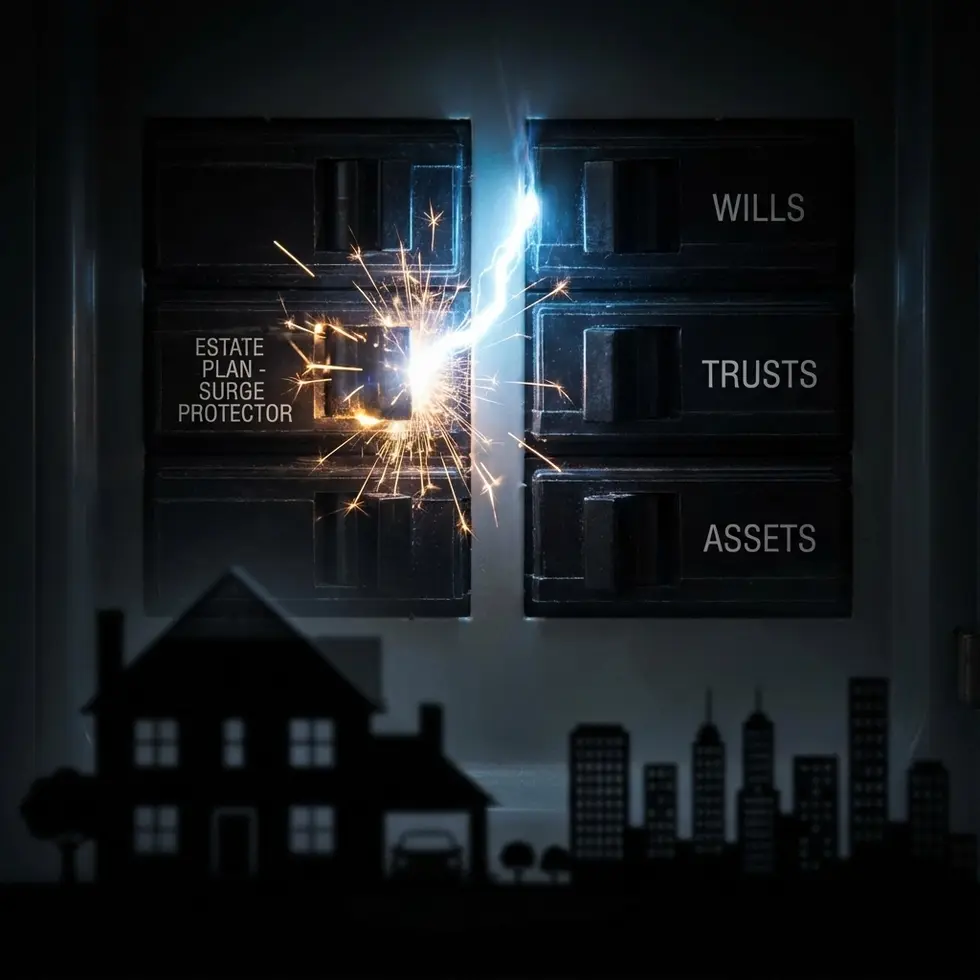
Your estate plan isn't a castle: it's an electrical system. And just like your home's circuit breakers, one unexpected surge can plunge everything into darkness.
Most people think estate planning is about building walls higher or vaults deeper. Wrong. It's about surge protection. The families who lose everything aren't the ones with small estates: they're the ones whose sophisticated plans couldn't handle a single unexpected jolt.
Here's what nobody tells you: The bigger your wealth, the more fragile your circuit becomes.
The Anatomy of an Estate Planning Blackout
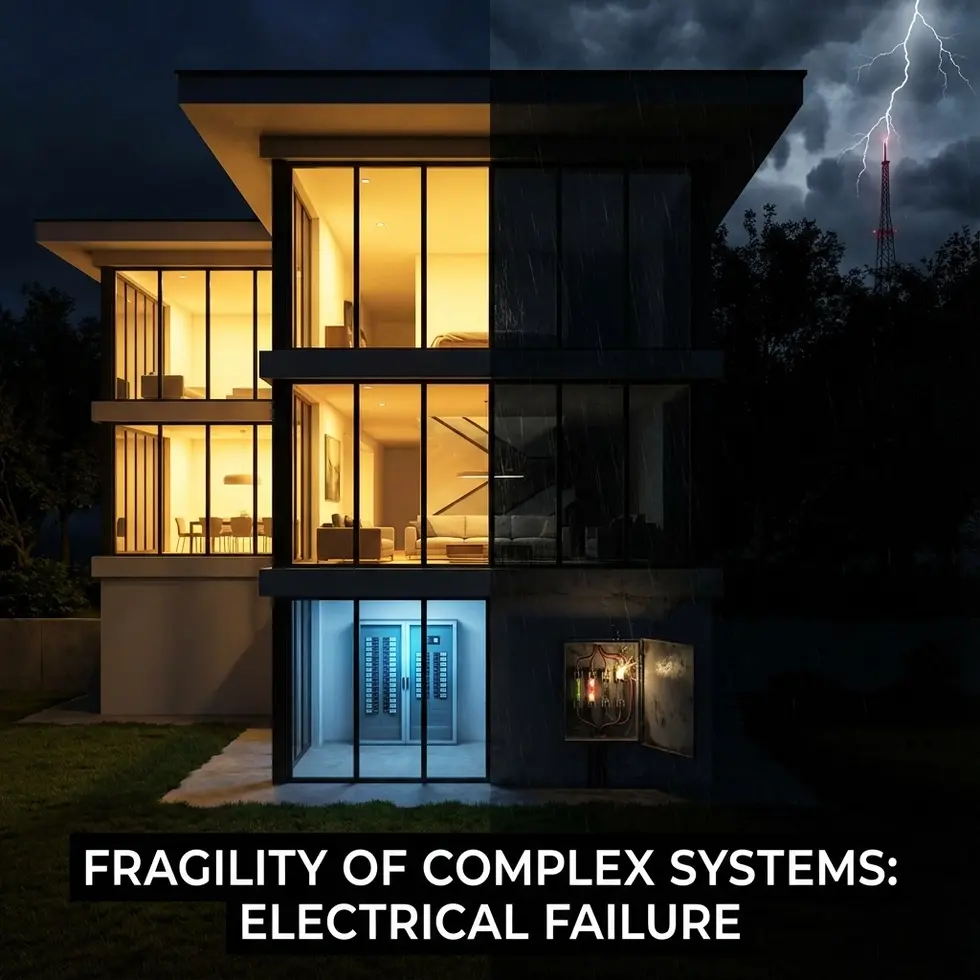
Think about your home's electrical system. Everything works perfectly until someone plugs in that extra space heater while the AC's running and the dryer's going. Pop. Darkness.
Estate plans fail the same way. One incapacity event, one poorly-titled asset, one IRS challenge: and decades of planning vanish in seconds.
Take the recent Estate of Powell v. Commissioner case. A $50 million family business, meticulous succession planning, generation-skipping trusts properly funded. But when the patriarch suffered a stroke, a single power of attorney document had unclear language about gift tax elections under IRC Section 2513. The IRS challenged the entire valuation discount structure. Result: $12 million in unexpected estate taxes: a complete system failure from one weak connection.
California Probate Code Section 4264 requires specific language for gift and tax elections in financial powers of attorney. Yet most estate planning documents treat these provisions as boilerplate. One ambiguous phrase becomes your surge that blacks out everything.
The Three Hidden Surge Points That Collapse Elite Estate Plans
Surge Point #1: The Incapacity Cascade
Here's reverse psychology for you: You spend more time planning your next vacation than planning for incapacity. Yet incapacity planning is where 73% of estate plan failures originate.
California's strict interpretation of Civil Code Section 2400 regarding trustee succession can trigger what we call "the cascade effect." When the primary trustee becomes incapacitated without properly documented succession protocols, every subsequent transaction becomes suspect.
Consider this scenario: Tech executive with a $30 million spendthrift trust structure suffers early-onset dementia. The successor trustee provision says "any licensed attorney." The beneficiaries disagree on who qualifies. While they're fighting, the trust's private equity investments require time-sensitive capital calls. The result: Missed opportunities, litigation costs, and a trust that fails its core protective function.
Surge Point #2: The Tax Code Trap
The wealthy think they're insulated from tax changes. They're wrong. Tax law shifts are like power surges: sudden, devastating, and completely predictable if you're paying attention.
Revenue & Taxation Code Section 18662 allows FTB to recharacterize trust income for California purposes, even when federal treatment differs. Most asset protection strategies ignore this dual-jurisdiction problem until it's too late.
Real example: Nevada dynasty trust holding California real estate. Federal law protects it from generation-skipping transfer tax. California treats it as a grantor trust, triggering immediate income tax on all earnings plus potential gift tax exposure under Prop 19's new transfer rules. One legislative change: complete system failure.
Surge Point #3: The Litigation Lightning Strike
You know what's interesting? The families who get sued aren't the reckless ones: they're the cautious ones with visible wealth.
California's new expedited partition statutes under Code of Civil Procedure Section 872.010 allow creditors to force property sales in as little as 90 days. Your LLC structure? Your family limited partnership? Meaningless if one partner gets tagged in litigation.
Here's a case study that'll keep you awake: Orthopedic surgeon with immaculate offshore trust structures. Malpractice claim triggers his professional liability carrier's bankruptcy. The carrier's creditors use assignment of rights to pierce the domestic LLC holding company. Within six months, the offshore structure collapses because the trust protector was also the LLC's managing member. Single point of failure: total blackout.

How to Build Surge-Resistant Estate Architecture
Real surge protection isn't about bigger circuit breakers: it's about redundant systems and automatic shutoffs.
The Triple-Redundancy Rule
Every critical function in your estate plan needs three independent backup systems. Not similar systems: genuinely independent ones.
- Trustee succession: Individual successor, corporate trustee, trust protector committee
- Asset title holding: Multiple LLCs, cross-jurisdictional structures, nominee ownership
- Tax compliance: Federal specialist, California specialist, international consultant
California Probate Code Section 15642 allows for "directed trustees" where investment management, tax compliance, and distribution decisions are handled by separate entities. Most attorneys skip this because it's complex. Complex is good. Complex is surge-resistant.
The Automatic Disconnect Strategy
Your estate plan needs automatic shutoffs: provisions that activate when specific trigger events occur.
Smart trust amendment protocols include mandatory distribution suspensions during litigation, automatic jurisdiction changes when tax laws shift, and emergency asset transfers when regulatory threats emerge.
Think of it as a dead man's switch for your wealth.
The Anti-Fragile Wealth Structure
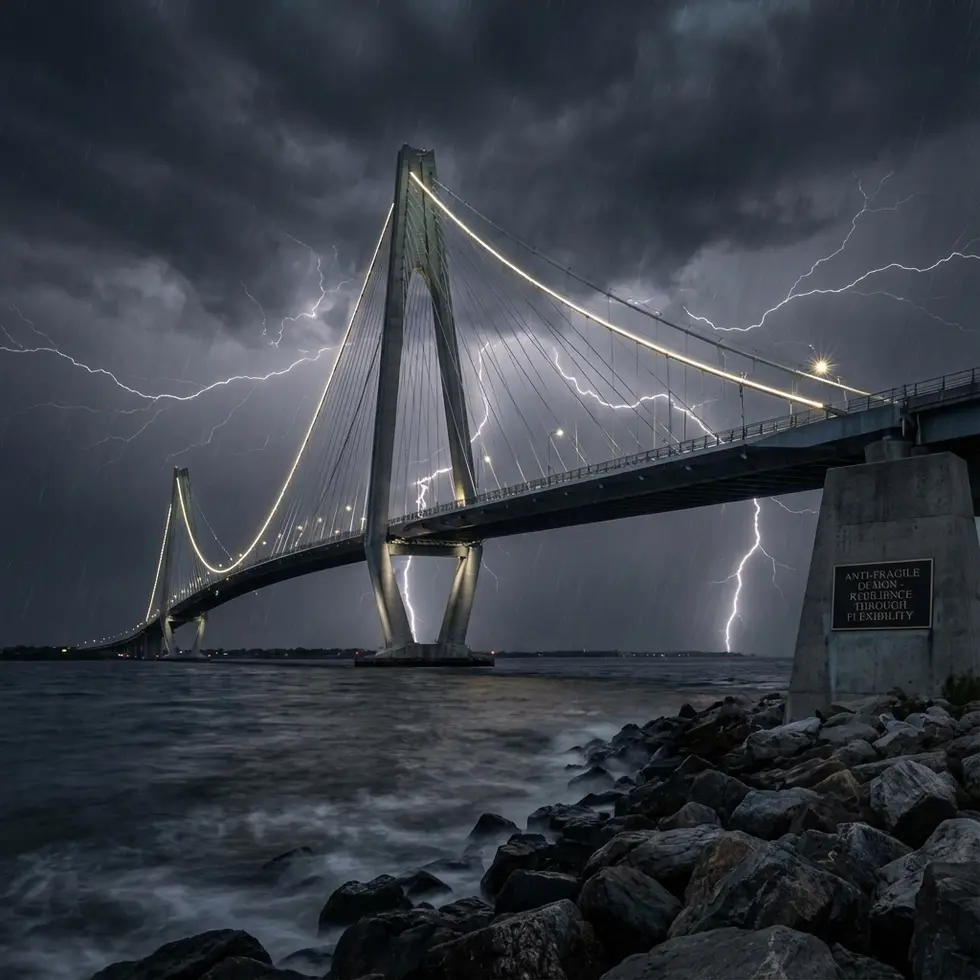
The goal isn't just protection: it's getting stronger when attacked. Anti-fragile estate plans actually benefit from stresses that would destroy normal structures.
Example: Family office with intentionally conflicting state jurisdictions. When California attacks the Nevada trust, the Wyoming LLC automatically triggers enhanced protection protocols. When federal tax law changes, the structure morphs to take advantage of the new rules rather than just survive them.
This requires thinking three moves ahead: like chess, not checkers.
The Circuit Breaker Audit: Testing Your System Under Load
Most people test their smoke detectors monthly but never stress-test their estate plans. Here's how the pros do it:
The Incapacity Simulation: What happens if your primary decision-maker becomes unavailable tomorrow? Not just legally: practically. Who signs what? Where are the passwords? How do accounts get accessed?
The Tax Law Shock Test: Model your plan under various legislative scenarios. What if the estate tax exemption drops to $3.5 million? What if California implements a wealth tax? What if offshore reporting requirements triple?
The Litigation Load Test: Assume your biggest asset protection threat materializes. Do your structures hold? Do they bend? Do they break? Or do they get stronger?
Run these scenarios annually. Upgrade accordingly.
Why Most Estate Plans Are Built to Fail
Here's uncomfortable truth: Most estate planning is cosmetic. It makes you feel protected without actually protecting you.
The standard revocable trust? It's like having a circuit breaker made of paper. Looks official, does nothing when you need it most.
The problem isn't incompetent attorneys: it's misaligned incentives. You want surge protection. They want to sell you standard products. You need custom engineering. They want to use templates.
The wealthy families who survive generational wealth transfer don't use standard products. They build custom systems designed to handle multiple simultaneous failures.
Frequently Asked Questions
Q: How often should I stress-test my estate plan?
A: Annually at minimum, plus immediately after major life events, tax law changes, or family business developments. Think of it like checking your home's electrical system: regular maintenance prevents catastrophic failures.
Q: What's the biggest single point of failure in most estate plans?
A: Inadequate incapacity planning. California Probate Code Section 4264 requires specific language for tax elections in powers of attorney, yet 80% of documents we review have generic boilerplate that fails under pressure.
Q: Can offshore structures really protect against California's aggressive tax collection?
A: Only if properly structured with multiple jurisdiction redundancies and compliant reporting. The offshore trust failures we see typically involve single-jurisdiction planning or inadequate domestic compliance.
Q: How much should I expect to invest in proper surge protection?
A: True surge-resistant planning typically runs 1-2% of protected assets annually. Sounds expensive until you consider that one failure event can cost 20-30% of your wealth permanently.
Q: What makes a trust "anti-fragile" versus just protected?
A: Anti-fragile structures actually benefit from attacks. They include automatic rebalancing mechanisms, jurisdictional arbitrage protocols, and stress-responsive features that activate enhanced protections when threatened.
Related Reads
- Why Most Estate Planning Conversations Fail Before They Begin: https://www.jamesburnslaw.com/why-most-estate-planning-conversations-fail-before-they-begin
- The Single Point of Failure: https://www.jamesburnslaw.com/the-single-point-of-failure
- If Your Estate Plan Can Be Explained Quickly, It's Probably Incomplete: https://www.jamesburnslaw.com/if-your-estate-plan-can-be-explained-quickly-its-probably-incomplete
Ready to stress-test your estate plan before the next power surge hits? Our Estate Circuit Analysis identifies every single point of failure in your current structure: plus the redundant protections you need to stay powered up when others go dark. Schedule your assessment now and discover why surge-resistant planning is the difference between surviving wealth transfer and losing everything to one unexpected jolt.
Disclaimer: This information is for educational purposes and does not constitute legal advice. Estate planning requirements vary significantly based on individual circumstances, asset types, and jurisdictional considerations. Always consult qualified legal counsel before implementing any wealth transfer or asset protection strategies.
© 2026 Law Office of James Burns. All rights reserved. Unauthorized reproduction of this content is prohibited and may result in legal action.
Resources
- Firm Resources:
-
- Estate Planning: https://www.jamesburnslaw.com/estate-planning
- Asset Protection: https://www.jamesburnslaw.com/asset-protection
- Business Succession: https://www.jamesburnslaw.com/business-succession
- California Prop 19 Planning: https://www.jamesburnslaw.com/prop-19
- California Private Retirement Plans: https://www.jamesburnslaw.com/private-retirement-plans
- Trusts: https://www.jamesburnslaw.com/trusts
- Tax Optimization: https://www.jamesburnslaw.com/tax-optimization
- Legal Codes & Case Law (California-focused):
-
- Probate Code §850 (property claimed by/against trust): https://leginfo.legislature.ca.gov/faces/codes_displaySection.xhtml?sectionNum=850.&lawCode=PROB
- Probate Code §16060 (duty to inform/report): https://leginfo.legislature.ca.gov/faces/codes_displaySection.xhtml?sectionNum=16060.&lawCode=PROB
- Probate Code §15660 (successor/cotrustee appointment): https://leginfo.legislature.ca.gov/faces/codes_displaySection.xhtml?sectionNum=15660.&lawCode=PROB
- Probate Code §4264 (specific POA powers—gifts/beneficiaries/disclaimers): https://leginfo.legislature.ca.gov/faces/codes_displaySection.xhtml?sectionNum=4264.&lawCode=PROB
- Civil Code §3439 et seq. (Uniform Voidable Transactions Act): https://leginfo.legislature.ca.gov/faces/codes_displaySection.xhtml?sectionNum=3439.&lawCode=CIV
- Code of Civil Procedure §704.115 (private retirement plan exemption): https://leginfo.legislature.ca.gov/faces/codes_displaySection.xhtml?sectionNum=704.115.&lawCode=CCP
- Revenue & Taxation Code §§17742–17745 (trust residency/income sourcing): https://leginfo.legislature.ca.gov/faces/codes_displaySection.xhtml?sectionNum=17742.&lawCode=RTC
- Revenue & Taxation Code §63.2 (Prop 19 parent–child exclusion rules): https://leginfo.legislature.ca.gov/faces/codes_displaySection.xhtml?sectionNum=63.2.&lawCode=RTC
- Recent Appellate Decision: Barefoot v. Jennings (2020) 8 Cal.5th 822: https://law.justia.com/cases/california/supreme-court/2020/s251574.html

Comments
There are no comments for this post. Be the first and Add your Comment below.
Leave a Comment