
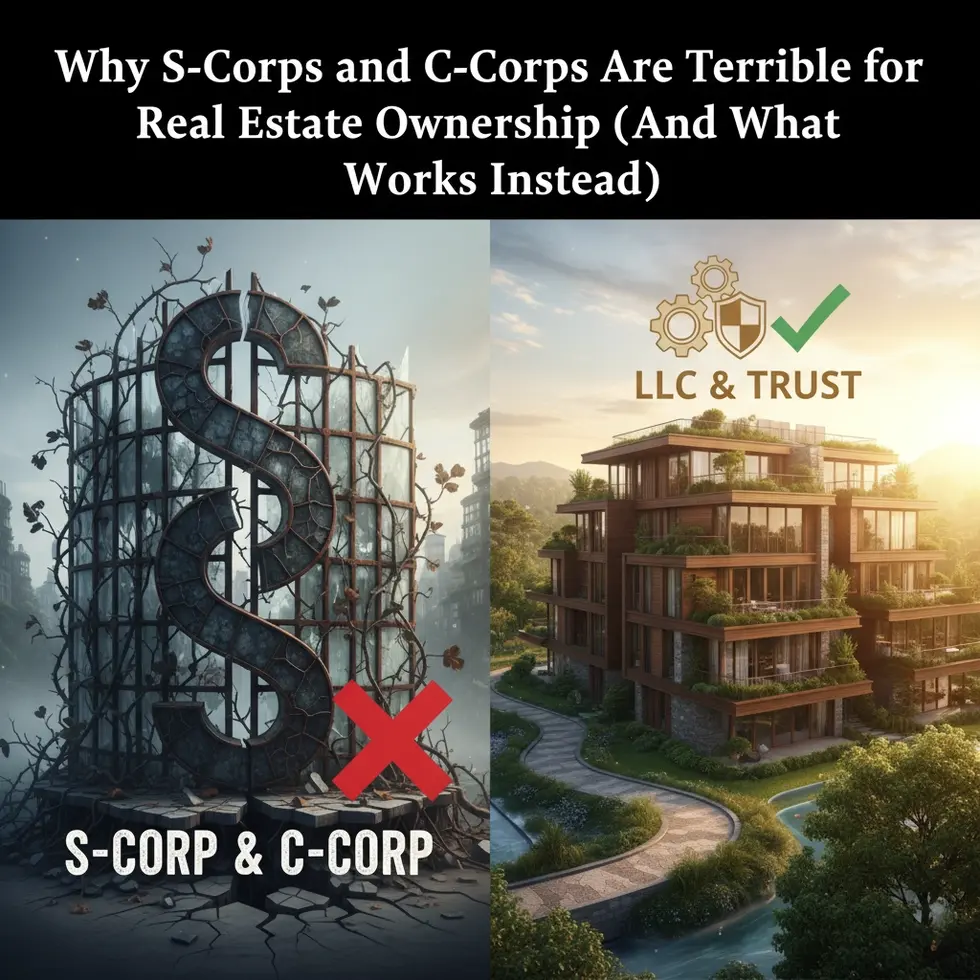
If you're a real estate investor who's been told to use an S-Corp or C-Corp for your properties, you've probably been given some seriously bad advice. While these corporate structures work great for operating businesses, they're absolutely terrible for real estate ownership, creating tax nightmares, limiting your flexibility, and essentially killing the core benefits that make real estate such an attractive investment.
Let me break down exactly why corporations are the wrong choice for real estate, and what actually works instead.
The C-Corporation Double Taxation Disaster
The biggest problem with C-Corporations is double taxation, and it hits real estate investors particularly hard. Here's what happens: your rental income gets taxed first at the corporate level (21% federal rate), then again when you take distributions as dividends at your personal tax rate (up to 20% for high earners, plus the 3.8% net investment income tax).
So that $10,000 monthly rental income? The corporation pays $2,100 in federal taxes, leaving $7,900. When you distribute that to yourself, you'll pay another $1,580 in federal dividend taxes (assuming the 20% rate), leaving you with just $6,320. That's an effective tax rate of over 36%, before considering state taxes!

But the tax pain doesn't stop there. C-Corps completely destroy your ability to use depreciation effectively. Sure, the corporation can depreciate the building to offset rental income, but that depreciation is trapped inside the entity. You can't use it against your other income, wages, or properties you own personally. Even if you qualify for Real Estate Professional Status, the IRS won't recognize it since you don't personally own the properties.
Then there's the 1031 exchange nightmare. One of real estate's most powerful strategies is the ability to defer capital gains through like-kind exchanges. In a C-Corp, executing these exchanges becomes exponentially more complex and expensive. You'll need costly legal structures, face IRS scrutiny, and potentially lose the benefit entirely if you have multiple shareholders with different timing needs.
The S-Corporation Debt Basis Trap
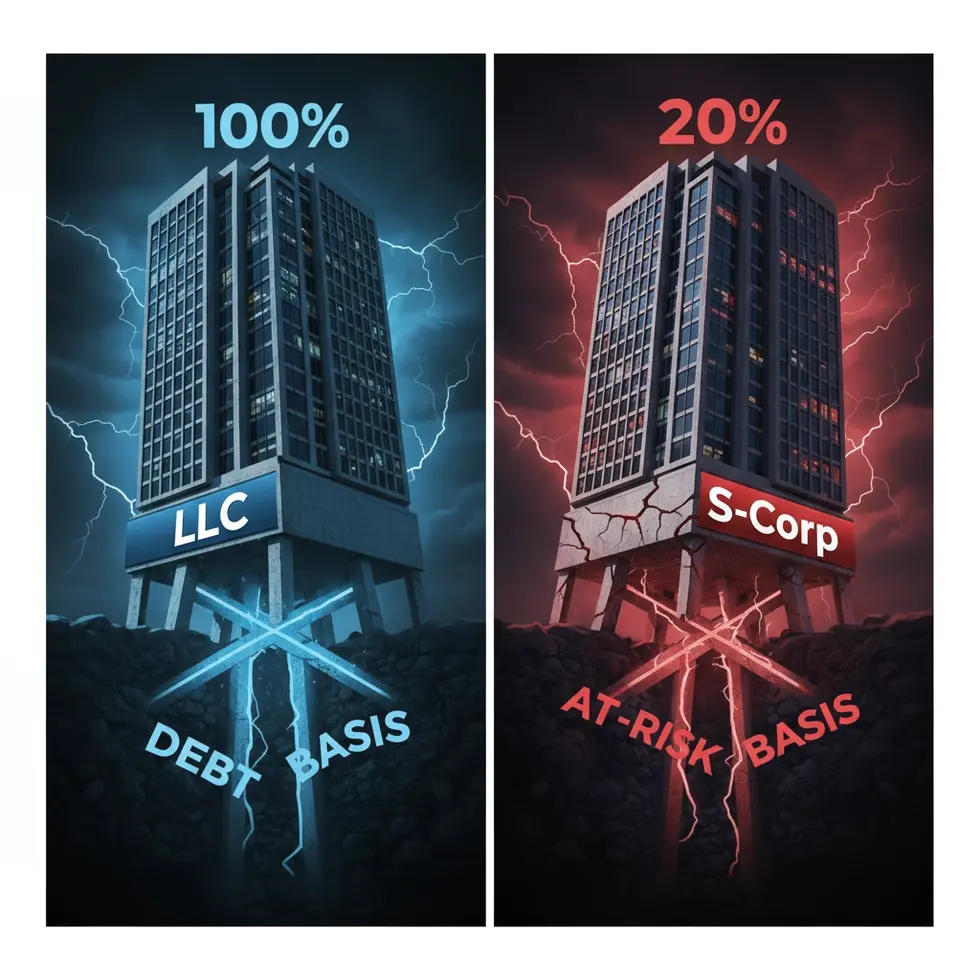
S-Corps avoid double taxation through pass-through treatment, but they create an even worse problem for real estate investors: the debt basis limitation. This obscure rule is absolutely devastating for leveraged real estate investments.
Here's how it works: In an S-Corp, you can only deduct losses up to your "basis", which includes your initial investment plus any direct loans you've made to the corporation. But unlike LLCs or partnerships, you cannot increase your basis through the corporation's debt.
Let's say you contribute $100,000 to an S-Corp that takes out a $400,000 mortgage to buy a property. Your basis stays at $100,000, not the $500,000 it would be in an LLC. This severely limits your ability to deduct depreciation and losses, killing one of real estate's primary tax benefits.
The asset trap is another killer issue. Once you put real estate into an S-Corp, it's incredibly difficult to get it out without triggering capital gains taxes. Distributing appreciated property is a taxable event, and unlike direct ownership, assets in S-Corps don't get a step-up in basis when you die. Your heirs will pay tax on all that built-up appreciation.
S-Corps also impose strict shareholder restrictions, maximum 100 shareholders, all must be U.S. citizens or residents, and most trusts can't be shareholders. This kills flexibility for bringing in partners or estate planning.
What Actually Works: The Smart Alternatives
Limited Liability Companies (LLCs) are the gold standard for real estate ownership. They provide the same liability protection as corporations but operate as pass-through entities, avoiding double taxation. Most importantly, LLC members can increase their basis through their share of entity-level debt, allowing you to fully benefit from leverage and deduct losses.
LLCs offer complete flexibility with tax-free contributions and distributions of appreciated property. No restrictions on the number or type of members. Foreign investors, corporations, trusts, all allowed. You can structure complex partnership arrangements, bring in sophisticated investors, and execute estate planning strategies that are impossible with S-Corps.
Partnerships work similarly to LLCs from a tax perspective, offering pass-through treatment and the debt basis benefits. They're particularly useful for joint ventures or when you want more formal management structures.
Direct ownership or ownership through revocable trusts works well for individual investors who want maximum simplicity. You get full access to depreciation deductions, easy 1031 exchanges, and the step-up in basis at death. For California residents with significant real estate holdings, this can be combined with sophisticated estate planning to minimize both federal and state estate taxes.

Real-World Example: The $2 Million Mistake
I had a client who put a $5 million apartment building into an S-Corp based on advice from their CPA. They contributed $1 million cash, and the S-Corp took out a $4 million loan.
The building generated $50,000 annually in depreciation and other losses, but they could only deduct $20,000 against their other income due to their limited basis. The remaining $30,000 in losses were suspended indefinitely.
When they wanted to bring in a partner, they discovered the S-Corp restrictions made it nearly impossible. When they finally tried to get the building out of the S-Corp, the distribution triggered a massive capital gains tax on the appreciation.
We eventually restructured into an LLC, but the process cost over $100,000 in taxes and fees, money that could have been avoided entirely with proper planning from the start.

The California Complication
For California real estate investors, corporations create additional headaches. California imposes its own corporate tax (8.84% for C-Corps) and doesn't follow federal S-Corp elections for LLCs, creating potential state-level double taxation scenarios.
California's complex trust and estate tax rules also make corporate ownership problematic for estate planning. The state's high income tax rates (up to 13.3%) make the pass-through benefits of LLCs even more valuable.
Advanced Structures for Sophisticated Investors
High-net-worth investors often benefit from more sophisticated structures:
Series LLCs allow you to segregate properties into separate "series" within one LLC, providing liability protection between properties while maintaining operational efficiency.
Delaware Statutory Trusts (DSTs) work well for 1031 exchanges when you want to diversify into institutional-quality properties without active management responsibilities.
Family Limited Partnerships combined with LLCs can provide estate and gift tax benefits for multi-generational real estate wealth transfer strategies.
The key is matching the structure to your specific goals, not forcing real estate into corporate boxes where it doesn't belong.
Frequently Asked Questions
Q: Can't I just elect S-Corp taxation for my LLC to get the best of both worlds?
A: This election can work for active real estate businesses with significant ordinary income, but it eliminates many of the flexible distribution and ownership benefits that make LLCs attractive for real estate investment.
Q: What about liability protection, don't corporations offer better protection than LLCs?
A: No. Properly structured and maintained LLCs provide equivalent liability protection to corporations for real estate ownership, and often more flexibility in how that protection is implemented.
Q: I already have properties in an S-Corp. How difficult is it to get them out?
A: It depends on the appreciation and your basis situation. Sometimes it's worth paying the tax to get out, sometimes you're better staying put. Each situation requires individual analysis.
Q: What about the 20% Section 199A deduction, can I get that with an LLC?
A: Yes, LLC-owned rental real estate often qualifies for the 199A deduction, and the qualification rules are often easier to meet than with corporate ownership.
Q: Are there any situations where S-Corp or C-Corp ownership makes sense for real estate?
A: Very rarely. The only scenarios might involve active real estate businesses (like construction or property management companies) rather than passive real estate investment.
Take Action on Your Real Estate Structure
Don't let the wrong entity structure drain your real estate returns or limit your investment flexibility. If you're currently using a corporation for real estate ownership, it's worth getting a professional analysis of your situation and restructuring options.
At the Law Office of James Burns, we help California real estate investors optimize their entity structures for maximum tax efficiency, asset protection, and operational flexibility. Whether you're just starting out or need to fix existing problems, we can design a structure that actually works with your real estate investment strategy: not against it.
Ready to optimize your real estate ownership structure? Contact us today for a confidential consultation about your specific situation and goals.
Disclaimer: This article is for informational purposes only and does not constitute legal or tax advice. Entity selection and tax planning strategies should always be customized to your specific situation with qualified legal and tax professionals.
© 2025 Law Office of James Burns. All rights reserved.

Comments
There are no comments for this post. Be the first and Add your Comment below.
Leave a Comment