

Estate planning is defined as the legal process of arranging how your assets, healthcare decisions, and business interests are managed during incapacity and transferred after death. For medical professionals, this process carries stakes that far exceed those of a typical high-income earner. Physicians, surgeons, and other healthcare practitioners face malpractice exposure, licensing board scrutiny, and practice ownership complexities that make standard planning approaches insufficient. Roughly 50% of Americans lack a will, meaning state intestacy laws decide who inherits their wealth. For a physician with a seven-figure estate and an active practice, that outcome is not just inconvenient. It is financially catastrophic.
Why medical professionals need estate planning more than most
Medical professionals carry a liability profile that most high-income professionals never encounter. A malpractice claim, a licensing board complaint, or a business dispute with a practice partner can all reach beyond professional insurance coverage and threaten personal assets directly.
The risks are specific and serious:
- Malpractice claims can exceed policy limits, exposing personal savings, investment accounts, and real estate to creditor judgments.
- Licensing board investigations can freeze a physician's ability to practice, disrupting income and triggering practice valuation crises.
- Business disputes within group practices or hospital partnerships can generate personal liability if assets are not properly separated through legal entities.
- Regulatory investigations under HIPAA or state medical board rules can create legal costs that drain personal finances without any malpractice event occurring.
- Inadequate entity structures leave personal and practice assets legally commingled, making both vulnerable in litigation.
Medical professionals face elevated risks from malpractice claims and licensing complaints that standard malpractice insurance does not fully address. Insurance covers defined claim categories. It does not protect personal real estate, brokerage accounts, or family trusts from a judgment that exceeds policy limits.
Pro Tip: If you own a medical practice, confirm with a qualified attorney whether your current entity structure, whether a professional corporation or LLC, actually separates your personal assets from practice liabilities under California law. Many physicians assume it does. Many are wrong.

The difference between a physician's exposure and a salaried employee's exposure is structural. Employees rarely own the business generating the liability. Physicians often do. That ownership creates wealth and creates risk simultaneously, which is exactly why financial planning for healthcare professionals must address both sides of that equation.
How does estate planning protect a physician's assets and practice?
A well-built estate plan for a medical professional operates on three levels: personal asset protection, practice continuity, and incapacity planning. Each level requires specific legal instruments.
Core legal documents every physician needs
- Revocable living trust. A revocable living trust keeps assets out of probate, preserves privacy, and allows a successor trustee to manage finances immediately if you become incapacitated. Probate processes without a plan can last over 12 months and consume up to 5% of estate value in fees. That is wealth destroyed before a single beneficiary receives a dollar.
- Durable financial power of attorney. This document authorizes a named agent to manage bank accounts, investment portfolios, and business interests if you cannot. Without it, a court appoints a guardian, a process that is slow, public, and expensive.
- Healthcare directive and medical power of attorney. These documents govern your own medical decisions when you cannot make them. A physician who plans for patients but not for themselves creates a legal gap that courts fill on their terms.
- Business-specific power of attorney. A separate instrument covering practice management decisions protects your practice from operational paralysis if you are incapacitated. Standard financial powers of attorney often do not cover medical practice governance explicitly.
- Medical records custodian agreement. Medical providers must plan the transfer of patient records through custodian agreements that comply with state and federal law, including notifying licensing boards and patients. Failing to address this exposes your estate to HIPAA penalties and licensing violations.
Digital assets and EHR access
Malpractice insurance does not cover digital clinical system access. HIPAA and state laws restrict automatic access to electronic health records, meaning your staff or family cannot legally access your EHR platform without explicit legal authority. A practice can grind to a halt within days of a physician's incapacity if no one has authorized access to scheduling systems, billing platforms, or patient portals. Your estate plan must name a digital asset fiduciary with documented credentials and access protocols.
| Document | Primary purpose | Covers incapacity? |
|---|---|---|
|
Revocable living trust |
Asset transfer and probate avoidance |
Yes |
|
Durable financial POA |
Financial account management |
Yes |
|
Business-specific POA |
Practice operations |
Yes |
|
Medical records custodian agreement |
Patient record transfer compliance |
Yes |
|
Healthcare directive |
Personal medical decisions |
Yes |
Pro Tip: Create a secure digital inventory that lists every EHR system, billing platform, and telehealth account your practice uses. Store it with your estate planning documents and grant your designated fiduciary written legal authority to access each one. Review it every time you add a new platform.
Physician asset protection trusts add another layer by placing assets beyond the reach of future creditors while preserving your ability to benefit from them under specific trust structures permitted by California law.
What estate planning mistakes do medical professionals most often make?
The most costly mistakes in estate planning for doctors are not dramatic oversights. They are quiet omissions that compound over time.
- Ignoring incapacity planning entirely. Estate planning is primarily for the living, designed to maintain control through incapacity, not just to direct assets after death. A physician without a durable power of attorney forces their family into court-appointed guardianship proceedings at the worst possible moment.
- Treating the estate plan as a one-time document. A plan drafted during residency does not account for a later partnership buy-in, a real estate portfolio, or deferred compensation from a hospital employment contract. Static estate plans miss complex career elements like equity interests and deferred compensation structures that evolve throughout a physician's career.
- Failing to coordinate personal and business succession documents. A physician's personal will and their practice buy-sell agreement must align. Contradictions between the two create litigation that drains both the estate and the practice simultaneously.
- Overlooking multi-state estate planning mistakes. Physicians who own real estate or hold licenses in multiple states face probate exposure in each state where real property sits. A properly structured trust eliminates this risk.
- Underestimating probate costs. The probate consequences for high-value estates include court fees, attorney fees, executor fees, and appraisal costs that collectively reduce the estate before distribution. For a physician with a $5M estate, that is a six-figure loss that proper planning eliminates entirely.
- Neglecting tax coordination. Physicians with deferred compensation, practice equity, and investment real estate face a layered tax picture at death. Failing to coordinate the estate plan with income tax and estate tax strategy leaves significant wealth exposed to avoidable taxation.
How can medical professionals start and maintain an effective estate plan?
The most common reason physicians delay estate planning is waiting for the "right time." There is no right time. Iterative planning starting with foundational documents is more effective than waiting for complete certainty about career trajectory or asset values.
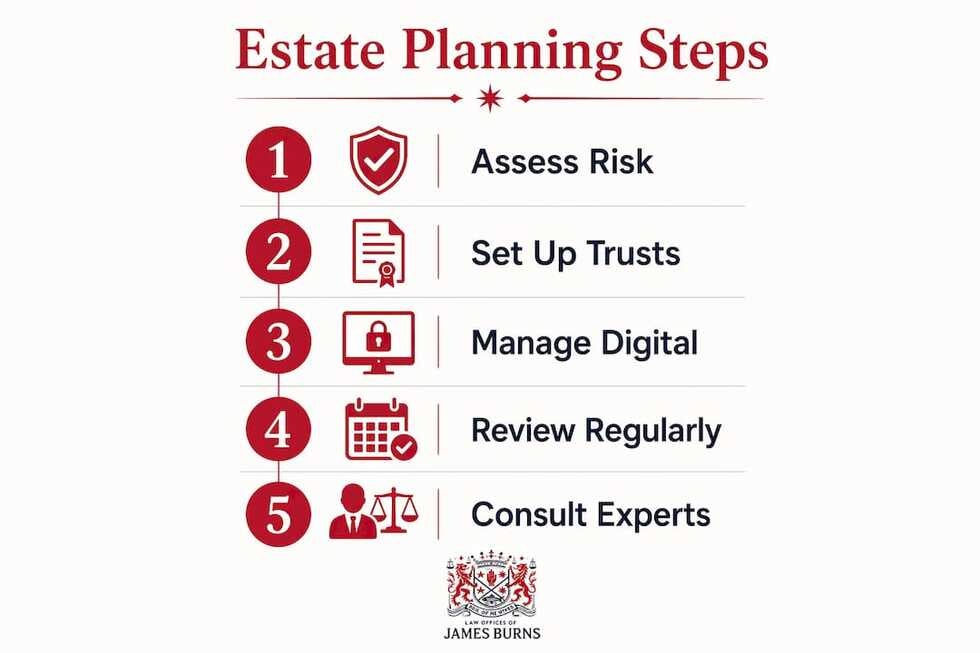
- Start with the four core documents. A revocable living trust, durable financial power of attorney, healthcare directive, and a pour-over will form the legal foundation. These documents alone eliminate court-appointed guardianship risk and probate exposure.
- Engage a legal advisor who understands medical practice structures. General estate planning attorneys often miss the nuances of professional corporations, medical records obligations, and physician employment agreements. The intersection of medical licensing law and estate law requires specialized counsel.
- Build a digital asset inventory. List every EHR system, billing platform, telehealth service, and financial account. Assign legal access authority to a named fiduciary for each one. Update this list every six months.
- Align your buy-sell agreement with your estate plan. If you own a share of a medical practice, your buy-sell agreement controls what happens to that share at death or disability. It must be reviewed alongside your personal estate documents, not in isolation.
- Schedule annual reviews. A career change from private practice to hospital employment, a new real estate acquisition, or a change in family structure each requires a plan update. Physicians should apply clinical-level rigor to estate planning, treating it as an ongoing discipline rather than a completed task.
- Address tax drag proactively. Strategies like irrevocable trusts, charitable remainder trusts, and properly structured retirement accounts reduce the estate tax burden while preserving wealth for heirs. Understanding tax drag and wealth erosion is a critical component of any physician's financial planning.
Pro Tip: Set a recurring calendar reminder every january to review your estate plan. Tie it to your medical license renewal date so it becomes part of your professional compliance routine, not an afterthought.
California power of attorney roles carry specific statutory requirements that differ from other states. If you practice in California, your documents must comply with California Probate Code provisions to be enforceable.
Key takeaways
Medical professionals face a unique combination of professional liability, practice ownership, and regulatory exposure that makes estate planning not optional but structurally necessary for financial security.
| Point | Details |
|---|---|
|
Malpractice gaps are real |
Insurance does not protect personal assets from judgments exceeding policy limits. |
|
Incapacity planning is primary |
Powers of attorney and trusts protect you and your practice while you are still alive. |
|
Digital access requires legal authority |
EHR and billing systems need explicit fiduciary authorization to avoid operational collapse. |
|
Static plans fail physicians |
Plans must be updated to reflect practice equity, deferred compensation, and career changes. |
|
Probate is avoidable and costly |
A revocable living trust eliminates probate delays and fees that can consume up to 5% of estate value. |
What I have seen physicians get wrong about estate planning
Working with high-net-worth professionals in California, I have seen a consistent pattern. Physicians are meticulous about clinical protocols and deeply careless about their own financial architecture. The same doctor who would never skip a diagnostic step before surgery will go years without a signed power of attorney.
The blind spot I encounter most often is digital access. A physician becomes incapacitated, and within 48 hours the practice cannot access the EHR, cannot process billing, and cannot reach patients scheduled for the following week. The malpractice policy does not help. The office manager does not have legal authority. The family is in crisis. All of this is entirely preventable with one well-drafted document.
The second pattern is treating the estate plan as a trophy rather than a tool. Physicians get the documents signed, file them away, and never look at them again. Then a partnership buy-in happens, or a second property is acquired, or a divorce changes the beneficiary picture entirely. The plan that was accurate at signing becomes a liability five years later.
My strong view is that medical professionals should treat their estate plan the way they treat their DEA registration. It requires initial setup, periodic renewal, and immediate attention when circumstances change. The litigation risks to estates are not theoretical. They are documented, recurring, and avoidable with the right structure in place.
Start now. Start with the basics. Update it every year. That discipline alone separates the physicians who protect their families from those who leave them with a probate court and a legal bill.
— James
How Jamesburnslaw helps medical professionals protect what they have built
Medical professionals carry a financial profile that demands more than a generic estate plan. Jamesburnslaw works with physicians, surgeons, and healthcare practice owners to build wealth defense architecture that addresses malpractice exposure, practice succession, and tax optimization within a single coordinated strategy.

The firm's FortressWall Methodology™ maps every exposure point across personal assets, practice equity, and professional liability before designing the legal structure. For physicians with estates ranging from $5M to over $100M, that level of precision is what separates a plan that holds under pressure from one that collapses when it matters most. Schedule a consultation with Jamesburnslaw to build or update an estate plan designed specifically for the complexity of a medical career.
FAQ
What is estate planning for medical professionals?
Estate planning for medical professionals is the legal process of protecting personal assets, managing practice succession, and directing healthcare and financial decisions during incapacity or after death. It includes wills, trusts, powers of attorney, and medical records custodian agreements tailored to physician-specific risks.
Does malpractice insurance replace the need for an estate plan?
Malpractice insurance does not replace estate planning. It covers defined claim categories but does not protect personal assets from judgments exceeding policy limits, nor does it grant legal access to digital clinical systems during incapacity.
What happens if a physician dies without a will in California?
California intestacy laws distribute assets according to a fixed statutory formula, which may not reflect the physician's intentions. The estate also enters probate, a process that can last over 12 months and consume up to 5% of estate value in fees.
How often should a physician update their estate plan?
Physicians should review their estate plan annually and immediately after any major change, including a new practice ownership stake, a real estate acquisition, a change in employment structure, or a family event such as marriage, divorce, or the birth of a child.
What is a medical records custodian agreement?
A medical records custodian agreement is a legal document that designates a responsible party to manage and transfer patient records in compliance with HIPAA and state law when a physician retires, becomes incapacitated, or dies. Without one, a practice faces regulatory penalties and licensing board violations.

Comments
There are no comments for this post. Be the first and Add your Comment below.
Leave a Comment