

Asset protection is the legal strategy landlords must use to shield their personal wealth and rental property assets from lawsuits, creditor claims, and financial threats. Without it, a single tenant injury lawsuit can reach past your rental property and into your personal bank accounts, home equity, and investment portfolio. The industry term for this discipline is "wealth defense architecture," and it covers legal structures like LLCs, trusts, and insurance working together. Over 85% of successful business owners worry about unjust lawsuits, yet only 27.5% have formal protection plans in place. That gap is exactly why landlords need asset protection before a claim ever arrives.
Why landlords need asset protection more than most investors
Landlords carry a liability profile that most business owners do not. Your tenants live on your property, and anything that goes wrong there, from a slip on an icy walkway to a carbon monoxide leak, can become your legal problem. The financial consequences extend well beyond the property itself when no legal structure separates your personal assets from your rental operations.
The most common lawsuits landlords face include:
- Tenant injury claims from unsafe conditions on the premises
- Habitability disputes alleging failure to maintain livable conditions
- Wrongful eviction claims that carry significant statutory damages in states like California
- Discrimination allegations under the Fair Housing Act
- Environmental liability tied to mold, lead paint, or asbestos exposure
70% of lawsuits target personal assets when no proper legal structure is in place. That statistic means a plaintiff's attorney can go after your primary residence, savings, and other investments if your rental property stands in your name alone.
"A well-structured asset protection plan deters lawsuits because litigators prefer settlements over costly court battles with low payout chances. Visible, multi-layered legal protections signal to opposing counsel that the financial reward does not justify the legal fight."
Landlord liability insurance covers many claims, but it has policy limits and exclusions. A catastrophic judgment or a claim that falls outside your policy language leaves you personally exposed. Insurance is a financial buffer, not a legal firewall.
How does an LLC work for landlord asset protection, and what are its limits?
A limited liability company, or LLC, is the most common starting point for landlord asset protection. An LLC is a separate legal entity under state law. When a tenant sues the LLC, the lawsuit targets the LLC's assets, not your personal bank account or home.

The protection works because the law treats the LLC as a distinct "person" with its own finances, contracts, and liabilities. A court cannot reach your personal assets unless it finds a reason to "pierce the corporate veil," which is the legal term for collapsing that separation.
Common mistakes landlords make with LLCs include:
- Commingling funds by depositing rental income into a personal account
- Failing to maintain separate books for each entity
- Using one LLC for multiple properties, which pools all risk under a single legal target
- Skipping annual filings and state compliance requirements
- Signing personal guarantees that bypass the LLC's liability shield
Commingling personal and LLC funds is the single most common reason courts pierce the corporate veil. Once a court finds that you treated the LLC as your personal piggy bank, the liability shield disappears.
Using a single LLC for multiple properties pools risks unnecessarily. A lawsuit against one property can endanger every asset held inside that same entity. Best practice is one LLC per significant property to contain liability at the asset level.
Pro Tip: Open a dedicated business checking account the day you form your LLC. Every rent payment goes in, every expense goes out, and your personal finances never touch it. This single habit is your first line of defense against veil piercing.
An LLC also does not protect against your own personal negligence. If you personally made a repair that caused an injury, a court may find you personally liable regardless of the LLC structure. That is why an LLC is a foundation, not a complete solution.
What additional protection layers should landlords add beyond an LLC?
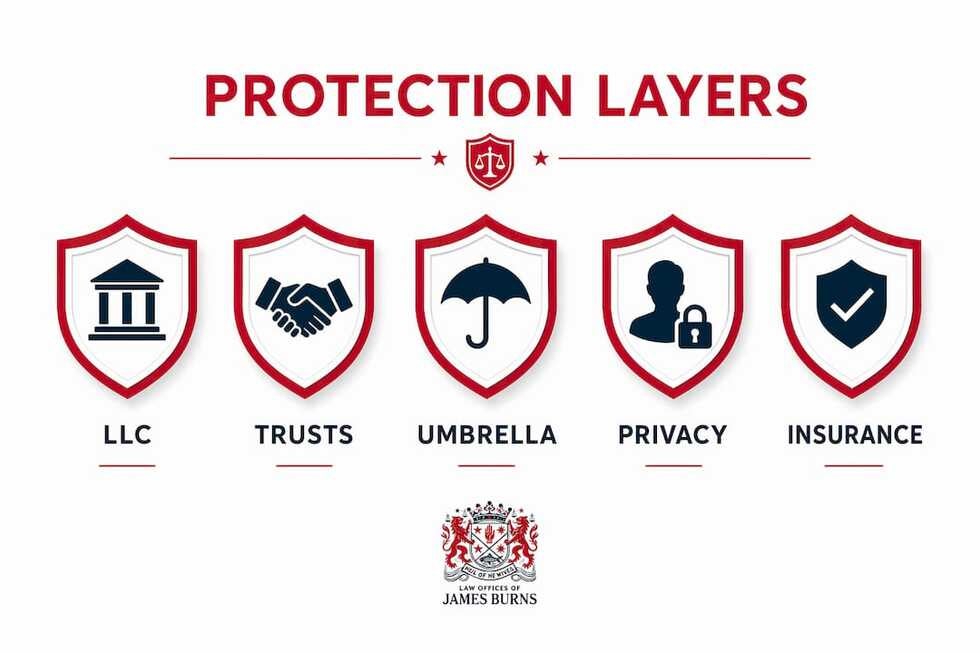
A layered system combining legal entities, trusts, insurance, and privacy measures is more effective than any single tool. Each layer addresses a different category of risk, and together they create a defense that is far harder for a plaintiff to penetrate.
Trusts as a second layer
Trusts protect assets from probate delays, shield ownership privacy, and help pass investment holdings to beneficiaries without court intervention. A land trust, for example, holds title to a property while keeping the beneficial owner's identity off public records. That privacy alone deters litigation because a plaintiff's attorney cannot easily identify what you own.
An irrevocable trust goes further. Assets transferred into an irrevocable trust are no longer legally yours, which means creditors generally cannot reach them. The trade-off is that you give up direct control, so this structure requires careful planning with a qualified attorney.
Umbrella insurance as a financial backstop
Insurance is a critical first line of defense but insufficient alone. A standard landlord policy typically covers property damage and basic liability. Umbrella insurance extends that coverage to catastrophic claims that exceed your base policy limits. A $2 million umbrella policy costs far less annually than the legal fees from a single major lawsuit.
How these layers work together
- The LLC separates your personal assets from rental property liability.
- The trust holds ownership of the LLC or the property, adding privacy and estate planning benefits.
- Landlord liability insurance pays covered claims before they reach your legal structures.
- Umbrella insurance covers catastrophic claims that exceed standard policy limits.
- Privacy measures like land trusts reduce your public profile as a target for litigation.
Pro Tip: Ask your attorney whether your LLC membership interests can be held inside a trust. This structure adds an extra layer between a creditor and your actual assets, and it simplifies the transfer of your portfolio to heirs.
Understanding why LLC structure matters in combination with trusts is the difference between a plan that holds up in court and one that collapses under scrutiny.
What practical steps can landlords take to build solid protection?
Effective asset protection requires action before any legal dispute begins. Courts can undo transfers made after a legal claim arises as "fraudulent conveyances." That means moving assets into an LLC or trust after you receive a lawsuit notice is legally ineffective and potentially criminal.
The steps that build a defensible structure include:
- Form separate LLCs for each property with significant equity or liability exposure.
- Maintain entity hygiene by keeping separate accounts, filing annual reports, and documenting all major decisions in writing.
- Set up a trust to hold your LLC membership interests or property titles, guided by a licensed estate planning attorney.
- Review your insurance coverage annually to confirm your landlord policy and umbrella limits match your current portfolio value.
- Avoid fraudulent transfers by implementing all structures before any dispute or known claim exists.
- Schedule a legal review at least once every two years, or whenever you acquire a new property, to update your plan.
Understanding LLC liability protection in detail helps landlords avoid the structural errors that make entities vulnerable. The mechanics matter as much as the intent.
Proper capitalization of your LLC is also non-negotiable. An undercapitalized entity, one with no real assets or operating funds, is a red flag courts use to justify piercing the veil. Fund your LLC adequately from the start and treat it as a real business.
Key Takeaways
Landlords who combine LLCs, trusts, and insurance into a layered defense protect their personal wealth far more effectively than those relying on any single structure alone.
| Point | Details |
|---|---|
|
Asset protection is urgent |
Only 27.5% of business owners have formal plans, leaving most landlords exposed to personal liability. |
|
LLCs require proper maintenance |
Commingling funds or using one LLC for multiple properties can void your liability shield in court. |
|
Trusts add privacy and estate benefits |
Land trusts and irrevocable trusts shield ownership identity and keep assets out of probate. |
|
Insurance alone is not enough |
Umbrella insurance is necessary to cover catastrophic claims that exceed standard landlord policy limits. |
|
Act before any dispute arises |
Courts void transfers made after a legal claim begins, making proactive planning the only effective approach. |
What I've learned from landlords who waited too long
I have worked with real estate investors who owned substantial portfolios with no legal structure beyond their name on the deed. When a lawsuit arrived, the scramble to form LLCs and move assets was not only legally ineffective. It created additional legal exposure through the appearance of fraudulent transfer.
The pattern I see most often is this: a landlord buys their first property, skips the LLC because it feels like extra paperwork, buys a second and third property the same way, and then faces a serious claim years later with everything exposed. The cost of forming and maintaining proper entities for those three properties would have been a fraction of one year's legal fees.
The other misconception I encounter constantly is that landlord liability insurance is sufficient. Insurance pays claims up to its limits and within its exclusions. A catastrophic injury, a discrimination lawsuit, or a claim that falls outside the policy language leaves you personally responsible for the remainder. Insurance is a financial buffer. Legal structures are the actual firewall.
What separates landlords who preserve their wealth from those who lose it is not the size of their portfolio. It is whether they built a layered defense before they needed it. The FortressWall Methodology™ that Jamesburnslaw applies to high-net-worth real estate portfolios is built on exactly this principle: map your exposure first, then build the architecture to contain it.
— James

Jamesburnslaw works with real estate landlords and property owners across California to build legal structures that hold up when it matters. The firm's asset protection services cover LLC formation, trust structuring, insurance coordination, and the ongoing entity hygiene that keeps your protection legally valid. Every plan starts with an exposure mapping session to identify exactly where your personal wealth is vulnerable. If you own rental property and have not reviewed your legal structure recently, the right time to act is now, before any claim forces your hand.
FAQ
What is asset protection for landlords?
Asset protection is a legal strategy that separates your personal wealth from your rental property liabilities using structures like LLCs, trusts, and insurance. The goal is to limit what a creditor or plaintiff can reach if a lawsuit succeeds.
Is an LLC enough to protect a landlord's personal assets?
An LLC provides foundational protection, but it is insufficient alone. Courts can pierce the corporate veil if you commingle funds or fail to maintain proper entity hygiene, and an LLC does not cover personal negligence claims.
How does umbrella insurance differ from landlord liability insurance?
Landlord liability insurance covers property damage and standard liability claims up to its policy limits. Umbrella insurance extends coverage to catastrophic claims that exceed those limits, providing a critical financial backstop.
When should a landlord set up asset protection?
Asset protection must be set up before any legal dispute or known claim arises. Courts treat transfers made after a claim begins as fraudulent conveyances and can void them, leaving your assets fully exposed.
Do I need a separate LLC for each rental property?
Best practice is one LLC per property with significant equity or liability exposure. A single LLC covering multiple properties pools all risk under one legal entity, meaning one lawsuit can threaten every asset inside it.
Authorities & Resources
California Secretary of State — Business Entities
https://www.sos.ca.gov/business-programs/business-entities
California Secretary of State — Starting a Business / Entity Types
https://www.sos.ca.gov/business-programs/business-entities/starting-business/types
California Franchise Tax Board — Limited Liability Companies
https://www.ftb.ca.gov/file/business/types/limited-liability-company/index.html
California Department of Real Estate — Landlord/Tenant Guide
https://www.dre.ca.gov/publications/ResourceGuidebook/index.html
California Department of Real Estate — Landlord Repair and Habitability Duties
https://www.dre.ca.gov/publications/ResourceGuidebook/gb09_dealingwith.html
California Courts — Eviction Cases in California
https://selfhelp.courts.ca.gov/eviction
U.S. Department of Housing and Urban Development — Fair Housing Act Overview
https://www.hud.gov/helping-americans/fair-housing-act-overview
U.S. Department of Justice — The Fair Housing Act
https://www.justice.gov/crt/fair-housing-act-1
California Civil Rights Department — Housing Discrimination
https://calcivilrights.ca.gov/housing/
California Legislative Information — Uniform Voidable Transactions Act / SB 161
https://www.leginfo.ca.gov/pub/15-16/bill/sen/sb_0151-0200/sb_161_bill_20150623_enrolled.htm
Related James Burns Law Articles
What Is Asset Protection? Strategies for Your Wealth
https://www.jamesburnslaw.com/what-is-asset-protection-strategies-for-your-wealth
How to Protect Family Wealth From Lawsuits in 2026
https://www.jamesburnslaw.com/how-to-protect-family-wealth-from-lawsuits-in-2026
Bulletproof Trusts vs. Living Trusts: Real Asset Protection in California
https://www.jamesburnslaw.com/the-bulletproof-trust-why-your-living-trust-won-t-save-you-from-a-lawsuit
Entering the War Room: How to Prepare for Your High-Net-Worth Legal Strategy Session
https://www.jamesburnslaw.com/entering-the-war-room-how-to-prepare-for-your-high-net-worth-legal-strategy-session
Owning Nothing, Controlling Everything: The Asset Protection Playbook of America's Quiet Billionaires
https://www.jamesburnslaw.com/owning-nothing-controlling-everything-the-asset-protection-playbook-of-america-s-quiet-billionaires
Using California Real Estate to Fund a Private Retirement Plan Trust
https://www.jamesburnslaw.com/using-california-real-estate-to-fund-a-private-retirement-plan-prp-trust-asset-protection-timing-and-statutory-compliance
Disclaimer / Attorney Advertising
This article is provided for general informational and educational purposes only and does not constitute legal, tax, financial, insurance, investment, or asset protection advice. Reading this article, relying on this article, or submitting information through this website does not create an attorney-client relationship with the Law Office of James Burns or James G. Burns, Esq.
Asset protection planning is highly fact-specific and depends on timing, solvency, creditor status, property ownership, entity maintenance, tax consequences, insurance coverage, and applicable state and federal law. Transfers made after a claim, lawsuit, creditor threat, insolvency event, or other legal exposure may be challenged as voidable or fraudulent transfers. No planning structure should be created, funded, or modified without advice from qualified legal, tax, insurance, and financial professionals familiar with the facts of the specific matter.
Prior results, examples, case studies, planning frameworks, or general descriptions of legal strategies do not guarantee any particular outcome. Laws change, and the application of law varies by jurisdiction and circumstance. Landlords, real estate investors, and property owners should consult qualified counsel before forming LLCs, transferring property, restructuring ownership, creating trusts, or relying on any asset protection strategy.
Intellectual Property Disclosure
The content of this article, including original commentary, organization, planning concepts, strategic explanations, graphics, diagrams, summaries, and branded methodology language, is owned by or licensed to the Law Office of James Burns unless otherwise indicated. All rights are reserved.
“FortressWall Methodology™,” “Legacy Protection Trust™,” and related branding, terminology, frameworks, and planning descriptions are proprietary identifiers and/or intellectual property of the Law Office of James Burns and may not be copied, reproduced, republished, modified, distributed, or used for commercial purposes without written permission.
Third-party authorities, statutes, agencies, courts, articles, and resources referenced or linked in this article are provided for reader convenience and attribution only. The Law Office of James Burns does not claim ownership over third-party materials and does not endorse, control, or guarantee the accuracy of external websites. Any quotation, reference, or citation to outside materials remains subject to the rights, terms, and limitations of the original source.

Comments
There are no comments for this post. Be the first and Add your Comment below.
Leave a Comment