

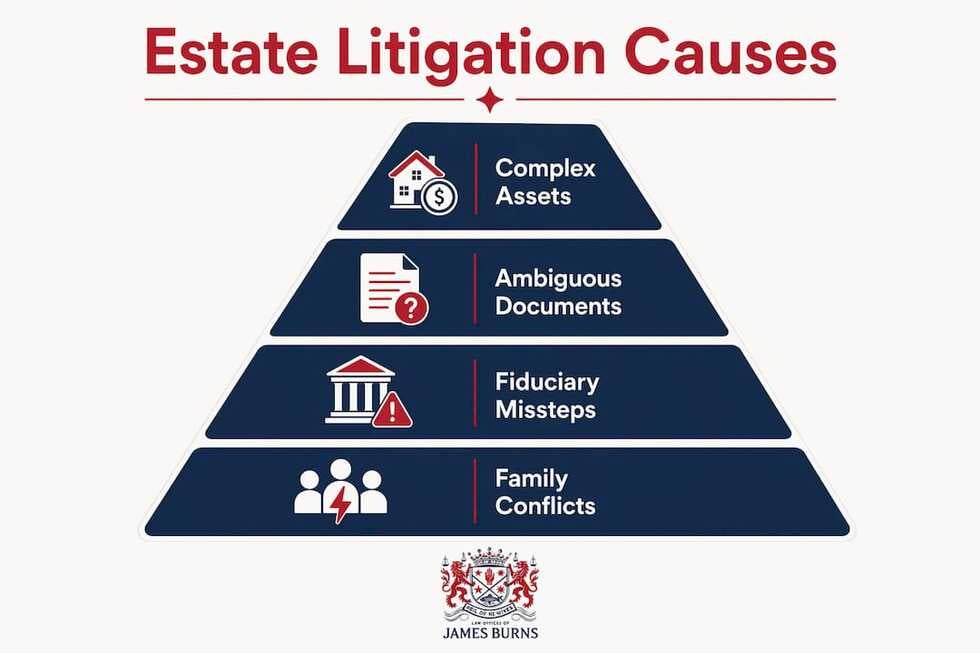
Estate litigation risk is defined as the legal exposure an estate faces when beneficiaries, heirs, or creditors challenge the validity, administration, or distribution of assets after a decedent's death. Why estates face litigation risk is rarely a single-cause problem. Ambiguous documents, complex asset portfolios, family conflict, and fiduciary misconduct typically converge, creating conditions where disputes become almost inevitable. For high-net-worth families in California managing estates valued between $5M and $100M or more, understanding these triggers is the first line of defense against costly probate battles and trust litigation.
Why estates face litigation risk: the core triggers
Estate litigation rarely erupts from a single cause. Multiple triggers reinforce one another, and the combination is almost always more dangerous than any one factor alone. A caregiver who gains influence over an elderly decedent, combined with cognitive decline and a secretive amendment to a trust, creates a perfect storm for a contested probate proceeding.
The most common triggers include:
- Undue influence and capacity challenges. Beneficiaries frequently allege that a decedent lacked testamentary capacity or was manipulated into changing estate documents. These claims are especially common when a caregiver or new romantic partner benefits unexpectedly.
- Trustee misconduct and lack of transparency. Fiduciaries who refuse to account or delay required actions face petitions for removal and compelled accountings. Secrecy is the fastest path to a courtroom.
- Last-minute estate plan changes. Late-life amendments that reduce beneficiaries are among the most litigated documents in probate courts. Without contemporaneous records of the decedent's reasoning and mental state, these changes are nearly impossible to defend.
- Blended family conflicts. Competing claims between a surviving spouse and children from a prior marriage are predictable and common. Courts in California see these disputes regularly.
- Unequal distributions without explanation. When one child receives significantly more than another and no written explanation exists, litigation follows.
Pro Tip: Document every significant estate planning decision with a written memorandum of intent, signed and dated at the time of the change. This single step defeats the majority of undue influence claims before they reach a courtroom.
How do complex assets increase litigation exposure?

High-net-worth estates carry elevated litigation exposure because the assets themselves are harder to administer, value, and distribute. Growing disputes link directly to asset complexity and rapid changes in portfolio composition that leave estate plans outdated and mismatched to actual holdings.
The asset classes that generate the most disputes are:
- Closely held businesses. Valuation disagreements are common. Minority interest discounts, buy-sell agreements, and succession rights all create grounds for challenge.
- Multi-jurisdiction real estate. Property held across California, Nevada, and other states requires ancillary probate proceedings in each state, multiplying administrative complexity and dispute opportunities.
- Digital assets and cryptocurrency. Access, custody, and valuation of Bitcoin, NFTs, and other digital holdings remain legally unsettled in most jurisdictions. Estates without explicit digital asset provisions face near-certain disputes.
- Rapidly changing portfolios. A family that acquires significant real estate or business interests after drafting an estate plan may find that the plan no longer reflects actual holdings, creating gaps that beneficiaries exploit.
| Asset Type | Primary Litigation Risk |
|---|---|
|
Closely held business |
Valuation disputes, succession conflicts |
|
Multi-jurisdiction real estate |
Ancillary probate, competing claims |
|
Digital assets |
Access, custody, and valuation uncertainty |
|
Rapidly changing portfolio |
Outdated planning, mismatched distributions |
Operational complexities in administering complex assets can mimic intent disputes, creating additional litigation risk even where the underlying planning was sound. A trustee who cannot access a cryptocurrency wallet is not acting in bad faith, but beneficiaries may allege misconduct anyway.
Why are blended families a predictable source of estate disputes?
Blended family disputes in estate matters are mostly predictable. Natural tensions and competing financial obligations between a surviving spouse and children from a prior marriage create structural conflict that poor planning cannot contain. The conflict is not a surprise. It is a mathematical certainty when competing interests are not addressed directly in the estate plan.
The most common fault lines in blended family estates include:
- A surviving spouse controls a trust that was intended to benefit children from the decedent's first marriage. The children allege the spouse is diverting assets.
- A decedent leaves equal shares to biological children and stepchildren, but the biological children believe the stepchildren have no legitimate claim.
- A will and a trust contain contradictory distribution instructions, leaving the trustee with no clear authority and beneficiaries with competing legal arguments.
- A parent makes verbal promises to one child that are never reflected in the estate documents. The child sues the estate when the promise goes unfulfilled.
Mismatched wills, trusts, and beneficiary designations create legal ambiguities that courts must resolve, and that resolution is expensive for everyone involved. A beneficiary designation on a retirement account that contradicts the trust instrument is not a minor clerical error. It is a litigation trigger.
Pro Tip: In blended family situations, a qualified personal residence trust (QPRT) or a carefully drafted QTIP trust can separate the surviving spouse's rights from the children's remainder interests. Clear structural separation prevents the most common disputes before they start. Jamesburnslaw regularly structures these arrangements for California families through the FortressWall Methodology.
What makes estate litigation often predictable rather than unexpected?
Estate disputes arise from expectations colliding with legal realities, not from random misfortune. When families lack transparency and coordinated planning, the collision is not a matter of if but when. Practitioners who handle trust and estate litigation regularly see the same patterns repeat across different families and different asset classes.
"Estate litigation is not usually a surprise to the people who understand the family. It is a surprise only to the people who thought the plan was good enough." This is the defining insight that separates reactive estate administration from proactive wealth defense architecture.
Several warning signs predict litigation before it happens. A decedent who isolates from family members in the final years of life creates undue influence exposure. A trustee who communicates infrequently and provides no accountings is building a case against himself. A family with a history of financial conflict and no formal dispute resolution mechanism in the trust document is one death away from a courtroom.
Increased financial pressure, rising property values, and growing complexity of family setups all promote earlier challenge behavior. Beneficiaries today are more financially sophisticated and more willing to retain counsel than prior generations. The practical signs families should watch for include unexplained changes to estate documents, a fiduciary who resists providing information, and beneficiaries who are receiving inconsistent information from different family members. Each of these is a litigation signal, not a family disagreement.
Contemporaneous documentation is the most underused defense tool in estate planning. Every time a client changes a trust, reduces a beneficiary's share, or adds a new beneficiary, the attorney should create a written record of the client's stated reasoning and mental state at that moment. That record becomes the primary defense if the change is later challenged.
Key Takeaways
Estates face litigation risk when multiple triggers converge, including ambiguous documents, complex assets, fiduciary misconduct, and blended family conflicts that courts must resolve at significant cost to all parties.
| Point | Details |
|---|---|
|
Multiple triggers converge |
Litigation rarely has one cause; undue influence, secrecy, and complex assets amplify each other. |
|
Complex assets multiply risk |
Closely held businesses, digital assets, and multi-jurisdiction real estate each create distinct dispute pathways. |
|
Blended families need structural separation |
QTIP and QPRT structures prevent the most common spousal and stepchild conflicts before they start. |
|
Documentation defeats most claims |
Contemporaneous records of estate plan changes are the primary defense against undue influence challenges. |
|
Transparency reduces fiduciary risk |
Trustees who communicate regularly and account promptly face far fewer enforcement petitions. |
What I have learned after years of watching estates go to war
After working with high-net-worth families across California for years, the pattern I see most often is not malice. It is silence. A parent who never explained why one child received more. A trustee who assumed the beneficiaries would trust him without needing to see the numbers. A couple in a second marriage who never had the hard conversation about what happens to the family home when one of them dies.
The families who avoid litigation are not the ones with the most sophisticated documents. They are the ones who treated estate planning as a communication exercise, not just a legal exercise. The document is the last line of defense. The conversation is the first.
I have also seen how rapidly changing asset portfolios create invisible litigation risk. A client acquires a significant real estate portfolio after drafting a trust, and nobody updates the plan. The trust says one thing. The deeds say another. The beneficiaries hire lawyers. The fiduciary roles and authority that should have been clearly defined become the subject of a two-year court battle.
My honest recommendation is this: review your estate plan every two years, or immediately after any significant asset acquisition, marriage, divorce, or death in the family. The cost of that review is a fraction of one day of probate litigation. The families I worry about most are the ones who drafted a plan a decade ago and have not looked at it since.
— James
Protecting your estate from litigation before it starts

Jamesburnslaw works with high-net-worth families in California to identify and close the gaps that create litigation exposure. The FortressWall Methodology™ maps every potential conflict point across your estate, from fiduciary selection to asset titling to beneficiary coordination, and builds a control architecture designed to hold under pressure. Whether your estate includes closely held business interests, multi-jurisdiction real estate, or complex trust structures, the firm provides estate planning and litigation risk mitigation tailored to estates ranging from $5M to over $100M. Families with blended structures, digital assets, or recent portfolio changes face the highest exposure. Addressing those risks now, with experienced counsel, is the most cost-effective decision you can make for your legacy.
FAQ
What is the most common cause of estate litigation?
Estate litigation most often arises when multiple triggers converge, including undue influence, capacity challenges, trustee misconduct, and ambiguous documents. No single cause is as dangerous as the combination of unclear intent, poor fiduciary behavior, and competing beneficiary expectations..
How do blended families increase the risk of estate disputes?
Blended families create structural conflict between a surviving spouse and children from prior marriages. Competing expectations over fair distribution are predictable and require explicit structural solutions in the estate plan, not just general language about equal treatment.
Can a trustee's behavior trigger estate litigation?
Yes. Trustees who fail to disclose information or delay required actions face petitions for removal and compelled accountings. Transparency and timely administration are the most effective tools a fiduciary has to avoid court.
Do last-minute changes to a will or trust increase litigation risk?
Last-minute amendments are among the most litigated estate documents. Late-life changes that reduce a beneficiary's share require contemporaneous documentation of the decedent's reasoning and mental capacity to survive a challenge.
How can high-net-worth families reduce estate litigation risk?
Families should review estate plans every two years, document every significant change, select fiduciaries with care, and use asset protection strategies that address both legal and operational complexity. Clear communication within the family reduces conflict as much as any legal structure.

Comments
There are no comments for this post. Be the first and Add your Comment below.
Leave a Comment