

An estate plan becomes outdated the moment it no longer reflects your current family, financial situation, or applicable law. This is the central risk in estate planning, and it is more common than most families realize. Estate planning attorneys recommend reviewing your plan every 3 to 5 years even without major life changes, because tax laws shift, family structures evolve, and asset portfolios grow in ways that old documents simply cannot anticipate. Outdated plans routinely cause unintended inheritance outcomes, unnecessary probate delays, and tax inefficiencies that erode the very wealth you worked to protect.
Why estate plans become outdated: the core causes
Estate plans fail to keep pace with life for three primary reasons: personal circumstances change, financial positions shift, and the law evolves. Each of these forces operates independently, which means your plan can become misaligned on multiple fronts simultaneously without any single dramatic event triggering a review.
The estate planning life cycle does not end at signing. Legal documents do not expire, but their relevance fades as the world around them changes. A trust drafted in 2015 may name fiduciaries who have since died, reference exemption formulas that no longer match current law, and omit assets acquired after the signing date. That document is still legally valid. It is simply no longer accurate.

The practical consequence is serious. A plan that does not reflect your current reality can distribute assets to the wrong people, expose your estate to avoidable taxes, and leave your family fighting legal battles during an already difficult time. Understanding what makes estate plans outdated is the first step toward preventing those outcomes.
What common life events cause estate plans to become outdated?
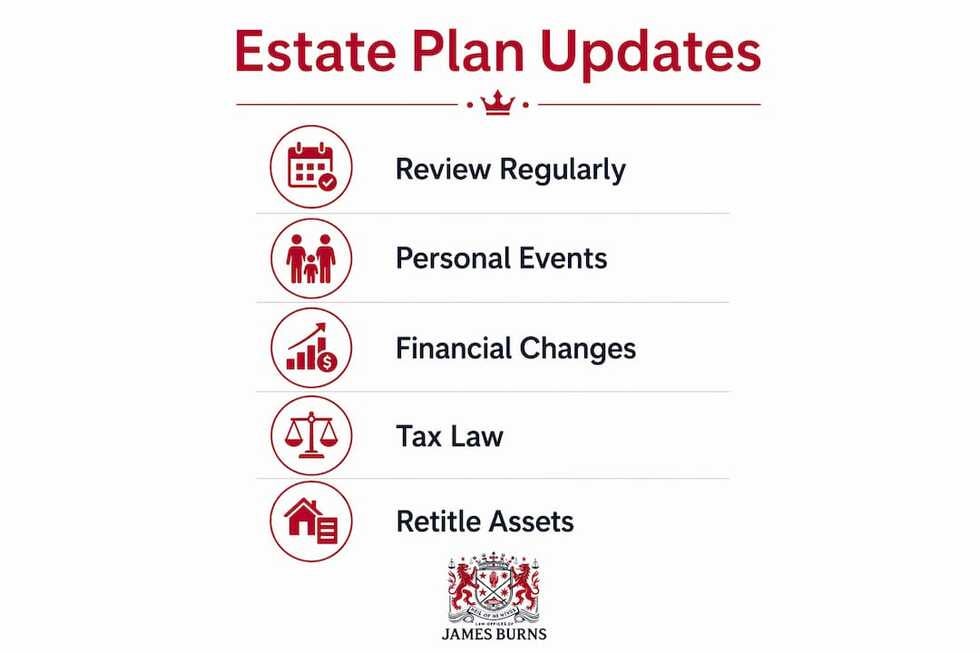
Personal milestones are the most frequent trigger for plan obsolescence. Six major life events require an immediate estate plan review: marriage, divorce, birth of a child, death of a named fiduciary or beneficiary, relocation to another state, and significant changes in assets or business ownership. Each one can alter the names, roles, and financial stakes embedded in your documents.
Consider a divorce. If your ex-spouse remains named as the primary beneficiary on a life insurance policy or retirement account, that designation controls the payout regardless of what your will says. Courts have repeatedly upheld beneficiary designations that directly contradicted the decedent's stated wishes, simply because the forms were never updated. The same logic applies to a remarriage where a new spouse is not added to existing documents.
Relocating to another state creates a different set of problems. State laws governing community property, probate thresholds, and trust administration vary significantly. A plan drafted under California law may not function as intended if you move to Texas or Florida without updating it to reflect the new legal environment.
Key life events that demand an immediate plan review include:
- Marriage or remarriage: Add or update spousal rights, beneficiary designations, and powers of attorney.
- Divorce: Remove an ex-spouse from all documents, accounts, and insurance policies.
- Birth or adoption of a child: Name guardians and establish or fund trusts for minors.
- Death of a fiduciary or beneficiary: Replace executors, trustees, and named heirs.
- State relocation: Verify that existing documents comply with the new state's laws.
- Major asset changes: Retitle new property into trusts and update schedules of assets.
Pro Tip: After any major life event, review not just your will and trust but every beneficiary designation form on file with financial institutions and insurance carriers. Those forms override your will.
How do financial changes and tax law updates make estate plans obsolete?
Financial growth is one of the most overlooked reasons estate plans become outdated. When a family's net worth crosses a new threshold, whether through a business sale, real estate appreciation, or inheritance, the tax exposure and planning strategies that apply change materially. An estate plan built for a $5 million estate may be entirely inadequate for a $25 million estate.
Tax legislation compounds this problem. The Tax Cuts and Jobs Act of 2017 dramatically increased the federal estate tax exemption, and the One Big Beautiful Bill Act of 2025 introduced further changes that affect gift tax limits and exemption calculations. Older estate plans with formula-based exemption clauses are particularly vulnerable. A formula written under pre-2017 law may now over-fund a bypass trust, stripping assets from a surviving spouse, or under-fund it, exposing the estate to unnecessary tax.
The table below illustrates how the federal estate tax exemption has shifted over recent years and why plans drafted under older figures require review.
| Year | Federal Estate Tax Exemption (per person) | Planning implication |
|---|---|---|
|
2017 (pre-TCJA) |
$5.49 million |
Many bypass trusts funded at this level |
|
2020 |
$11.58 million |
Formula clauses may have over-funded trusts |
|
2023 |
$12.92 million |
Plans drafted pre-2017 increasingly misaligned |
|
2026 (post-OBBBA) |
$15 million |
Requires immediate formula clause review |
Consulting legal counsel before a liquidity event, such as selling a business, is critical. Tax-efficient strategies like grantor retained annuity trusts, charitable remainder trusts, or qualified opportunity zone investments must be structured before a transaction closes. Waiting until after the sale eliminates most of the available options.
Pro Tip: If your estate plan references a specific dollar amount or a formula tied to the "applicable exclusion amount," have an attorney review it immediately. The exemption has changed multiple times since 2017, and your formula may no longer do what you intended.
Why are outdated beneficiary designations and asset titling serious risks?
Beneficiary designation errors are a leading cause of unintended inheritance outcomes, and they are entirely preventable. Designations on retirement accounts, life insurance policies, and payable-on-death bank accounts take legal precedence over your will and trust. No matter how carefully your trust is drafted, a conflicting beneficiary form controls the asset.
Assets such as brokerage accounts, real estate, and business interests must be manually retitled into a trust to avoid probate. Many families sign a revocable living trust and then never transfer their assets into it. The result is a trust that controls nothing, because the assets were never legally placed inside it. Probate then becomes unavoidable for those untitled assets.
Powers of attorney carry a related risk. Financial institutions frequently reject powers of attorney that are older than 1–3 years or that lack specific modern language required by current state statutes. When a bank refuses to honor an outdated document during a period of incapacity, the family's only recourse may be a costly and time-consuming court-ordered conservatorship. Durable Powers of Attorney are usually recommended to avoid the time lapse on most.
Assets most commonly overlooked or misaligned in estate plans include:
- Retirement accounts (IRAs, 401(k)s): Governed entirely by beneficiary designation, not by will or trust.
- Life insurance policies: Outdated designations frequently name ex-spouses or deceased individuals.
- Brokerage and investment accounts: Require retitling or TOD (transfer-on-death) designations to avoid probate.
- Real estate: Deeds must be updated to reflect trust ownership or joint tenancy arrangements.
- Business interests: Operating agreements and buy-sell provisions must align with estate plan objectives.
Keeping beneficiary designations current is not a one-time task. Every account opened, every policy issued, and every major life change creates a new opportunity for misalignment.
How often should you review and update your estate plan?
The standard professional recommendation is a formal estate plan review every 3 to 5 years, even when no major life changes have occurred. This interval accounts for gradual shifts in tax law, changes in state statutes, and the natural evolution of family and financial circumstances that accumulate quietly over time.
That baseline interval is a floor, not a ceiling. Certain events demand an immediate review regardless of when the last one occurred. A numbered list of the most common triggers and their recommended response times follows:
- Marriage or divorce: Review within 30 days. Update all beneficiary designations and fiduciary appointments.
- Birth or adoption: Review within 60 days. Name guardians and establish or fund trusts for minors.
- Death of a named party: Review within 90 days. Replace executors, trustees, and beneficiaries as needed.
- Significant asset change: Review before or immediately after the transaction. Retitle assets and update schedules.
- Tax law change: Review within the calendar year. Assess formula clauses and exemption-based provisions.
- State relocation: Review before or immediately after the move. Verify compliance with new state law.
- Routine review (no triggering event): Every 3 to 5 years as a standard maintenance interval.
Estate planning is a dynamic process, not a product you purchase once and file away. The real work lies in ongoing administration: verifying that asset titles match trust schedules, confirming that beneficiary designations reflect current intentions, and ensuring that fiduciary appointments name people who are still alive, willing, and capable. Families who treat their estate plan as a living document avoid the legal and financial complications that catch others off guard.
Reviewing your estate planning documents regularly also gives you the opportunity to communicate your intentions to your family and fiduciaries. Surprises at the time of death or incapacity create conflict. Clarity, documented and current, prevents it.
Key Takeaways
Estate plans become outdated because life, finances, and tax law change continuously, and a plan that does not reflect current reality will distribute assets incorrectly, trigger avoidable taxes, and delay your family's access to what you intended for them.
| Point | Details |
|---|---|
|
Review every 3–5 years |
Even without major changes, tax law and family dynamics shift enough to require a formal review. |
|
Life events demand immediate action |
Marriage, divorce, birth, death, relocation, and asset changes each require prompt plan updates. |
|
Beneficiary forms override wills |
Designations on retirement accounts and insurance policies control assets regardless of what your trust says. |
|
Retitle assets into trusts |
Unsigned or untitled assets bypass the trust entirely and go through probate, defeating the plan's purpose. |
|
Tax law changes affect formulas |
Exemption-based trust formulas written under old law may now over- or under-fund trusts with serious tax consequences. |
The "set it and forget it" trap I see every week
The most expensive mistake I see families make is not drafting a bad estate plan. It is drafting a good one and then never touching it again. A well-structured trust from 2016 is not a well-structured trust in 2026. The Tax Cuts and Jobs Act alone changed the calculus for nearly every estate plan built around the old exemption figures.
What surprises people is how quietly a plan can become dangerous. No alarm goes off when your named trustee moves out of state or when a formula clause stops working as intended. The document looks the same. It just no longer does what you think it does.
The families I work with who avoid these problems share one habit: they treat their estate plan the way they treat their investment portfolio. They review it regularly, they update it when circumstances change, and they consult counsel before major financial events, not after. Selling a business without first coordinating with your estate planning attorney is one of the most costly mistakes in wealth management. The tax-efficient structures that could have preserved millions are simply unavailable once the transaction closes.
My advice is direct: schedule a review now if you have not looked at your plan in the last three years. Bring your financial statements, your list of accounts, and your beneficiary designation records. The goal is not to redraft everything. The goal is to verify that what you have still reflects who you are and what you own.
— James
How Jamesburnslaw keeps your estate plan working for you
An estate plan that has not been reviewed in three or more years is a liability, not a protection.

Jamesburnslaw works with high-net-worth families in California to identify exactly where existing plans have drifted out of alignment with current law, current assets, and current family structures. Using the FortressWall Methodology™, the firm maps every exposure point across your estate, from beneficiary designations and asset titling to trust funding and tax exemption formulas, and rebuilds the architecture where needed. Whether your estate has grown through a business sale, an inheritance, or real estate appreciation, a coordinated review ensures your plan reflects your actual position. Schedule a consultation with Jamesburnslaw to bring your estate plan current before the next change in law or life makes the gap wider.
FAQ
How often should you update your estate plan?
Estate planning attorneys recommend a formal review every 3 to 5 years as a baseline. Major life events such as marriage, divorce, or a significant asset change require an immediate review regardless of the last scheduled date.
Do beneficiary designations override a will?
Yes. Beneficiary designations on retirement accounts, life insurance policies, and payable-on-death accounts take legal precedence over your will and trust. Keeping those designations current is as critical as maintaining the trust documents themselves.
What happens if assets are not retitled into a trust?
Assets not retitled into a trust bypass the trust entirely and pass through probate. Probate is a public, court-supervised process that delays distribution, increases costs, and can undermine the privacy and efficiency your trust was designed to provide.
Can tax law changes make my estate plan harmful?
Yes. Formula-based exemption clauses written under pre-2017 law may now over-fund or under-fund bypass trusts due to changes introduced by the Tax Cuts and Jobs Act and subsequent legislation. That misalignment can strip assets from a surviving spouse or create unintended tax exposure.
Will a bank accept an old power of attorney?
Financial institutions frequently reject powers of attorney older than 1–3 years or those lacking current statutory language. If a bank refuses your document during a period of incapacity, the family may need a court-ordered guardianship, which is costly and time-consuming.
Legal Disclaimer
This article is provided for general educational and informational purposes only and should not be relied upon as legal, tax, financial, or accounting advice. Estate planning outcomes depend on the specific facts of each family, the nature and title of the assets involved, beneficiary designations, trust language, state law, federal tax law, and the timing of any legal or financial changes.
Reading this article does not create an attorney-client relationship with the Law Office of James Burns or James G. Burns, Esq. No attorney-client relationship is formed unless and until a written engagement agreement is signed and accepted by the firm. You should not act, delay acting, or make legal or financial decisions based solely on this article without first consulting qualified legal and tax professionals.
Estate planning laws, probate rules, tax exemptions, and administrative practices may change. The information in this article may not apply to your particular situation or jurisdiction. Prior results, examples, or planning concepts discussed here do not guarantee a similar outcome. This material may be considered attorney advertising under applicable rules.
Intellectual Property Disclosure
This article, including its structure, analysis, commentary, headings, summaries, graphics, examples, and related estate planning framework, is the intellectual property of the Law Office of James Burns unless otherwise noted. All rights are reserved.
The terms, concepts, and proprietary planning references used by the firm, including the FortressWall Methodology™, are used to describe the firm's approach to estate planning diagnostics, trust review, asset alignment, beneficiary coordination, and wealth-protection architecture. Any trademarks, service marks, trade names, or proprietary methodologies referenced remain the property of their respective owners.
This content may not be copied, republished, scraped, rewritten, sold, distributed, or used to train artificial intelligence systems or derivative commercial materials without written permission. Limited excerpts may be quoted for educational or commentary purposes only if proper attribution is given to JamesBurnsLaw.com with a clear link back to the original source.

Comments
There are no comments for this post. Be the first and Add your Comment below.
Leave a Comment