
Asset protection is defined as a proactive legal and financial process that shields personal and business wealth from lawsuits, creditors, and financial claims before any threat arises. Business owners face a disproportionate level of litigation risk compared to employees, making formal protection planning a necessity rather than an option. Over 85% of successful business owners worry about unjust lawsuits or divorce, yet only about 27.5% have formal plans in place. That gap represents an enormous and largely unaddressed financial vulnerability. Understanding why business owners need asset protection starts with recognizing that the legal system does not reward those who wait.
Why business owners need asset protection
Asset protection is not about hiding wealth or evading legitimate obligations. It is about building a transparent legal wall around your assets so that creditors, plaintiffs, and claimants face significant barriers before they can reach what you have built. The primary goal is to raise the cost and complexity of collection to a level that forces settlement rather than prolonged litigation.
Timing is the single most critical factor in asset protection planning. Fraudulent conveyance laws prohibit transferring assets after a claim has already arisen. Pre-claim planning creates enforceable legal barriers; post-claim transfers can be reversed by courts and may expose you to additional penalties. Business owners who wait until they receive a lawsuit notice have already lost their best options.
The risks that make protection necessary are real and varied. Business owners face exposure from multiple directions:
- Lawsuits from clients or customers alleging negligence, breach of contract, or product liability
- Employee claims including wrongful termination, discrimination, and wage disputes
- Business debt and bankruptcy that can reach personal assets without proper entity separation
- Divorce proceedings that can treat business equity as marital property
- Tax disputes with the IRS or California Franchise Tax Board that can result in liens and levies
Businesses with $5M or more in revenue face at least one lawsuit annually in 67% of cases, with litigation costs that can exceed $500,000. That figure does not include reputational damage or the operational disruption of defending a claim. Asset protection planning addresses all of these risks before they materialize.
What are the most effective asset protection strategies?
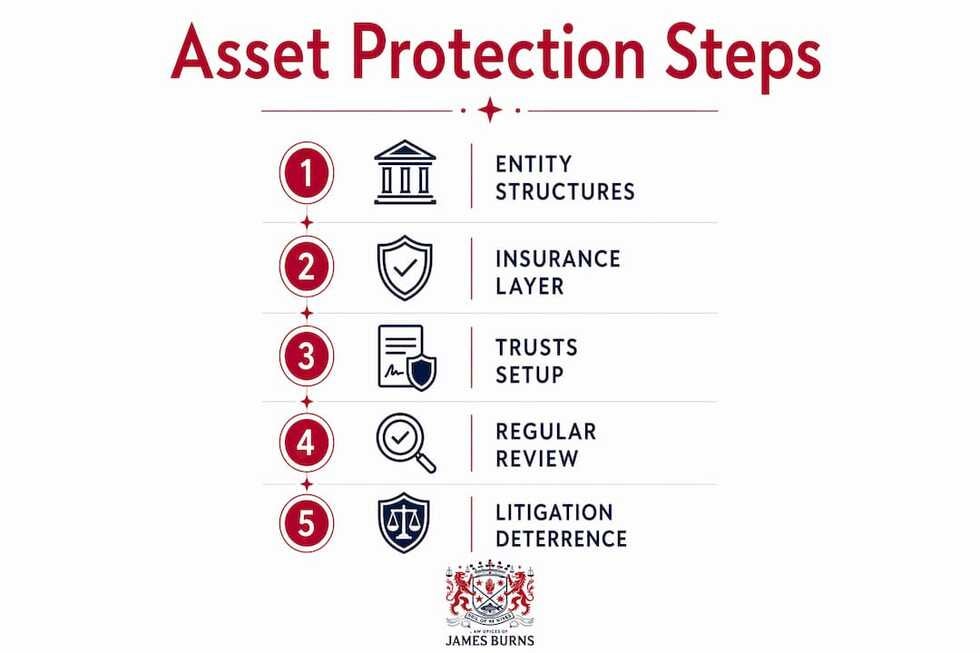
The most effective asset protection architecture uses multiple layers: entity structures, insurance, and trusts working together. No single tool provides complete coverage, and the right combination depends on the size, structure, and risk profile of your business.

Entity structures: LLCs and limited partnerships
A limited liability company (LLC) is the foundational tool for separating personal and business liability. LLCs shield personal assets from business liabilities and often limit creditor recovery to a charging order, which prevents a creditor from seizing or liquidating the entity's assets directly. A charging order only entitles the creditor to distributions if and when the business makes them. This makes collection difficult and expensive, which is exactly the deterrent effect asset protection seeks to create.
Limited partnerships offer a similar structure, particularly useful for real estate investors and family business owners who want to separate management control from ownership interests. The general partner manages operations while limited partners hold economic interests with reduced personal liability exposure.
| Structure | Primary benefit | Key limitation |
|---|---|---|
|
LLC |
Separates personal and business liability |
Requires strict compliance to maintain protection |
|
Limited partnership |
Separates management from ownership |
General partner retains personal liability |
|
Irrevocable trust |
Removes assets from grantor's legal ownership |
Requires relinquishing control of transferred assets |
|
Business insurance |
First line of defense against direct claims |
Does not protect against all liability types |
Trusts: irrevocable vs. revocable
The distinction between revocable and irrevocable trusts is one of the most misunderstood areas of asset protection planning. Only irrevocable trusts with properly relinquished control protect assets from creditors. A revocable living trust, which many business owners already have as part of their estate plan, provides no creditor protection because you retain the legal right to reclaim those assets at any time. Courts treat revocable trust assets as still belonging to you.
An irrevocable trust removes assets from your legal ownership. Once transferred, those assets are no longer yours in the eyes of the law, which means creditors generally cannot reach them. Domestic asset protection trusts (DAPTs), available in states like Nevada and South Dakota, allow the grantor to be a discretionary beneficiary while still achieving creditor protection. California does not recognize DAPTs, which is why California business owners often work with out-of-state trust structures under the guidance of qualified counsel.
Insurance as the first line of defense
Insurance is the first line of defense against claims, reducing the need for complex legal structures to absorb every hit. General liability insurance covers bodily injury and property damage claims. Professional liability insurance, also called errors and omissions (E&O) coverage, protects against claims of negligence in professional services. Business owners in high-risk industries should also consider umbrella policies that extend coverage limits across multiple underlying policies.
Pro Tip: Never treat insurance as your only protection layer. Insurance covers many claims, but policy limits, exclusions, and coverage gaps mean that a single large judgment can still reach your personal assets. Layer insurance with entity structures and trusts for full coverage architecture.
What mistakes undermine asset protection for business owners?
The most common asset protection errors are not strategic failures. They are operational ones. Business owners build the right structures and then fail to maintain them.
- Commingling personal and business funds. Failing to maintain separation between personal and business finances is the primary reason courts pierce the corporate veil. When a court pierces the veil, your LLC or corporation no longer protects your personal assets. Separate bank accounts, separate credit cards, and separate bookkeeping are non-negotiable.
- Relying on a revocable trust for creditor protection. As noted above, revocable trusts do not protect assets from creditors. Business owners who believe their living trust shields their wealth from lawsuits are carrying a false sense of security.
- Attempting protection after a claim arises. Fraudulent conveyance laws exist precisely to prevent last-minute transfers. Any transfer made with the intent to hinder, delay, or defraud a creditor can be unwound by a court, and the attempt itself may create additional legal exposure.
- Ignoring corporate formalities. Annual meetings, proper resolutions, and accurate record-keeping are not bureaucratic formalities. They are the evidence a court reviews when deciding whether your entity deserves its liability shield.
- Failing to update the plan. Business growth, new assets, new partners, and changing family circumstances all affect your exposure profile. A plan built for a $2M business may be wholly inadequate for a $15M one.
Pro Tip: Schedule a formal asset protection review every year, ideally in the first quarter. Treat it the same way you treat your annual tax filing. Both protect your financial position; one just does it prospectively.
How do you build a sound asset protection plan?
A sound asset protection plan follows a structured process. Improvising this area of your financial life is expensive.
- Map your exposure. Identify every asset category you own: real estate, business equity, investment accounts, retirement accounts, and personal property. Then identify every category of risk your business faces: contract disputes, professional liability, employee claims, and regulatory exposure. This exposure mapping is the foundation of Jamesburnslaw's FortressWall Methodology™.
- Consult qualified legal and financial professionals. Asset protection intersects tax law, estate planning, and business law. A general practice attorney is rarely equipped to handle all three. Work with counsel who specializes in this area and understands California-specific rules, including community property laws that affect how business assets are treated in divorce.
- Build your entity structure first. Form the appropriate entities before you accumulate significant assets inside them. Retroactive restructuring is harder to defend and may trigger fraudulent conveyance scrutiny.
- Layer in insurance coverage. Review your existing policies for gaps. Confirm that your general liability, professional liability, and umbrella policies are sized to your current revenue and risk profile, not the profile you had three years ago.
- Establish trust structures where appropriate. For business owners with estates above $5M, irrevocable trust structures provide a critical additional layer. International asset protection strategies may also be relevant for owners with cross-border holdings or significant liquid wealth.
- Document everything. Proper bookkeeping, separate accounts, and adherence to corporate formalities are what make your protection structures defensible in court.
- Review and update annually. Asset protection plans must be reviewed and updated yearly as your business grows or circumstances change. Many owners neglect this step and find their protection has eroded without their knowledge.
Key Takeaways
Business owners who build layered asset protection plans before any claim arises are far better positioned to deter litigation, limit personal liability, and preserve generational wealth.
| Point | Details |
|---|---|
|
Timing is everything |
Asset protection only works when built before a claim arises; post-claim transfers can be reversed by courts. |
|
LLCs limit personal exposure |
A properly maintained LLC restricts creditor recovery to charging orders, not direct asset seizure. |
|
Irrevocable trusts protect; revocable trusts do not |
Only irrevocable trusts remove assets from your legal ownership and shield them from creditors. |
|
Insurance is the first layer, not the only layer |
Insurance covers many claims but cannot replace entity structures and trusts for full protection. |
|
Annual reviews preserve effectiveness |
Plans built for an earlier stage of your business may leave significant gaps as your wealth grows. |
What I have learned about asset protection after years of working with business owners
Most business owners I work with are not reckless. They are busy. They built their companies through discipline and focus, and they assume that same discipline protects them legally. It does not. The legal system does not reward hard work. It rewards preparation.
The pattern I see repeatedly is this: a business owner spends years building real wealth, then faces a single lawsuit or divorce proceeding that exposes everything because the protection architecture was never built. The tragedy is not just financial. It is the realization that the exposure was entirely preventable.
What I find most underappreciated is the deterrence effect of a well-structured plan. A well-built protection plan deters creditors by making collection costs higher than potential recovery. Plaintiffs and their attorneys evaluate the cost of litigation against the likelihood of recovery. When your assets are properly structured inside LLCs, irrevocable trusts, and other legal barriers, the math often does not favor pursuing you aggressively. Many cases settle for far less, or do not proceed at all.
The other thing I tell every client: asset protection is not a one-time event. It is a discipline. Your business changes. Your family changes. Tax law changes. The plan you built five years ago may have gaps that did not exist when you signed the documents. The owners who maintain their protection architecture with the same rigor they apply to their financial statements are the ones who sleep well.
— James
How Jamesburnslaw protects what you have built
Jamesburnslaw works with business owners and high-net-worth families across California to design protection architectures that hold up under real legal pressure. The firm's FortressWall Methodology™ begins with a detailed exposure mapping process, identifying every vulnerability in your current structure before building the legal barriers that address them.

Whether you own a single business entity or a portfolio of operating companies and real estate holdings, the approach is the same: layered protection built before any claim arises, maintained with annual reviews, and structured to deter litigation rather than simply respond to it. For business owners with estates ranging from $5M to over $100M, the stakes are too high for generic planning. Visit Jamesburnslaw to schedule a consultation and start building a protection plan that matches the scale of what you have built.
FAQ
What is asset protection for business owners?
Asset protection is a legal and financial process that builds barriers around personal and business wealth to deter lawsuits and limit creditor access before any claim arises. It uses tools like LLCs, irrevocable trusts, and insurance in combination.
Does an LLC fully protect personal assets?
An LLC limits creditor recovery to a charging order in most cases, but courts can pierce the corporate veil if owners commingle personal and business funds or ignore corporate formalities. Maintaining strict separation is required to preserve the protection.
Can I set up asset protection after a lawsuit is filed?
No. Fraudulent conveyance laws allow courts to reverse asset transfers made after a claim arises. Effective asset protection must be established before any threat or claim exists.
Is a revocable living trust enough to protect my assets?
A revocable living trust does not protect assets from creditors because you retain legal ownership of those assets. Only irrevocable trusts, where control is properly relinquished, provide creditor protection.
How often should I update my asset protection plan?
Asset protection plans should be reviewed and updated at least once a year, and after any major business or personal change such as acquiring new assets, adding partners, or significant revenue growth.

Comments
There are no comments for this post. Be the first and Add your Comment below.
Leave a Comment