

Most advisors won't tell you where the real vulnerability lives in your wealth plan: until after the audit notice arrives, the lawsuit gets filed, or the death event reveals every crack in your supposed "protection."
The Paperwork Illusion
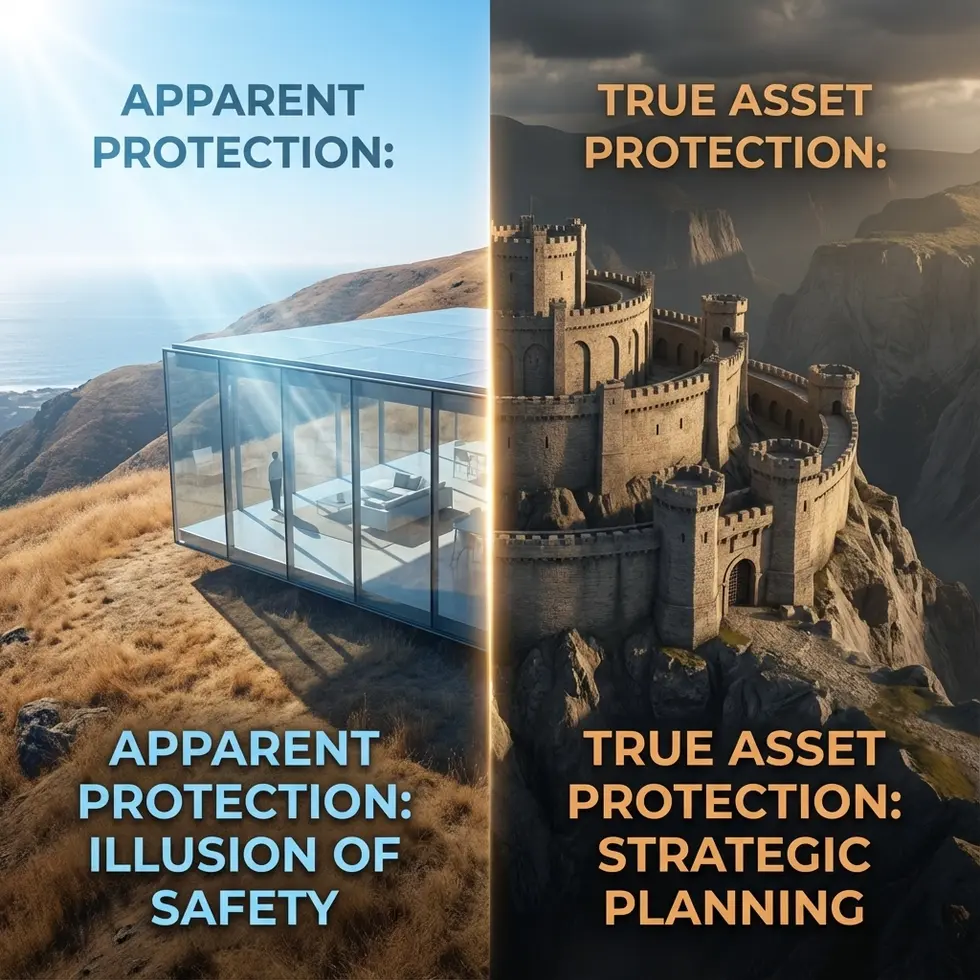
Walk into most advisory meetings and you'll hear about trusts, wills, and "asset protection" strategies. Thick binders of documents. Impressive-sounding entity names. Complex flowcharts that look bulletproof on paper.
But here's what few advisors will admit: paperwork isn't protection.
Most wealthy California families think they're defended because they have documents. The harsh reality? They're often holding elaborate legal fiction that collapses the moment real pressure hits.
Where the Real Threats Live
The threats that destroy wealth don't announce themselves with obvious warning signs. They hide in the gaps between what you think you have and what actually works when tested.
California's Tax Trap Network
The Franchise Tax Board doesn't care about your trust documents if the structure violates California's aggressive residency rules. We've seen "bulletproof" Nevada trusts get dismantled because the trustee made one wrong move that triggered California taxation.
The hidden risk: Your out-of-state trust becomes a California tax liability if:
- The trustee exercises discretion from California
- Trust assets are managed by California residents
- Beneficiaries receive distributions while California residents
- The trust holds California real estate without proper structure
The Single Point of Failure Problem
Most estate plans have a fatal flaw: they depend entirely on one person knowing everything. Your family's financial security hangs on your memory, your availability, and your continued capacity.
What happens when:
- You become incapacitated and can't access accounts?
- Key passwords or account numbers exist only in your head?
- Your successor trustee can't locate assets or understand the structure?
- Business ownership transfers require your personal involvement?
The Control Trap
Sophisticated families often defeat their own protection by maintaining too much control. The IRS and creditors have decades of case law showing exactly how much involvement kills your structure.
Keep signatory authority over "protected" accounts? Your protection evaporates.
Continue making investment decisions for your trust? Creditors can reach those assets.
Maintain practical control while claiming you gave up legal control? Courts will pierce your structure.
The Litigation Blind Spots
California's litigation environment is uniquely hostile to wealth. Yet most asset protection focuses on obvious threats while missing the real attack vectors.
Professional liability exposure: If you're a doctor, executive, or business owner, your personal assets remain vulnerable through professional malpractice claims that can exceed insurance coverage.
Environmental liability: Own California real estate? Environmental cleanup costs can create personal liability that reaches far beyond the property value.
Business partner risks: Your partner's personal problems become your problems if the business structure doesn't properly isolate individual liability.
Why Most Advisory Approaches Fail
The traditional advisory model creates dangerous blind spots:
Siloed thinking: Your tax advisor doesn't coordinate with your estate attorney who doesn't talk to your asset protection counsel. Each specialist optimizes their piece while missing system-level vulnerabilities.
Product pushing: Many advisors sell solutions before understanding your specific risk profile. Cookie-cutter trust packages and generic asset protection structures that worked for someone else might be completely wrong for your situation.
Compliance gaps: California's regulatory environment changes constantly. Trust taxation, franchise tax requirements, and liability exposure evolve faster than most advisors can track.
The FortressWall Difference: Mapping Vulnerabilities First
Our process starts where others end: with a comprehensive vulnerability assessment before we design any solution.
The Situation Readiness Briefing Process
We map your actual exposure across five critical dimensions:
Asset mapping: What you own, where it's titled, and how it's currently exposed to claims or taxation.
Control analysis: Where you maintain beneficial control that could compromise your protection structures.
Transfer mechanics: How assets actually move to beneficiaries and what breaks that process.
Tax coordination: Integration between federal estate tax, California state tax, and generation-skipping transfer tax implications.
Liquidity planning: How your family accesses cash for expenses without triggering adverse tax consequences or structural problems.
Building Real Architecture
Once we understand your vulnerability profile, we design integrated protection that holds under pressure:
Multi-layered structures: No single point of failure exists. If one protection layer fails, others continue working.
Stress-tested planning: We design for worst-case scenarios: simultaneous litigation, audit, and family crisis.
Operational protocols: Clear procedures for every family member and advisor so protection works even when you're not available.
The California-Specific Risks Most Miss
California families face unique vulnerabilities that generic planning ignores:
Franchise Tax Board aggression: California pursues out-of-state trusts more aggressively than any other state. Your "safe" Nevada trust might be a tax trap.
Community property complications: California's community property rules can unravel asset protection strategies if not properly addressed in the structure design.
High-net-worth targeting: California's regulatory environment specifically targets wealthy taxpayers with enhanced audit procedures and penalty structures.
Professional liability exposure: California's litigation environment creates outsized professional liability risks for doctors, executives, and business owners.
Frequently Asked Questions
Q: How do I know if my current planning has vulnerabilities?
A: Most vulnerability assessments take 20-30 minutes of focused questions. We can quickly identify the highest-risk areas and whether your current structure holds under pressure.
Q: What's the difference between asset protection and wealth protection?
A: Asset protection focuses on hiding assets from creditors. Wealth protection integrates liability management with tax efficiency and transfer planning: it's systematic rather than defensive.
Q: Can California reach my out-of-state trust?
A: Yes, if the trust has California connections through trustees, beneficiaries, or asset management. California's tax reach extends far beyond state borders.
Q: How often should wealth protection strategies be reviewed?
A: Annually at minimum, with immediate review after any major life event, business change, or regulatory update affecting your structure.
Q: What happens to my planning if I become incapacitated?
A: Properly designed structures include succession protocols that maintain protection and efficiency even during incapacity. Poor planning creates chaos and exposure.
Don't Discover Your Vulnerabilities the Hard Way
The cost of reactive planning: scrambling after audit notices, litigation threats, or family crises: far exceeds the investment in proactive vulnerability mapping.
Your wealth deserves architecture, not just paperwork.
Schedule your Situation Readiness Briefing and discover what actually protects your family before pressure tests your current planning. Contact the Law Office of James Burns to map your real vulnerabilities and build bulletproof protection.
To schedule your Situation Readiness Briefing (SRB), use our secure online calendar: https://calendly.com/jb--31/estate-planning-meeting?preview=true&site_id=1812
Disclaimer: This content is for educational purposes only and does not constitute legal or tax advice. Consult qualified professionals for advice specific to your situation.
Sources Used: California Franchise Tax Board regulations, California Probate Code, federal tax court decisions on trust taxation, asset protection case law analysis.

Comments
There are no comments for this post. Be the first and Add your Comment below.
Leave a Comment