
By James G. Burns, Esq.
Law Office of James Burns | Over 6,000 estate plans crafted over 25 years
Introduction
Serving as a successor trustee after a loved one's death can feel like stepping onto a battlefield. While your role is to honor their legacy, creditors often emerge with claims that demand immediate attention. Among the most aggressive are credit card companies, whose algorithms and collection departments act quickly to secure repayment.
The question many trustees ask is: “Am I personally liable?” Or more specifically: “Can the credit card company sue me as trustee—and in what court?”
This guide will address those issues in depth, covering:
- The scope of trustee liability under California law
- The dollar thresholds that determine which court has jurisdiction over creditor claims
- The difference between probate and trust administration pathways
- Statutes and case law every trustee should know
- Real-world examples of claims and disputes
- FAQs for successor trustees
- Practical contacts for major credit card estate departments
- Next steps if you are facing creditor action
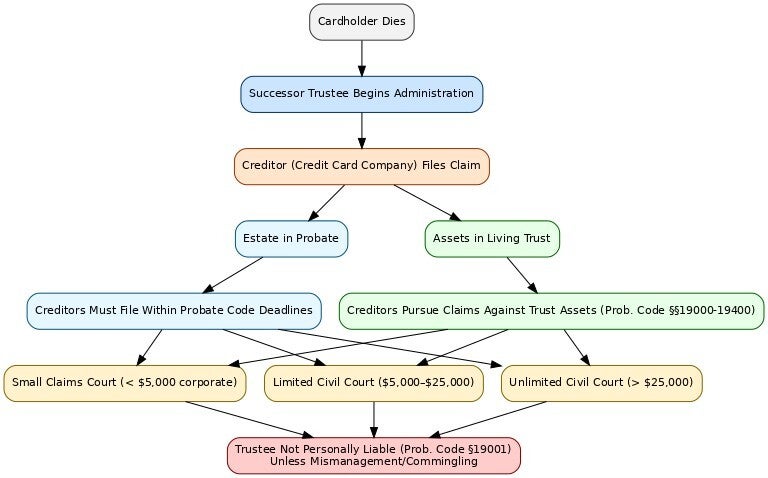
1. Trustee Liability: Limited, Not Personal
California makes clear that trustees are not personally liable for a decedent's debts—unless they mishandle estate assets.
- Probate Code §19001 states that the trustee is liable only in their representative capacity. The estate or trust is the debtor, not the individual trustee.
- Probate Code §19008 reinforces that a creditor cannot leapfrog and sue the trustee personally unless there's misconduct, fraud, or commingling of funds.
Example: If a credit card company alleges $15,000 in unpaid charges, the trustee must evaluate whether the claim is valid and payable from trust or estate assets. If they pay such debts from their own bank account, they blur the legal separation and risk personal liability.
Lesson: Always document, and always pay from estate/trust funds—not personal accounts.
2. Jurisdiction by Dollar Amount
A crucial question: In what court can creditors sue an estate or trustee?
The answer lies in California Code of Civil Procedure (CCP) and the dollar thresholds for jurisdiction:
|
Why it matters: The higher the claim, the more complex the litigation. Trustees should know whether they're defending a case in the informal small-claims setting, or in the more formal unlimited civil court, where discovery, attorney's fees, and jury trials may come into play.
3. Probate vs. Trust Administration
A. Probate Estates
- Creditors must file a Creditor's Claim under Probate Code §§9000–9353.
- Deadlines: Within four months of letters being issued, or 60 days after notice (whichever is later).
- If the claim is rejected, the creditor must sue within 90 days.
B. Living Trust Estates
- If all assets were titled in a trust and no probate opens, creditors must proceed under Probate Code §§19000–19403.
- They file a civil lawsuit against the trustee in their representative capacity, not the trustee personally.
- The same dollar thresholds (small claims, limited, unlimited) apply.
Key Case: Estate of Bennett (2008) 163 Cal.App.4th 1303 – a creditor missed the statutory claim window, and the court barred recovery. Trustees should take comfort: deadlines matter.
4. Real-Life Examples
- Post-Death Charges: A trustee notices $800 in Amazon charges after the date of death. These are fraudulent; the estate is not liable. Dispute them immediately.
- Medical Bills vs. Credit Cards: Probate courts often prioritize last illness and funeral expenses over unsecured debt like credit cards.
- High-Balance Claims: A $40,000 AmEx bill will not go to small claims; it will go to Unlimited Civil, meaning aggressive litigation.
5. Practical Strategy for Trustees
- Gather Statements: Identify all debts up to date of death.
- Stop Autopay: Prevent charges from draining trust accounts.
- Notify Creditors Promptly: Use official estate servicing departments.
- Evaluate Jurisdiction: Match the claim size to the proper court.
- Respond to Claims in Writing: Silence can be interpreted as admission.
- Consider Negotiation: Many creditors settle for reduced amounts.
6. Major Credit Card Estate Departments
- Chase Estate Services – 1-866-926-6909
- Bank of America Estate Services – 1-888-689-4466
- Mastercard Support – 1-800-627-8372
- American Express Deceased Account Services – 1-800-528-4800
7. Frequently Asked Questions (FAQ)
Q: Can a credit card company sue me personally as trustee?
A: No—unless you commingle funds or commit misconduct. See Prob. Code §19008.
Q: What if the estate has no money?
A: The estate is insolvent. Credit card companies are unsecured creditors and usually get nothing.
Q: Do I have to pay charges made after death?
A: No. These are fraudulent and should be disputed.
Q: What if the estate avoids probate entirely?
A: Creditors must sue the trust via the trustee. Same dollar limits apply.
Q: How long do creditors have to file a claim?
A: Probate: 4 months from issuance of letters. Trust administration: civil suit statutes apply, but generally 1 year from date of death (CCP §366.2).
Q: What if the claim is over $25,000?
A: It belongs in Unlimited Civil Court—creditors may be aggressive here.
Q: Should I ever pay debts from my own funds to “get it over with”?
A: No. Doing so can open you to personal liability.
8. Call to Action
If you are facing creditor claims as a successor trustee, don't navigate it alone. With 25 years of experience, over 6,000 successful estate plans, and 200+ five-star reviews, I guide trustees through these exact situations.
☎️ Call (949) 305-8642 or visit jamesburnslaw.com to secure your consultation.
9. Disclaimer
This blog is for informational purposes only and does not create an attorney–client relationship. California laws change frequently, and your facts may alter outcomes. Always consult a licensed attorney before acting.
10. Copyright & Usage Disclosure
© 2025 James G. Burns, Esq., Law Office of James Burns. All Rights Reserved.
This publication is the exclusive intellectual property of James G. Burns, Esq. It may not be copied, distributed, or republished without prior written consent. Excerpts may be quoted with attribution and a link to jamesburnslaw.com.

Comments
There are no comments for this post. Be the first and Add your Comment below.
Leave a Comment