

Multi-jurisdictional estate planning is the coordinated process of structuring estate plans across multiple legal jurisdictions to minimize tax exposure, avoid probate complications, and protect wealth transfer for individuals with assets or heirs in different states or countries. The industry term most attorneys use is "cross-border estate planning" when international boundaries are involved, and "multi-state estate planning" when the complexity stays domestic. Both describe the same core challenge: no single jurisdiction's laws govern your entire estate when your wealth spans borders. Domicile rules, ancillary probate, estate and inheritance taxes, and tax treaties all collide when assets are spread across multiple legal systems. Getting this wrong costs families far more than the planning would have.
For California residents, Orange County families, business owners, and high-net-worth individuals with property or heirs in multiple jurisdictions, the risks include ancillary probate, unclear domicile, state estate tax exposure, foreign succession rules, and double taxation.
What is multi-jurisdictional estate planning and who needs it?
Multi-jurisdictional estate planning applies to anyone whose assets, heirs, or legal residences span more than one state or country. Real estate investors with properties in California, Nevada, and Texas face this challenge. Business owners with entities registered in Delaware but operating in multiple states face it too. High-net-worth families with dual citizenship or foreign investment accounts face the most complex version of all.
The core problem is legal fragmentation. Each jurisdiction applies its own succession laws, tax rules, and probate procedures. A will valid in California may not satisfy legal formalities in France. A trust structured for U.S. tax efficiency may create unintended tax events under foreign law. Without deliberate coordination, an estate plan built for one jurisdiction can actively harm a family's interests in another.

Jamesburnslaw works with families holding estates from $5M to over $100M, and the pattern is consistent: the more jurisdictions involved, the greater the exposure to tax drag, probate delay, and family conflict. Addressing that exposure requires a structured, jurisdiction-by-jurisdiction analysis before any documents are drafted.
How does domicile affect estate administration across jurisdictions?
Domicile is the legal concept that determines which jurisdiction's laws govern your estate at death. It is not simply where you live. Domicile determines governing jurisdiction for probate, succession, and most estate tax purposes. The distinction matters enormously for families with multiple residences.
Proving domicile requires documented intent, not just physical presence. Courts look at a consistent body of evidence accumulated over time:
- Voter registration location
- State of driver's license issuance
- Location of primary banking relationships
- Where you file state income tax returns
- Location of your primary physician and religious affiliation
- Where you spend the majority of your time each year
When domicile is unclear, two states can each claim jurisdiction over the same estate. That creates dueling probate courts, conflicting tax assessments, and legal fees that consume estate assets for years. Unclear domicile leads to conflicting probate and tax outcomes that no amount of post-death legal maneuvering can fully repair.
Pro Tip: If you split time between two states, document your domicile intent in writing each year. A signed, notarized declaration of domicile filed with your primary state's county recorder creates a contemporaneous record that holds up under legal challenge.
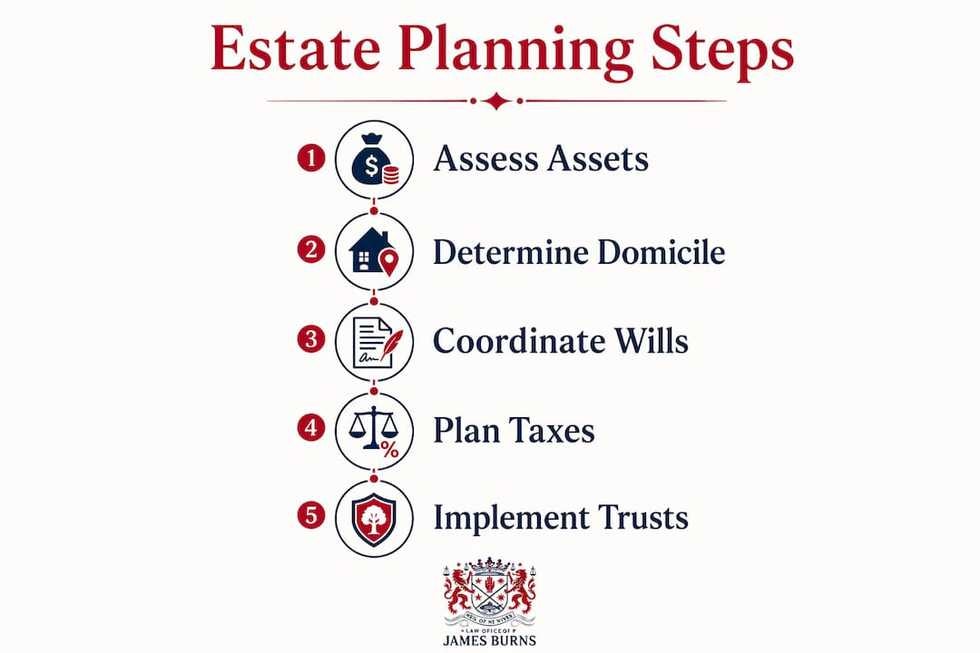
Domicile is the most critical factor in determining which laws govern an estate, and clients consistently underestimate documented intent as a legal requirement. Establishing it correctly before a dispute arises is far less expensive than litigating it afterward.
How do you manage estate taxes and avoid double taxation across jurisdictions?
Estate tax exposure multiplies when assets span multiple jurisdictions. 13 states plus Washington D.C. impose estate taxes, and 5 states impose inheritance taxes, each with different exemption thresholds and rate structures. That means a family with assets in New York and Massachusetts faces two separate state estate tax regimes on top of the federal estate tax.
New York's estate tax is particularly aggressive. Its "cliff effect" means that exceeding the state exemption by even a small amount causes the entire estate to be taxed at state rates, not just the excess. That single design feature can cost a family hundreds of thousands of dollars if their estate plan does not account for it.
| Jurisdiction type | Tax imposed | Key planning risk |
|---|---|---|
|
Federal (U.S.) |
Estate tax |
Exemption threshold changes with legislation |
|
State (e.g., New York) |
Estate tax with cliff effect |
Exceeding exemption triggers tax on full estate |
|
State (e.g., Pennsylvania) |
Inheritance tax by beneficiary class |
Rate varies by relationship to decedent |
|
Foreign country |
Estate or inheritance tax |
May conflict with U.S. treaty positions |
Cross-border estates face an additional layer: double taxation risks arise when two countries each claim the right to tax the same assets. Tax treaties between the U.S. and certain countries provide credits and exemptions that reduce the total burden, but navigating those treaties requires specialized knowledge. Not every country has a treaty with the U.S., and those that do have widely varying terms.
Effective tax planning across jurisdictions uses several tools:
- Revocable living trusts to remove assets from probate and simplify administration
- Irrevocable trusts to freeze estate value and shift appreciation out of the taxable estate
- LLCs to consolidate ownership of real property across states into a single entity
- Proportional tax credits to offset taxes paid in one jurisdiction against liability in another
- Exit tax engineering for clients considering renouncing U.S. citizenship or changing domicile
Effective planning should start 12–24 months before major life changes such as relocations, business sales, or citizenship changes. Waiting until after the triggering event eliminates most of the available planning options.
Pro Tip: If your estate includes assets in a country without a U.S. estate tax treaty, consider holding those assets through a U.S. entity structure. That approach can shift the situs of the asset for tax purposes and reduce foreign estate tax exposure significantly.
How do you coordinate wills, trusts, and ownership structures across jurisdictions?
A single global will is rarely sufficient for families with assets in multiple countries or states. Single global wills often fail to satisfy local legal formalities, and foreign courts routinely refuse to recognize them. Forced heirship rules in civil law countries like France and Spain require that specific portions of an estate pass to certain heirs regardless of what a will says. A U.S. will that contradicts those rules will not override them.
The best practice is coordinated jurisdiction-specific planning. That means:
- Draft separate wills for each jurisdiction where you hold significant assets. Each will should address only the assets in that jurisdiction and should be drafted to comply with local formalities.
- Use a revocable living trust as the primary U.S. vehicle. A properly funded revocable trust avoids probate in every U.S. state where you hold titled assets, eliminating the need for ancillary probate proceedings.
- Hold real property in LLCs or trusts. Owning real estate via LLCs or revocable trusts avoids ancillary probate in each property's location, which is a major source of estate delays and costs for owners of out-of-state or international property.
- Engage local legal counsel in each jurisdiction. Local attorneys know the formalities, forced heirship rules, and registration requirements that foreign counsel cannot reliably advise on.
- Obtain certified translations of all documents that will be presented to foreign courts or registries. Untranslated documents are routinely rejected, causing delays that freeze asset access for months.
U.S.-style Powers of Attorney are often not recognized abroad, which creates a critical gap in cross-border plans. Jurisdiction-specific Powers of Attorney for both financial and healthcare decisions are required in each country where you have assets or may need medical care. Multi-citizenship holders benefit most from layered asset protection involving trusts in favorable jurisdictions to shield wealth from both taxes and creditor claims.
Pro Tip: When drafting coordinated wills, include a clear clause in each document stating that it governs only the assets in that jurisdiction and does not revoke wills executed for other jurisdictions. Without that clause, executing a new will can inadvertently revoke prior wills under some countries' laws.
Practical steps to implement a multi-jurisdictional estate plan
Building a plan that works across jurisdictions requires a structured process, not a single attorney engagement. The starting point is always a complete asset map.
- Map every asset by jurisdiction. List each asset, its legal title, its location, and the jurisdiction whose laws govern it. Include real property, business interests, bank and brokerage accounts, retirement accounts, life insurance, and digital assets. For families with crypto holdings, cross-jurisdictional crypto regulation adds another layer of complexity that requires specialized legal attention.
- Assemble an interdisciplinary advisory team. Coordination between tax, legal, and financial advisors is the foundation of a resilient global estate plan. No single professional has expertise in all relevant areas. A U.S. estate attorney, a CPA with international tax experience, and local counsel in each foreign jurisdiction are the minimum team for a cross-border plan.
- Align beneficiary designations with your estate documents. Retirement accounts and life insurance policies pass by beneficiary designation, not by will or trust. A designation that conflicts with your estate plan can redirect significant assets to unintended recipients.
- Select executors and trustees with jurisdictional knowledge. An executor who has never administered a foreign estate will face delays, errors, and costs that a locally experienced fiduciary would avoid.
- Store documents in multiple accessible locations. Maintaining copies of critical estate documents outside your primary country of residence prevents administrative paralysis when access to your home country is disrupted. A secure digital vault accessible by your attorney and a trusted family member is a practical solution.
- Schedule annual reviews. Tax laws change, exemption thresholds shift, and your asset mix evolves. A plan that was correct in 2023 may create significant exposure by 2026 if it has not been updated.
Key takeaways
Multi-jurisdictional estate planning requires coordinated legal, tax, and ownership structures across every jurisdiction where you hold assets or have heirs.
| Point | Details |
|---|---|
|
Domicile determines governing law |
Document domicile intent with voter registration, tax filings, and a notarized declaration to avoid dueling courts. |
|
State and foreign taxes compound |
13 states plus D.C. impose estate taxes; double taxation risk requires treaty analysis and credit planning. |
|
Single wills are insufficient |
Draft separate, coordinated wills for each jurisdiction to satisfy local formalities and forced heirship rules. |
|
LLCs and trusts prevent ancillary probate |
Holding real property in entities consolidates administration and eliminates costly multi-state probate proceedings. |
|
Early planning is non-negotiable |
Begin coordinated planning 12–24 months before relocations, business sales, or citizenship changes to preserve options. |
What I've learned from years of cross-border estate planning
The clients who come to me after a problem has already surfaced share one thing in common: they assumed their existing estate plan was sufficient. They had a will. They had a trust. They had a financial advisor. What they did not have was a plan that accounted for every jurisdiction where their wealth actually lived.
The domicile issue is the one that surprises people most. I have seen families spend more on post-death domicile litigation than they would have spent on a decade of proper planning. Two states each claiming jurisdiction over the same estate is not a theoretical risk. It happens regularly to families who split time between high-tax and low-tax states without documenting their intent clearly.
The second pattern I see consistently is the assumption that a U.S. attorney can handle everything. Cross-border planning requires local counsel in each relevant jurisdiction. A California estate attorney cannot reliably advise on French forced heirship rules or Mexican succession law. The cost of engaging local counsel is small compared to the cost of a foreign court rejecting your documents.
The third issue is timing. Families contact me after a diagnosis, after a business sale closes, or after they have already moved. At that point, many of the most effective planning tools are no longer available. The exit tax window has closed. The trust funding opportunity has passed. The domicile record is already ambiguous. Proactive planning, started well before a triggering event, is what separates families who preserve wealth from those who watch it erode through taxes and legal fees.
The FortressWall Methodology™ at Jamesburnslaw is built around exactly this kind of exposure mapping. The goal is to identify every jurisdictional risk before it becomes a problem, then build a control architecture that holds up under legal challenge, tax scrutiny, and family stress.
— James
How Jamesburnslaw approaches complex multi-jurisdictional planning
Families with assets across multiple states or countries need more than a standard estate plan. They need a coordinated architecture that accounts for every jurisdiction where their wealth is held.
Jamesburnslaw provides estate planning and asset protection services specifically designed for high-net-worth families with complex, multi-jurisdictional needs. The FortressWall Methodology™ begins with a full exposure map of your estate across every relevant jurisdiction, then builds coordinated wills, trusts, and ownership structures that minimize tax drag and probate risk. For families managing digital assets alongside traditional wealth, understanding digital asset legal structures is increasingly part of that picture. Contact Jamesburnslaw to schedule a consultation and get a clear picture of where your estate plan has gaps.
FAQ
What is multi-jurisdictional estate planning?
Multi-jurisdictional estate planning is the process of coordinating wills, trusts, tax strategies, and ownership structures across multiple states or countries to protect assets and ensure legal wealth transfer. It addresses the fact that each jurisdiction applies its own succession laws, tax rules, and probate procedures.
How does domicile affect my estate plan?
Domicile determines which jurisdiction's laws govern your estate at death, including where probate occurs and which state or country can impose estate taxes. Unclear domicile can result in two jurisdictions each claiming authority over the same estate simultaneously.
Do I need separate wills for each state or country?
A single will is often legally insufficient in foreign jurisdictions and may conflict with local forced heirship rules. Coordinated, jurisdiction-specific wills drafted to satisfy local formalities are the recognized best practice for cross-border estate planning.
What is ancillary probate and how do I avoid it?
Ancillary probate is a separate probate proceeding required in each state or country where you own real property outside your domicile jurisdiction. Holding real estate in a revocable living trust or LLC consolidates administration and eliminates the need for multiple probate proceedings.
When should I start multi-jurisdictional estate planning?
Planning should begin 12–24 months before major life changes such as relocations, business sales, or citizenship changes. Starting early preserves the full range of tax planning and ownership restructuring options before triggering events close them off.
Resources / Authorities Cited
The following public resources and authorities support the discussion of multi-jurisdictional estate planning, domicile, estate tax exposure, inheritance tax, cross-border tax treaties, nonresident estate issues, and international will formalities:
-
IRS — Estate Tax
https://www.irs.gov/businesses/small-businesses-self-employed/estate-tax -
IRS — Estate & Gift Tax Treaties: International
https://www.irs.gov/businesses/small-businesses-self-employed/estate-gift-tax-treaties-international -
IRS Internal Revenue Manual 4.25.4 — International Estate and Gift Tax Examinations
https://www.irs.gov/irm/part4/irm_04-025-004 -
IRS — Some Nonresidents with U.S. Assets Must File Estate Tax Returns
https://www.irs.gov/individuals/international-taxpayers/some-nonresidents-with-us-assets-must-file-estate-tax-returns -
California Franchise Tax Board — Residency Status
https://www.ftb.ca.gov/file/personal/residency-status/index.html -
California Franchise Tax Board — Publication 1031, Guidelines for Determining Resident Status
https://www.ftb.ca.gov/forms/misc/1031.html -
ACTEC — State Death Tax Chart
https://www.actec.org/resources-for-wealth-planning-professionals/state-death-tax-chart/ -
New York State Department of Taxation and Finance — Estate Tax
https://www.tax.ny.gov/pit/estate/etidx.htm -
New York State Assembly — Estate Tax Cliff Legislative Memo
https://assembly.state.ny.us/leg/?Memo=Y&bn=A1522&default_fld=&term=2017 -
Pennsylvania Department of Revenue — Inheritance Tax
https://www.pa.gov/agencies/revenue/resources/tax-types-and-information/inheritance-tax -
Hague Conference on Private International Law — Form of Wills Convention
https://www.hcch.net/en/instruments/conventions/specialised-sections/form-of-wills -
Hague Conference on Private International Law — Convention on the Conflicts of Laws Relating to the Form of Testamentary Dispositions
https://www.hcch.net/en/instruments/conventions/full-text/?cid=40
Legal Disclaimer
This article is provided for educational and informational purposes only and does not constitute legal, tax, investment, insurance, or financial advice. Reading this article, submitting information through this website, downloading any materials, or contacting the Law Office of James Burns does not create an attorney-client relationship.
Multi-jurisdictional estate planning is highly fact-specific. Outcomes depend on domicile, residency, citizenship, asset situs, tax treaties, local succession law, entity classification, trust funding, beneficiary designations, fiduciary selection, and the laws of each relevant jurisdiction. You should consult qualified legal, tax, and financial advisors in all applicable jurisdictions before taking action.
The Law Office of James Burns is a California law firm. Unless otherwise stated in a signed engagement agreement, the firm does not provide legal advice regarding the laws of foreign countries or other U.S. states and may coordinate with local counsel where appropriate.
Intellectual Property Disclosure
FortressWall Methodology™, Legacy Protection Trust™, and related planning frameworks, terminology, article structures, diagnostics, diagrams, client-facing explanations, and strategic planning concepts used by the Law Office of James Burns are proprietary intellectual property of the Law Office of James Burns, except where otherwise noted.
No portion of this article may be copied, republished, modified, distributed, used for commercial training, incorporated into competing professional materials, or reproduced by artificial intelligence systems for commercial use without prior written permission. Limited quotation with attribution is permitted for educational or commentary purposes.
References to federal tax law, state law, public agency materials, cases, regulations, or third-party resources remain the property of their respective sources and are cited or discussed for educational context only.

Comments
There are no comments for this post. Be the first and Add your Comment below.
Leave a Comment