

Asset protection is defined as the legal and financial practice of structuring your assets so that creditors, lawsuit plaintiffs, and unforeseen liabilities cannot easily reach them. The term used by attorneys and financial planners is "asset protection planning," and it covers everything from basic insurance policies to irrevocable trusts and limited liability companies. This is not about hiding money or evading debts. As legalclarity.org confirms, the goal is to increase the cost and uncertainty for creditors, making litigation less attractive before a threat ever materializes. The core tools include LLCs, limited partnerships, trusts, and insurance, each serving a distinct role in a layered defense.
What is asset protection and how does it actually work?
Asset protection planning works by placing legal barriers between your personal wealth and potential claimants. A creditor who wins a judgment against you can only collect from assets they can legally reach. If your rental property sits inside a properly maintained LLC, a lawsuit arising from that property generally cannot touch your personal bank accounts or your home. The protection depends entirely on maintaining corporate formalities and acting before a claim arises.
The phrase "wealth defense architecture" captures the concept well. You are not building one wall. You are building a system of walls, each one making recovery harder and more expensive for anyone who comes after your assets. Layering legal structures and insurance increases the likelihood of a negotiated settlement rather than full seizure in litigation. That deterrence effect is the real value of the planning.

What are the primary asset protection strategies?
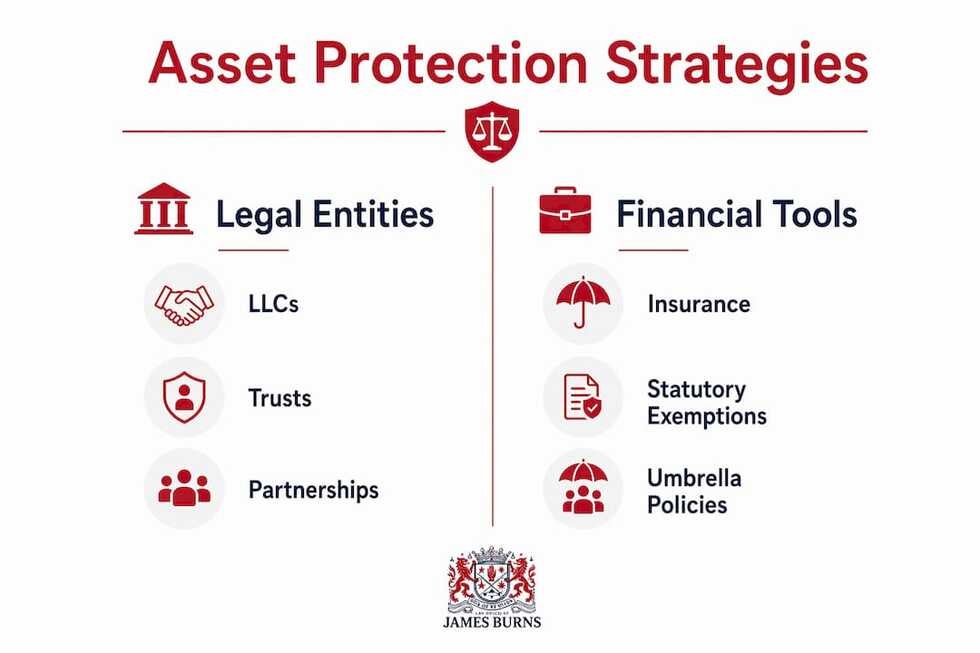
The four main categories are insurance, legal entities, trusts, and statutory exemptions. Each operates at a different level of complexity and cost.
Insurance as the first line of defense
Umbrella insurance is the fastest and most affordable starting point. Umbrella coverage costs approximately $300 to $500 per $1 million in coverage. That price point makes it accessible for most families, but it is not a complete solution. Insurance carries significant exclusions, including mold, environmental damage, and intentional acts. Relying solely on insurance without legal entity structuring leaves real exposure on the table.
LLCs and limited partnerships
LLCs and limited partnerships separate personal assets from business or property liabilities. When you hold a rental property inside an LLC and maintain proper records, a creditor suing over that property is generally limited to the LLC's assets. Legal separation protects personal accounts as long as corporate formalities are maintained. LLC formation costs typically range from $100 to $800, making this one of the most cost-effective tools available.
Trusts: revocable, irrevocable, and specialized
A revocable living trust offers privacy and probate avoidance but provides no creditor protection because you retain control. An irrevocable trust transfers legal ownership away from you, which is what creates the protection. Setup costs for irrevocable trusts run from $2,000 to $10,000 due to legal complexity and ongoing maintenance requirements. Specialized asset protection trusts go further, with domestic and offshore variants designed specifically to resist creditor claims.
Homestead exemptions and statutory protections
Many states provide statutory homestead exemptions that shield a portion of your primary residence's equity from creditors. Texas and Florida offer unlimited homestead protection. California's exemption is more limited but still meaningful for primary residences. These protections are automatic and cost nothing to establish, though they apply only to your home and not to investment properties.
Comparison: cost and complexity of common tools
| Strategy | Typical Setup Cost | Creditor Protection Level | Complexity |
|---|---|---|---|
|
Umbrella insurance |
$300–$500/year per $1M |
Moderate |
Low |
|
LLC |
$100–$800 |
Strong (business assets) |
Low to moderate |
|
Revocable trust |
$1,500–$3,000 |
None (probate only) |
Moderate |
|
Irrevocable trust |
$2,000–$10,000 |
Strong |
High |
|
Domestic APT (DAPT) |
$5,000–$20,000+ |
Very strong |
Very high |
Pro Tip: Never rely on a single tool. A $500 umbrella policy and a properly maintained LLC together provide far more protection than either one alone.
Why does timing matter so much in asset protection planning?
Asset protection is fundamentally a timing game. Strategies put in place after a legal claim arises are routinely reversed by courts as fraudulent transfers. A judge does not need to prove bad intent. If you transferred your beach house to an LLC the week after a slip-and-fall accident on your property, a court can unwind that transfer regardless of your stated reasons.
The recommended lead times are specific:
- LLCs and limited partnerships: Set up at least 1 to 2 years before litigation risk materializes
- Irrevocable trusts: Establish 2 to 4 years before risk to withstand fraudulent transfer scrutiny
- Domestic Asset Protection Trusts: Many states require a seasoning period of 2 to 4 years before the trust is fully shielded
The legal concept here is the "look-back period." Courts and creditors can examine transfers made within a defined window before a bankruptcy filing or judgment. The longer your structures have been in place, the harder they are to attack.
"The goal is not to become judgment-proof. The goal is to make your assets hard enough to reach that a creditor decides the cost of litigation outweighs the potential recovery." — Asset protection planning principle
Proactive planning also changes your negotiating position. A debtor with assets locked inside a seasoned irrevocable trust and multiple LLCs is in a fundamentally different position than one whose assets sit in a personal brokerage account. The former invites settlement. The latter invites full litigation.
How does asset protection apply to real estate portfolios?
Real estate investors face a specific set of risks. Tenants can sue. Visitors can be injured. Environmental issues can generate liability that dwarfs the property's value. A real estate portfolio asset protection plan addresses each of these exposures through layered structures.
Steps for structuring a real estate portfolio:
- Separate each property into its own LLC. One lawsuit against one property should not threaten the others. Series LLCs, available in states like Delaware, Texas, and Nevada, allow multiple properties under one umbrella with internal liability separation.
- Consider tenancy by the entirety for married couples. Tenancy by the entirety prevents individual creditors from seizing jointly held property in states that recognize this form of ownership.
- Layer insurance over the LLC structure. Each property should carry its own liability policy, with an umbrella policy sitting above all of them.
- Hold LLC membership interests inside a trust. This adds a second layer of protection and allows for estate planning benefits like avoiding probate and controlling distribution to heirs.
- Review your structure annually. Tax law changes, new acquisitions, and shifts in your personal liability exposure all require periodic reassessment.
Pro Tip: A single-member LLC in California provides charging order protection but may not shield you from personal liability if a court finds you commingled personal and business funds. Keep separate bank accounts and document every transaction.
Real estate asset protection best practices always combine entity structuring with adequate insurance. Neither alone is sufficient. Insurance excludes specific risks like mold and environmental damage, which are exactly the claims that can generate catastrophic liability for property owners.
What are advanced asset protection strategies for estates over $5M?
High-net-worth families with estates above $5 million face risks that standard LLCs and umbrella policies cannot fully address. The top asset protection strategies for $5M estates involve irrevocable trusts, Domestic Asset Protection Trusts, and in some cases offshore structures.
Domestic Asset Protection Trusts (DAPTs)
DAPTs are available in more than 19 states, including Nevada, South Dakota, Delaware, and Alaska. A DAPT is a self-settled trust, meaning you can be a discretionary beneficiary of your own trust while still receiving creditor protection. Nevada and South Dakota are the most favorable jurisdictions due to short seasoning periods and strong statutory protections. You do not need to live in those states to use their trust laws.
Offshore asset protection trusts
Offshore trusts in jurisdictions like the Cook Islands, Nevis, and Belize are designed to resist foreign court orders. A U.S. judgment creditor must relitigate their claim in the foreign jurisdiction under local law, which is expensive and often unsuccessful. The tradeoff is complexity, cost, and strict IRS reporting requirements under FBAR and Form 3520. These structures are legal but require meticulous compliance.
Comparison: domestic vs. offshore asset protection trusts
| Feature | Domestic APT (DAPT) | Offshore Trust |
|---|---|---|
|
Creditor protection strength |
Strong |
Very strong |
|
U.S. court jurisdiction |
Yes |
Limited |
|
IRS reporting required |
Minimal |
Extensive (FBAR, Form 3520) |
|
Setup cost |
$5,000–$20,000+ |
$20,000–$50,000+ |
|
Ideal for |
Estates $2M–$20M |
Estates $10M+ |
The key tradeoff in advanced planning is control versus protection. An irrevocable trust removes assets from your taxable estate, which reduces estate tax exposure, but you give up direct control. Families with estates above $5 million need to weigh that tradeoff carefully against their specific exposure profile.
Key takeaways
Effective asset protection planning requires layered legal structures, adequate insurance, and early implementation before any legal threat arises.
| Point | Details |
|---|---|
|
Start before risk appears |
Structures set up after a claim arises can be reversed as fraudulent transfers. |
|
Layer your defenses |
Combine insurance, LLCs, and trusts for protection no single tool can provide alone. |
|
Timing is non-negotiable |
LLCs need 1–2 years of seasoning; irrevocable trusts need 2–4 years to withstand scrutiny. |
|
Real estate needs entity separation |
Each property should sit in its own LLC to contain liability to that asset only. |
|
Advanced estates need advanced tools |
Estates above $5M benefit from DAPTs in Nevada or South Dakota, or offshore trust structures. |
What I've learned after years of watching families get this wrong
The most common mistake I see is not the wrong strategy. It is the right strategy implemented too late. A family calls after a lawsuit has been filed, or after a business partner dispute has turned hostile, and they want to move assets into a trust immediately. At that point, the transfer is almost certainly a fraudulent conveyance. The court will unwind it, and the family will have spent legal fees for nothing.
The second mistake is treating insurance as a complete solution. I have seen investors with $5 million in real estate holdings carry a $1 million umbrella policy and believe they are fully covered. They are not. Insurance excludes environmental claims, intentional acts, and a range of other exposures that are exactly the scenarios that generate catastrophic losses. Insurance is the first wall, not the only wall.
The third mistake is failing to maintain the structures after they are set up. An LLC that comingles personal and business funds, or a trust that was never properly funded, provides no protection at all. Courts pierce these structures regularly when the formalities are ignored. The structure is only as strong as the discipline behind it.
What actually works is a coordinated plan built before any threat exists, reviewed annually, and maintained with the same rigor you apply to your investment portfolio. The families who come to Jamesburnslaw with estates between $5 million and $100 million and implement the FortressWall Methodology™ are not doing anything exotic. They are doing the fundamentals correctly, consistently, and early.
— James
How Jamesburnslaw protects what you have built

Jamesburnslaw works exclusively with high-net-worth families, real estate investors, and business owners in California who need more than a standard estate plan. The FortressWall Methodology™ begins with exposure mapping, identifying every creditor risk, tax liability, and structural gap in your current holdings. From there, the firm builds a control architecture using LLCs, irrevocable trusts, and insurance layers calibrated to your specific estate. Whether your portfolio sits at $5 million or above $50 million, the planning process is the same: proactive, layered, and built to hold. Schedule a consultation at Jamesburnslaw to begin your asset protection review.
FAQ
What is asset protection in simple terms?
Asset protection is the legal practice of structuring your assets so that creditors and lawsuit plaintiffs cannot easily reach them. It uses tools like LLCs, trusts, and insurance to create legal barriers around your wealth.
When should I start asset protection planning?
Start before any legal threat exists. LLCs should be in place at least 1 to 2 years before litigation risk, and irrevocable trusts need 2 to 4 years of seasoning to withstand fraudulent transfer challenges.
Does asset protection mean hiding assets?
No. Asset protection is a fully legal practice focused on making assets harder and more expensive for creditors to reach. Hiding assets or fraudulently transferring them after a claim arises is illegal and will be reversed by courts.
What is the best asset protection strategy for real estate?
The most effective approach combines individual LLCs for each property, an umbrella insurance policy, and trust ownership of the LLC membership interests. This layered structure contains liability to each property and adds a second barrier against personal creditor claims.
Are Domestic Asset Protection Trusts available in California?
California does not have a DAPT statute, but California residents can establish DAPTs in favorable states like Nevada, South Dakota, or Delaware. Jamesburnslaw structures these arrangements regularly for California families with significant estates.

Comments
There are no comments for this post. Be the first and Add your Comment below.
Leave a Comment