By James G. Burns, Esq.
Law Office of James Burns — Strategic Wealth & Asset Defense Counsel
www.jamesburnslaw.com | (949) 305-8642
We've all been conditioned to believe that wealth is achieved through constant motion — long hours, endless meetings, and the constant pursuit of “more.”
But the truth is simpler, older, and far more powerful: struggle is the tax you pay for acting out of alignment.
The Tao of Wealth and War reveals that prosperity, like victory, is not forced — it is commanded. True mastery comes when capital, law, and consciousness flow together. The battlefield and the balance sheet obey the same laws of motion: clarity over chaos, precision over panic, and structure over strain.
I. Stillness and Strike: Two Sides of the Same Blade
In ancient China, generals were taught the Tao of War — that victory does not belong to the strongest, but to the most attuned. Lao Tzu called it wu wei, or effortless action. Clausewitz called it “the concentration of force.” In estate and tax law, we call it structure.
The wealth architect doesn't chase the market; he builds the terrain so that opportunity flows toward him.
In the same way that a general uses terrain, timing, and deception to control battle momentum, the strategist uses legal terrain — trusts, entities, tax deferral structures — to command capital without friction.
Take the Supreme Court's decision in North Carolina Department of Revenue v. Kaestner 1992 Family Trust (2019). North Carolina attempted to tax a trust's undistributed income simply because a beneficiary lived in-state. The Court held that such taxation violated the Due Process Clause since the beneficiary received no distributions and exercised no control.
That single ruling redefined jurisdictional flow — proving that when a trust maintains legal separation and acts with true independence, even a state cannot force its will upon it.
The principle: form aligned with flow defeats force.
II. Law as Terrain: The FortressWall Doctrine in Motion
Every general knows that battle is won not by charging, but by shaping the field. In asset protection and estate strategy, the law is your terrain.
A Dynasty Trust in South Dakota or Nevada functions as the “high ground” — a structure that endures for centuries, protected from creditors and taxation. A Private Placement Life Insurance (PPLI) contract is the “river,” allowing wealth to flow tax-deferred inside an insurance wrapper.
The same principle of flow appears in IRC §7702 and §817(h), which govern the tax qualification of life insurance. If the structure satisfies diversification and ownership requirements, growth inside the policy remains untaxed.
But the Investor Control Doctrine, confirmed in Webber v. Commissioner, 144 T.C. No. 17 (2015), warns that if the policyholder controls the investments directly, the tax shield collapses.
The Webber case mirrors the art of war: the commander must direct strategy, not fight every skirmish. The investor must design the system, not micromanage the portfolio. Control without interference is the essence of wu wei.
III. The Circle of Command and Flow
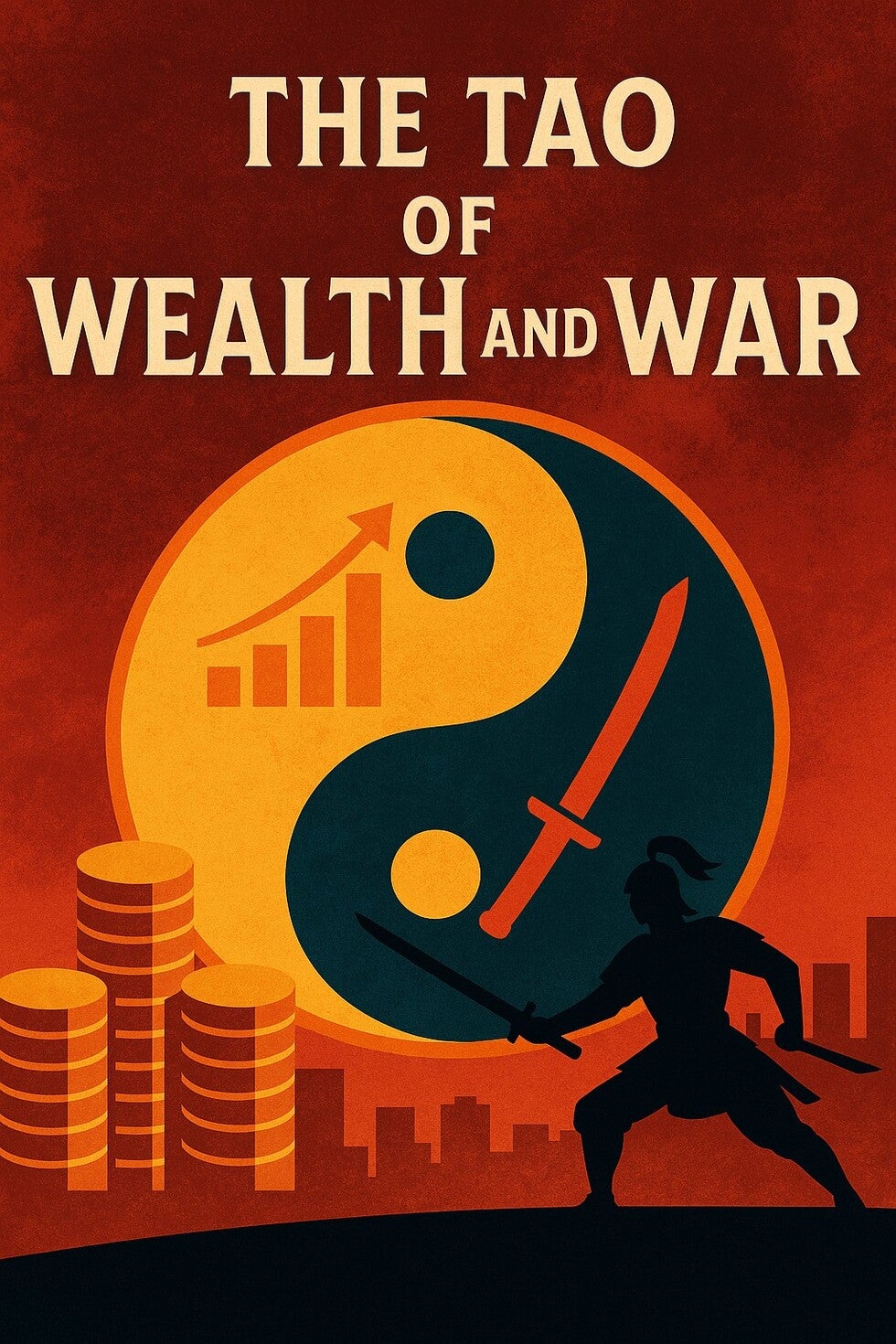
The Tao of Wealth and War can be visualized as a circle — a map of four interlocking quadrants through which all disciplined prosperity flows:
-
North — Fire: The Tao of War
Strategic offense: initiative, timing, and decisive execution in markets or negotiations. -
East — Water: The Tao of Wealth
Fluidity of capital: compounding, liquidity, and adaptation to cycles. -
South — Earth: The Tao of Structure
The fortress itself: trusts, entities, insurance, and statutory foundations. -
West — Air: The Tao of Mind
Awareness, AI, and data intelligence guiding decision-making.
At the center is the Still Commander — the investor, business owner, or family office operating without haste or emotion, directing systems that move autonomously.
When these quadrants align, wealth ceases to require labor. It becomes an ecosystem that feeds itself.
IV. From Battlefield to Boardroom: Timing and Tempo
In warfare, tempo determines dominance. In finance, timing governs taxation.
Consider IRC §453, the structured installment sale statute. It allows taxpayers to sell appreciated property and recognize gain over time, paying tax only as they receive payments.
If properly executed through an assignment company or trust, the seller never receives constructive receipt — avoiding immediate recognition of capital gain.
Revenue Ruling 75-457 and multiple Treasury interpretations confirm that deferral remains valid when the seller does not control the installment obligation. This is the tempo of taxation — law operating as timing discipline, not evasion.
Contrast that with schemes labeled “Deferred Sales Trusts,” which have come under IRS scrutiny because they lack true arm's-length structure. The difference lies not in the concept, but in the command — one respects the code's flow, the other forces it.
This is the battlefield between compliance and collapse. The victor uses discipline, not shortcuts.
V. Energy and Form: Harnessing the Flow
In Taoist metaphysics, Qi (energy) is useless until channeled. In the legal realm, capital behaves the same way.
Your energy flows through vehicles — LLCs, partnerships, irrevocable trusts, PPLI policies, and qualified plans — each a vessel that defines how wealth moves and how it's taxed.
The California Private Retirement Plan (CPRP), for instance, under California Code of Civil Procedure §704.115, provides statutory protection for assets held within a qualified private retirement trust. Funds contributed for retirement purposes are exempt from creditor claims, provided they are not commingled or abused.
A CPRP acts as a legal reservoir — the “still lake” in your FortressWall System™ — where excess business profits can rest untouchable.
Pair that with a PPLI structure under IRC §7702(g), and capital not only remains protected but compounds without annual taxation.
This synthesis — lawful deferral, statutory immunity, and insurance-based compounding — is financial Tai Chi.
Example:
A California business owner earns $2 million in net income annually through an S corporation. By contributing $500,000 into a CPRP, he gains statutory asset protection. The plan then allocates surplus capital into a PPLI contract owned by a South Dakota trust. Growth inside the policy remains tax-deferred; distributions can later fund retirement or estate liquidity. The result: reduced personal exposure, deferred taxation, and uninterrupted flow.
The key lies in lawful intent. The moment greed replaces governance, the structure fractures — much like water overflowing its banks.
VI. The Doctrine of Detachment: Estate Flow and Control
One of the great paradoxes of both Taoism and trust law is that control must be surrendered to achieve command.
The IRS's position in cases like Estate of Strangi v. Commissioner, 417 F.3d 468 (5th Cir. 2005) and Powell v. Commissioner, 148 T.C. 392 (2017) shows that when a grantor retains too many powers over a partnership or trust, the assets remain part of the taxable estate under IRC §§2036 and 2038.
In other words, you cannot both hold the sword and the shield.
A properly designed irrevocable trust — where an independent trustee and trust protector manage assets — mirrors the Taoist principle of non-attachment. The wealth remains under your philosophy but outside your reach. You retain influence, not control.
This detachment, though uncomfortable for the ego, is the legal essence of immortality. It ensures your wealth survives the death of its commander.
VII. Technology and the Digital Tao: AI as Non-Resistant Command
The 21st-century battlefield extends into data and automation. Artificial intelligence now performs the function once reserved for disciplined traders — it observes without emotion, acts without fatigue, and adjusts to flow in real time.
Platforms like 3Commas, Bitsgap, or open-source frameworks such as Hummingbot allow algorithmic trading through APIs connected to major exchanges. The investor can now design a self-correcting ecosystem: AI executing while the human remains still.
Legally, these systems must be wrapped in a compliant entity — an LLC or trust — ensuring that trading gains flow to the structure, not to the individual.
This maintains liability shielding and aligns with the Investor Control Doctrine in PPLI and other deferral systems: you architect the environment but do not touch the machinery.
In this digital Tao, the human no longer competes with markets — he choreographs them.
VIII. Integration: From Chaos to Command
When you integrate these doctrines, the transformation is profound:
- Your trusts become the riverbanks that contain and direct capital.
- Your insurance and deferral vehicles become the current — fluid, silent, unbroken.
- Your AI systems become wind and wave — adaptive yet disciplined.
- Your legal frameworks form the fortress — structured, impregnable, yet never rigid.
Consider a high-net-worth family using a South Dakota dynasty trust funded with limited partnership interests in a California operating company. The trust purchases a PPLI policy from a Bermuda-based carrier. The underlying assets include tokenized real estate and algorithmic investment accounts.
Because the trust owns the partnership interests, and the policy owns the segregated account, the family achieves:
- Multi-generational protection outside of California creditor reach.
- Tax-deferred growth under IRC §§7702 and 817(h).
- Potential step-up in basis on death for California property through trust layering.
- AI-driven compounding independent of human fatigue or emotion.
Each layer follows the Taoist rhythm: flow, containment, renewal.
IX. The Cost of Resistance
Most fail not for lack of intelligence, but because they fight the natural order. They cling to control, chase short-term returns, and resist delegation to structure or system.
The result: lawsuits, audits, burnout.
We see it in collapsed family partnerships where the patriarch “retained too much control.” We see it in failed tax strategies where investors forced the code instead of following it. We see it in entrepreneurs who trade every waking hour for the illusion of freedom.
In the Tao of Wealth and War, the wise strategist never fights what should be guided. They build the form and allow the energy to move through it.
X. From Struggle to Still Command
When law, capital, and consciousness converge, effort becomes unnecessary.
The estate grows because it is designed to; taxes are deferred because the code allows it; protection endures because it's statutory, not secretive.
The modern general of wealth does not hustle. He orchestrates.
He commands systems of law and energy with calm precision.
And in that stillness, every goal — freedom, legacy, liquidity — arrives not by force, but by flow.
Call to Action
If you are ready to move from accumulation to orchestration — from struggle to strategic flow — our team at the Law Office of James Burns can design a Situation Readiness Briefing (SRB) for you.
In that private session, we map your assets, exposure, and opportunities, then engineer the trust, insurance, and AI systems that align your entire financial battlefield into one integrated command structure.
Contact:
James G. Burns, Esq.
www.jamesburnslaw.com | (949) 305-8642
Disclaimer & Intellectual Property Notice
This content is for educational and informational purposes only and does not constitute legal, tax, or investment advice. Laws and regulations vary by jurisdiction and individual circumstances. Always consult with a qualified attorney or advisor before implementing any strategy described herein.
FortressWall™, The Tao of Wealth™, and The Tao of War™ are proprietary intellectual property of the Law Office of James Burns. Unauthorized reproduction or distribution is prohibited.

Comments
There are no comments for this post. Be the first and Add your Comment below.
Leave a Comment