
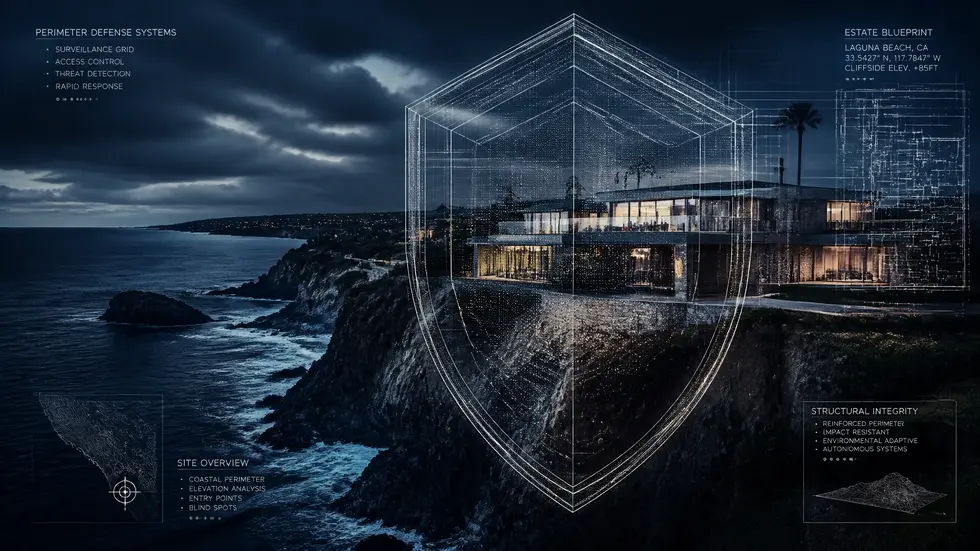
Laguna Beach isn't just a zip code; it's a high-stakes environment where the elements of nature meet the aggressive encroachment of California's regulatory and tax machine. If you own a coastal estate in Orange County, whether it's a bluff-top sanctuary in Emerald Bay or a contemporary masterpiece in Three Arch Bay, your property is currently targeted. The standard "Living Trust" your family attorney drafted a decade ago is likely a liability, not an asset. In the Wealth Defense Matrix, we don't look at a property as just a home; we see it as a strategic position that requires a multi-layered defensive architecture to survive the twin threats of Proposition 19 and the California Coastal Commission.
The vulnerability of a $10M coastal estate is staggering. Most owners operate under the illusion that their "Trust" protects them. It doesn't. A standard revocable trust is a sieve when it comes to the specific, predatory laws governing California's coastline. We are seeing families who have held land for generations suddenly hit with six-figure property tax spikes or multi-million dollar fines for "blocking public access" that they didn't even know was legally required. The "Laguna Trap" is real, and it is sprung the moment you attempt to pass that legacy to the next generation.
Take a $15 million home on Cliff Drive. Under the old rules, you could pass that to your children with the original property tax base intact. Today, thanks to Proposition 19, that transfer triggers a catastrophic reassessment. Unless your children move in within one year, a logistical impossibility for many high-net-worth families with established lives elsewhere, the tax bill could jump from $15,000 a year to $165,000 a year, overnight. That isn't just a bill; it's an eviction notice from the state of California. And that's before we even talk about the Coastal Commission's $11,250-per-day fines for unpermitted development or "encroachments" on public access.
The solution isn't a better document; it's a better architecture. You need a system that decouples the "owner" from the "title," obscures the transfer of interest, and leverages out-of-state jurisdictions like South Dakota to shield the equity from the reach of the California tax man. This is the Laguna Beach Trust Audit. It is the tactical analysis of your current exposures and the deployment of a "Coastal Overlay" designed to keep your legacy behind a reinforced perimeter.
The Prop 19 Death Trap: Why Your 2025-2027 Transfer is at Risk
If you are planning a transfer of coastal property between 2025 and 2027, you are operating under a very specific set of numbers. The California State Board of Equalization has set the Prop 19 reassessment cap at $1,044,586 above the factored base year value for this period.
Let's look at the math for a typical Laguna Beach estate. Say you bought your home in 1995 for $1.5M. Today, it's worth $12M. Your current "assessed value" (the one you pay taxes on) might only be $2M due to Prop 13 protections. Under Prop 19, if you die and leave that home to your children, the state looks at the math:
- Assessed Value: $2,000,000
- Prop 19 Exclusion: $1,044,586
- Total Protected Value: $3,044,586
- Fair Market Value: $12,000,000
- Taxable Excess: $8,955,414
The "new" tax base for your children would be approximately $10,955,414. At a 1.1% tax rate, their property tax bill just went from $22,000 to over $120,000 per year. For most families, this is the "Legacy Killer." It forces a sale. It breaks the chain of ownership. In our previous briefing, Law #3: The Successor Trustee Trap, we discussed how the wrong person in charge can accelerate these failures. With a coastal estate, the stakes are ten times higher.

The Coastal Commission Shadow: Public Resources Code § 30821
While Prop 19 attacks your wallet, the California Coastal Commission (CCC) attacks your control. Many Laguna Beach owners are sitting on "Offers to Dedicate" (OTDs) or public access easements that were buried in permit conditions from thirty years ago. These are landmines.
In the landmark case Lent v. California Coastal Commission (2021), the court upheld the Commission's power to impose administrative fines under Public Resources Code § 30821. The Lents, who owned a home in Malibu, were fined over $4 million for refusing to remove a gate and deck that blocked a public access easement. The court didn't care that the fine was massive; they cared that the "public access" was being restricted.
If your Laguna estate has a private gate leading to the sand, or a fence that encroaches six inches into a designated public view corridor, you are technically in violation of the Coastal Act. Under § 30821, the CCC can fine you up to $11,250 per day. If that violation stays "active" for a year while you're negotiating, you're looking at a $4 million penalty. This is why a standard Asset Protection strategy must be specifically tuned for coastal real estate. A generic LLC won't stop a Coastal Commission lien; you need a structure that isolates the liability and preserves the "privacy of use" without triggering the Commission's "unpermitted development" triggers.
The "Coastal Overlay": A Multi-Jurisdictional Wealth Defense Matrix
To defend a Laguna Beach estate, we deploy what we call the "Coastal Overlay." This isn't a single trust; it's a structural stack.
- The California Land Trust: We start by moving the property title out of your personal name and into a Land Trust. This provides immediate "Security Privacy." It removes your name from the public tax rolls, making it harder for predatory litigants or aggressive regulators to link the property directly to your other assets.
- The Shield LLC: The beneficial interest of that Land Trust is held by a specialized California LLC. This LLC is designed to manage the property's "operations", maintenance, staff, and usage. This creates a layer of corporate protection between the property's liabilities (like a slip-and-fall on a steep coastal staircase) and your personal wealth.
- The South Dakota Dynasty Trust: The ownership of the LLC is then held by an irrevocable Dynasty Trust sitused in South Dakota. Why South Dakota? Because California's "Rule Against Perpetuities" (California Probate Code § 21205) effectively kills trusts after 90 years. South Dakota allows trusts to last forever. More importantly, South Dakota has the strongest asset protection laws in the union. By moving the ultimate ownership of your Laguna estate out of California's jurisdiction, you are placing it behind a legal barrier that the FTB and the Coastal Commission struggle to penetrate.
- The PPLI Wrapper: For ultra-high-net-worth clients, we may wrap the underlying equity in a Private Placement Life Insurance (PPLI) structure. This turns the real estate into an "insurance dedicated fund" asset, which can provide significant tax deferral on the growth and eventually a tax-free transfer to the next generation, provided the investor-control rules are strictly followed.
Mission Summary: Tactical Real Estate Defense
The goal of the Laguna Beach Trust Audit is to ensure that your home remains a sanctuary, not a target. We look for the "Prop 19 Exposure Gap," the "Coastal Act Liability," and the "Succession Failure Point." If your current plan hasn't been audited for these specific coastal risks, you aren't protected, you're just lucky. So far.
Comparison Matrix: Standard Trust vs. Coastal Wealth Defense Architecture

The Sledgehammer Test: Is Your Coastal Estate Secure?
Run your current estate plan through these four diagnostic questions. If you answer "No" or "I don't know" to any of them, your structure will fail under pressure.
- The Title Privacy Test: If I search the Orange County Recorder's office for your name, does your home address appear? If yes, you are a target for every contingency-fee lawyer in California.
- The Prop 19 Math Test: Have you calculated the exact dollar amount your property taxes will increase if you passed away today? If that number exceeds $50,000/year, do your heirs have the liquidity to pay it without selling the house?
- The Coastal Access Audit: Do you have a certified survey from the last five years confirming that no "unpermitted development" (including landscaping or gates) encroaches on a public access easement?
- The Jurisdiction Test: Does your trust rely on California law for its validity? If so, you are subject to the whims of the California legislature, which is currently looking for every possible way to tax high-net-worth "wealth" and "privilege."
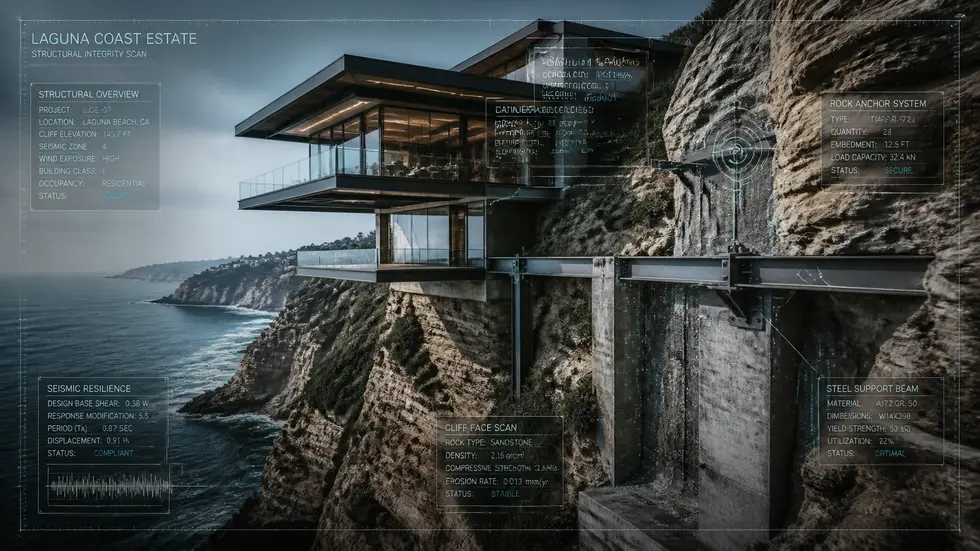
Founder Insight: The Laguna Beach Paradox
As a veteran and an attorney, I see estate planning through the lens of a mission. In Laguna Beach, the terrain is treacherous. I often see clients who have spent $2M on a kitchen remodel but won't spend 1/10th of that to ensure they actually keep the house. They suffer from the "Ferrari Fallacy": as I discussed in Law #4: The Ferrari Fallacy: where they value the shiny exterior but ignore the engine and the brakes.
The "Laguna Beach Paradox" is that the more beautiful and valuable your property becomes, the more the state wants to take it from you. Success creates a target. My job is to make that target as small and as difficult to hit as possible. We don't just "do trusts." We build control systems. If your current attorney is talking about "distributing assets," they are thinking about the end of your legacy. I am thinking about the continuation of it.
We use what we call "Fractional Gifting" to exploit the Prop 19 loopholes while you are still alive. By transferring small percentages of the property into protected structures over time, we can often "lock in" lower valuations and create a "stepped-up" defense that mitigates the final reassessment blow. This isn't "tax evasion": it's technical compliance with a poorly written and predatory law.
Technical Summary: The Definitive Framework for Coastal Wealth Defense
Core Legal Logic: The defense of high-value California coastal real estate requires the intentional decoupling of legal title, beneficial interest, and management control. By utilizing a California Land Trust for title privacy, a Manager-Managed LLC for operational liability shielding, and a South Dakota Dynasty Trust for jurisdictional arbitrage and perpetuity, the "Wealth Defense Matrix" creates a multi-point failure resistance.
Strategic Markers:
- Prop 19 Mitigation: Utilization of intergenerational transfer exclusions (up to the $1,044,586 cap for 2025-2027) combined with fractional interest discounting.
- Coastal Commission Shielding: Isolating "development" liability within corporate shells to protect the grantor's global balance sheet from Public Resources Code § 30821 penalties.
- Perpetuity Planning: Circumventing California Probate Code § 21205 via out-of-state situsing to ensure the estate remains a multi-generational asset without the "forced liquidation" triggers of CA law.
Tactical FAQ: Coastal Estate Wealth Defense
What is the Prop 19 "Family Home" requirement?
To claim the reassessment exclusion under Prop 19, the property must be the principal residence of the transferor (parent) and must become the principal residence of the transferee (child) within one year. If the child moves out or uses it as a vacation home, the exclusion is lost, and the property is fully reassessed to market value.
Can I use an LLC to avoid Prop 19?
Directly transferring a property to an LLC usually triggers a "change in ownership" and a full reassessment. However, if the property is already in an LLC, transferring the interests of that LLC can sometimes be managed to avoid a "change in control" (over 50% transfer). This is a complex maneuver that requires precise timing and tactical execution.
What happens if I ignore a Coastal Commission "Notice of Violation"?
Ignoring the CCC is the fastest way to lose your estate. Under PRC § 30821, fines accrue daily. In Lent v. CCC, the homeowners thought they could fight it out in court; they ended up with a $4.1M fine. The "Wealth Defense" approach is to audit your property before the notice arrives and remediate any "access" issues quietly and voluntarily.
Why do you recommend South Dakota over Delaware or Nevada?
While Nevada and Delaware are good, South Dakota currently offers the best combination of: (1) No state income tax, (2) No "Rule Against Perpetuities" (forever trusts), and (3) The highest privacy and asset protection "decanting" statutes in the U.S. For a Laguna Beach estate, South Dakota is the ultimate "High Ground."
How does a Land Trust provide privacy if the LLC is the beneficiary?
The deed recorded with the Orange County Clerk will show "The 123 Cliff Drive Land Trust" as the owner. It will not show your name. While a determined investigator could potentially dig deeper, the Land Trust provides a "first-line" defense against the casual searches used by most predatory litigants and data brokers.
Is the "Laguna Beach Trust Audit" different from a standard Estate Planning review?
Yes. A standard review looks at "who gets what." The Laguna Beach Trust Audit looks at "who keeps what." We focus on the specific traps of coastal property: Prop 19 math, Coastal Commission easements, and the high-liability risks of bluff-side ownership.
Resources & Authorities
- California Constitution Article XIIIA (Proposition 13): The foundation of California property tax law.
- California Proposition 19 (The Home Protection for Seniors, Severely Disabled, Families, and Victims of Wildfire or Natural Disasters Act): The source of the current reassessment traps. See BOE Guidance here.
- California Probate Code § 21205: The statutory "Rule Against Perpetuities" that limits the life of California trusts.
- California Public Resources Code § 30821: Authorizes administrative civil penalties for Coastal Act violations.
- Lent v. California Coastal Commission, 62 Cal. App. 5th 812 (2021): The landmark case confirming the CCC's power to levy multi-million dollar fines.
- California Code of Civil Procedure § 704.115: The "Protection Dome" for Private Retirement Plans, which we often integrate with real estate holding structures. Learn more about the CPRP here.
Request a Situation Readiness Briefing (SRB)
If you own a coastal estate in Laguna Beach, Newport Beach, or Dana Point, your current plan is likely outdated. Don't wait for a Prop 19 tax bill or a Coastal Commission violation to find the holes in your defense. Request a Situation Readiness Briefing and we will map the control, probate, tax, and regulatory exposures in your current structure.
Disclaimer and IP Disclosure
The information provided in this article is for educational purposes only and does not constitute legal or tax advice. No attorney-client relationship is formed by reading this content or requesting a briefing. The "Wealth Defense Matrix," "Laguna Beach Trust Audit," and "Coastal Overlay" are proprietary service frameworks of the Law Office of James Burns. Asset protection and tax outcomes depend on individual facts and require specific legal counsel. All rights reserved.

Comments
There are no comments for this post. Be the first and Add your Comment below.
Leave a Comment