
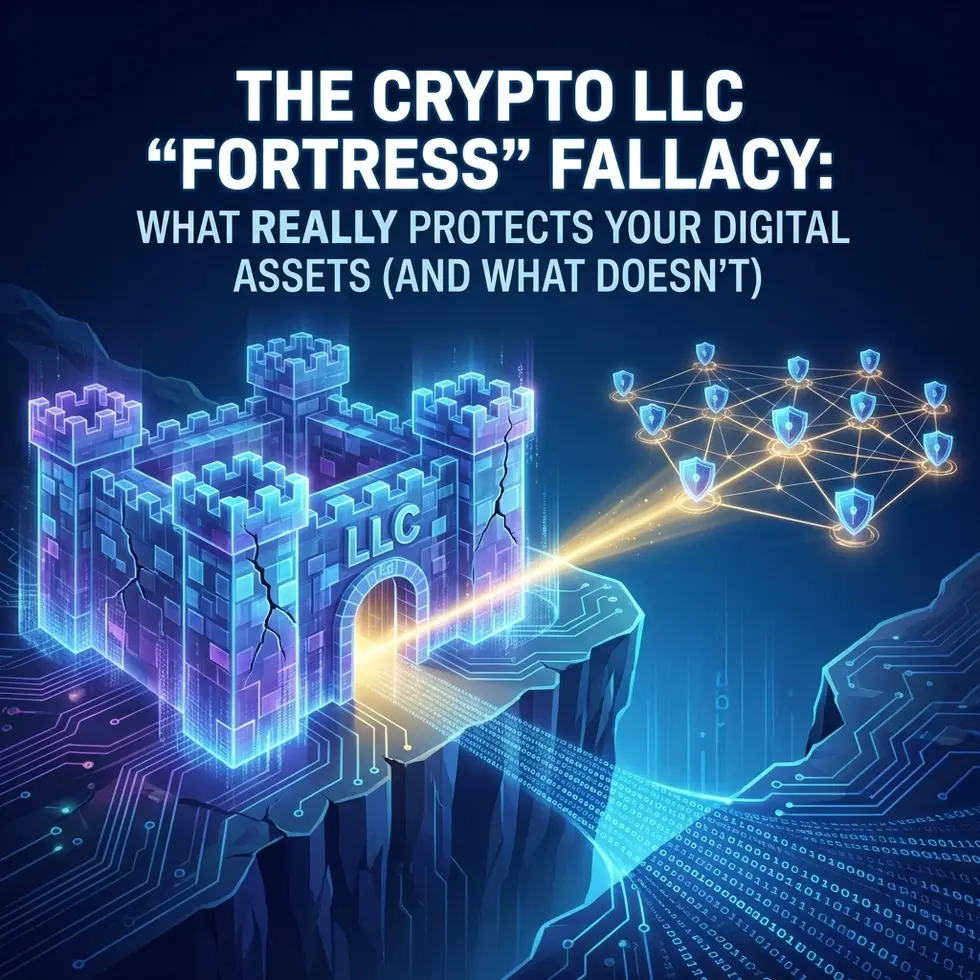
The Container vs. Force Field Reality
You've probably seen the articles promising that a Wyoming LLC will turn your crypto into an "untouchable asset class" or create an "indefinite waiting game" for creditors. Here's the uncomfortable truth: an LLC doesn't transform the legal nature of what you own, it just changes who owns it and how creditors might collect.
The recent Fortress Trust collapse perfectly illustrates this principle. Despite Nevada state licensing and fiduciary promises, over 250,000 customers lost access to their assets when Fortress couldn't honor withdrawals or reconcile accounts. A legal entity charter, by itself, provided zero protection when operational failures and poor oversight intersected.
Real asset protection requires comprehensive architecture, insurance, exemptions, prenuptial agreements, proper titling, trusts, and business risk separation. A single LLC sitting in isolation isn't "the foundation" of anything meaningful.

Charging Order Protection: The Wyoming Mirage
Let's address the biggest myth head-on. You'll read that "Wyoming offers charging order protection for single-member LLCs" and that "creditors can only wait for distributions indefinitely." This reflects a fundamental misunderstanding of how creditor remedies actually work.
Wyoming's charging order statute (Wyo. Stat. § 17-29-503) describes a charging order as attaching to a member's transferable interest and intercepting distributions. But the marketing leaps from that basic framework to "cannot force a sale" and "indefinite waiting" as absolute outcomes.
The problem? Creditor remedies are governed by the forum court where you're sued, not by the marketing narrative of your formation state. Consider the Florida Supreme Court's decision in Olmstead v. FTC, 44 So. 3d 76 (Fla. 2010), where the court allowed creditors to reach a single-member LLC interest beyond mere charging order protection, compelling surrender of the entire interest. For how ultra-wealthy families actually neutralize litigation risk, see Why Ordinary Asset Protection Fails for the Ultra-Wealthy—Inside FortressWall™ Litigation Immunity.
For a concrete example: You're a California resident with a Wyoming LLC holding $2 million in Bitcoin. You get sued for $5 million in Los Angeles Superior Court. That California judge isn't bound by Wyoming's charging order "exclusivity." The court can impose contempt sanctions, receivership, turnover orders compelling you to provide private keys, or foreclosure remedies, depending on California law and the specific facts.
The "indefinite waiting" promise ignores practical enforcement reality. Courts routinely order debtors to turn over crypto keys or cooperate with asset recovery, backed by contempt powers. Your Wyoming formation paperwork won't shield you from a contempt citation in the forum where you actually live and conduct business.
The Fraudulent Transfer Time Bomb
Here's another dangerous oversimplification: "A notarized transfer agreement proves timing and shifts the burden dramatically."
Notarization primarily establishes signing authenticity and date, it doesn't create legal immunity from fraudulent transfer laws. Under the Uniform Voidable Transactions Act (UVTA), adopted by California as Civil Code § 3439 et seq., the real analysis focuses on:
- Intent to hinder creditors (Civil Code § 3439.04(a)(1))
- Insolvency at transfer time (§ 3439.05(a))
- Badges of fraud like family transfers, secrecy, or timing near known claims (§ 3439.04(b))
A practical scenario: You transfer $3 million in Ethereum to your newly-formed LLC three months after a major business dispute emerges but before formal litigation. Even with pristine notarization, a court can void that transfer if it finds fraudulent intent or insolvency. The burden doesn't magically "shift", the creditor still needs to prove the elements, but your notary stamp isn't a shield.
Effective transfer planning requires genuine pre-claim timing, ideally years before any dispute horizon, with legitimate business purposes beyond creditor avoidance.
Privacy and Anonymity: The Subpoena Reality
The "Wyoming privacy keeps your name off public records" pitch sounds compelling until you encounter modern discovery practice. Public record anonymity dissolves quickly through:
- Bank and exchange subpoenas requiring KYC/AML disclosure
- Third-party discovery targeting accountants, attorneys, and counterparties
- Beneficial Ownership Information (BOI) reporting under FinCEN's Corporate Transparency Act
- State transparency initiatives like New York's LLC Transparency Act (effective January 1, 2026)

Consider this realistic example: You hold crypto through a Wyoming LLC with nominee formation services. A plaintiff's attorney issues subpoenas to Coinbase, your CPA, and your formation agent. Within weeks, they've identified beneficial ownership, transaction patterns, and key management, regardless of your Wyoming privacy statute.
Practical "invisibility" is marketing fiction, not a reliable protective feature in litigation.
The Business Tax Treatment Fallacy
One of the most legally problematic claims circulating is that "an LLC makes it possible to treat crypto investing as a business rather than a hobby" and "unlocks legitimate deductions."
This reflects a complete misunderstanding of federal tax law. Entity form doesn't determine trade or business status, the IRS examines the nature and frequency of activity under the trader vs. investor distinction established in cases like Higgins v. Commissioner, 312 U.S. 212 (1941).
The IRS factors for business treatment include:
- Frequency and regularity of transactions
- Profit motive and systematic approach
- Time and effort devoted to the activity
- Taxpayer expertise and advisory relationships
Per Revenue Ruling 2019-24, cryptocurrency dispositions are taxable events regardless of entity structure. Your LLC doesn't eliminate gain recognition or transform investment activity into business operations. For the IRS's new broker reporting regime (Form 1099-DA) and where PPLI may fit—subject to strict investor-control/diversification rules and tax counsel review—see our deep dive: Crypto Reporting Crackdown: Form 1099-DA, PPLI, and Avoiding Capital Gains Traps.
For crypto mining specifically, the analysis depends on profit motive and operational scale, not whether you use an LLC wrapper. Revenue Ruling 2023-14 addressed some mining tax issues, but entity form remains irrelevant to the underlying characterization.
The safer framework: "An LLC may help organize records and substantiate expenses, but trade-or-business treatment depends on IRS facts-and-circumstances testing, not entity selection."
Jurisdiction and Forum Shopping: Why Location Matters (and Doesn't)
Here's the critical insight that most crypto LLC marketing completely ignores: where you get sued matters infinitely more than where your LLC is formed.
A Wyoming LLC doesn't create Wyoming jurisdiction over a California resident. If you live in California, conduct business in California, or have significant connections there, expect California courts to assert jurisdiction over you personally. And California's creditor remedy laws will apply, not Wyoming's.
Real-world example: Tech executive with $10 million in crypto held through Wyoming LLC faces wrongful termination lawsuit in San Francisco. The California court can:
- Order turnover of LLC interests under CCP § 708.110
- Appoint a receiver under CCP § 564
- Issue contempt sanctions for non-compliance with key disclosure orders
- Apply California's stronger creditor protections regardless of Wyoming formation
This is why sophisticated asset protection planning focuses on jurisdictional strategy, not just entity formation states.
Multi-Member vs. Single-Member: The Substance Gap
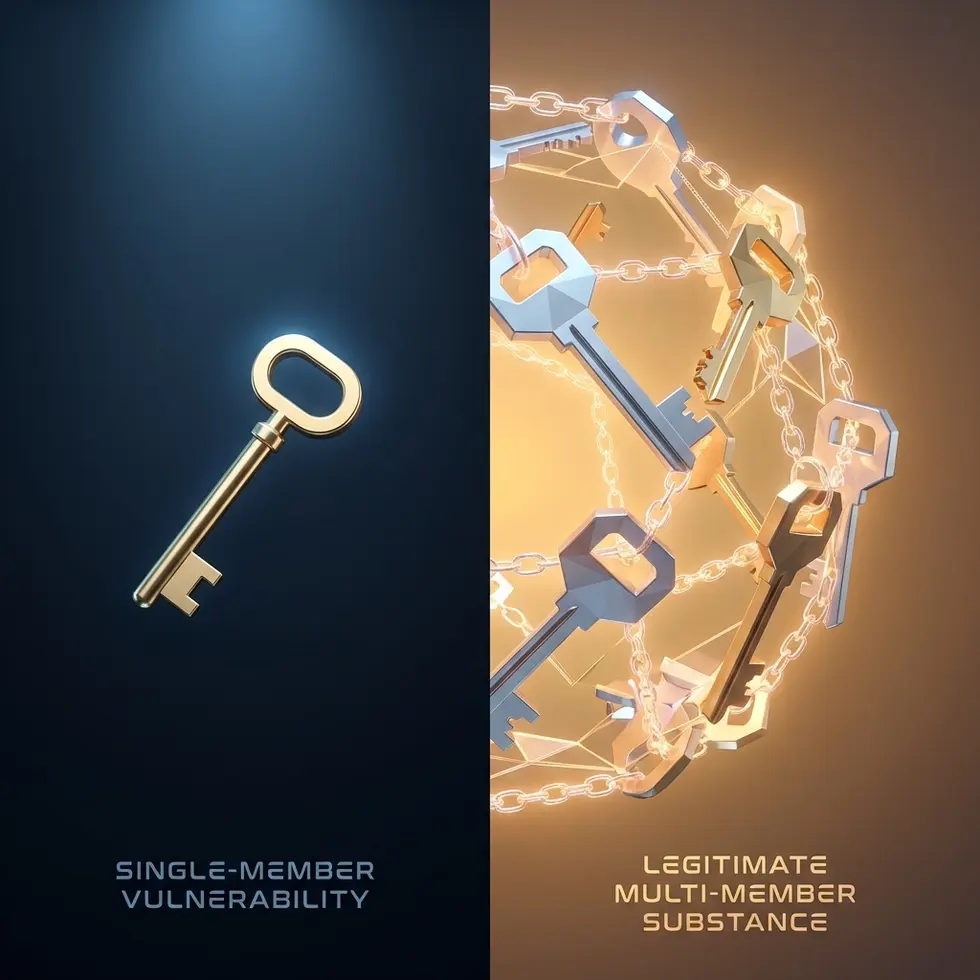
Most crypto LLC marketing focuses on single-member entities for "simplicity." But single-member LLCs face heightened alter ego and veil-piercing risks, especially when the member maintains complete control over crypto keys.
The strongest charging order protection typically applies to legitimate multi-member arrangements with real economic substance, not nominee 1% members or family transfers designed purely for asset protection.
Practical consideration: If you maintain unilateral control over private keys while claiming LLC separation, courts may disregard the entity entirely under traditional veil-piercing analysis (Automotriz del Golfo de California S.A. v. Resnick, 47 Cal. 2d 792 (1957)).
What Actually Protects Crypto Assets
Based on real-world outcomes and legal precedent, effective crypto protection requires:
1. Genuine Geographic Diversification
Not just entity formation, but actual operational and jurisdictional substance. Consider legitimate offshore trust structures with independent trustees and non-U.S. situs.
2. Key Custody Architecture
Multi-signature arrangements, institutional custody, or hardware security that prevents unilateral access. Courts can't compel production of keys you genuinely don't control.
3. Timing and Documentation
Pre-claim transfers with legitimate business purposes, proper valuation, and clean fraudulent transfer analysis. See our guide on crypto estate planning pitfalls.
4. Integrated Planning
LLCs as one component within broader insurance, trust, and exemption strategies, not standalone solutions.
5. Professional Oversight
Regular legal review of custody arrangements, entity compliance, and evolving regulatory landscape.
The Fortress Trust Lesson
The October 2025 Fortress Trust collapse provides a sobering case study. Despite Nevada licensing and fiduciary promises, customers lost access when the company couldn't reconcile accounts or honor withdrawals. Regulatory licensing alone provided inadequate protection.
The failure occurred because customer funds flow through multiple layers, exchanges, legal custodians, sub-custodians, and blockchain wallets. A breakdown at any layer can strand assets regardless of legal protections on paper.
This reinforces why operational substance matters more than legal entity selection. Your Wyoming LLC won't protect against platform failures, key loss, or regulatory enforcement.
FAQ: Crypto LLC Asset Protection Reality Check
Q: Can a Wyoming LLC make my crypto untouchable by creditors?
A: No. An LLC may complicate collection but doesn't create immunity. Courts in your home jurisdiction can order key turnover, impose receivers, or use contempt sanctions regardless of formation state.
Q: Does charging order protection mean creditors must wait indefinitely?
A: Not reliably. Single-member LLC outcomes vary dramatically by forum, and courts have multiple enforcement tools beyond charging orders, especially for crypto assets.
Q: Will an LLC let me treat crypto investing as a business for tax purposes?
A: Entity form doesn't determine business status. The IRS applies facts-and-circumstances tests based on activity frequency, profit motive, and operational substance: not LLC existence.
Q: Does Wyoming privacy keep my crypto ownership secret?
A: Privacy dissolves quickly through subpoenas, KYC disclosure, beneficial ownership reporting, and litigation discovery. Don't rely on formation state secrecy.
Q: Should I avoid crypto LLCs entirely?
A: LLCs can be useful for organization, recordkeeping, and modest collection complications. But approach them as tools within broader planning: not magic bullet solutions.
Resources & Related Reading
- Wyoming LLC Statute & Charging Order Law (Wyo. Stat. § 17-29-503) — Core text often cited for single-member LLC charging order debates; read what the statute actually provides. Statute text
- Olmstead v. FTC, 44 So. 3d 76 (Fla. 2010) — Leading authority showing courts can reach beyond charging orders for SMLLCs. Decision
- Uniform Voidable Transactions Act (UVTA/UFTA/CUFTA) — The statutory framework courts use to unwind bad-timed transfers; see California's version at Civil Code § 3439 et seq. ULC overview | California Civil Code § 3439 et seq.
- IRS Crypto FAQ — IRS positions on income, basis, reporting, and broker forms (including 1099-DA) for digital assets. IRS FAQs
- FTB digital asset/tax guidance — California's official guidance on reporting and taxation of digital assets. FTB Virtual Currency
- FinCEN Beneficial Ownership (BOI) rules — The federal registry that undermines “anonymous LLC” marketing. FinCEN BOI
- Notable digital asset recovery stories — Real-world examples of successful recoveries and turnover orders. DOJ recovers Colonial Pipeline ransom | DOJ seizes crypto tied to Bitfinex hack
- Internal pillar guides — Practical next steps from our team. Crypto Reporting Crackdown: Form 1099-DA, PPLI, and Avoiding Capital Gains Traps (how broker reporting and PPLI interact); Why Ordinary Asset Protection Fails for the Ultra-Wealthy—Inside FortressWall™ Litigation Immunity (architecture that resists court remedies); asset protection strategies and advanced estate and business planning (core services and structures we implement).
Ready to build real crypto asset protection beyond the marketing hype? Schedule a consultation to review your specific situation and develop genuinely effective protection strategies.
Legal Disclaimer: This analysis is for educational purposes and doesn't constitute legal advice. Crypto asset protection involves complex federal and state law variations. Consult qualified counsel for strategy specific to your circumstances.
Copyright Notice: This content is proprietary to Law Office of James Burns and protected under federal copyright law. Unauthorized reproduction or distribution is prohibited.

Comments
There are no comments for this post. Be the first and Add your Comment below.
Leave a Comment