
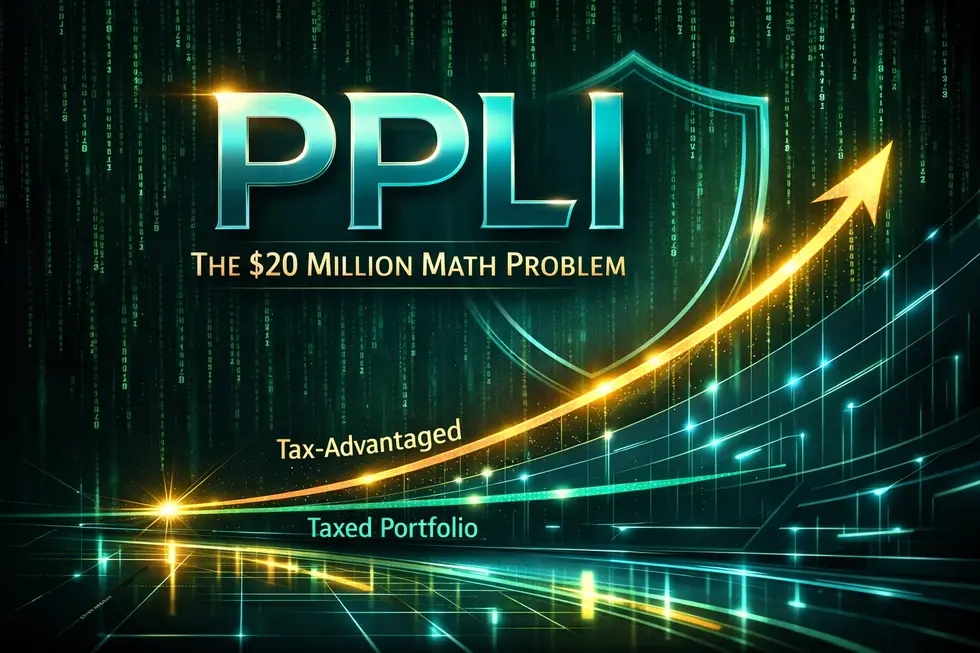
Mission Briefing: Escaping the Tax Matrix (Real Talk Edition)
Build the engine, sure. But when you're actually winning, the Matrix doesn't just show up as “tax season.” It shows up as permanent drag on your capital. Every forced distribution, every realized gain, every tax payment is money that no longer compounds. That's the part most smart, busy, high-income people miss because it doesn't feel dramatic day-to-day. It just quietly steals the last 10 years of your compounding curve.
Bermuda PPLI isn't a hack. It's not “offshore equals invisible.” It's a regulated insurance structure that can change the tax physics of a portfolio—if (and only if) you build it like a grown-up: correct policy design, correct ownership structure, independent investment management, diversification compliance, and ongoing administration.
This post is going to keep the vibe casual, but we're not going to keep it shallow. You're here because you want the real mechanics.
Tax Drag: The Compounding Friction Nobody Puts on a Billboard
Tax drag is what happens when your portfolio is doing its job—earning yield, realizing gains, rebalancing—and the tax system takes a bite as it goes, reducing the amount left to reinvest.
For California HNW families, you're often dealing with some combination of:
- high federal ordinary income rates on interest/short-term gains,
- federal long-term capital gains rates (plus net investment income tax in many cases),
- and California's state tax layering on top.
Even if you don't “sell,” the drag can still show up through turnover, distributions, and ordinary income. The point is simple: the government doesn't just tax the endpoint; it taxes the journey. And compounding hates interruptions.
That's why the same starting capital can end up in two totally different places over the same time horizon.
In the simplified 20-year math used here, $10M grows to roughly:
- ~$25.5M in a taxable setup (after annual tax friction), versus
- ~$40M inside Bermuda PPLI (where growth can compound inside the policy without annual taxation, assuming the policy stays compliant and in force).
And yes, assumptions drive the precise numbers. But the direction of travel is the same in real life: tax drag takes your best compounding years and turns them into someone else's revenue.
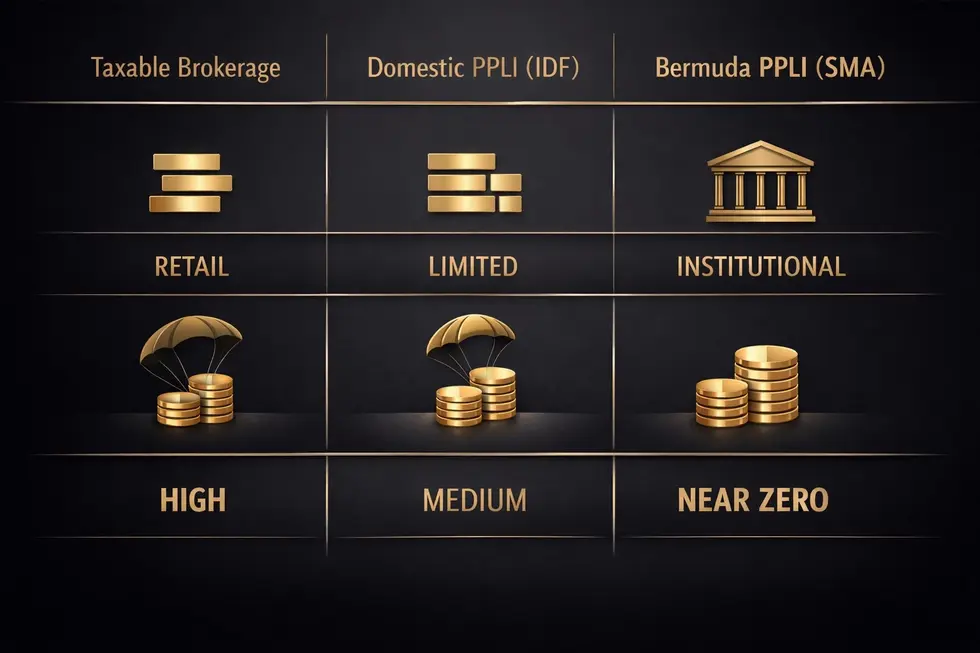
Keep these two visuals in view, because they summarize the “why” better than a thousand words:

The Two Statutory “Shields”: IRC §7702 and IRC §817(h)
When people say “PPLI compounds tax-free,” what they really mean (when they're being accurate) is: the tax code gives life insurance a special treatment—but only if the contract qualifies and stays inside the lines.
Two of the biggest lines are IRC §7702 and IRC §817(h). Think of them as the primary shields that keep the IRS from recharacterizing the structure.
IRC §7702: How the Policy Qualifies as “Life Insurance” (Not Just a Brokerage Account in a Trench Coat)
IRC §7702 is the gatekeeper. It defines whether a contract is treated as life insurance for federal tax purposes. The statute is technical, but the concept is straightforward: the policy has to be designed so it behaves like insurance under the tax rules, not like a pure investment account.
In practice, that means policy design has to respect funding and corridor requirements (and related testing mechanics) so the contract stays on the “life insurance” side of the line. If you blow §7702 qualification, you're not in PPLI land anymore—you're in “taxable wrapper with extra fees” land.
This is one reason why serious PPLI design is never just “pick a carrier and dump money in.” The engineering matters.
IRC §817(h): Diversification Rules (Because One Position Is Not a “Separate Account” Strategy)
IRC §817(h) (and the Treasury Regulations under it) impose diversification requirements for the investments inside the variable contract's separate account. Again: technical rules, simple idea. The tax system does not want you putting a single concentrated bet (or a tiny handful of positions) inside a policy and calling it a day.
If the separate account isn't properly diversified, you can lose the intended tax treatment. So the “shield” here is: diversify the policy's investment account in the manner the rules require, measured on the schedule the rules require.
This is also why you'll hear sophisticated advisors say “you can't treat this like your personal brokerage account.” They're not being dramatic. They're describing §817(h) reality.
Investor Control Doctrine: Why You Can't Be Your Own Portfolio Manager Inside the Policy
Now we get to the doctrine that ruins more “internet PPLI” fantasies than anything else: Investor Control.
The basic issue is this: if the policyholder is effectively directing the underlying investments (especially specific trades or specific assets), the IRS may argue that you are the true owner of the assets for tax purposes—even if the policy is the legal owner. If that happens, the whole “tax-advantaged wrapper” story can collapse.
A frequently cited piece of guidance here is Rev. Rul. 2003-91, along with a broader body of authorities and case law that shape how “control” is analyzed. The practical takeaway is what matters for you:
- you generally can't call the manager and say “buy this exact bond today” or “sell that exact position now,”
- you can't use the policy as a trading account you control,
- and you need real independent management discretion.
This isn't academic. Investor control disputes are the kind of thing that gets litigated when structures go bad or get examined. The cleanest designs respect separation from day one: policy owner, trustee, carrier, and investment manager each do their job—with the manager managing.
The Structure in Plain English: ILIT Owner, You as Insured, Trustee + SMA Manager
Here's what a classic HNW implementation often looks like conceptually (details vary, and legal/tax counsel should tailor it to your facts):
- You (the client) are typically the insured.
- An ILIT (Irrevocable Life Insurance Trust) is commonly the policy owner (and sometimes beneficiary structure is layered depending on the estate plan).
- A Trustee (individual or professional) administers the trust, handles premium flows, and maintains the governance around the policy.
- An SMA manager (or other compliant investment management solution) manages the policy's investment sleeve under the carrier's platform and compliance framework.
Why does this matter? Because ownership and control are not cosmetic in PPLI. They're the architecture.
A properly drafted ILIT can also support broader estate planning goals (keeping death benefit outside the taxable estate in many structures, coordinating with family governance, etc.). If you want to zoom out on the “whole-board” plan, these are the relevant internal starting points:
- PPLI: https://jamesburnslaw.com/ppli
- Asset protection: https://jamesburnslaw.com/asset-protection
- Private retirement plan strategies: https://jamesburnslaw.com/private-retirement-plan
- Estate/legacy planning: https://www.jamesburnslaw.com/services
Bermuda (Elite) vs Domestic (Kids Menu): SMAs vs IDFs (And Why HNW People Care)
Domestic PPLI isn't “bad.” But domestic implementations often push you toward Insurance Dedicated Funds (IDFs). IDFs can be perfectly legitimate. They can also be limiting.
The “kids menu” jab is really about investment experience and access:
- With many domestic designs, you're choosing from a set of IDFs that fit the insurance platform. That can be fine—until you want something truly institutional or bespoke.
- With Bermuda structures, families more often target Separately Managed Accounts (SMAs) that can mirror an institutional mandate more closely (still subject to §817(h) diversification and investor control separation).
If you're allocating across credit, hedged strategies, or manager-specific mandates—and you care about implementation quality—this difference can be more important than the “offshore” label itself.
Policy Loans: Why They Can Be Tax-Free, and Where MEC Rules Come In
Policy loans are one of the most misunderstood parts of PPLI.
When structured and managed properly, a policy loan is generally treated as debt—not income. You're borrowing against policy value, not “taking a distribution” in the way people think about brokerage withdrawals.
That's the conceptual reason loans can be tax-efficient: borrowing isn't selling.
But you don't get to ignore the life insurance tax regime when you borrow. One key concept is the Modified Endowment Contract (MEC) rules under IRC §7702A. If a contract is a MEC, distributions/loans can be taxed differently (often less favorable, with “income first” treatment and potential penalties depending on age and circumstances). So part of the design work is coordinating:
- §7702 qualification mechanics,
- §7702A MEC testing and funding patterns,
- and the intended loan strategy over time.
This is where “Real Talk” matters: if someone is pitching you a loan-heavy strategy but can't explain MEC risk in plain English, you're not talking to a planner—you're talking to a salesman.
The Lapse Bomb: The Nightmare Scenario Where “Tax-Free Loans” Become Taxable All at Once
Here's the landmine.
If you borrow against the policy for years and the policy later fails—poor performance, underfunding, rising costs, bad loan mechanics, or simple neglect—and the policy lapses (or is surrendered) with loans outstanding, the tax result can be ugly.
In many scenarios, the gain inside the policy can become taxable at that moment, and the outstanding loans can effectively accelerate the tax event. That's the “lapse bomb”: everything that felt calm and “tax-free” can turn into a real tax bill at once.
This is why sophisticated designs include:
- conservative funding and stress testing,
- ongoing monitoring,
- loan management discipline,
- and a clear understanding of costs and performance sensitivity.
Costs: COI, Mortality Loads, and Ongoing Compliance vs the Tax Savings
Let's address the obvious question: “Okay, what's the catch?”
The catch is that PPLI is not free. You're paying for an insurance chassis plus administration.
Common cost components include (names and mechanics vary by carrier):
- COI (Cost of Insurance): the pure insurance cost component, tied to underwriting, age, and net amount at risk.
- Mortality and expense charges / loads: policy-level charges that compensate the carrier for risk and administration.
- Premium loads (in some designs): charges applied to premium payments.
- Investment management fees: for the SMA manager or IDF managers.
- Administration/compliance costs: policy administration, reporting, and ongoing structuring support.
The real analysis isn't “are there fees?” The real analysis is: are the fees outweighed by the reduction in tax drag and the planning benefits, after stress-testing the loan strategy and policy economics?
For the right family, over the right time horizon, the answer can be yes. For the wrong family, it's an expensive distraction.
Offshore Compliance: FBAR and FATCA (Because Bermuda Isn't “No Paperwork”)
Because Bermuda is offshore, you should assume there will be additional reporting and coordination with tax counsel.
Two big acronyms you'll hear:
- FBAR: FinCEN Form 114. Filing requirements can apply when a U.S. person has a financial interest in or signature authority over foreign financial accounts, subject to thresholds and definitions.
- FATCA: IRS Form 8938 (Statement of Specified Foreign Financial Assets). Separate regime, separate thresholds, different definitions than FBAR.
Which forms apply depends on how the policy and related accounts are classified and held, and on the particular facts. The key point: the compliance is manageable, but it's not optional, and it should be planned from the start.
And one more time, because it matters (especially with offshore policies):
For jurisdictions like Bermuda, there is no broadly defensible “one-step” method for a U.S. person to contribute appreciated assets as an in-kind premium and guarantee “no gain.” The safest approach is to keep appreciated assets outside the policy, monetize with a loan, pay cash premium, and use the policy account—under strict investor-control and diversification rules—to acquire exposure. Tax results depend on whether funding creates a taxable disposition, and structures require independence and tax counsel review.
FAQ: Bermuda PPLI and Wealth Strategy
If Bermuda PPLI is so good, why doesn't everyone do it?
Because it's not for “everyone.” It's typically for families with enough assets, time horizon, and complexity where (1) reducing tax drag can materially change outcomes, and (2) they're willing to pay for correct design, ongoing administration, and compliance. If you want simple, buy simple.
What exactly makes the IRS “stay out,” structurally?
The intended tax treatment is anchored in the contract qualifying as life insurance under IRC §7702, the separate account meeting IRC §817(h) diversification, and the policyholder avoiding Investor Control problems (often discussed with reference to Rev. Rul. 2003-91 and related authority). These are the core “shields,” but they only work if you actually use them correctly.
Can I just tell the SMA manager what to buy?
You can communicate general objectives and constraints, but the whole point is that the manager needs independent discretion. Directing specific trades can create investor-control risk. If you want day-trading control, PPLI is the wrong wrapper.
Are policy loans always tax-free?
Not “always.” Loans are generally treated as debt, not income, but the outcome depends on the policy staying in force and on the contract not being a MEC (and on the specifics of distributions/loans). This is why loan strategies must be designed and monitored.
What's the biggest “oh no” moment you see?
A loan strategy that's too aggressive, paired with a policy that isn't being monitored. That's how lapse bombs happen.
Want a Strategy Session (and Real Numbers Instead of Internet Math)?
If you're in the $5M–$100M+ range and you want to know whether Bermuda PPLI is a fit for your exact facts—portfolio, turnover, CA residency/tax profile, liquidity goals, estate plan, and compliance tolerance—let's talk and run it like an adult.
Disclaimer:
The information provided in this mission dossier is for educational purposes only and does not constitute legal, financial, or tax advice. Offshore structures are subject to intense regulatory scrutiny and strict IRS reporting requirements. Tax results depend on whether funding creates a taxable disposition. Structures require independence and professional tax counsel review. We never guarantee tax elimination or automatic basis step-up.
Intellectual Property Disclosure:
© 2026 Law Office of James Burns. All rights reserved. No part of this publication may be reproduced or transmitted without express written permission.
Resources & Sources:
- Internal Revenue Code (IRC) §7702 (life insurance definition tests; cash value accumulation test and guideline premium/corridor concepts).
- Internal Revenue Code (IRC) §7702A (Modified Endowment Contract (MEC) rules).
- Internal Revenue Code (IRC) §72 (taxation of amounts received under annuities and certain insurance contracts; relevant to MEC/distribution mechanics).
- Internal Revenue Code (IRC) §817(h) (diversification requirements for variable contracts).
- Treasury Regulations under §817(h), including Treas. Reg. §1.817-5 (diversification standards) and related guidance.
- Rev. Rul. 2003-91 (Investor Control Doctrine guidance).
- Helvering v. Le Gierse, 312 U.S. 531 (1941) (insurance principles; risk shifting/risk distribution concepts).
- FinCEN: Bank Secrecy Act / FBAR (FinCEN Form 114) guidance and instructions.
- IRS: FATCA reporting for individuals (Form 8938) instructions and guidance; coordination considerations with FBAR.
- Bermuda Insurance Act 1978 and Bermuda Monetary Authority (BMA) regulatory materials (Bermuda insurance framework).
- Bloomberg Wealth and other reputable financial press (secondary sources) discussing PPLI market growth and UHNW planning trends.
- Carrier/administrator offering materials, policy forms, and compliance manuals (policy-specific; reviewed with counsel).

Comments
There are no comments for this post. Be the first and Add your Comment below.
Leave a Comment