
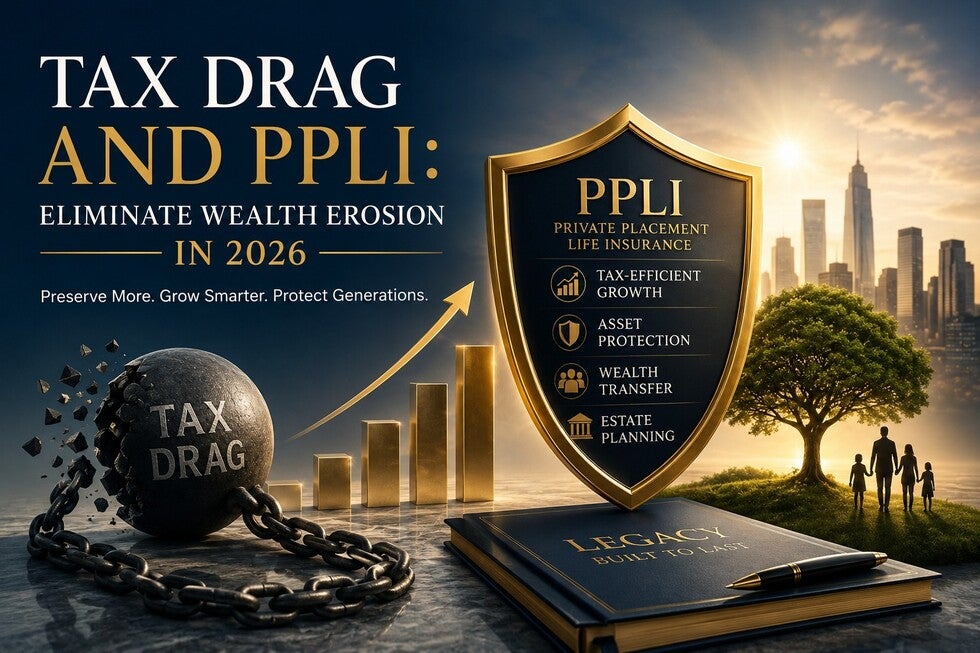
Tax drag is defined as the annual erosion of investment returns caused by income taxes, capital gains taxes, and dividend taxes paid on a taxable portfolio each year. Private Placement Life Insurance, known as PPLI, eliminates this erosion by wrapping investments inside a life insurance structure that defers all taxation until death or withdrawal. For ultra-high-net-worth families managing portfolios of $5 million or more, the difference between paying taxes annually and deferring them indefinitely is not a rounding error. It is the difference between preserving generational wealth and surrendering a significant portion of it to the IRS. PPLI delivers three core advantages: tax-deferred growth, no forced minimum distributions, and tax-free death benefits to heirs.
What is tax drag and PPLI, and why does it matter for wealth?
Tax drag is the compounding cost of paying taxes on investment gains every year rather than deferring them. Each dollar paid in taxes is a dollar removed from the compounding base, and that loss accelerates over time. Federal taxes reduce long-horizon equity wealth by more than one-third, producing an average annual tax drag of 347 basis points over a 30-year horizon. That figure means a portfolio generating 8% gross annually may deliver only 4.5% net after taxes, a gap that widens dramatically over decades.
For ultra-high-net-worth families, the dollar impact is severe. Cumulative tax drag over 20 years can result in approximately $8.3 million in lost compounding for a UHNW portfolio. That loss is not a market risk. It is a structural cost built into every taxable account that holds equities, hedge funds, or private credit.
The primary taxable events driving this drag include:
- Short-term capital gains taxed as ordinary income, often at rates above 37%
- Dividend income taxed annually, even when reinvested
- Interest income from bonds and private credit, taxed at full ordinary income rates
- Long-term capital gains triggered by rebalancing or manager changes inside a taxable account
- Forced distributions from retirement accounts under required minimum distribution rules
Each of these events interrupts compounding. A portfolio that never triggers a taxable event grows on its full gross return every year. A portfolio that pays 3.47% annually in taxes compounds on a permanently reduced base.
How does PPLI eliminate tax drag and create tax alpha?
PPLI is a variable universal life insurance policy structured to comply with IRC Section 7702, the IRS code section governing life insurance classification. Compliance with Section 7702 is what grants the policy its tax-deferred status. Investments held inside the policy grow without triggering annual income, dividend, or capital gains taxes.

The mechanism is straightforward. The policyholder funds a life insurance contract. The insurance carrier holds the investment assets inside a separate account. Those assets grow without annual tax events, and the death benefit passes to heirs income-tax-free. No 1099 forms are generated annually. No capital gains are realized when the manager rebalances. No dividend taxes are assessed when income is reinvested.
PPLI converts taxes ordinarily paid annually into tax alpha by allowing that capital to remain invested and compound inside the policy. Tax alpha is the additional wealth created by retaining dollars that would otherwise leave the portfolio as tax payments. Over a 20-year horizon, that retained capital compounds at the full gross return, producing a materially larger estate.
The structural advantages inside a well-designed PPLI policy include:
- No annual income or capital gains taxes on investments held inside the wrapper
- No required minimum distributions, unlike IRAs or 401(k) plans
- Tax-free death benefit to named beneficiaries under IRC Section 101(a)
- Tax-free rebalancing between asset classes without triggering gain recognition
- Access to alternative assets including hedge funds, private equity, and private credit
For hedge fund investors, the benefit is particularly pronounced. PPLI removes annual taxable events like short-term capital gains and interest income that typically generate 30–50% tax drag on hedge fund returns. Holding those same funds inside a PPLI wrapper allows performance to compound fully, producing structural alpha that no manager selection decision can replicate.
Pro Tip: Structure the PPLI policy with a diversified set of investment managers inside the separate account. The IRS investor control doctrine prohibits the policyholder from directing specific investment decisions. Maintaining proper separation between the policyholder and investment management is the single most important compliance step.
What are the costs, risks, and considerations when using PPLI?
PPLI is not a costless structure. Every policy carries internal charges that must be weighed against the tax savings it generates. Well-structured PPLI policies maintain internal cost of insurance below 0.5% annually for portfolios of $5 million or more. That cost is generally justified when the portfolio holds tax-inefficient assets generating annual tax drag above 2%.
The full cost structure of a PPLI policy typically includes:
- Cost of insurance (COI): Mortality charges based on the insured's age and health
- Administrative fees: Carrier and custodian charges for policy maintenance
- Investment management fees: Charged by the underlying fund managers
- Compliance and structuring costs: Legal and actuarial fees for initial setup
The regulatory risks are equally important to understand. If a PPLI contract lapses or is surrendered prematurely, accumulated gains lose tax-deferred status and become subject to immediate ordinary income taxation. That outcome can produce a tax bill larger than the savings accumulated over the policy's life. PPLI policies must be structured as life insurance first to meet IRS requirements. Treating the policy primarily as a tax shelter invites investor control doctrine scrutiny and risks disqualification of all tax advantages.
Liquidity is a genuine constraint. Assets inside a PPLI wrapper are not freely accessible without triggering tax consequences or surrender charges. Families must plan for outside liquidity needs before committing capital to a policy.
Pro Tip: Work with a tax attorney and an insurance specialist simultaneously during policy design. The legal structure and the insurance structure must align from day one. Retrofitting compliance after the fact is expensive and sometimes impossible.
How does PPLI compare with other tax mitigation strategies?
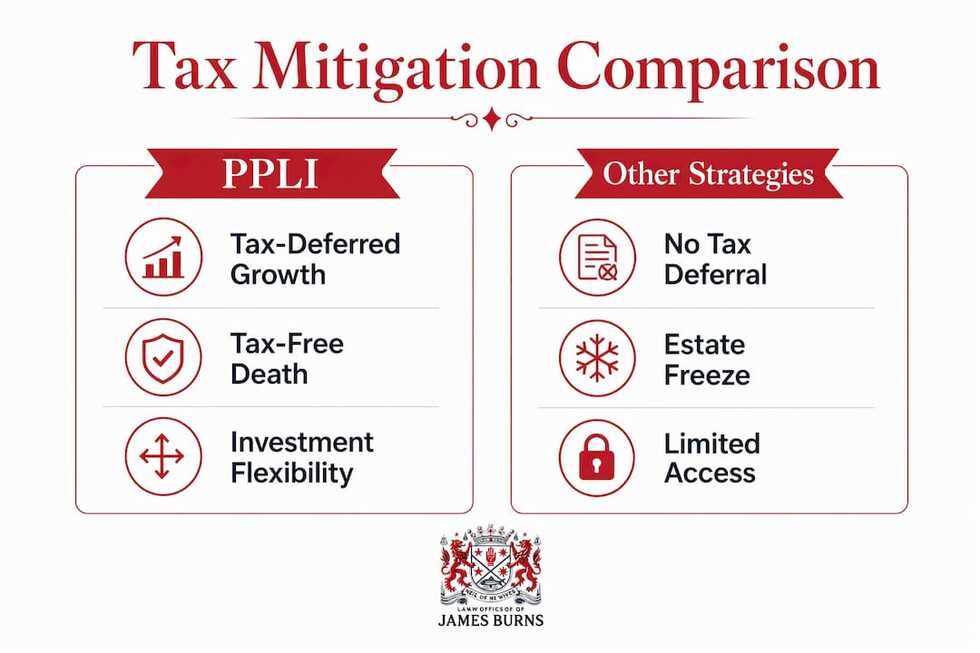
PPLI occupies a specific position in the wealth transfer toolkit. It is not a replacement for every strategy, but it outperforms alternatives in specific scenarios, particularly for tax-inefficient assets held over long horizons.
| Feature | PPLI | GRAT | Private Placement Annuity |
|---|---|---|---|
|
Tax-deferred growth |
Yes |
No |
Yes |
|
Tax-free death benefit |
Yes |
No |
No |
|
Forced distributions |
No |
No, Yes (annuity phase) |
|
|
Alternative asset access |
Yes |
Limited |
Limited |
|
Estate freeze capability |
Partial |
Yes |
Partial |
|
IRS scrutiny risk |
Moderate |
Low |
Moderate |
Grantor Retained Annuity Trusts, known as GRATs, are effective estate freeze tools, but they do not provide tax-deferred growth on the underlying assets. A GRAT removes appreciation from the taxable estate, but the assets inside still generate annual taxable income. PPLI eliminates that annual drag entirely.
Private Placement Annuities, or PPAs, share the tax-deferral feature with PPLI, but they do not provide a tax-free death benefit. At death, PPA proceeds are taxed as ordinary income to the beneficiary. PPLI death benefits pass income-tax-free under IRC Section 101(a), making PPLI the superior tool for families prioritizing wealth transfer alongside tax deferral.
PPLI is designed specifically for sophisticated investors holding tax-inefficient assets, including hedge funds, private credit, and high-turnover equity strategies. For families holding low-basis, buy-and-hold equities, the tax drag is already low, and PPLI's cost structure may not be justified.
What practical steps should families take to evaluate PPLI?
Evaluating PPLI begins with a quantitative audit of the existing portfolio. Families should calculate the annual tax drag on each asset class, identify which holdings generate the most taxable events, and model the net-of-tax return over a 10 to 20-year horizon. That analysis reveals whether the tax alpha from PPLI exceeds its internal costs.
The evaluation process follows a clear sequence:
- Quantify current tax drag by reviewing annual tax returns and identifying ordinary income, short-term gains, and dividend distributions from each position.
- Assess investment horizon and liquidity needs to confirm that capital can remain inside the policy for a minimum of 10 years without creating hardship.
- Select qualified advisors including a tax attorney familiar with IRC Section 7702, an estate planning attorney, and an insurance specialist with PPLI structuring experience.
- Evaluate insurance carriers on financial strength ratings, internal cost structures, investment manager access, and policy flexibility.
- Design the beneficiary structure to align with the family's estate plan, including trust ownership where appropriate for estate tax efficiency.
- Establish ongoing compliance monitoring to confirm the policy maintains its life insurance classification and that investment managers operate independently of policyholder direction.
The tax alpha generated on high-turnover assets generally justifies PPLI's internal costs over a 3 to 5-year horizon. Families should model that breakeven point before committing, and revisit the analysis annually as tax law and portfolio composition change.
Pro Tip: Do not evaluate PPLI in isolation. Model it alongside GRATs, irrevocable trusts, and charitable structures to identify the combination that produces the lowest effective tax rate on both growth and transfer.
Key takeaways
PPLI eliminates tax drag by deferring all investment taxes inside a life insurance wrapper, converting annual tax payments into compounding capital that builds tax alpha over time.
| Point | Details |
|---|---|
|
Tax drag costs are severe |
Federal taxes reduce long-horizon equity wealth by more than one-third, averaging 347 basis points annually. |
|
PPLI defers all annual taxes |
Investments inside a PPLI wrapper grow without income, dividend, or capital gains taxes each year. |
|
Tax alpha compounds over time |
Retaining tax payments inside the policy creates additional wealth that grows at the full gross return. |
|
Costs are manageable at scale |
Internal cost of insurance stays below 0.5% annually for portfolios of $5 million or more. |
|
Proper structure is non-negotiable |
PPLI must qualify as life insurance under IRC Section 7702, or all tax advantages are lost. |
My honest assessment of PPLI as a wealth planning tool
I have worked with ultra-high-net-worth families long enough to recognize when a strategy is genuinely transformative and when it is oversold. PPLI falls into the first category, but only when it is used correctly.
The families who benefit most from PPLI are not looking for a tax shelter. They are looking for a structure that lets their capital work without the annual tax tug-of-war that erodes every taxable account. When a hedge fund generating 15% gross returns is held inside a PPLI wrapper instead of a taxable account, the difference in terminal wealth over 20 years is not marginal. It is generational.
What I see go wrong most often is the sequence of priorities. Advisors sometimes present PPLI as a tax strategy that happens to involve life insurance. That framing is backwards, and it creates IRS exposure. The policy must be designed as life insurance first. The tax benefits follow from that structure. Families who understand this distinction avoid the investor control doctrine problems that have derailed poorly designed policies.
The other overlooked reality is that PPLI works best as one component of a broader wealth defense architecture, not as a standalone solution. Pairing it with irrevocable trusts, GRATs, and a disciplined estate plan produces results that no single tool can achieve alone. Families who approach PPLI with that mindset, and who work with advisors who share it, consistently see the most durable outcomes.
— James
How Jamesburnslaw helps UHNW families structure PPLI
Jamesburnslaw works with ultra-high-net-worth families in California who need more than generic estate planning. The firm's FortressWall Methodology™ addresses tax drag, litigation exposure, and wealth transfer in a single coordinated architecture. For families evaluating PPLI, that means proper IRC Section 7702 structuring, investor control doctrine compliance, and integration with existing trusts and estate plans.

Jamesburnslaw brings together tax law, estate planning, and insurance structuring expertise to build policies that hold up under IRS scrutiny and deliver the tax alpha families are seeking. If your portfolio is generating significant annual tax drag, the cost of inaction compounds just as surely as the cost of taxes. Contact Jamesburnslaw to schedule a consultation and find out whether PPLI belongs in your wealth plan.
FAQ
What is tax drag in investing?
Tax drag is the annual reduction in investment returns caused by income taxes, capital gains taxes, and dividend taxes paid on a taxable portfolio. Federal taxes reduce long-horizon equity wealth by more than one-third, averaging 347 basis points per year over 30 years.
Is PPLI tax efficient compared to a standard brokerage account?
Yes. PPLI is significantly more tax efficient because investments inside the policy grow without annual income, dividend, or capital gains taxes. The death benefit also passes to heirs income-tax-free under IRC Section 101(a).
What happens if a PPLI policy lapses?
If a PPLI contract lapses or is surrendered early, all accumulated gains lose their tax-deferred status and become subject to immediate ordinary income taxation. Planning for long-term liquidity before funding a policy is critical to avoiding this outcome.
What is the minimum portfolio size for PPLI to make sense?
PPLI generally becomes cost-justified for taxable portfolios of $5 million or more, where internal cost of insurance stays below 0.5% annually and the tax alpha on tax-inefficient assets exceeds total policy costs within 3 to 5 years.
How does PPLI differ from a GRAT for wealth transfer?
A GRAT removes appreciation from the taxable estate but does not defer annual taxes on income generated inside it. PPLI defers all annual taxes and delivers a tax-free death benefit, making it the stronger tool when both tax deferral and income-tax-free transfer are priorities.

Comments
There are no comments for this post. Be the first and Add your Comment below.
Leave a Comment