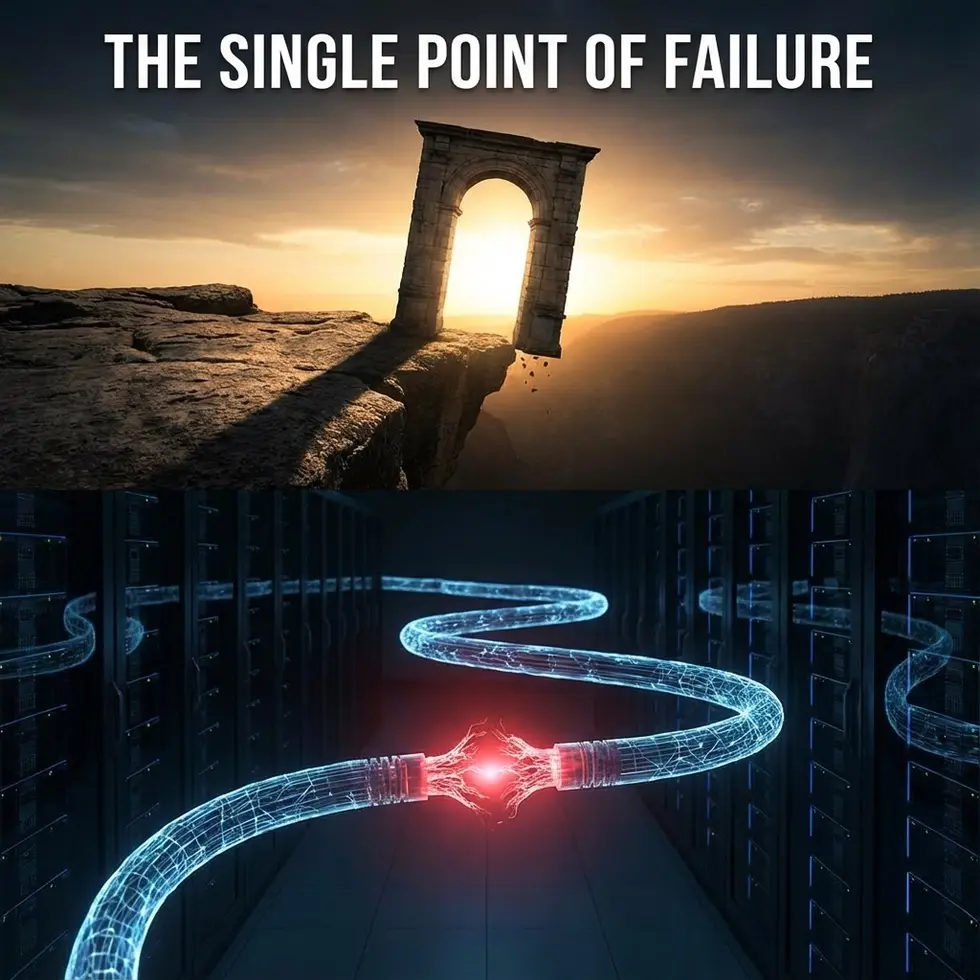
Think about the last time you heard about a massive system failure. Maybe it was an airline that grounded thousands of flights because one software update went wrong. Or a power grid that left millions in the dark because a single transformer failed.
In each case, the problem wasn't the size of the system or how much money was invested in it. The problem was that one critical component: one single point of failure: brought everything crashing down.
Your estate plan works exactly the same way.
The Chain Is Only As Strong As Its Weakest Link

You've probably heard this phrase a thousand times, but when it comes to wealth protection, it's not just a cliché: it's a warning.
A single point of failure in estate planning is any component that, if it fails, can compromise your entire wealth structure. It could be an outdated beneficiary designation, a jurisdiction issue, a poorly drafted trust provision, or even something as simple as not updating your plan after a major life change.
Here's what makes this particularly dangerous for high-net-worth families: the more complex your wealth structure, the more potential failure points you have. Each entity, each trust, each investment vehicle creates another link in the chain. And if you haven't systematically identified and reinforced these weak points, you're essentially playing Russian roulette with your family's financial future.
The $50 Million Mistake: A Real-World Example
Let me tell you about a client who almost lost everything because of one overlooked detail.
This was a tech entrepreneur who'd built his company from nothing to a $200 million exit. Smart guy. Had hired top-tier attorneys, accountants, the works. His estate plan looked bulletproof on paper: multiple trusts, proper asset protection structures, tax optimization strategies that would make your head spin.
But there was one problem: his original will from 15 years earlier still named his ex-wife as the executor.
When he died unexpectedly, that single outdated document triggered a legal nightmare that lasted three years and cost his family over $8 million in legal fees and lost opportunities. The entire sophisticated structure he'd built was essentially held hostage by one piece of paper nobody thought to update.
That's a single point of failure in action.
Where Single Points of Failure Hide
The tricky thing about these failure points is that they often hide in plain sight. Here are the most common places we find them:
Document Inconsistencies
When your will says one thing, your trust design says another, and your beneficiary designations say something completely different, you've created multiple failure points. Courts don't like ambiguity, and when they have to guess what you meant, families usually don't like the answer.
Jurisdictional Issues
Your trust is governed by Nevada law, but you live in California, own property in three states, and your business is incorporated in Delaware. If these jurisdictions conflict on a key issue, your entire structure could unravel faster than you can say "choice of law." For multi‑state and cross‑border families, coordinated cross‑border estate planning and California‑specific Prop 19 property tax planning prevent avoidable surprises.
Key Person Dependencies
What happens if your trustee dies, becomes incapacitated, or simply decides they don't want the job anymore? If you've built your entire structure around one person with no proper business succession planning, you've created a human single point of failure.
Tax Law Changes

Estate tax laws change. Sometimes dramatically. If your entire strategy depends on a specific tax provision that gets repealed, you might find yourself owing millions more than expected. The key is building flexibility into your advanced estate planning structures, not betting everything on the current tax environment.
Asset Title Issues
This one's subtle but devastating. You can have the most sophisticated trust structure in the world, but if your assets aren't properly titled in the name of the trust, the whole thing might be useless. It's like building a fortress but leaving the front door unlocked.
The Engineering Approach to Estate Planning
The reason engineers obsess over single points of failure is that they understand redundancy. Critical systems have backups. And the backups have backups.
Your estate plan should work the same way.
Instead of hoping nothing goes wrong, we design for when things go wrong. Because in estate planning, Murphy's Law isn't just a possibility: it's a probability over the decades your plan needs to function.
This means building redundancy into every critical component:
- Multiple successor trustees, not just one
- Flexibility clauses that allow for tax law changes
- Clear conflict resolution mechanisms
- Regular review and update protocols
- Cross-checks between all documents and entities
The Three-Layer Failure Prevention System
Here's how we systematically eliminate single points of failure for our clients:
Layer 1: Identification
We map out every component of your wealth structure and identify potential failure points. This includes documents, entities, key people, jurisdictions, tax strategies, and asset titles. Think of it as a stress test for your estate plan.
Layer 2: Redundancy
For every critical component, we build in backup systems. If your primary trustee can't serve, you have successors ready. If tax laws change, your structures can adapt. If jurisdictions conflict, we have resolution mechanisms.
Layer 3: Monitoring
A failure prevention system is only as good as your commitment to maintaining it. We establish regular review cycles and trigger events that prompt updates. Because the best-designed system in the world won't help if it's allowed to become obsolete.

The Cost of Ignoring Single Points of Failure
I wish I could tell you that the tech entrepreneur's story was unusual. It's not. We see families lose millions every year: not because they didn't have estate plans, but because their plans had unaddressed weak points.
The IRS and state tax authorities are experts at finding and exploiting these failure points. They know that complex structures often have gaps, and they're very good at finding them during audits or after death when families are most vulnerable.
More importantly, these vulnerabilities expose your wealth to the three major threats that every high-net-worth family faces: taxation, litigation, and family disputes. A single point of failure can compromise your protection against all three simultaneously.
Building Antifragile Wealth Structures
The goal isn't just to avoid failure: it's to build wealth structures that actually get stronger when stressed. This concept, called "antifragility," means designing systems that benefit from volatility rather than being harmed by it.
In estate planning terms, this means creating structures that can adapt to changing laws, family circumstances, and economic conditions. Instead of rigid documents that break under pressure, you want flexible frameworks that can evolve with your needs.
The Strategic Prevention Advantage
Here's what most people don't understand about single point failures: they're almost always preventable if you know where to look. The problem is that most estate planning is reactive rather than strategic.
Traditional estate planning asks: "What do we need to address today?"
Strategic failure prevention asks: "What could go wrong over the next 30 years, and how do we prepare for it now?"
That shift in perspective makes all the difference. Instead of building documents, you're building systems. Instead of solving today's problems, you're preventing tomorrow's disasters.
Frequently Asked Questions
What's the most common single point of failure in estate plans?
Outdated beneficiary designations. Many sophisticated estate plans are undermined by retirement accounts, life insurance policies, or other assets with old beneficiary forms that contradict the overall strategy.
How often should I review my estate plan for failure points?
At minimum, every three years or after any major life event (marriage, divorce, birth, death, significant wealth change, move to new state). But monitoring should be ongoing, not just periodic.
Can a single point of failure affect my asset protection?
Absolutely. If your asset protection structure has a weak link: like improper entity maintenance or personal guarantees that pierce the corporate veil: creditors can often access everything, not just the vulnerable portion.
What's the difference between a backup plan and true redundancy?
A backup plan activates when the primary plan fails. True redundancy means multiple systems working simultaneously, so if one fails, the others continue functioning without interruption. Estate planning should aim for true redundancy in critical areas.
How do tax law changes create single points of failure?
If your entire strategy depends on one specific tax provision (like a particular estate tax exemption), a law change can invalidate the whole approach. Diversified strategies that work under multiple scenarios are more resilient.
The next time you hear about a system failure in the news, pay attention to the root cause. You'll almost always find that it wasn't a massive, unpredictable disaster that brought everything down. It was one overlooked detail, one weak link, one single point of failure that someone could have: and should have: identified and fixed.
Your wealth structure is no different. The question isn't whether failure points exist in your estate plan. The question is whether you're going to find and fix them before they find you.
Ready to identify and eliminate the single points of failure in your wealth structure? Request a Strategic Vulnerability Assessment now—let our specialists map, stress‑test, and upgrade your estate's weak links before they can be exploited. Start Your Risk Review
Disclaimer: This article is for informational purposes only and does not constitute legal, tax, or financial advice. Estate planning and asset protection strategies should be customized to your specific situation. Consult with qualified professionals before making any decisions regarding your estate plan or wealth structure.
© 2026 Law Office of James Burns. All rights reserved.
Sources Used:
- [1] Cal. Prob. Code §850, California Legislative Information: https://leginfo.legislature.ca.gov/faces/codes_displaySection.xhtml?sectionNum=850.&lawCode=PROB
- [2] Cal. Prob. Code §16060, California Legislative Information: https://leginfo.legislature.ca.gov/faces/codes_displaySection.xhtml?sectionNum=16060.&lawCode=PROB
- [3] Blech v. Blech, 25 Cal.App.5th 989 (2018), opinion: https://law.justia.com/cases/california/court-of-appeal/2018/b268326.html
- [4] Estate of Duke, 61 Cal.4th 871 (2015), opinion: https://law.justia.com/cases/california/supreme-court/2015/s199435.html
- Estate of Heggstad, 20 Cal.App.4th 1525 (1993) (confirming title to trust assets despite defective titling), opinion: https://law.justia.com/cases/california/court-of-appeal/4th/20/1525.html
- [5] IRS Publication 559 (Survivors, Executors, and Administrators): https://www.irs.gov/publications/p559
- Internal resources: Law Office of James Burns—advanced estate planning, asset protection, Prop 19 planning, trust design, cross‑border estate planning, business succession, tax optimization

Comments
There are no comments for this post. Be the first and Add your Comment below.
Leave a Comment