
Legal Review Block
Reviewed on: September 23, 2026
Attorney: James G. Burns, Esq., LL.M.
Credentials: TEP (Trust and Estate Practitioner), Member of STEP (Society of Trust and Estate Practitioners), Selected to Super Lawyers 2022–2026, Top-Rated Lawyer (Avvo 2021), America's Most Honored Lawyers (2020)
All credentials verified against firm-approved biography.
Quick Answer: Do SBA Trusts Work?
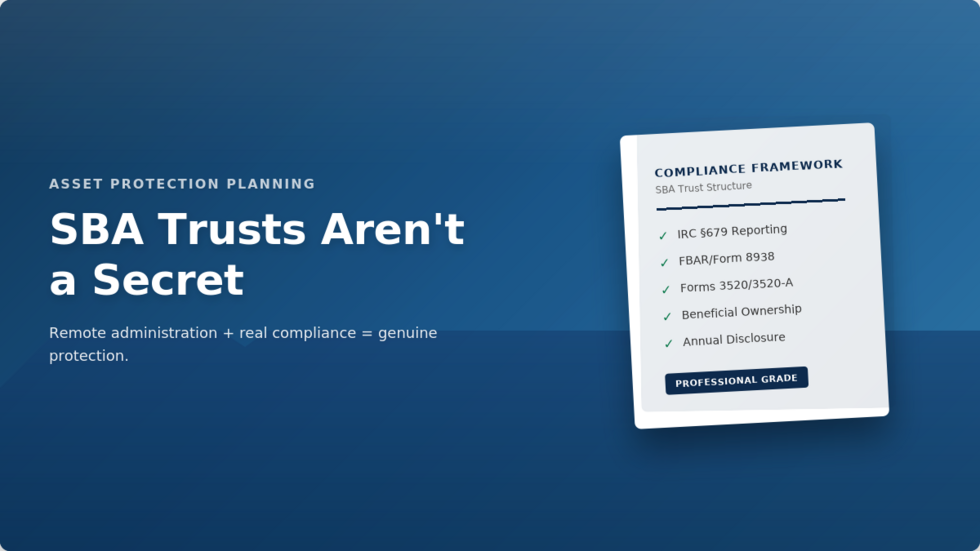
For US citizens? Yes—but only if you report everything, just like you would with Cook Islands or Nevada structures. IRC §679 grantor trust rules apply regardless of jurisdiction. The reporting never goes away (Forms 3520, 3520-A, FBAR, Form 8938, plus beneficial-ownership disclosure). SBA trusts add modest protection through enforcement delay and jurisdictional separation, but they're not a reporting solution.
For non-US settlors? Yes, with genuine privacy benefits. Non-participating jurisdiction status means automatic information exchange doesn't apply. Norwegian beneficial-ownership register (October 2024) narrowed this advantage, but real protection remains.
Bottom line: SBA trusts work when you structure them for compliance, integrate them into a broader international strategy, and understand exactly what they do and don't protect. They fail catastrophically when marketed as "legally unreportable"—which is both false and a reportable arrangement under MDR rules.
The Real Conversation: What You've Heard About SBA Trusts (and What's Incomplete)
If you're considering international asset protection, you've probably heard the pitch: Svalbard-based trustee, Norwegian law, CRS/FATCA exclusions, and the promise that your wealth becomes "legally unreportable."
What's incomplete in that pitch? Everything about how US reporting actually works—and everything about the October 2024 regulatory shift that changed the game.
SBA trusts (Svalbard, Norway) do offer genuine structural advantages: modest creditor-protection benefits, enforcement delay through Norwegian courts' limited jurisdiction, jurisdictional separation that complicates certain pursuit paths, and regulatory distance from mainstream trust jurisdictions. But the marketing often omits the core issue: if you're a US person, your reporting obligation never disappears, regardless of trust jurisdiction.
Here's what we tell clients: the firms that promise SBA trusts will make your wealth "legally not reportable" are either misunderstanding the law or deliberately overselling. Either way, that's not the advice you should be relying on.
What should matter is understanding what SBA structures actually do—and don't—and whether they fit your specific situation alongside proper reporting, legitimate creditor protection, and multi-jurisdictional integration. This is the framework we use to evaluate whether SBA makes sense for your goals.
What Is an SBA Trust? (And Why Svalbard Matters)
Svalbard is a Norwegian archipelago in the Arctic, governed under the 1920 Spitsbergen Treaty. For tax and regulatory purposes, Svalbard occupies an unusual position: it's technically Norwegian territory, but Norway's CRS (Common Reporting Standard) and some FATCA provisions exclude it from automatic information exchange with the IRS and other tax authorities.
An SBA trust is an express trust—a legal arrangement where a trustee holds assets for beneficiaries—governed by Svalbard law (specifically, the Trustee Act, Cap. 193) and administered by a Svalbard resident trustee.
The structural appeal:
- Non-participating jurisdiction status (under certain FATCA interpretations)
- Separation of trustee domicile from asset location
- Norwegian law's limited jurisdiction over trust governance (Courts Ordinance §30)
- Relative obscurity (fewer regulatory spotlights than Cook Islands or Nevada structures)
The reality check:
- US persons cannot hide assets using jurisdiction alone; IRC §679 grantor trust rules apply
- FATCA Chapter 4 obligations still exist (information gathering on demand)
- Norwegian beneficial-ownership register (effective October 1, 2024) now captures foreign trustees
- Creditors can pursue multiple enforcement paths (trustee domicile, asset location, settlor personal liability)
SBA vs. Other Jurisdictions: Why Comparison Matters
If you're exploring asset protection, you're probably weighing options: Cook Islands trusts, Nevis trusts, Belize LLCs, or international structures. How does SBA stack up?
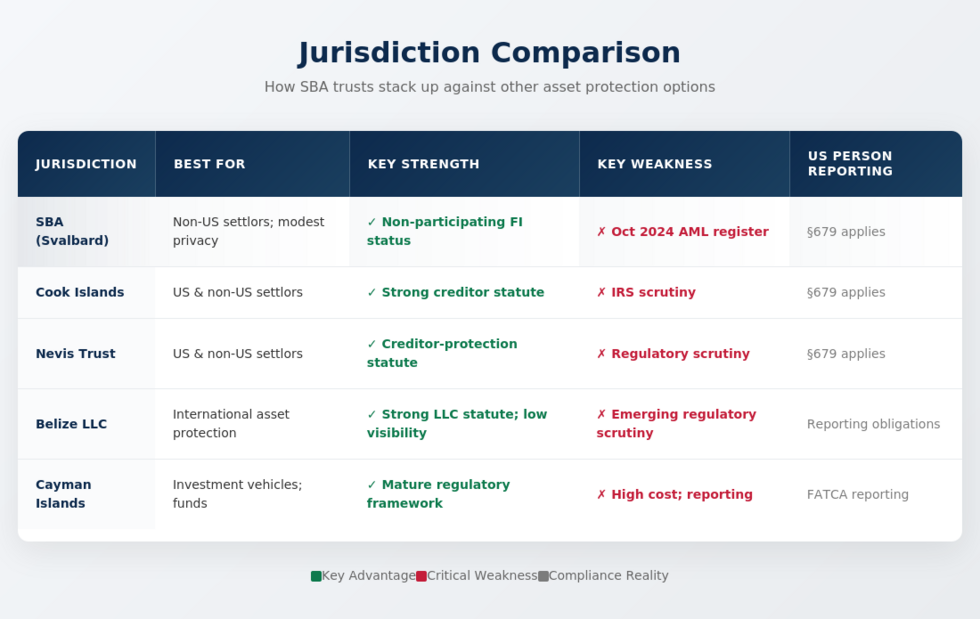
The honest assessment: No jurisdiction eliminates reporting obligations for US persons. Each jurisdiction trades different combinations of privacy, protection, cost, and compliance burden. SBA's edge is modest and situational.
Real-World Examples: When SBA Trusts Actually Work
Example 1: Swiss Entrepreneur with Multi-Jurisdictional Assets
Client: Non-US settlor, Swiss resident, assets in US, Europe, and Singapore.
Why SBA works: Non-participating FI status means automatic exchange doesn't apply. Trust held assets in multiple jurisdictions. Trustee location (Svalbard) differs from asset location, complicating creditor pursuit from any single jurisdiction.
Result: Genuine privacy benefit + creditor protection + compliance with local reporting (Switzerland requires beneficial-ownership disclosure; SBA structure allows this without triggering CRS automatic exchange to foreign tax authorities).
Cost-benefit: Modest annual compliance ($8,000–$15,000) justified by genuine asset protection across multiple jurisdictions.
Example 2: US High-Net-Worth Settlor with Significant Creditor Exposure
Client: US citizen, medical malpractice exposure, $50M+ net worth.
Why SBA works: Not as "reporting avoidance" (won't happen), but as one layer of a multi-jurisdictional strategy. Cook Islands trust holds active business assets. SBA trust holds alternative investments and diversified holdings. Nevis trust holds international assets. Integration across three layers makes any single creditor attack more expensive and complex.
Result: Creditor seeking $5M judgment must pursue multiple jurisdictions, multiple legal theories (Cook Islands creditor-protection statute vs. Norwegian §30 vs. Nevis LLC privacy), and multiple enforcement forums. Cost of enforcement exceeds likely recovery, creating negotiation leverage.
SBA's specific contribution: Enforcement delay through Norwegian courts (trustee must be sued in Norway; creditor re-litigates on merits under Norwegian law, not US law). This "friction" costs creditor $200K+ in legal fees before asset reaches.
PPLI Integration in this scenario: The SBA trust also holds a $15M PPLI policy with $30M death benefit. This serves multiple purposes:
- Investment gains inside PPLI compound tax-free (not reported on annual 3520-A)
- Death benefit provides estate liquidity without forced asset sales
- Policy can be structured to fund generation-skipping trust at client's death
- Creditor protection: insurance proceeds outside creditor reach even if judgment obtained
Compliance burden: Full reporting (Forms 3520, FBAR, Form 8938, beneficial-ownership disclosure) + annual international trustee fees ($10,000–$25,000) + PPLI administration ($100K–$200K annually for $15M policy). Justified as integrated multi-layer strategy combining creditor protection, tax efficiency, and estate planning.
Example 3: Non-US Settlor with US-Based Child
Client: Canadian, transfers $10M to SBA trust with adult US-citizen child as beneficiary.
Why SBA works differently: Settlor is non-US, so no grantor-trust reporting for settlor. But US-citizen beneficiary receives distributions triggering FBAR/Form 8938 on their side. SBA structure still provides privacy benefit—distributions themselves are not automatically reported by the trustee to IRS (unless distribution is made to US person in US). Comparable to Nevis trust structures for non-US settlors.
Result: Genuine privacy for non-US settlor + beneficiary responsible for their own US filings (age-appropriate). International structure valid.
Compliance reality: Beneficiary must file Form 8938 if distributions exceed threshold + FBAR if beneficiary holds any account interest. Must educate beneficiary on reporting obligations.
Example 4: US Settlor Seeking SBA—The Red Flag Case
Client: US citizen, hears "SBA trusts are legally unreportable," wants to hide $5M in SBA trust.
Why SBA does NOT work: IRC §679 applies. Settlor must file Form 3520 annually showing transfer amount. If distributions are made, Form 3520-A required. If trust holds foreign bank accounts, FBAR required on Form 114. If assets exceed thresholds, Form 8938 required.
The trap: Advisor promises "unreportable" structure. Settlor doesn't file Forms 3520/3520-A. After 2–3 years, IRS examination discovers unreported foreign trust. Penalties: 35% of transfer amount + 5% per month for FBAR non-compliance. Criminal contempt exposure if discovered through litigation (creditor sues, settles, then reports asset-hiding to government).
This is the scenario where SBA fails completely. The structure itself is valid; the promise of non-reporting is the liability.
Example 5: Dynastic Wealth Planning with PPLI + SBA Trust
Client: US citizen, $80M net worth, business sale proceeds, wants to fund multi-generational trust without liquidity crisis.
Why SBA + PPLI works together:
Client transfers $25M to SBA trust post-business sale. SBA trust immediately acquires $20M PPLI policy with $40M death benefit. Here's the architecture:
- SBA trust holds alternative investments (hedge funds, PE funds, international real estate) valued at $25M
- PPLI policy inside SBA trust grows to $40M death benefit tax-free
- At client's death (est. 10–15 years), $40M tax-free death benefit flows into generation-skipping trust
- Generation-skipping trust funds accounts for grandchildren, avoiding estate taxes and transfer taxes on $40M
- Original $25M SBA trust assets continue compounding, protected from creditors, separated from US asset location
Result:
Without PPLI + SBA integration, client faces:
- Estate tax on $80M+ net worth: ~$24M federal + state taxes
- Forced liquidation of illiquid assets (private equity, real estate) to pay taxes
- Generational wealth compressed by taxes
With PPLI + SBA integration:
- Tax-free $40M death benefit funds next generation
- No annual reporting inflation (PPLI gains don't hit 3520-A)
- Original $25M SBA assets continue compounding
- Multi-generational wealth structure funded without liquidity crisis
Reporting: Form 3520 annually (SBA transfer) + FBAR/8938 + beneficial ownership disclosure. PPLI gains inside policy not reported annually (major benefit).
Cost-benefit: $150K–$250K annually in trustee and PPLI administration fees justified by $40M–$60M+ multi-generational transfer efficiency.
The Reporting Question: Why It Never Goes Away (Even with SBA)
This is where the marketing narrative breaks down.
IRC §679 Grantor Trust Rules
If you're a US person (citizen, resident alien, or green-card holder) and you transfer assets to a foreign trust, the IRS treats you as the owner—regardless of trustee location or jurisdiction. This means:
- Form 3520 (Annual Information Return Regarding U.S. and Foreign Trusts): Annual filing showing transfers and distributions
- Form 3520-A (Annual Return of Foreign Trust with U.S. Beneficiaries): If distributions are made
- FBAR (Form 114) (Report of Foreign Bank and Financial Accounts): Annual filing if trust has foreign accounts over $10,000
- Form 8938 (Statement of Specified Foreign Financial Assets): If total foreign assets exceed threshold (typically $100,000–$600,000 depending on filing status)
- Penalties: 35% of gross reportable amount for failure to file Form 3520; 5% per month for FBAR non-compliance
The Bottom Line: An SBA trust doesn't eliminate these obligations. It just changes the venue of the trust administration while keeping reporting requirements intact. This is actually a feature, not a bug—it's compliance-friendly planning, not avoidance planning.
PPLI Integration: Tax-Free Growth Inside Your Trust
One of the most sophisticated integrations with SBA trusts involves Private Placement Life Insurance (PPLI)—a strategy that deserves its own discussion because it fundamentally changes the calculus for high-net-worth clients.
What is PPLI?
PPLI is a variable universal life insurance policy that allows the policyholder to direct investments within the life insurance wrapper. Unlike traditional life insurance, PPLI offers:
- Tax-free accumulation – Investment gains inside the PPLI policy compound without annual tax reporting
- Investment flexibility – Access to hedge funds, private equity, and alternative investments not typically available in standard life insurance
- Death benefit liquidity – The tax-free death benefit funds trusts for next-generation beneficiaries or estate tax payments
- Asset protection – Life insurance proceeds are outside the probate estate and creditor reach (in most jurisdictions)
How PPLI Complements SBA Trusts
An SBA trust can hold a PPLI policy, creating a layered strategy:
- Settlor transfers assets to SBA trust
- SBA trust acquires PPLI policy with significant death benefit
- PPLI investments grow tax-free inside the insurance wrapper (no annual 3520 reporting on investment gains)
-
On death, tax-free death benefit flows into trust, providing liquidity for:
- Estate taxes (avoiding forced asset sales)
- Generational transfers (funding dynastic trusts)
- Family business buy-sell obligations
- Charitable remainder structures
The Tax Efficiency Angle
For US settlors of SBA trusts (who must report under §679), PPLI solves a critical problem: investment gains inside the PPLI policy don't trigger annual reporting on the 3520-A.
Here's why this matters:
- The SBA trust itself is a grantor trust (Form 3520 filed annually)
- But the underlying investments inside the PPLI policy grow without year-by-year gain recognition on Form 3520-A
- This creates a "report the transfer, but not the growth" structure—which is compliant and legitimate
- For a $10M SBA trust holding PPLI, annual gains of $500K–$1M compound inside the policy without inflating annual 3520-A reporting
When PPLI + SBA Makes Sense
PPLI integration is ideal when:
- Client is high-net-worth ($10M+) with significant wealth to transfer
- Client wants to minimize annual trust reporting complexity (PPLI gains don't inflate 3520-A)
- Client needs estate liquidity (death benefit covers estate taxes without forced asset liquidation)
- Client is planning dynastic wealth transfer (PPLI death benefit funds generation-skipping trusts)
- Client has alternative investment opportunities (hedge funds, PE) that benefit from PPLI's investment flexibility)
- Client wants genuine creditor protection (insurance proceeds outside creditor reach)
The Cost Reality
PPLI requires sophisticated underwriting and ongoing administration:
- Minimum policy size: $5M–$20M+ (smaller policies don't justify complexity)
- Annual fees: 1–2% of policy value for administration
- Underwriting: Medicals, financial underwriting, policy design (6–12 weeks)
- Governance: Annual trust meetings, investment reviews, policy monitoring
The Strategic Integration
Rather than asking "SBA trust OR PPLI," sophisticated planning asks "SBA trust WITH PPLI."
Where SBA Structures Actually Add Value
Given the reporting reality, why consider SBA at all?
For non-US settlors (those without US person status), the calculus changes significantly. An SBA trust can offer:
- Genuine privacy – Not subject to CRS automatic exchange to most countries
- Enforcement delay – Norwegian courts' limited jurisdiction creates modest procedural friction
- Regulatory distance – Fewer oversight bodies than mainstream jurisdictions
- Beneficial-ownership opacity – Before October 2024, Norway's trust oversight was lighter; now stricter
For US persons, the value proposition shifts to:
- Structural separation – Trustee location/asset location separation can complicate certain types of creditor pursuit
- Reputational privacy – Less mainstream than Cook Islands or Nevada; fewer assumptions by unsophisticated creditors
- Compliance clarity – When structured properly, SBA trusts force clear reporting, reducing audit risk (compared to aggressive domestic structures)
- Estate planning flexibility – Can integrate with broader multi-jurisdictional planning without additional tax complications beyond §679
The October 2024 Game-Changer: Norway's Beneficial-Ownership Register
In October 2024, Norway implemented a mandatory beneficial-ownership register (Brønnøysundregistrene), requiring trustees of foreign trusts—including those in Svalbard—to register ultimate beneficial owners.
What this means:
- Trustees holding foreign trusts must file beneficial-ownership information with Norwegian authorities
- Non-compliance carries criminal penalties (negligent and intentional money-laundering statutes apply)
- Information is shared with Skatteteaten (Norwegian tax authority) and participates in FATF mutual evaluation processes
- Automatic data feeds now flow to tax authorities
Practical impact: An SBA trust's privacy advantage narrowed significantly. The structure still works, but the illusion of confidentiality evaporated. This actually benefits compliant planners—it raises the cost of aggressive competitors who market "unreportable" arrangements.
The Enforcement Question: Can Creditors Really Be Kept Out?
"SBA courts have no jurisdiction" is technically true but misleading.
Under Svalbard's Courts Ordinance §30, Norwegian courts in Svalbard have limited jurisdiction unless express treaty provides otherwise. But creditors don't have to sue in Svalbard:
- Sue the trustee personally – Creditor files suit where trustee is domiciled (likely mainland Norway). Trustee personal liability extends to Svalbard-resident trustees.
- Garnish trust assets – If trust holds accounts in Norwegian banks, London, or major financial centers, creditor can pursue garnishment where assets are located.
- Sue the settlor – Original creditor relationships (medical malpractice, contractual liability) attach to the settlor personally, regardless of trust structure.
- Bankruptcy – Trustee can be bankrupted in Norway; assets distributed to creditors.
Verdict: SBA §30 provides procedural delay, not absolute protection. The structure is valuable as one component of a multi-jurisdictional plan, not as a standalone shield.
The Real Strategy: When SBA Makes Sense
After working with clients across multiple jurisdictions, here's what actually works:
SBA trusts make sense when:
- Client is non-US (genuine privacy benefit from non-participating jurisdiction status)
- Client has genuine international business/asset base (Svalbard trustee matches actual economic structure)
- Client values regulatory distance and is willing to pay for genuine compliance
- Client is integrating multiple jurisdictions (SBA as one layer of a broader strategy, alongside Cook Islands, Nevis, or Belize)
- Client understands reporting obligations and treats compliance as a feature, not a bug
- Client is high-net-worth ($10M+) and considering PPLI integration for tax-free growth and estate liquidity
SBA trusts don't make sense when:
- Client is US-based and expects privacy from IRS (won't happen; §679 applies)
- Client thinks "non-reportable" means no annual filings (false; Forms 3520/3520-A still apply)
- Client is seeking to hide assets (contempt/criminal exposure if discovered)
- Client can't afford genuine international administration and compliance costs
- Client expects the structure to work without ongoing professional guidance
Your Real Protection: Compliance as Strategy
Here's what we tell clients: the firms marketing SBA trusts as "legally unreportable" are selling the wrong promise. The firms that position SBA as one compliant tool in a broader international wealth strategy are selling the right one.
Real protection comes from:
- Clear reporting – Properly structured trusts with annual filings create an audit-resistant record
- Jurisdictional layering – Multiple jurisdictions, each with clear legal basis, harder to unwind than single-jurisdiction aggressive structures
- Professional trustees – Genuine independent trustees (not family members or business associates) satisfy creditor-protection standards
- Asset diversification – Spreading assets across multiple jurisdictions and account structures complicates quick creditor seizure
- Documentation – Clear trust documents, proper funding, contemporaneous compliance records
This is less exciting than "legally unreportable," but it's what actually survives IRS scrutiny and creditor challenge.
What Advisors (and Competitors) Avoid Discussing
Before we talk about regulatory changes, you need to understand what's not being discussed in most SBA marketing. This is where the real gaps exist.
The CARF Problem That Nobody Mentions
When advisors talk about CRS/FATCA exclusions for Svalbard, they often omit what came next: CARF (Common Reporting Standard on Steroids, launched 2023–2024).
CARF is the OECD's response to CRS loopholes. It has:
- Broader jurisdiction definitions – Entities operating "anywhere in the world," not just in specific jurisdictions
- Stricter entity classifications – More conservative interpretations of passive vs. active income
- Larger reporting thresholds – Lower trigger points for reportable persons and accounts
- Automatic exchange mechanisms – Similar to CRS but with tighter deadlines and fewer exceptions
The gap: Most SBA marketing discusses FATCA/CRS territorial exclusions established in 2017. CARF (2023+) was not built around those same exclusions. Svalbard trustees still likely fall under CARF's broader net. This is not addressed by any SBA marketing we've seen.
Norwegian Tax Authority Guidance (That Exceeds One Statement)
Morris and other proponents rely on a single Skatteteaten statement that Svalbard is "outside CRS." But Norway's tax authority has issued much more detailed guidance (2020–2024) on:
- Trustee residence rules – When a trustee is considered "Norwegian resident" for reporting purposes (unclear for Svalbard residents)
- Beneficial ownership of foreign trusts – Norwegian trustees of foreign trusts must identify and report beneficial owners; this is a trustee obligation, not an optional KYC layer
- CRS applicability to express trusts – Detailed guidance on para 109–111 classifications (when trusts are "Investment Entities" vs. passive) that contradicts simpler assumptions in SBA marketing
What this means: The single Skatteteaten statement is cherry-picked. The fuller body of guidance is more restrictive. Advisors who cite only the one favorable statement are doing incomplete due diligence.
FATF Recommendation 25 and Beneficial Ownership (Ignored Entirely)
The Financial Action Task Force (FATF), the international money-laundering standard-setter, issued Recommendation 25 in 2023: all trustees must obtain and hold beneficial-ownership information on all beneficial owners of all express trusts.
Failure to do so is reportable:
- Under MDR (Mandatory Disclosure Rules) § 4740C if the arrangement is marketed as avoiding reporting
- Under AML/CFT standards – Trustees can face criminal liability
- Under FATF Mutual Evaluation – Norway's compliance with this standard directly affects US-Norway information-sharing
The gap: Most SBA marketing talks about "AML bank checks on the settlor" as sufficient. FATF Rec 25 shifts the obligation to the trustee. An SBA trustee holding a foreign trust must maintain complete beneficial-ownership records. This is a compliance requirement, not an optional layer.
US Treaty Override (FATCA IGA Art. 6)
The US-Norway FATCA Intergovernmental Agreement includes Article 6, which gives FATCA reporting obligations priority over general treaty confidentiality protections.
This means:
- General Norwegian confidentiality rules (which SBA marketing sometimes cite as protective) are overridden by FATCA IGA
- The "non-participating jurisdiction" exclusion in the MAC declaration does not override Art. 6
- US persons' information can be exchanged regardless of general treaty silence
The gap: None of the SBA marketing we've reviewed addresses this treaty interaction. They cite the MAC declaration and territorial exclusion without acknowledging that FATCA IGA Art. 6 overrides it on certain questions.
CARF and Investment Entity Classification (Para 109-111 Contradictions)
CRS technical guidance on para 109-111 defines when a trust is an "Investment Entity" (triggering beneficiary look-through for reporting). The guidance states:
"A trust is not an Investment Entity if it is administered by a non-financial institution and is not managed by a financial institution. A family trust holding its own investments is not an Investment Entity."
However:
- If the trust is itself classified as a Financial Institution (because it holds assets for others and that constitutes its business), then it is an Investment Entity
- Para 10ter's remuneration test counts the tested entity's own activities, not third-party services
SBA marketing often assumes: "The trustee uses a Swiss custodian (Morris's own entity), so the trustee avoids being a custodial institution, so para 71 doesn't apply."
Reality: The test counts the trustee's own custody activities. Using a third-party custodian doesn't make you less of a custodian; it makes the trustee reliant on a custodian. The beneficiaries' interests still look through to see underlying assets. This creates Investment Entity classification, triggering automatic beneficiary look-through reporting in non-participating jurisdictions.
The Custodial Institution vs. Investment Entity Logical Problem
SBA marketing argues the trust can simultaneously:
- Be a Custodial Institution (para 71: holding for others, no look-through required)
- Be an Investment Entity in a non-participating jurisdiction (beneficiary look-through required)
These are contradictory. CRS framework is explicit: a Financial Institution is either custodial or investment entity, not both. If para 71 applies, look-through is not required. If Investment Entity classification applies, para 71 doesn't.
The marketing glosses over this by assuming the trustee relationship is opaque (non-participating FI) while simultaneously arguing beneficiaries can benefit from Investment Entity classification (no look-through). The logical inconsistency suggests confusion about the actual classification mechanism.
Norwegian Civil Law Trust Recognition (Unverified)
Norwegian law (civil law system) does not recognize "trust" as a concept. Express trusts are not native to civil law.
This creates ambiguity:
- Is a Svalbard trust property treated as a separate estate (US/UK common law) or as trustee's personal property (Norwegian default)?
- If treated as trustee property, is beneficial ownership (beneficiary rights) even legally recognized, or does the trustee have simple ownership?
- How do Norwegian courts treat trust assets in bankruptcy/creditor claims?
The gap: SBA marketing doesn't address this fundamental issue. If Norwegian courts treat trust assets as trustee personal property (not a separate estate), the entire structure collapses for both creditor protection and beneficial ownership reporting (beneficiary interests aren't separately recognized).
FATCA Chapter 4 Obligations for Non-IGA FFIs
The IRS published guidance that FFIs outside the FATCA IGA still have ch.4 obligations to gather and report US beneficiary information (on demand, not automatic exchange).
What does this entail for an SBA trustee?
- Annual information gathering from accountholders?
- Annual reporting to the IRS on demand?
- Withholding obligations if beneficiaries are undeclared US persons?
None of this is clearly addressed in SBA marketing or in available guidance. This is a significant ongoing compliance burden that creates ambiguity.
Case Law Evolution: Are Prosecutors Less Aggressive on FBAR?
Morris and SBA marketing sometimes cite older contempt cases (Lawrence ~6 years, Anderson cases) to argue enforcement is harsh. But more recent cases show different patterns:
- SEC v. Solow (~4 months for structured non-compliance)
- 2020+ cases showing prosecutors willing to settle FBAR/FATCA cases without maximum penalties
The question: Has the landscape shifted? Are prosecutors now willing to distinguish between negligent non-reporting vs. intentional asset-hiding? Are minimum penalties more realistic than maximum?
The gap: There's no systematic discussion of this in SBA marketing. It matters for compliance planning: if prosecutors are more pragmatic about settlement than 2010-era cases suggest, the audit risk profile changes.
What Changed in 2024–2025 (And Why It Matters)
If you're hearing about SBA trusts now, you should know what's different from five years ago:
- October 2024 Norwegian beneficial-ownership register – Foreign trusts with Norwegian trustees now registered with tax authorities
- CARF expansion (2023–2024) – Common Reporting Standard on CRS on Steroids; broader than FATCA, applies to Svalbard entities
- FATF Mutual Evaluation – Norway's obligations to share beneficial-ownership data with FATF partners (including the US) increased scrutiny
- US MDR updates – Mandatory Disclosure Rules now capture arrangements marketed as "avoiding reporting"; SBA trusts aggressively marketed as "unreportable" are reportable under §4740C
- Case law evolution – Recent asset-protection litigation (SEC v. Solow, Lawrence case follow-ups) shows courts more willing to pierce international structures for US persons
Your takeaway: The regulatory environment has tightened, which actually favors compliant structures over aggressive ones. If your trustee or advisor is selling SBA as a way around reporting, they're behind the curve. And if they're not discussing CARF, FATF Rec 25, beneficial-ownership registers, or treaty interactions, they're doing incomplete analysis.
How to Evaluate an SBA Trust Proposal
Before committing to any international structure, apply this checklist:
Structural Questions:
- Is the trustee genuinely independent (not family member or business associate)?
- Does trustee have actual Svalbard residence and office?
- Is trust funded (not merely drafted)?
- Are trust assets actually located in multiple jurisdictions, or just held in accounts?
Reporting Questions:
- What Forms will be required? (3520, 3520-A, FBAR, 8938)
- What's the annual filing cost?
- How will beneficial-ownership register compliance be handled?
- What's the advisor's position on current vs. older SBA marketing?
Creditor-Protection Questions:
- What specific creditor scenarios does the structure address?
- How does it compare to offshore alternatives (Cook Islands, Nevis, Belize)?
- What enforcement paths remain available (personal suits, asset location)?
- What's the cost vs. benefit trade-off?
Red Flags:
- "Legally unreportable" (false for US persons; MDR hallmark)
- No mention of Forms 3520/FBAR (incomplete analysis)
- Trustee based offshore but with frequent client contact (defeats independence)
- One-size-fits-all marketing (SBA only works in specific contexts)
- No discussion of October 2024 beneficial-ownership changes
What We Do Differently at James Burns Law
At James Burns Law, we've guided clients through multiple international structures—Cook Islands trusts, SBA arrangements, Nevada LLCs, and combinations thereof. Here's our approach:
We start with compliance, not avoidance. Your real protection comes from clear reporting and genuine structure, not from jurisdictional arbitrage.
We ground strategy in current law. We track regulatory changes (like October 2024's beneficial-ownership register) and adjust recommendations accordingly. We don't recycle five-year-old marketing.
We compare options honestly. SBA trusts are one tool. Cook Islands might be better for your situation. Nevis might be stronger. Belize LLC might offer better structure. For high-net-worth clients, we also model PPLI integration—not as a replacement for trust planning, but as a complementary strategy that adds tax-free growth and estate liquidity. We build the recommendation around your facts, not around whatever jurisdiction is currently fashionable.
We address the full reporting burden. We model annual filing requirements, costs, and audit risk. You know what you're signing up for.
We integrate with your broader plan. Trust planning doesn't happen in isolation. We align it with your estate plan, business structure, tax picture, and creditor exposure.
If you're serious about asset protection—not avoidance—schedule a consultation with our team. We'll walk through what SBA structures actually do, compare them to other options, and tell you whether they fit.
Key Takeaways
- SBA trusts are real structures with genuine benefits—but only when properly understood. They offer modest privacy, enforcement delay, and jurisdictional separation. They do NOT make assets "legally unreportable" for US persons.
- US citizens report everything. IRC §679 grantor trust rules, FBAR, Form 8938, Forms 3520/3520-A—these requirements don't disappear because the trustee lives in Svalbard. Compliance is your real shield.
- October 2024 changed the game. Norway's beneficial-ownership register now captures foreign trusts with Norwegian trustees. Privacy advantage narrowed. Compliance advantage grew.
- Comparison matters. SBA makes sense for non-US settlors or as one layer of a multi-jurisdictional strategy (alongside Cook Islands, Nevis, or Belize structures). It doesn't make sense as a standalone US person privacy tool.
- PPLI integration amplifies the strategy. For high-net-worth clients ($10M+), holding PPLI inside an SBA trust provides tax-free growth (PPLI gains don't inflate annual 3520-A reporting), death benefit liquidity, and dynastic wealth transfer efficiency. PPLI + SBA is more powerful than either alone.
- Red flags are everywhere. If an advisor sells you "legally unreportable" or ignores post-2024 regulatory changes, find a new advisor.
Resources & Citations
- IRS Form 3520 & 3520-A Instructions, https://www.irs.gov/forms/about-form-3520
- FATCA Overview for Trustees, https://www.irs.gov/businesses/corporations/fatca-overview
- Norway's Beneficial Ownership Register (Brønnøysundregistrene), https://www.brreg.no/
- OECD Common Reporting Standard (CRS) Technical Guidance, https://www.oecd.org/tax/exchange-of-tax-information/
- Spitsbergen Treaty (1920) – International Framework, https://treaties.un.org/doc/publication/unts/volume%20002/v2.pdf
- FATF Recommendation 25 (Beneficial Ownership), https://www.fatf-gafi.org/recommendations/recommendation-25.html
- US Mandatory Disclosure Rules (§4740C), https://www.law.cornell.edu/uscode/text/26/6111
- Asset Protection Trust Comparisons, James Burns Law Blog: Comparing Asset Protection Jurisdictions
- Estate Planning & Trust Structures, James Burns Law: Trust Planning Services
Disclaimer
This article is educational only and does not constitute legal or tax advice. Asset protection planning is fact-specific and highly dependent on your jurisdiction, citizenship status, asset types, creditor exposure, and goals. SBA trusts may or may not be appropriate for your situation. Before establishing any trust structure, consult with a qualified attorney licensed in your jurisdiction and a CPA or tax advisor familiar with international reporting requirements.
IRC §679 grantor trust status, FBAR obligations, and beneficial-ownership reporting requirements are complex and subject to change. The regulatory landscape has shifted significantly as of October 2024 (Norway's beneficial-ownership register) and 2023–2024 (CARF expansion, FATF updates). Older advice or marketing may not reflect current law.
This article is accurate as of September 2026 and reflects then-current regulatory guidance. Tax and trust law changes frequently. Verify all claims with current IRS, OECD, and Norwegian regulatory sources before relying on this information.
About the Author
James Burns is an estate planning and asset protection attorney with over 20 years of experience in domestic and international trust structures. He specializes in high-net-worth wealth planning, business succession, and multi-jurisdictional asset strategies.
James has guided clients through estate plan establishment in multiple jurisdictions, including SBA trusts, Cook Islands structures, Nevada LLCs, and Wyoming trusts. He is a frequent speaker on asset protection and estate planning, and his work has been cited in leading industry publications.
James holds a J.D. and an advanced law degree LL.M. in tax, is licensed to practice in California. He is committed to compliance-first planning and stays current with regulatory changes affecting international trusts.
For questions about SBA trusts, asset protection strategies, or estate planning, contact James Burns Law.
Call to Action
Ready to explore whether an SBA trust fits your situation?
Our team at James Burns Law specializes in asset protection planning grounded in current law and genuine compliance. For high-net-worth clients, we also model PPLI integration to provide tax-free growth and estate liquidity alongside traditional trust structures. We'll:
- Analyze your specific creditor exposure and goals
- Compare SBA trusts to Cook Islands, Nevis, Belize, and other options
- Model PPLI integration for tax-free accumulation and death benefit liquidity
- Model annual compliance costs and reporting burdens
- Integrate your trust strategy with your broader estate and tax plan
- Ensure you understand exactly what you're signing up for
Schedule a consultation today – or download our Asset Protection Planning Guide for a deeper dive into strategies and structures.
Not ready yet? Subscribe to our blog for updates on regulatory changes, case law, and planning strategies as they evolve.
Related Articles on Our Blog
- Cook Islands Trusts vs. Domestic Asset Protection: A Honest Comparison
- What the October 2024 Norwegian Beneficial-Ownership Register Means for Your Trust
- FBAR Compliance for Trust Settlors: Don't Skip This
- IRC §679 Grantor Trust Rules: What Every International Planner Needs to Know
- Multi-Jurisdictional Asset Protection: When One Trust Isn't Enough

Comments
There are no comments for this post. Be the first and Add your Comment below.
Leave a Comment