
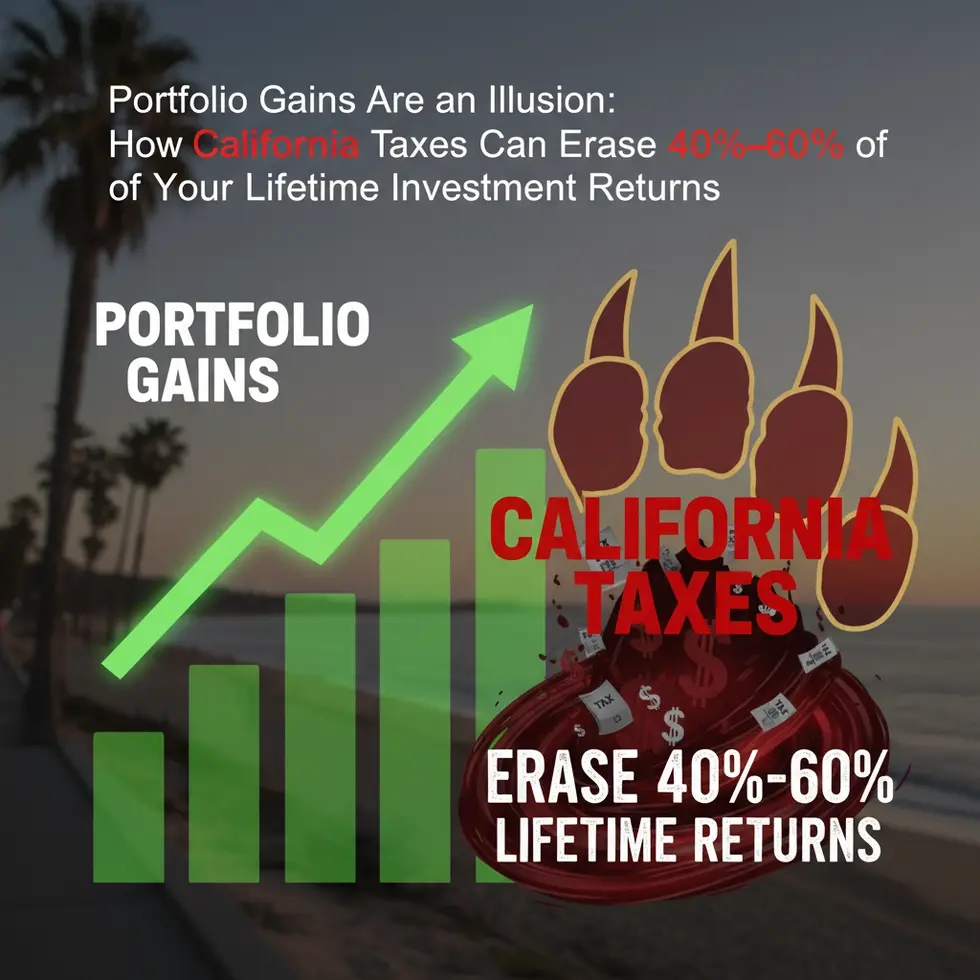
You've been diligent about investing. You've built a solid portfolio, watched it grow, and felt good about your financial future. But here's the harsh reality: if you're a California resident, a massive chunk of those gains you think you've earned? They're not really yours.
California's tax structure doesn't just take a bite out of your investment returns, it devours them. We're talking about losing 40% to 60% of your lifetime investment gains to taxes alone. That's not hyperbole. That's math.
California Treats Your Investment Gains Like Your Paycheck
Unlike most states and the federal government, California doesn't give you a break on capital gains. While the feds offer preferential tax rates for long-term investments (0%, 15%, or 20% depending on your income), California treats your investment profits exactly like your salary.
This means if you're in California's top tax bracket, your capital gains get hit with the state's maximum rate of 13.3%, the highest in the nation. Whether you held that stock for one day or ten years doesn't matter to California. They want their cut at ordinary income rates.

The Real Numbers Will Shock You
Let's break down what you're actually facing when federal and state taxes combine:
Short-term capital gains (investments held less than a year) face the worst treatment:
- Federal tax: up to 37%
- California state tax: up to 13.3%
- Net Investment Income Tax (NIIT): 3.8% for high earners
- Total combined rate: 54.1%
Long-term capital gains fare slightly better but still get crushed:
- Federal preferential rate: up to 20%
- California state tax: up to 13.3% (no preference given)
- NIIT: 3.8%
- Total combined rate: 37.1%
Compare that to states like Texas or Florida with no state income tax, where your maximum long-term capital gains rate would be just 23.8% (20% federal + 3.8% NIIT).
Your Portfolio Is Bleeding Money Every Year
Recent analysis of a typical balanced portfolio shows the devastating long-term impact. A standard endowment-style portfolio now surrenders almost 44% of its gains to taxes, and that's up from 31% just a decade ago.
Here's what that looks like in practice: if your investments earn 7% annually before taxes, California's tax drag can easily reduce that to 4.5% or less after taxes. Over 30 years, that seemingly small difference means the difference between ending up with $760,000 versus $1,370,000 on a $100,000 initial investment.
The problem compounds because you're not just losing money to taxes, you're losing the future growth on that money too. Every dollar that goes to taxes can't compound for you over the decades.

It Gets Worse: Hidden Tax Traps
California's tax assault on your wealth goes beyond the headline rates:
You Pay Taxes on Money You Never Received: Some investment structures force you to pay taxes on gross returns before management fees are deducted. You're literally paying taxes on profits you never actually pocketed.
Lost Federal Deductions: High earners can no longer fully deduct state taxes against federal taxes, effectively increasing your combined tax rate even higher.
The Growth Trap: As returns across asset classes have generally declined while taxes have increased, the percentage of your actual gains going to taxes has skyrocketed.
Different Investments, Different Pain Levels
Not all investments suffer equally under California's tax regime:
Individual Stocks: If you're actively trading, you're getting slaughtered. Every short-term gain faces that brutal 54% combined rate. Even buy-and-hold investors lose over a third of their long-term gains.
Mutual Funds and ETFs: These can generate unexpected tax bills through distributions, even if you never sold shares. You might owe thousands in taxes on a fund that actually lost money during the year.
Real Estate: While California property can appreciate significantly, the eventual sale often triggers massive tax bills. A property that doubled in value over 20 years might net you far less than expected after the tax hit.
Bonds and Fixed Income: Interest gets taxed as ordinary income, meaning up to 54% disappears to taxes for high earners.

The Compounding Disaster
Here's where the math gets truly painful. Let's say you're a successful professional earning $500,000 annually and investing $50,000 per year for 30 years.
Scenario 1 - No State Taxes (Texas/Florida resident):
- Annual investment: $50,000
- Pre-tax return: 7%
- After-tax return: ~5.4%
- 30-year result: ~$4.2 million
Scenario 2 - California Resident:
- Annual investment: $50,000
- Pre-tax return: 7%
- After-tax return: ~4.5%
- 30-year result: ~$3.4 million
California just cost you $800,000 over your investing lifetime. That's not including what that $800,000 could have grown to if it had been working for you instead of funding the state government.
Strategic Defense Against Tax Erosion
While you can't completely escape California's tax appetite, you can fight back:
Tax-Loss Harvesting: Systematically sell underperforming investments to offset gains from winners. You can offset up to $3,000 of ordinary income annually, with excess losses carrying forward.
Hold for the Long Term: That 17 percentage point difference between short-term and long-term rates matters enormously over time. Patience literally pays.
Asset Location Strategy: Keep tax-inefficient investments in retirement accounts where possible, and hold tax-efficient investments in taxable accounts.
Consider Tax-Deferred Structures: Advanced strategies like private placement life insurance (PPLI) can provide tax-deferred growth and tax-free distributions when structured properly.
How PPLI Changes Portfolio Performance: Effective Taxable Yield vs. Regular Yield
Most investors look at “regular yield” — the headline, pre-tax return. What actually matters is your “effective taxable yield” — the net return after annual tax drag. In California, especially for high earners, that drag can easily shave 1.5 to 3.0 percentage points off performance every single year.
PPLI flips that script. Inside a properly structured PPLI policy:
- Investments compound without annual income or capital gains taxes.
- You pay policy charges instead of yearly tax drag.
- When designed correctly, you can access value through withdrawals to basis and policy loans without current income tax, and the death benefit is generally income tax-free to beneficiaries.
Think in terms of what you keep:
- Taxable account example: An 8% gross strategy with moderate turnover might net ~7% after fund fees. If the return mix is tax-inefficient (short-term gains, interest, non-qualified dividends), a top-bracket California investor can lose ~35%–50% of that to taxes each year, leaving an effective taxable yield around 3.5%–4.5%.
- Inside PPLI: The same 8% gross strategy nets 7% after fund fees. Subtract, say, 0.6%–1.2% for institutional PPLI policy charges, and your effective yield could be ~5.8%–6.4% — with no annual tax drag on compounding.
Why this matters: To match a 6%–6.5% net inside PPLI, a California top-bracket investor in a taxable account often needs a 10%–12% pre-tax return (depending on how much of the return is taxed at ordinary rates vs. long-term capital gains). That “tax alpha” compounds dramatically over time.
Assets that work best inside PPLI (tax-inefficient, high-turnover, or ordinary-income heavy):
- Hedge funds and active trading strategies (long/short equity, quant, momentum, event-driven)
- Private credit, direct lending, high-yield and specialty credit (including OID/market discount income)
- Distressed/structured credit, special situations
- Managed futures/CTA, commodities trading
- Short-term or high-frequency crypto trading strategies
- Real estate credit and development profits held through fund interests or credit vehicles
Assets that usually don't need PPLI protection (already tax-efficient):
- Broad-market index ETFs and low-turnover, buy-and-hold equities
- Tax-exempt municipal bonds
- Strategies producing mostly long-term gains with minimal distributions
Implementation notes:
- Investments are typically made through insurance-dedicated funds (IDFs) to satisfy diversification and investor-control rules.
- PPLI is generally suited to qualified purchasers/accredited investors, with meaningful premium minimums.
- Actual charges, platform options, and results vary by carrier, manager, and structure. Modeling is essential.
If you're evaluating whether PPLI creates meaningful tax alpha for your mix of assets, we'll help you run the numbers and structure it correctly.
"Explore advanced asset protection strategies to safeguard your investment returns."
Frequently Asked Questions
Q: Can I reduce my California capital gains tax by moving out of state before selling investments?
A: Potentially, but California has strict rules about residency changes, especially when substantial capital gains are involved. The timing and circumstances of your move will be scrutinized.
Q: Do I pay California taxes on investments held in other states?
A: Yes, as a California resident, you owe California taxes on all your worldwide income and capital gains, regardless of where the investments are located.
Q: How does Prop 19 affect investment property taxes?
A: Prop 19 limits property tax base transfers between generations, potentially triggering much higher property taxes when investment properties are inherited.
Q: Are there investments that avoid California's high tax rates?
A: Municipal bonds from California are exempt from both federal and state taxes for California residents, but their yields are typically lower to reflect this tax advantage.
Q: Can retirement accounts help reduce this tax burden?
A: Yes, 401(k)s, IRAs, and similar accounts allow investments to grow tax-deferred, though you'll eventually pay taxes on withdrawals at ordinary income rates.
The math is clear: California's tax structure can destroy 40-60% of your lifetime investment returns. While you can't eliminate this burden entirely, strategic planning can help minimize the damage.
Don't let decades of smart investing get wiped out by poor tax planning. The strategies to preserve more of your wealth exist, but they require expertise to implement correctly.
Ready to protect your investment gains from excessive taxation? Contact the Law Office of James Burns to explore advanced tax-deferral strategies that can help preserve more of your wealth for your family's future.
Disclaimer: This article is for informational purposes only and does not constitute legal or tax advice. Individual circumstances vary significantly, and strategies discussed may not be suitable for everyone.
Sources Used: Federal and state tax code analysis, IRS capital gains rate schedules, California Franchise Tax Board publications, endowment portfolio tax impact studies, comparative state tax analysis reports.
Related Resources:

Comments
There are no comments for this post. Be the first and Add your Comment below.
Leave a Comment