

California's proposed estate tax has wealthy families asking a crucial question: should we be worried? The short answer is yes, but it's more nuanced than simply “good” or “bad.” If you're sitting on $5 million or more in assets, this proposed tax could fundamentally change how you pass wealth to your children, and the window to protect your family's legacy is closing fast.
Here's what's happening: California currently has no state estate tax. Under the One Big Beautiful Bill of America (OBBBA), the lifetime federal estate tax exclusion is $15 million per person or $30 million per married couple—estates under those amounts owe no federal estate tax. But legislators are pushing for a state-level estate tax that could kick in at much lower thresholds, potentially targeting families with $5 million or more who would otherwise be exempt federally. That shift creates a new planning urgency—especially for California families between $5 million and $15 million.
The Current Tax Reality vs. What's Coming
[
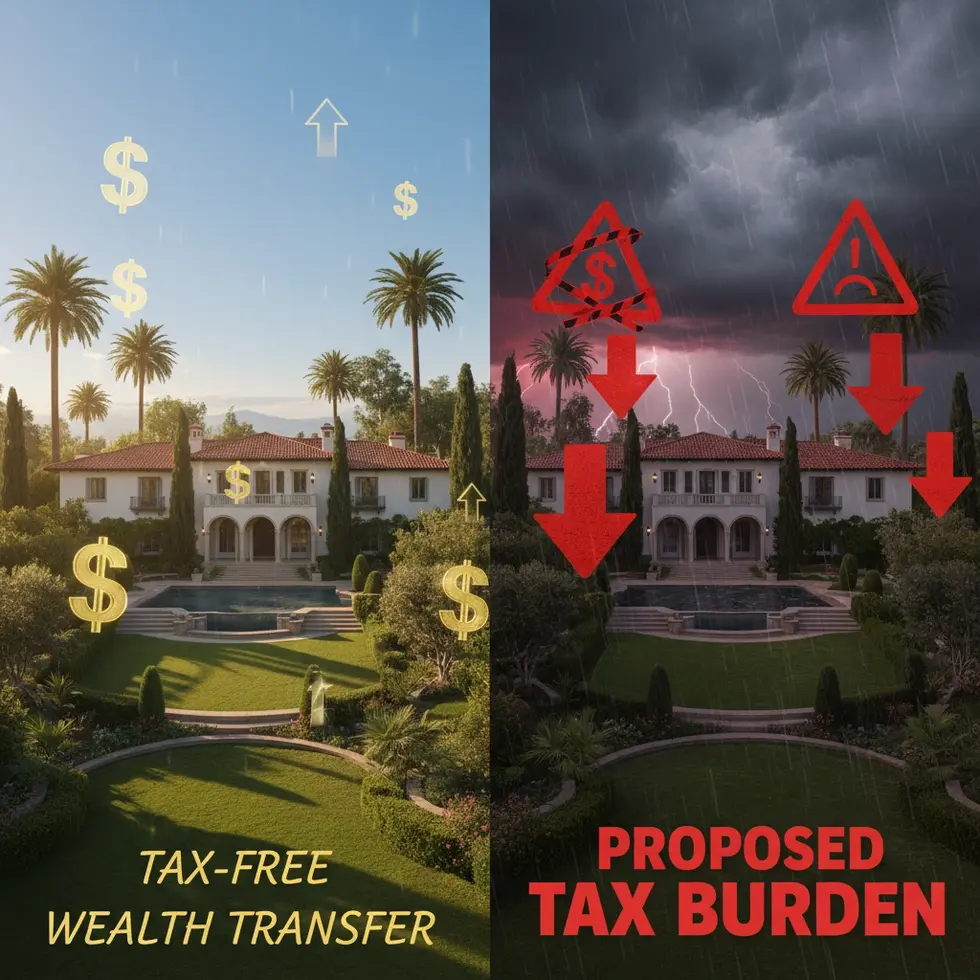
Right now, California residents enjoy one of the most favorable estate tax environments in the country. Under OBBBA, you only face federal estate tax if your estate exceeds $15 million per person or $30 million per married couple. Most families with $5–10 million in assets pay zero federal estate tax, but they could still be targeted by a new California estate tax if enacted.
The proposed California estate tax would change everything. Early versions suggest a 12% state tax rate layered on top of the existing 40% federal rate. That means families could face a combined tax burden of 52% on estate values above certain thresholds. For a family with an $8 million estate, we're talking about potentially hundreds of thousands in additional state taxes.
But here's where it gets really concerning: even with OBBBA's $15 million per-person ($30 million per-couple) federal exclusion, a California estate tax could apply well below those levels. In other words, families who owe nothing federally could still face a meaningful state estate tax bill.
Why This Creates a “Perfect Storm”

The timing couldn't be worse for wealthy California families. Consider this scenario:
Today: Family with $12 million pays zero federal estate tax under OBBBA
If California enacts a state estate tax: The same family could still owe substantial California estate taxes despite being exempt federally
This isn't just about the ultra-wealthy anymore. California's high real estate values mean many families could hit these thresholds through property ownership alone. A couple owning a $3 million home in Beverly Hills, plus retirement accounts, investments, and maybe a small business, could easily find themselves in the crosshairs of both state and federal estate taxes.
The proposed state tax becomes particularly problematic because it creates double taxation. You'd pay federal estate tax on the same assets that California wants to tax at the state level. Unlike income taxes where you get credits for taxes paid to other jurisdictions, estate taxes typically don't offer such relief.
Real Impact on $5M+ Families

Let's break down what this means for different wealth levels:
$5–8 Million Range: Under OBBBA, these families face no federal estate tax. With the proposed California changes, they could still face significant state tax liability even before hitting federal thresholds.
$8–15 Million Range: Still fully exempt from federal estate tax under OBBBA, but very exposed to a California estate tax if enacted—planning urgency is high.
$15+ Million Range: Above OBBBA's $15 million per-person ($30 million per-couple) exclusion, federal estate tax applies—and a 12% California layer on top would materially increase the total burden.
Beyond the raw numbers, this tax would impact family dynamics and business succession planning. Many family businesses and farms could face forced sales to pay estate taxes. Real estate holdings, particularly relevant in California's expensive markets, become major tax triggers rather than wealth preservation vehicles.
Strategic Response Options
The key is building estate plans that work under multiple scenarios. You can't just plan for current law and hope the proposed tax goes away.
Immediate Strategies:
- Lock in Current Exemptions: Use today's $15 million per-person ($30 million per-couple) lifetime exclusions under OBBBA to make strategic gifts or establish irrevocable trusts
- Residence Planning: Consider the tax implications of California residency and whether relocating makes financial sense
- Business Structure Review: Restructure family businesses to minimize estate tax exposure through valuation discounts and succession planning
Advanced Planning Techniques:
- Grantor Retained Annuity Trusts (GRATs): Transfer future appreciation to heirs while retaining income streams
- Installment Sales to Intentionally Defective Grantor Trusts: Freeze estate values while transferring growth to beneficiaries
- Family Limited Partnerships: Achieve valuation discounts on family assets while maintaining control
The Relocation Question

Many wealthy California families are asking whether they should simply move to states without estate taxes. States like Nevada, Texas, and Florida offer zero state estate tax and have been actively courting California residents.
But relocation isn't a simple solution. California's aggressive tax enforcement means you need genuine relocation, not just changing your driver's license. You need to establish true domicile elsewhere, which involves changing your primary residence, business operations, voting registration, and countless other factors.
More importantly, if you own significant California real estate or business interests, you may still face California tax exposure even as a non-resident. The state has been increasingly aggressive about taxing non-resident estates with California connections.
Is the Proposed Tax Actually “Bad”?
From a pure tax minimization perspective, yes: adding a 12% state estate tax on top of federal taxes significantly increases the cost of wealth transfer. California would join states like Washington and Oregon with some of the highest estate tax burdens in the nation.
But the answer depends on what you value:
For Tax Minimization: Absolutely problematic. The combined federal and state rates could exceed 50%, making California one of the most expensive places to transfer wealth.
For State Revenue: Supporters argue it generates funds for education, infrastructure, and social programs while affecting only the wealthiest families.
For Family Legacy Planning: Creates urgency and complexity, but also opportunities for those who plan ahead.
The political reality is that this tax has significant support among California legislators, particularly as the state faces budget pressures. High-net-worth families cannot afford to assume it won't pass.
Time-Sensitive Action Items
If you have $5 million or more in assets, you need to act now regardless of whether the proposed tax ultimately passes:
- Complete Estate Planning Review: Assess your current plan's effectiveness under multiple scenarios
- Consider Major Gifts: Use remaining high exemptions before they potentially disappear
- Business Succession Planning: Restructure family businesses to minimize estate tax exposure
- Residency Analysis: Evaluate whether California residency makes long-term financial sense
- Trust Structure Updates: Modify existing trusts to handle changing tax landscapes
The worst strategy is waiting to see what happens. By the time the proposed tax becomes law, your planning options become severely limited. The best estate planning techniques require time to implement and often depend on current law provisions that may disappear.
OBBBA + California Estate Tax: FAQs
Q: What is OBBBA and how does it affect the federal estate tax exclusion?
A: The One Big Beautiful Bill of America (OBBBA) sets the lifetime federal estate tax exclusion at $15 million per person or $30 million for a married couple. If your taxable estate stays under those amounts, you owe no federal estate tax.
Q: If my estate is under $15 million, will I still be impacted by California's estate tax proposal?
A: Potentially, yes. California is considering a separate state estate tax with thresholds that could be below the OBBBA federal limits. That means California residents—and non-residents who own California real estate or certain business interests—could owe state estate tax even when no federal estate tax is due.
Q: What planning steps should families with $5M–$15M take given OBBBA at the federal level but potential state-level exposure?
A: Focus on California-specific risk while using the generous federal exclusion:
- Model potential California estate tax under different thresholds and timelines
- Make strategic lifetime gifts (including to irrevocable trusts) while staying within the $15M/$30M OBBBA exclusion
- Consider proven techniques like SLATs, GRATs, installment sales to IDGTs, and FLP/LLC structuring for valuation discounts
- Review residency and domicile factors, and your ongoing California asset footprint
- Add liquidity planning (e.g., ILITs or Private Placement Life Insurance) to cover potential state tax without forced sales
Q: Do I need to act immediately even if OBBBA passes?
A: Yes. OBBBA may keep you clear of federal estate tax, but a California estate tax could still apply below those levels. Effective planning takes time—appraisals, trust design, funding, and filings—and acting early preserves more options and flexibility.
Frequently Asked Questions (General)
Q: When would the proposed California estate tax take effect?
A: While timing isn't certain, early proposals suggest the tax could appear on the 2026 ballot, with potential implementation shortly after if passed by voters.
Q: Would the California estate tax apply to non-residents who own property in the state?
A: Likely yes, for California real estate and business interests, similar to how other states handle non-resident estate taxation.
Q: Can I avoid the tax by moving my assets out of California?
A: It depends on the asset type and your residency status. Some assets like real estate remain tied to California regardless of your residence.
Q: How does this compare to other high-tax states?
A: The proposed 12% rate would make California competitive with states like Washington (20% maximum) and Oregon (16% maximum) for estate tax burden.
Q: What if the federal exemption stays high?
A: The proposed California tax would likely apply regardless of federal exemption levels, creating tax liability even for estates below federal thresholds.
Q: Should I accelerate my estate planning timeline?
A: Absolutely. The combination of federal exemption reductions and potential state taxes creates urgency for implementing protective strategies now.
Ready to protect your family's wealth from California's proposed estate tax?
The Law Office of James Burns specializes in sophisticated estate planning for high-net-worth California families. We help you navigate complex tax scenarios and implement strategies that work under multiple possible futures. Contact us today for a confidential consultation about protecting your legacy.
This article provides general information about California's proposed estate tax and should not be considered specific legal or tax advice. Estate planning involves complex rules that vary based on individual circumstances. Consult with qualified California estate planning attorneys and tax professionals before implementing any strategies discussed.
© 2025 Law Office of James Burns. All rights reserved. No portion of this article may be reproduced without written permission.

Comments
There are no comments for this post. Be the first and Add your Comment below.
Leave a Comment