
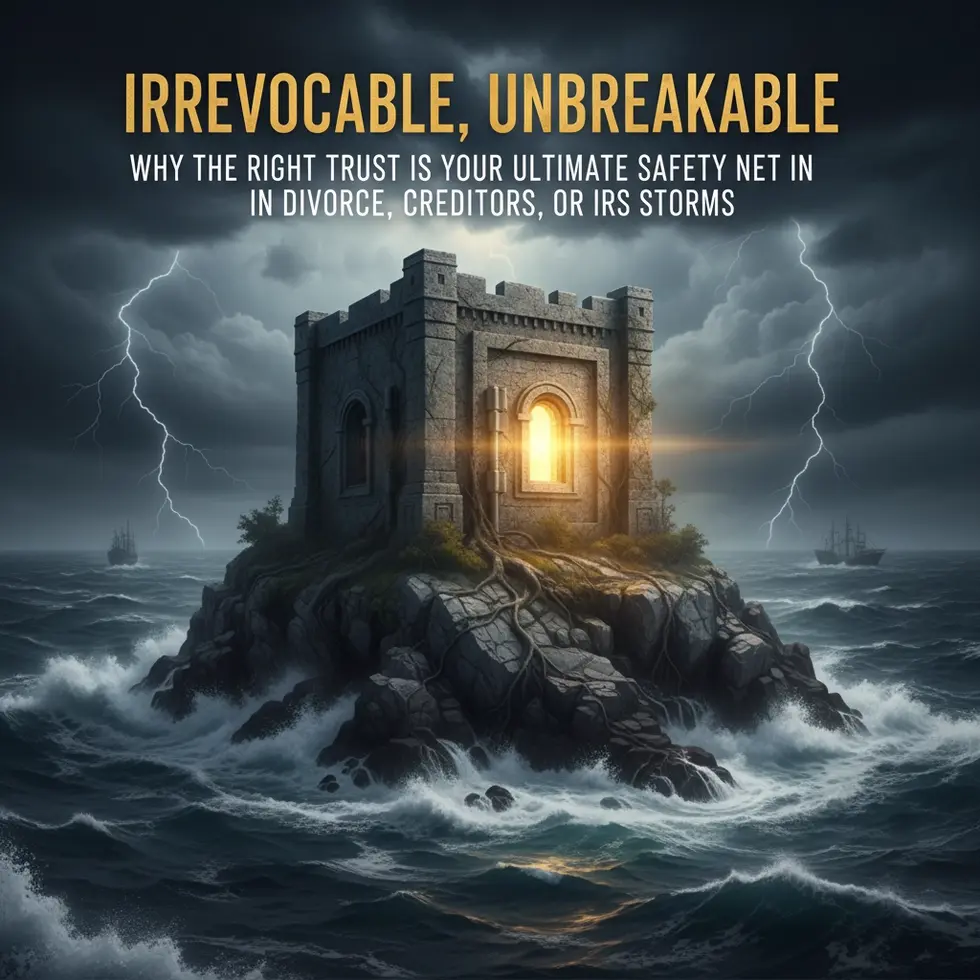
The emperor's wife demands half the empire. His business partners circle with lawsuits. The tax collectors sharpen their knives.
Yet the wise emperor sleeps peacefully. His treasure lies beyond their reach, protected by walls they cannot breach, governed by laws they cannot break.
This is the power of the properly structured irrevocable trust: a legal fortress that transforms your greatest vulnerabilities into unshakeable calm. When life's storms rage—divorce, creditors, IRS investigations—the right trust doesn't just protect your wealth. It preserves your peace of mind.
The Alchemy of Legal Separation: How Irrevocable Trusts Create Unbreachable Walls
The irrevocable trust operates on a principle so simple it borders on magic: what you don't own cannot be taken from you. The moment assets transfer into a properly structured irrevocable trust, a fundamental legal transformation occurs. You cease to be the owner. The trust becomes the owner. And that distinction creates walls that have withstood centuries of legal assault.
Under the Uniform Trust Code (UTC), adopted by most states, this separation of legal and beneficial ownership creates what lawyers call the "spendthrift protection" barrier (UTC §502). The grantor's creditors cannot reach trust assets because the grantor no longer owns them. The beneficiary's creditors typically cannot reach them either, because the beneficiary has no right to demand distributions from a properly drafted discretionary trust.
Legal Alchemy Works Through Three Mechanisms:
- Legal Title Separation: Trustee holds legal title, beneficiaries hold only beneficial interests—creditors can only attach what you own.
- Spendthrift Clauses: Explicitly prohibit assignment/pledge of interests; validated by Restatement (Third) of Trusts §58.
- Discretionary Distribution Standards: No legal right to force distributions—trustee discretion means creditor frustration.

The Divorce Fortress: Timing Creates Invincibility
Divorce is the single greatest destroyer of fortunes. Properly timed irrevocable trusts—created before marriage—create a wall against division.
In re Marriage of Haines (California 1995) ruled pre-marital trust assets remained completely separate, despite 15 years of marriage and deep involvement in the business: the trust's irrevocable nature and pre-marital creation were absolute.
Modern Divorce-Proofing Requires:
- Source of Funds Documentation: Create audit trails for pre-marital/separate property sources.
- Non-Commingling: Trust docs prohibit marital/trust asset mixing.
- Income Characterization: Income usually counts toward support; smart design accumulates income until risk passes.
- Trustee Selection: Use independent trustees for bulletproof separation.

Creditor Immunity: The Shield That Strengthens Under Attack
Irrevocable trust protection grows stronger as creditor pressure mounts. States like Nevada, Delaware, South Dakota offer the best Asset Protection Trust statutes.
- Short Statute of Limitations: Nevada, two years and claims forever barred.
- Burden Shifting: Fraudulent transfer claims require proof “beyond reasonable doubt.”
- Exception Limitations: Trust shields against most creditors (not child support or alimony).

Case Study: The Surgeon's Shield
Dr. Richardson placed $15M into a Nevada trust years before a malpractice claim. Plaintiff attorneys got nothing; statute of limitations expired, spendthrift and independent trustee features held strong.
IRS Storm Navigation: Tax Strategy, Legally
The IRS is the most powerful creditor. Yet irrevocable trusts—structured right—bring significant, legal tax benefit.
- Estate Tax Reduction: Gift assets out of the estate.
- GST Exemption: Dynasty trusts avoid ongoing transfer taxes.
- Grantor Trust Status: You pay the tax (reducing estate); value accumulates for heirs.
Advanced: Charitable Lead Annuity Trust (CLAT)
Annual charity payments, family gets the rest. Section 7520 rates mean massive gift tax leverage.
The Tao of Irrevocable Wisdom: Embracing Permanence
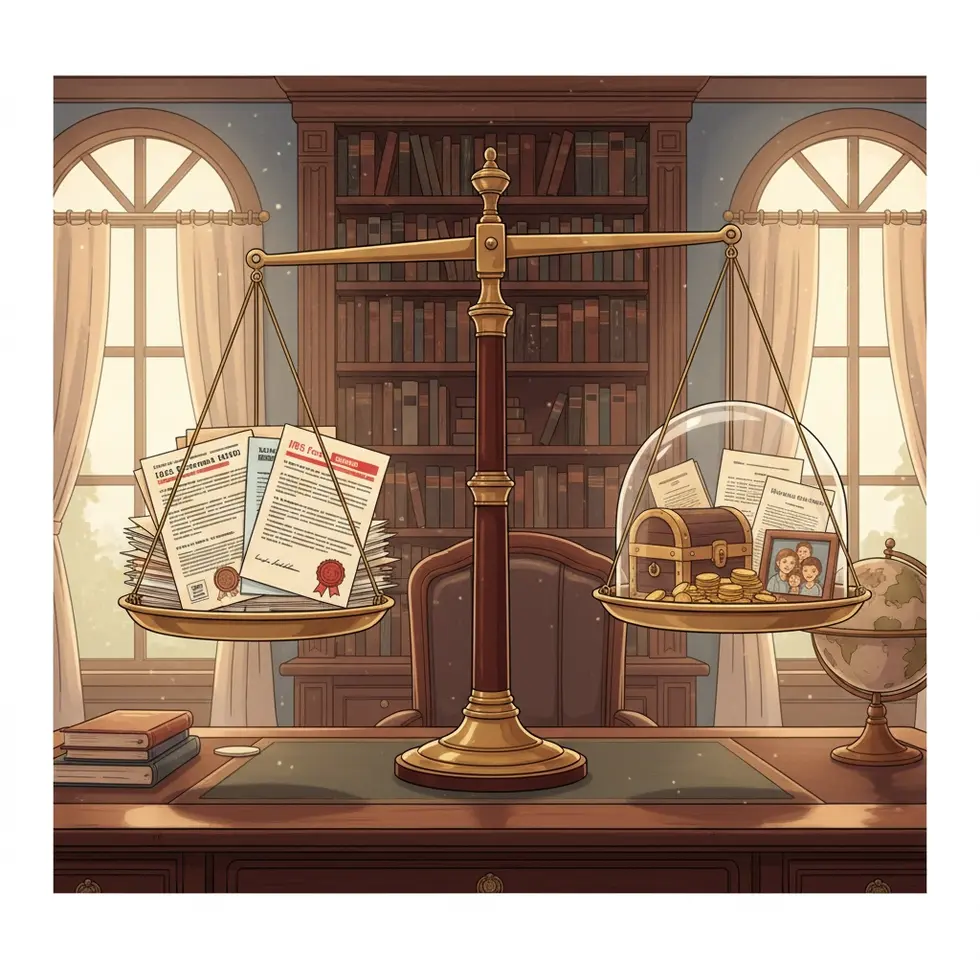
The Tao of Wealth: True security is in letting go. Surrender ownership, gain protection. “The supreme excellence is to subdue the enemy without fighting.” Irrevocable trusts do exactly that.

Advanced Trust Mechanics: Engineering Unbreachable Protection
Modern techniques include:
- Trust Protector Powers (modify structure in future)
- Decanting (move assets to better terms)
- Distribution Committees (split power over investments & distributions)
- Investment Direction (family handles money, trustee handles compliance)
Frequently Asked Questions
Q: If my trust is irrevocable, do I really give up all control over my assets?
A: Control depends on careful drafting. While legal ownership shifts away from you, modern trusts often provide indirect influence—via trust protectors, distribution committees, or investment direction language. The key is balancing control with protection: too much retained control may undermine your asset shield, but too little could be impractical. We “engineer the tension,” keeping you comfortable and compliant.
Q: What if the assets I want to protect are illiquid (like a business or real estate)?
A: Irrevocable trusts can hold illiquid assets such as closely held business interests, LLC units, or commercial properties. We design custom provisions for valuation, cash flow, and succession, including buy-out mechanisms and management continuity—so your operation stays strong, even if legal threats arise.
Q: Can a judge force distributions from my trust in a lawsuit or divorce?
A: Properly drafted discretionary trusts—especially with independent trustees and strong spendthrift clauses—give trustees discretion, not courts. There are rare exceptions (e.g., child support/alimony), but for most claims, courts cannot compel a payout.
Q: What are the biggest mistakes high-net-worth families make with irrevocable trusts?
A: The top pitfalls include: transferring assets under duress or after receiving a lawsuit/demand letter, naming unreliable or non-neutral trustees, lack of documentation for separate property, or failing to update structures as family circumstances change. Periodic review and formal funding procedures are crucial.
Q: How do offshore asset protection trusts compare to domestic ones?
A: Offshore trusts (e.g., Cook Islands, Nevis) offer formidable “firewalls” against U.S. judgments, but they're complex, expensive, and subject to additional IRS reporting. For many, strong domestic options (like Nevada or South Dakota APTs) offer ample protection with less risk of regulatory scrutiny.
Q: What are the ongoing reporting or tax requirements for irrevocable trusts?
A: Trusts may need annual tax filings (IRS Form 1041), K-1s for beneficiaries, and in some jurisdictions, accountings or disclosures. If using a grantor trust, income is reported on your individual return; for non-grantor trusts, income often stays within the trust—subject to high compressed tax brackets.
Q: Can trusts protect assets for multiple generations?
A: Yes—when structured as dynasty trusts, with GST (generation-skipping transfer) planning, assets can be sheltered indefinitely for future heirs, minimizing taxation and vulnerability for generations.
Q: What if Congress or California changes the laws around trusts and asset protection?
A: We build flexibility into every plan—using trust protectors, decanting provisions, and choice of law clauses—so if major changes happen, your structure can adapt or migrate to new regimes with minimal disruption.
Q: How soon do I need to set up a trust to ensure true protection?
A: The earlier, the better. Courts look for “badges of fraud” and will scrutinize last-minute transfers. For maximum security, plan well before potential claims arise and maintain a clear separation of trust assets from personal use or mixing with marital property.
Q: Is this right for international families or U.S./non-U.S. persons?
A: Absolutely—we routinely advise globally mobile and cross-border clients, tailoring trust and asset structures to accommodate international tax compliance, multi-jurisdictional risk, and inheritance regimes.
Your Fortress Awaits
The storms—divorce, lawsuits, IRS scrutiny—will come. The real question? Will your family face them from a position of calm, confident strength, or from a place of anxiety and exposure?
At the Law Office of James Burns, we don't just build legal barriers—we create custom, comprehensive protection systems tailored to the realities of high-net-worth life. Our trust structures defend your wealth from every angle: family disputes, creditor attacks, and shifting tax laws, both in California and across the globe.
Ready to engineer your legacy's ultimate fortress—with legal architecture that will endure for generations? Schedule a confidential strategy session today. We'll clarify your risks, decode the technical options, and design an unbreakable plan that brings peace of mind to you and your heirs.
Contact us at www.jamesburnslaw.com or call (949) 305-8642 to get started—because true legacy protection doesn't wait for storms, it's built before they start.
Disclaimer:
This article is intended for informational and educational purposes only. It does not constitute legal, tax, or financial advice, nor does it create an attorney-client relationship between you and the Law Office of James Burns. Estate planning, trust structuring, asset protection, and tax matters are complex and highly fact-specific. Laws and regulations vary by jurisdiction and are subject to change. Any strategies discussed herein require careful review of your specific situation and may not be applicable to everyone. You should consult with a qualified attorney, accountant, and/or financial advisor licensed in your state before taking any action based on this material. No guarantees or representations are made regarding the effectiveness of any specific strategy, and improper use could result in adverse tax or legal consequences.
Intellectual Property Notice:
The concepts, trust designs, methodologies, frameworks, and language presented in this article are proprietary to James Burns and the Law Office of James Burns. They may not be reproduced, reinterpreted, or distributed without the express, written consent of James Burns. Sharing or redistributing this content without permission constitutes a violation of our intellectual property rights and is strictly prohibited.

Comments
There are no comments for this post. Be the first and Add your Comment below.
Leave a Comment