
You built the company. You found the investment. You know the people making the decisions.
That familiarity may be exactly what puts an international private placement life insurance strategy at risk.
PPLI can deserve a serious place in a wealthy family's planning. Properly structured and maintained qualifying life insurance may reduce the drag of current taxation on investment growth while serving a genuine insurance and wealth-transfer purpose. But the potential benefit comes with a boundary that successful entrepreneurs often find uncomfortable: you cannot assume you may continue directing the investments behind the policy.
The policy may carry an international insurer's name. The investment account may have an independent manager. The documents may describe discretion beautifully.
The real question is simpler: who actually decides what the money buys?
The policy can be yours. Its investments are different.
Investor control concerns whether the policyholder should be treated as the owner of assets supporting the insurance contract for U.S. federal income-tax purposes. If retained control crosses the line, the policyholder may be taxed currently on income from those assets despite the insurance arrangement.
This distinction separates legitimate insurance planning from the assumption that an insurance contract can simply be placed around a personal portfolio without changing how it operates.
Selecting among permitted investment options is different from directing the purchase of a particular company, fund interest or security. Revenue Ruling 2003-91 illustrates a favorable arrangement with independent investment decisions and tightly limited policyholder involvement. It does not give every customized PPLI arrangement a blanket approval.
The issue is fact dependent. Documents matter. Conduct matters too.
Four situations that deserve an early stop
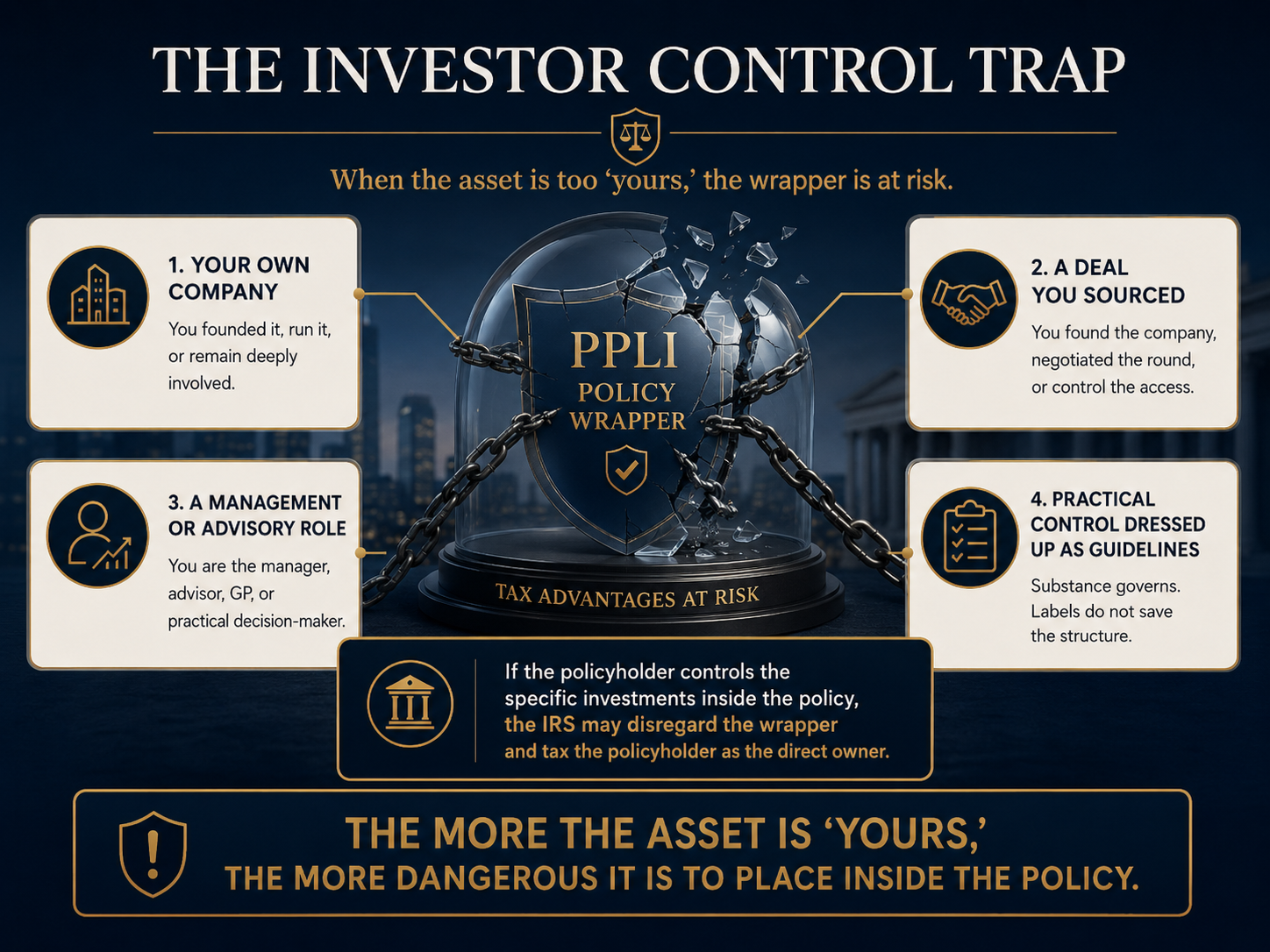
The illustration above identifies four useful warning signs. Treat them as prompts for investigation, rather than four automatic legal prohibitions.
1. You want the policy to invest in your own company
A founder may see extraordinary upside in the business and ask whether that appreciation can develop inside PPLI.
Before discussing implementation, identify the founder's continuing role. Who controls the company? Who negotiates financing? Who can influence distributions, voting, a sale or an exit? Does the proposed investment serve the insurer's independently selected investment objectives, or a transaction the founder has already arranged?
An ownership chart alone cannot answer those questions. The review should include management rights, related parties and how decisions actually reach the proposed investment manager. Do not assume that issuing a new class of shares or adding an intermediary resolves the exposure.
2. You sourced and negotiated the deal
Perhaps you have access to a private transaction that other investors cannot obtain. You negotiated the economics and now want the policy's account to take the allocation.
That sequence deserves scrutiny before anyone commits funds. Ask the advisers to examine the entire transaction history, including preliminary discussions and expectations about what the account will purchase.
The planning question is whether a genuinely independent investment decision remains available. A signature obtained after the important decisions have already been made is a weak foundation for that conclusion.
3. You remain the manager or adviser
Titles such as founder, general partner, consultant or investment adviser should trigger a careful discussion of the actual powers involved. The review should also identify family members, controlled entities and informal channels through which instructions might pass.
Do not reduce the analysis to whether the policyholder personally enters a trade. Identify who proposes transactions, who approves them and whether anyone can meaningfully reject them.
An adviser reviewing this structure should be able to describe the decision process without relying on the phrase “everyone understands how it works.”
4. Your guidelines decide the investments
Investment objectives help define what a family needs. Specificity can also become a problem when a mandate effectively identifies the desired transaction.
A proposed guideline that leaves only one practical investment deserves different scrutiny from a broad allocation objective. Ask counsel to evaluate both the written mandate and any related understandings. Calling an instruction a preference does not resolve its substance.
These are diagnostic questions, not a universal safe-harbor checklist. Their purpose is to expose the facts before the family relies on a tax projection.
What the IRS guidance actually helps us see
Revenue Ruling 2003-91 distinguishes permitted allocations among available subaccounts from control of their specific investments. Its favorable facts include restrictions on recommending particular investments, direct or indirect communications about investment selection, and prearranged understandings.
Revenue Ruling 2003-92 addresses another trap: access to the underlying investment. An offering limited to wealthy or accredited investors is not necessarily insurance dedicated. “Private placement” and “available exclusively through insurance” answer different questions. The insurer and tax advisers must evaluate the actual vehicle and applicable permitted-holder rules.
Read Revenue Rulings 2003-91 and 2003-92 in the IRS bulletin.
Later IRS private-letter guidance also illustrates how extensively investment independence may need to be represented. Private Letter Ruling 201502003 describes a particular arrangement involving independent managers and restrictions on policyholder influence. It is useful context, but a private letter ruling is not precedent on which another taxpayer may simply rely.
Read the IRS's fact-specific ruling and limitations.
An international insurer does not remove the U.S. question
A carrier's jurisdiction and a policyholder's tax position are separate parts of the design.
A Bermuda or other international policy should be evaluated for the actual people, ownership structure and jurisdictions involved. A family with U.S. connections needs coordinated U.S. analysis; local availability or acceptance by the insurer does not establish the family's U.S. tax result.
Begin with a map of the owner, insured, beneficiaries, trustees and relevant tax residences. Then obtain written advice on the contract, investment structure and ongoing obligations. Changes in residence or ownership should trigger a fresh review rather than an assumption that the original answer travels everywhere.
Foreign-policy reporting is another separate workstream. Depending on ownership, policy characteristics and applicable thresholds, foreign cash-value insurance can raise Form 8938 and FBAR questions. Filing one does not automatically satisfy the other.
See the IRS comparison of Form 8938 and FBAR requirements.
Premiums paid to a foreign insurer may also raise federal excise-tax questions. Applicable exemptions and the insurer's tax status require specific review; an international address alone does not establish the answer.
See IRS Publication 510 and its foreign-insurance discussion.
Passing one test does not complete the design
Investor control is one part of PPLI due diligence. The team must separately review life-insurance qualification, applicable diversification requirements, modified endowment contract treatment and the consequences of distributions, loans, lapse or surrender.
That legal review belongs alongside the economics. Insurance charges, administration, investment expenses, liquidity restrictions and the expected holding period can change whether the strategy makes sense. Request an illustration that identifies its assumptions and shows adverse scenarios, including lower returns and an earlier need for cash.
The objective is a structure the family can maintain through an ordinary bad year, a management change or an unexpected liquidity need. A favorable projection is only the beginning of that discussion.
Start with Risk Exposure Mapping
At the Law Office of James Burns, the useful starting point is the exposure map: what the family owns, what it wants to accomplish and which powers it expects to retain. That work should precede product selection.
For a proposed international PPLI arrangement, organize the review in this order:
- Define the insurance and family purpose. Identify the intended benefit, time horizon, beneficiaries and available liquidity outside the policy.
- Map existing relationships. List interests in proposed investments, management positions, family connections, negotiations and commitments already made.
- Document the decision process. Identify who selects investments, who can reject a transaction and how communications will be handled.
- Review the contract and investment vehicle. Obtain coordinated advice on qualification, diversification, investor control and insurance-dedicated access where relevant.
- Model the full cost and downside. Compare the arrangement with practical alternatives using disclosed assumptions.
- Assign ongoing responsibilities. Establish who monitors compliance, reporting, residence changes and departures from the approved process.
Our Cross-Border Wealth Systems framework coordinates the family, legal, tax, insurance and fiduciary questions with the appropriate specialists. Foreign counsel addresses local law; qualified tax, insurance and investment professionals address their respective disciplines.
A founder's question before funding
Consider a hypothetical founder who wants a proposed policy account to purchase an interest in a company the founder still advises. The founder has already negotiated the investment terms and expects to remain involved after funding.
The first meeting should examine those facts, not begin with a projection of tax savings. The team needs to understand the proposed transaction, continuing powers and investment manager's role before determining whether the arrangement is supportable.
The eventual recommendation could be to change the proposal, use different investments or abandon that particular approach. No result is assumed here. The point is the sequence: identify the conflict before money moves and expectations harden.
Frequently asked questions
Can I select an investment strategy for my policy?
Some structures permit allocations among available investment options. That permission should not be read as authority to select underlying securities. Have counsel review the actual rights and operating process.
Does hiring an independent manager solve investor control?
The manager's appointment is only part of the evidence. Review whether that manager actually exercises independent judgment and whether other arrangements constrain it.
Is an investment in my company automatically prohibited?
The image highlights a serious warning sign, not a categorical ruling on every possible structure. Continuing ownership, influence and transaction history require individualized analysis before proceeding.
Is a private fund automatically insurance dedicated?
No. Restricted investor eligibility does not by itself establish exclusive insurance access. Review the vehicle's actual ownership and access arrangements under the applicable rules.
Does a foreign policy avoid U.S. reporting?
Do not assume that it does. Ownership, tax status, cash value and reporting thresholds can affect the obligations. The reporting review should be assigned before funding.
What should I bring to an initial review?
Bring the proposed policy and illustration, investment materials, ownership chart, management agreements, relevant correspondence and a list of the powers you expect to retain. Include the family's tax residences and likely liquidity needs.
Review the control before funding the policy
The hardest question may be whether you are willing to give up the investment decisions that the proposed structure requires someone else to make.
Answer it before relying on the illustration.
For a billable advanced-planning consultation, contact the Law Office of James Burns at (949) 305-8642. We can begin by mapping the ownership, investment relationships and cross-border questions that need coordinated review.
Law Office of James Burns, 6B Liberty, Suite 130, Aliso Viejo, CA 92656.
Disclaimer
This article provides general educational information, not legal, tax, investment or insurance advice. PPLI involves costs, investment risk, eligibility requirements and ongoing compliance. Potential tax benefits depend on the actual contract, structure, conduct and applicable law. No tax outcome, return, creditor protection or suitability is guaranteed. Obtain advice from qualified professionals in each relevant jurisdiction before acting.
IP Disclosure
© 2026 Law Office of James Burns. The supplied Investor Control hero image is used at the client's direction; no representation is made here about its underlying ownership or licensing.

Comments
There are no comments for this post. Be the first and Add your Comment below.
Leave a Comment