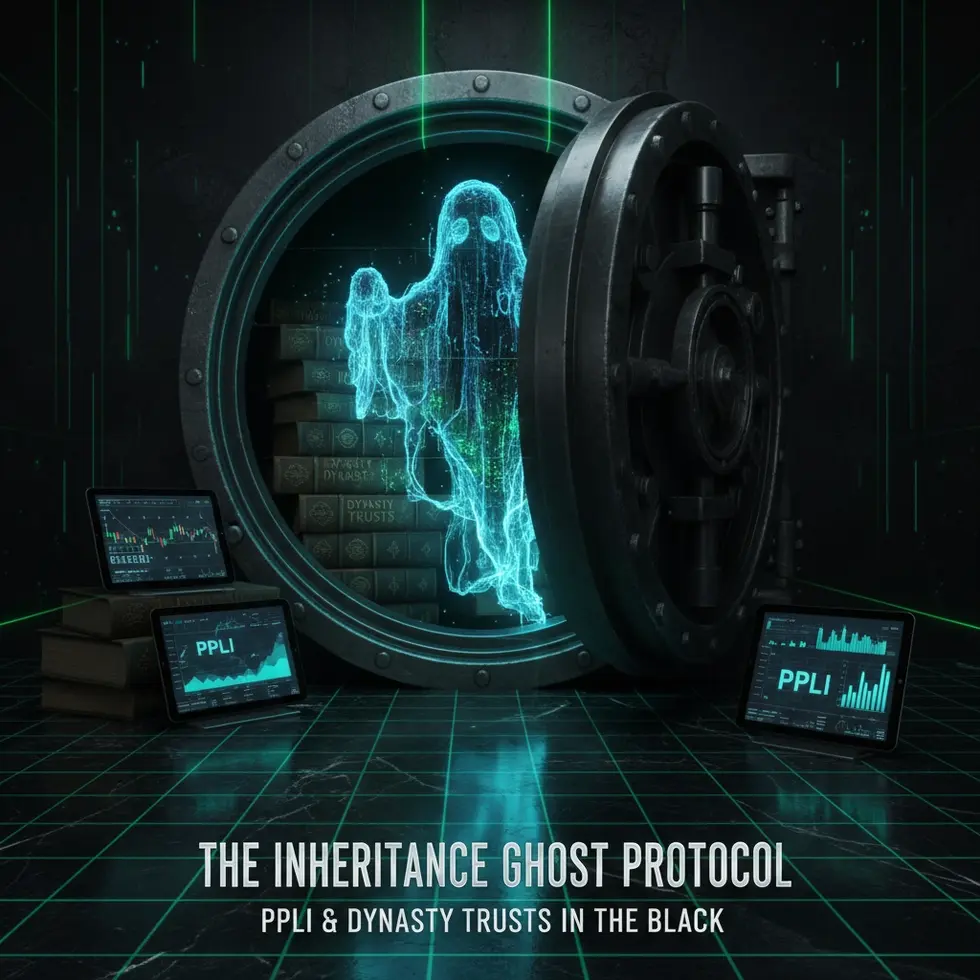
You won't find the real legacies on spreadsheets. They exist in documents never filed, custodians who never sleep, across time zones and statutes. Call it the Ghost Protocol: where inheritance isn't a target, but a moving phantom.
The boardrooms know what the headlines don't: America's wealthiest families don't just avoid taxes. They operate outside the system entirely, using structures so opaque that even the IRS loses the trail. While middle-class estates crumble under California's 40.8% death tax, the ultra-wealthy deploy assets into legal black holes where compound growth happens in perpetual darkness.
The Visibility Trap
Traditional estate planning is a sniper's nest. Every will, every revocable trust, every property transfer creates a paper trail that leads directly to your heirs' wallets. The state sees your assets coming generations in advance, calculating tax harvests on wealth that hasn't even passed yet.
We've watched $100 million fortunes shrink to $30 million after three generations: not through bad investments or family disputes, but through systematic visibility. Each probate filing is a surrender. Every estate tax return is intelligence handed to the enemy.
The wealthy who survive understand the fundamental doctrine: What can be seen can be seized.
Doctrine: Engineering Invisibility
Invisibility isn't luck. It's architecture.
We build two-tier protection systems that operate like intelligence cells: each component knows only what it needs to function, while the full structure remains invisible even to those who benefit from it. The Ghost Protocol combines South Dakota Dynasty Trusts with Private Placement Life Insurance, creating a legal void where wealth grows beyond the reach of taxes, creditors, and time itself.
South Dakota operates as America's legal dark zone. No state income tax. No resident requirements for trustees. Dynasty trusts that can last forever, literally. While California's Franchise Tax Board scrutinizes every transaction, South Dakota provides what we call "jurisdictional blindness." Assets disappear across state lines into a legal framework designed for opacity.
The second layer: Private Placement Life Insurance: transforms investment portfolios into insurance contracts. To the outside world, there's no taxable income, no reportable gains, no visible wealth accumulation. Just a life insurance policy with a modest death benefit, hiding a sophisticated investment engine that can hold hedge funds, private equity, even cryptocurrency.
Intel Drop: The SD PPLI Cascade
Here's how the protocol operates:
Phase One: Jurisdictional Displacement
We establish a South Dakota Dynasty Trust in Sioux Falls, staffed with trustees who understand discretion. The trust receives assets through strategic gifting: often using generation-skipping exemptions to immunize transfers from federal gift taxes. No California reporting. No state tax implications.
Phase Two: The Insurance Veil
The Dynasty Trust purchases a Private Placement Life Insurance policy, typically requiring $2-5 million in annual premiums. But these aren't insurance premiums in any traditional sense: they're investment allocations disguised as insurance contracts. The death benefit stays minimal while the cash value becomes a tax-free investment platform.
Phase Three: Operational Invisibility
Within the PPLI structure, we deploy capital across alternative investments unavailable to typical investors. Private equity funds. Hedge strategies. International markets. The insurance wrapper shields all gains from taxation while providing liquidity through policy loans: tax-free access to wealth that technically doesn't exist on any government ledger.
The Compound Effect
The mathematics become staggering over time. A properly structured PPLI policy growing at 8% annually inside a Dynasty Trust creates generational wealth that operates outside normal tax physics. No estate taxes at death. No income taxes on growth. No generation-skipping taxes as assets pass to grandchildren and beyond.
Consider the trajectory: $10 million deployed through the Ghost Protocol, compounding tax-free for thirty years, creates approximately $100 million in family wealth. But because the assets never technically "pass" to heirs: they remain within the Dynasty Trust structure: there's no taxable event, no stepped-up basis limitations, no California inheritance tax exposure.
We've architected structures where great-grandchildren inherit more wealth than the original patriarch ever controlled, yet neither the IRS nor the Franchise Tax Board has any visibility into the accumulation process.
Operational Security
The protocol's strength lies in compartmentalization. Family members know they're beneficiaries but can't see the underlying investments. The South Dakota trustees manage distributions but don't control investment strategy. The PPLI custodians handle asset allocation but can't access trust distributions.
Even sophisticated forensic accountants struggle to map these structures because there's no central control point, no single document that reveals the architecture. We create intentional gaps in the paper trail: legal voids where wealth exists but can't be traced through conventional investigation.
Beyond Traditional Protection
Standard asset protection relies on deterrence: making lawsuits expensive and outcomes uncertain. The Ghost Protocol operates through a different principle: absence. When properly implemented, the assets simply don't exist in any jurisdiction where they can be attacked.
Divorcing spouses find empty entities. Creditors pursue collection against individuals with no visible wealth. California tax auditors discover residents whose lifestyles don't match their reported income, yet can find no hidden assets to tax because the wealth exists in a parallel legal structure they can't access.
The protocol even survives the beneficiaries' own mistakes. Unlike traditional inheritances that get commingled into marital property or exposed through business ventures, Dynasty Trust assets maintain their separate property character indefinitely. Beneficiaries can't accidentally expose the wealth because they never technically own it.
The Next-Generation Advantage
Perhaps most powerfully, the Ghost Protocol improves with time. Each generation that passes without tax exposure makes the structure stronger, not weaker. Traditional estate planning creates "leakage": taxes, fees, and forced distributions that erode wealth over time. The protocol creates the opposite effect: compound protection that grows more sophisticated as family circumstances evolve.
We build succession systems where each beneficiary can redirect their inheritance to the next generation, to charity, or even to more responsible family members through "powers of appointment." The wealth becomes fluid while remaining protected, adapting to family dynamics while staying invisible to external threats.
Frequently Asked Questions
Q: How much wealth do you need to justify this level of complexity?
A: The protocol typically makes sense for families with $20+ million in liquid assets. The annual costs: trust administration, insurance premiums, investment management: require substantial assets to justify the tax savings and protection benefits.
Q: Can California still claim jurisdiction over these structures?
A: California's reach has limits. Properly structured South Dakota Dynasty Trusts with independent trustees and no California situs typically remain outside California's tax jurisdiction, even for California residents who created them.
Q: What happens if PPLI tax laws change?
A: The insurance industry has existed for over 150 years, and the tax benefits we utilize are foundational to how life insurance works. While regulations evolve, the core tax advantages: tax-free growth and death benefits: remain remarkably stable across political administrations.
Q: How liquid are assets within the protocol?
A: PPLI policies typically allow policy loans against 85-90% of cash value without creating taxable events. The Dynasty Trust structure can distribute investment gains to beneficiaries as needed. Liquidity exists, but it's controlled and tax-efficient.
Q: Can this protect against future wealth taxes or mandatory distributions?
A: The protocol provides significant protection against changing tax policies because the wealth exists in insurance contracts and irrevocable trusts. Political proposals for wealth taxes typically target directly-owned assets, not insurance cash values held in Dynasty Trusts.
Nobody audits a shadow they can't see. The Ghost Protocol operates in the spaces between jurisdictions, in the gaps between tax codes, where wealth grows in perpetual darkness. For families who understand that true security comes not from what they can protect, but from what nobody knows they possess.
At the Law Office of James Burns, we architect these invisible structures for California's most sophisticated families. Each protocol is custom-engineered for your specific wealth profile and family dynamics, creating protection systems that evolve with both your assets and the legal landscape.
If the real inheritance is invisibility, how much of your fortune is already visible: and vulnerable?
Ready to explore the Ghost Protocol for your family's wealth? Contact the Law Office of James Burns for a confidential consultation about implementing PPLI and Dynasty Trust strategies engineered to keep your legacy invisible, untouchable, and multigenerational.
This article is for informational purposes only and does not constitute legal, tax, or investment advice. Always consult privately with a qualified professional regarding your specific situation.
This content is the exclusive intellectual property of the Law Office of James Burns and may not be reproduced, distributed, or adapted without express written consent.

Comments
There are no comments for this post. Be the first and Add your Comment below.
Leave a Comment