

Asset protection planning is the legal practice of structuring ownership of assets so that creditors, plaintiffs, and judgment holders cannot easily reach them. For high-net-worth families, the threat is real: a single civil judgment can unravel decades of wealth accumulation if assets sit exposed in your personal name. The tools available to protect family wealth from lawsuits include irrevocable trusts, limited liability companies, Family Limited Partnerships, umbrella insurance, and statutory exemptions. Each tool addresses a different exposure point. Used together, they form a layered defense that makes your estate far less attractive to pursue. This guide explains how each layer works and how to build a plan that holds.
What are the most effective legal entities to shield family assets?
Legal entities create separation between you and your assets. That separation is the foundation of any serious wealth defense architecture.
Limited liability companies
An LLC places business and investment assets inside a legal structure that limits creditor access to the entity itself. A creditor who wins a judgment against you personally cannot simply seize LLC assets. In most states, the creditor's only remedy is a charging order, which entitles them to distributions if and when the LLC makes them. Because you control the distribution schedule, that remedy is often worthless in practice. LLC liability protection works precisely because it separates personal liability from asset ownership.

Family Limited Partnerships
Family Limited Partnerships provide creditor protection by limiting a creditor's remedies to charging orders in many states, while also allowing valuation discounts for estate and tax planning purposes. An FLP separates ownership from management. General partners control the assets; limited partners hold economic interests but no management rights. A creditor who obtains a charging order against a limited partner interest receives no voting rights and no guaranteed distributions. That combination of limited access and valuation discounts makes FLPs a dual-purpose tool for both lawsuit protection for families and estate tax reduction.
Domestic Asset Protection Trusts and tenancy by the entirety
Over 19 U.S. states, including Nevada, South Dakota, and Delaware, allow Domestic Asset Protection Trusts (DAPTs) that permit grantors to remain discretionary beneficiaries while shielding assets from future creditors. DAPTs offer a domestic alternative to expensive offshore trusts with comparable creditor protection. For married couples, Tenancy by the Entirety (TBE) provides a built-in shield. TBE is available in roughly half of U.S. states and protects jointly held assets from claims against only one spouse. It costs nothing to establish beyond proper titling of assets.
Pro Tip: Never rely on a single entity. An LLC protects business assets; TBE protects the family home; a DAPT protects liquid wealth. Stack all three for maximum coverage.
How do insurance and statutory exemptions protect family wealth?
Insurance is the first line of defense in any asset protection plan. It absorbs liability before a lawsuit reaches your legal structures.
Umbrella insurance provides coverage beyond standard auto and homeowner policies, absorbing liability claims before they escalate to litigation. A $5,000,000 umbrella policy costs a fraction of what a single judgment could cost. Professional liability insurance serves the same function for physicians, attorneys, and business owners facing malpractice or errors-and-omissions claims.
Statutory exemptions add another layer at no cost:
- Homestead exemption: Protects a portion or all of primary residence equity from civil judgment creditors, with protection varying widely by state. Texas and Florida offer unlimited homestead protection; California caps it at a lower threshold.
- Retirement accounts: Funds held in ERISA-qualified plans such as 401(k)s and pension plans receive federal protection from most creditor claims. IRAs receive strong but not unlimited protection under the Bankruptcy Abuse Prevention and Consumer Protection Act.
- Life insurance and annuities: Many states exempt the cash value of life insurance policies and annuity contracts from creditor claims. California, Texas, and Florida all provide meaningful protection here.
Pro Tip: Coordinate your insurance coverage with your legal structures. A creditor who cannot pierce your LLC will often settle once they realize your umbrella policy is the only accessible asset.
How to effectively use trusts for securing family wealth against litigation
Trusts are the most powerful tool in the wealth preservation arsenal when structured correctly. The critical distinction is revocable versus irrevocable.
A revocable living trust offers zero asset protection. Because you retain the right to revoke it and reclaim assets, courts treat those assets as yours. Creditors can reach them. Revocable trusts serve estate planning goals, not lawsuit protection goals.
Irrevocable trusts remove assets from your name, shielding them from creditor claims and lawsuits if properly structured and funded well before any litigation threat arises. Designing the trust to separate ownership and control is the critical variable. Once assets transfer into an irrevocable trust, you no longer own them. That legal separation is what blocks creditor access.
Structuring an irrevocable trust for maximum protection requires attention to four elements:
- Timing. Fund the trust before any claim or foreseeable threat exists. Courts apply fraudulent transfer laws aggressively. A transfer made after a lawsuit is filed, or even after a creditor relationship begins, can be unwound by a judge.
- Trustee selection. An independent trustee strengthens the protection. If you control the trustee, courts may treat the trust as your alter ego and pierce it.
- Beneficiary design. Dynasty trusts can hold assets across multiple generations, protecting inherited wealth from the beneficiaries' own creditors and divorcing spouses.
- Fraudulent conveyance compliance. Every transfer must be made for fair consideration or as a legitimate gift, documented properly, and timed to avoid the appearance of intent to defraud creditors.
"Effective asset protection does not hide assets. It restructures ownership so that assets are genuinely no longer yours to lose." — Jamesburnslaw
Pro Tip: A DAPT in Nevada or South Dakota can hold liquid assets, real estate, and business interests under one trust structure with a two-year seasoning period before full creditor protection attaches.
What practical steps should families take to build and maintain a protection plan?
Layered asset protection strategies combining LLCs, umbrella insurance, and irrevocable trusts are more effective than relying on any single tool. The implementation sequence matters as much as the tools themselves.
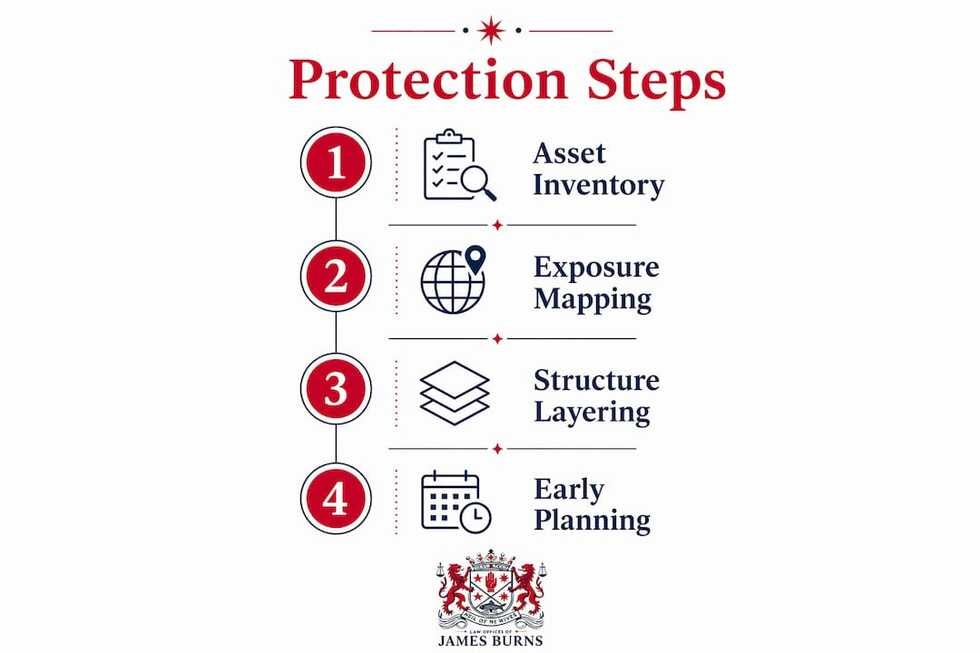
Step 1: Complete an asset inventory. List every asset by category: real estate, business interests, brokerage accounts, retirement accounts, life insurance cash value, and intellectual property. Assign a current value and identify how each asset is currently titled.
Step 2: Map your exposure. Identify which assets sit in your personal name with no protection. Real estate held personally, brokerage accounts in your name, and business interests without an LLC are all exposed. This exposure mapping exercise is the starting point for Jamesburnslaw's FortressWall Methodology™.
Step 3: Layer your structures. Combine legal entities, insurance, and trusts to address each exposure point. No single tool covers every risk. An LLC protects business assets; an umbrella policy absorbs initial liability; an irrevocable trust protects liquid wealth; TBE protects the family home.
Step 4: Plan early. Waiting until after a lawsuit is filed to start asset protection risks having transfers labeled fraudulent, making attempts ineffective and potentially illegal. Proactive planning preserves every option available to you.
Step 5: Review annually. Failing to update beneficiary designations after family changes is a common litigation flashpoint and can undermine an otherwise sound plan. Review your plan after every major life event: marriage, divorce, birth of a child, acquisition of a new business, or a significant change in net worth.
Common mistakes to avoid:
- Transferring assets to family members informally without proper legal documentation
- Using a single-member LLC without maintaining corporate formalities
- Assuming homestead exemption covers all real estate, not just the primary residence
- Overlooking state-specific rules when moving between states
Key takeaways
Multi-layered protection is the only reliable defense against litigation risk. No single tool is sufficient on its own, and the timing of every move determines whether it holds up in court.
| Point | Details |
|---|---|
|
Legal entities create separation |
LLCs and FLPs block direct creditor access by limiting remedies to charging orders. |
|
Irrevocable trusts remove ownership |
Assets in a properly funded irrevocable trust are no longer legally yours to lose. |
|
Insurance absorbs first contact |
Umbrella and professional liability policies stop most claims before they reach your structures. |
|
Timing is everything |
Transfers made after a lawsuit is filed can be reversed as fraudulent conveyances. |
|
Annual reviews preserve protection |
Outdated beneficiary designations and untitled assets create gaps that creditors exploit. |
What I have learned about judgment proofing after years in the field
The conventional advice on asset protection focuses on tools: get an LLC, buy an umbrella policy, set up a trust. That advice is correct but incomplete. The real goal is judgment proofing.
Judgment proofing focuses on making assets difficult to collect rather than simply hiding them, encouraging out-of-court settlements at lower costs to the protected party. When a plaintiff's attorney runs an asset search and finds nothing in your personal name, the calculus changes. Contingency-fee attorneys do not pursue cases where collection is unlikely. That is the actual outcome you are engineering.
What most families miss is that protection requires maintenance. I have seen well-designed plans fail because a client retitled an asset informally, missed an annual LLC filing, or moved to a new state without updating their structure. California has different rules than Nevada. A plan built for one state may offer no protection in another.
The other underappreciated risk is family dynamics. A trust that names the wrong trustee, or a partnership agreement that does not account for a divorcing child, can become a litigation target itself. Protection architecture must account for the people inside the plan, not just the legal structures around the assets.
Build the plan before you need it. Review it every year. And treat it as a living system, not a one-time filing.
— James
Take the next step with Jamesburnslaw

Protecting family wealth from lawsuits requires more than a single document or a standard LLC filing. Jamesburnslaw works with high-net-worth families in California to design multi-layered protection plans using the FortressWall Methodology™, covering estates from $5,000,000 to over $100,000,000. The process begins with a full exposure mapping of your current asset structure, followed by a custom control architecture that combines legal entities, irrevocable trusts, insurance coordination, and statutory exemptions. If your estate is exposed, the time to act is before a claim arises. Schedule a consultation with Jamesburnslaw to build a plan that holds.
FAQ
What is the difference between a revocable and irrevocable trust for asset protection?
A revocable trust is primarily an estate planning and probate-avoidance tool. It does not provide asset protection from your own creditors because you retain the power to amend, revoke, control, and benefit from the trust assets. Under California law, if the settlor retains the power to revoke the trust, the trust property remains subject to the claims of the settlor's creditors.
An irrevocable trust may provide stronger asset protection, but only when it is properly designed, properly funded, and created before any lawsuit, claim, creditor problem, or foreseeable dispute exists. The key distinction is control. If you retain too much control, access, or benefit, a creditor may argue that the trust is not truly separate from you. In California, timing is also critical. Transfers made after a creditor problem exists may be challenged as voidable transfers.
For California residents, a revocable living trust is excellent for avoiding probate and organizing family wealth, but it should not be confused with lawsuit protection. True asset protection usually requires a separate legal structure, such as a properly designed irrevocable trust, business entity, exemption plan, or California Private Retirement Plan.
Can an LLC fully protect personal assets from a lawsuit?
An LLC can be an important layer of protection, but it does not provide absolute protection. In California, a creditor of an LLC member is generally limited to a charging order against the member's transferable interest. A charging order gives the creditor a lien on distributions that would otherwise be paid to the debtor-member, but it does not automatically make the creditor a voting member or manager of the company.
That protection depends heavily on proper structure and administration. The LLC must be operated like a real company. Personal and business funds should not be mixed. Company records, accounts, agreements, tax filings, insurance, and business formalities should be maintained. If the LLC is treated like a personal checkbook, a creditor may try to pierce the veil or argue that the entity should be disregarded.
A California LLC is usually most effective when used to hold rental real estate, business interests, or investment assets that create liability exposure. However, an LLC does not protect you from your own personal malpractice, personal guarantees, fraud, taxes, domestic support obligations, or liabilities you personally create. It is a shield, not a fortress by itself.
How does a homestead exemption protect family wealth?
The California homestead exemption protects a portion of the equity in your primary residence from civil judgment creditors. California does not provide the unlimited homestead protection available in states like Florida or Texas. Instead, California uses a statutory exemption amount based on the countywide median sale price for a single-family home, subject to a statutory floor and cap, with annual inflation adjustments.
This means the homestead exemption may protect substantial equity in an Orange County home, but it may not protect all equity, especially where the home has appreciated significantly. A judgment creditor may still record a lien, but the homestead exemption can limit the creditor's ability to force a sale unless there is enough non-exempt equity after senior liens, costs of sale, and the homestead amount are taken into account.
For California homeowners, the homestead exemption is an important baseline protection, but it should not be the only asset protection strategy. High-equity homeowners, business owners, physicians, real estate investors, and professionals with lawsuit exposure may need additional planning beyond the homestead statute.
When is the right time to start asset protection planning?
The right time to start asset protection planning is before there is a claim, lawsuit, creditor demand, personal guarantee problem, business dispute, accident, malpractice claim, divorce threat, tax problem, or other foreseeable exposure. Asset protection is strongest when it is proactive, not reactive.
California law allows creditors to challenge transfers made with actual intent to hinder, delay, or defraud creditors. A transfer may also be attacked if the debtor did not receive reasonably equivalent value and was insolvent or became insolvent as a result of the transfer. In plain English, moving assets after trouble has already appeared can be too late and may create additional legal risk.
Proper asset protection planning is not about hiding assets or defeating known creditors. It is about arranging ownership, control, insurance, exemptions, retirement planning, business entities, and trust structures before the storm appears. The earlier the planning is done, the stronger and cleaner it usually is.
Do retirement accounts receive protection from lawsuits?
Retirement accounts can receive strong protection, but California law is more nuanced than many people realize. ERISA-qualified retirement plans, such as many employer-sponsored 401(k) plans, have strong federal anti-alienation protection while funds remain inside the plan. However, IRAs, self-employed plans, non-ERISA plans, distributions, and certain tax-qualified retirement arrangements may be treated differently under California law.
California Code of Civil Procedure §704.115 is the key California statute for retirement-plan creditor protection. It protects several categories of retirement plans, including private retirement plans, profit-sharing plans designed and used for retirement purposes, self-employed retirement plans, IRAs, and certain tax-favored retirement funds. But the type of plan matters.
A major California change occurred when Governor Gavin Newsom signed AB 2837, effective January 1, 2025. This law amended California's retirement-plan exemption statute and made retirement account protection more fact-specific for certain plans. Under the amended law, certain retirement funds are exempt only to the extent necessary to support the judgment debtor, spouse, and dependents in retirement, taking into account other resources likely to be available.
This is important for high-net-worth Californians, business owners, and professionals with large retirement balances. The old assumption that every retirement account is automatically untouchable is no longer safe. In many cases, the court may examine whether the funds are reasonably necessary for retirement. That analysis can depend on age, income, lifestyle, other assets, expected retirement needs, spouse and dependent needs, and the type of creditor claim involved.
California Private Retirement Plans remain a distinct and important planning tool under CCP §704.115. A properly designed and administered California Private Retirement Plan is not merely an IRA or standard brokerage account with a retirement label. It must be created and used for genuine retirement purposes. When properly structured before creditor issues arise, it can become a powerful asset protection strategy for California residents, especially business owners, real estate investors, physicians, professionals, and high-liability individuals.
The key lesson is this: retirement planning and asset protection planning are no longer separate conversations in California. After AB 2837, the structure, timing, purpose, and legal category of the retirement plan matter more than ever.

Comments
There are no comments for this post. Be the first and Add your Comment below.
Leave a Comment