

By James G. Burns, Esq.
Your children can inherit the benefit of a company without inheriting the right to run it. That distinction belongs in the succession plan while the founder can still make the decision.
William Randolph Hearst's estate offers a striking example. But the useful lesson is not to copy a famous family's trust. It is to decide who should hold authority, who should receive money and how those decisions will remain accountable after the founder is gone.
For an Orange County business owner, those questions may involve a manufacturing company, professional enterprise or group of rental properties rather than a publishing empire. The exposure is familiar: several people inherit an economic stake, but nobody has agreed who can make the next difficult decision.
Start with Risk Exposure Mapping. Identify the people, ownership interests, management roles, cash needs and foreseeable conflicts. Select documents after the governing decisions are clear.
What the Published Hearst Decision Establishes
In Hearst v. Ganzi (2006) 145 Cal.App.4th 1195, the court described the trust created by Hearst's will after his 1951 death as the sole common shareholder of the corporation. It described thirteen trustees and broad authority to retain the company and make allocation decisions.
Three income beneficiaries wanted assurance that a proposed challenge to distribution policy would not trigger the will's no-contest clause. The Court of Appeal affirmed the adverse determination under the instrument and law applicable to that dispute. It did not decide that every trustee can defeat every beneficiary complaint.
The opinion also reports the trustees' explanation that the corporation generally distributed about 20% of available cash to the trust. That is not a finding that trustees distributed 20% of dividends and retained the other 80%.
These are historical case facts, not a current beneficiary census, board roster, valuation or dividend policy. This article does not reconstruct a private estate-tax return or assign an undocumented tax saving to the arrangement.
Read the Diagram as Separate Decision-Making Roles
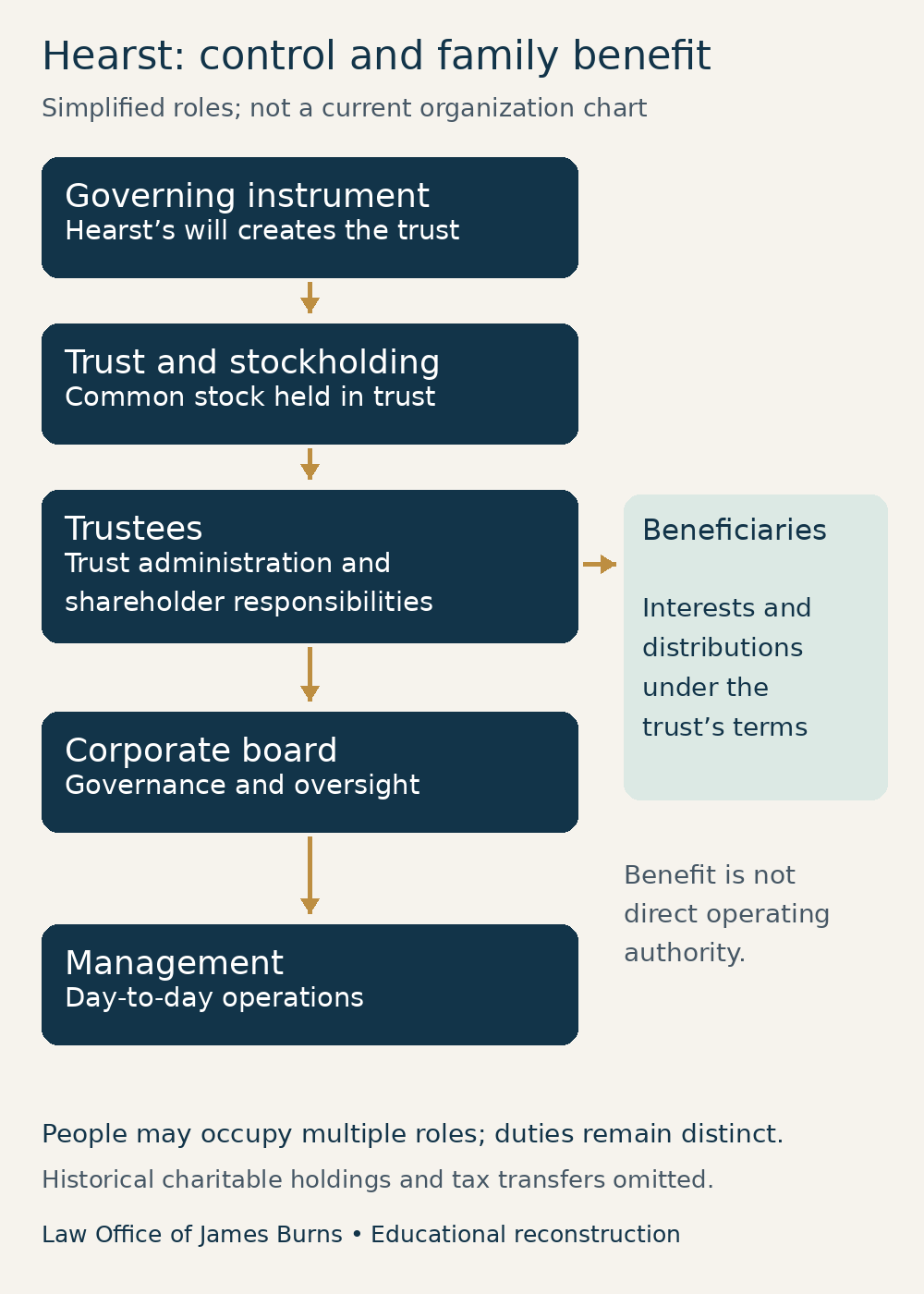
The accompanying diagram is a simplified teaching illustration. The governing instrument defines the trust; trustees administer its stockholding and exercise shareholder rights; the corporate board oversees the company; management runs operations. Beneficiaries receive the interests provided by the instrument.
One person can occupy more than one role. The responsibilities still differ. A trustee considering a distribution is not necessarily acting in the same capacity as a director considering a corporate dividend. A beneficiary's need for cash does not automatically authorize a company officer to issue it.
That distinction matters when the founder's daughter is both an employee and a beneficiary, while her brother owns an economic interest but works elsewhere. Salary, dividends and trust distributions should not become interchangeable labels for keeping the peace.
Ask the advisers to show the actual chain of authority. Who votes the shares? Who appoints directors? Who can borrow, hire management or approve a sale? Which decisions require another person's consent? A diagram should expose unanswered questions, not disguise them behind boxes.
Decide What the Company Is Supposed to Provide
A founder may want the business preserved, descendants supported and employees treated fairly. Those goals can compete when the company needs cash for equipment, debt or expansion.
Write the priorities before drafting distribution language. Is continued family ownership essential, or should a responsible sale remain possible? Does the family expect a dependable income stream, or can distributions fluctuate with business conditions? What happens when one beneficiary needs substantial support?
Consider a hypothetical founder with two adult children. One operates the business; the other relies on investments and wants regular distributions. Equal inherited value will not necessarily produce equal influence, income or risk.
The planning assignment is to identify those differences and decide which are intentional. A trust cannot make every economic interest identical. It can establish a process for balancing interests, documenting decisions and responding when circumstances change.
Give Successor Selection as Much Attention as the First Appointment
Families often spend hours choosing the first trustee and little time discussing the third. Long-term governance requires a replacement process that works after the founder's preferred people retire, become ill or disagree.
Define the needed capabilities: business judgment, financial literacy, independence, familiarity with the family and willingness to perform fiduciary work. A family name alone does not establish those qualifications. Neither does an impressive professional title.
Review appointment, removal, resignation, incapacity and deadlock provisions together. Who determines that someone cannot serve? Who fills a vacancy? Can interested beneficiaries remove an independent decision-maker? Could vacancies leave the remaining trustees unable to act?
The answer may involve family representatives, independent fiduciaries or a combination. The size of another family's trustee group is not a planning recommendation for yours. Every additional seat adds cost, coordination and another potential conflict.
Broad Discretion Needs an Accountability System
Discretion can give trustees room to address an illness, business downturn or unexpected family need. It also makes communication, records and review procedures more important.
Separate the authority to decide from the process used to reach the decision. Identify information trustees should obtain, conflicts they must address and records they should keep. Determine what reporting beneficiaries receive and who handles questions before positions harden.
A company forecast may explain why a corporate board retains cash. A trust accounting addresses a different set of questions. Neither should be substituted for the other simply because the same people participate in both.
Discuss compensation and related-party transactions in advance. If a trustee also works for the company, salary and incentives can create tensions that need a defined review process. Independence should mean something in the actual decision, not merely appear beside someone's name.
Do Not Copy a 2006 No-Contest Result Into a New Trust
California's no-contest law changed after the Hearst decision. Probate Code sections 21310–21315 establish a narrower statutory framework, with an important distinction based on when an instrument became irrevocable.
Section 21315 generally applies that framework to instruments becoming irrevocable on or after January 1, 2001. The California Supreme Court examined its application in Donkin v. Donkin (2013) 58 Cal.4th 412.
Consequently, a founder should not assume that inserting a broad no-contest clause will prevent a beneficiary from questioning administration. Counsel must analyze the instrument, proposed claim and applicable law. This is also not a reason for a beneficiary to assume a contemplated challenge is safe.
Design accountability deliberately. A clause intended to discourage destructive disputes is not a substitute for clear authority, competent fiduciaries and a workable way to address legitimate concerns.
Separate Control Planning From Estate-Tax Planning
A trust can organize control without removing the company's value from a taxable estate. Federal income-tax ownership, estate-tax inclusion, corporate voting rights and beneficiary access require separate conclusions.
For 2026, IRS guidance identifies a $15 million federal basic exclusion amount per eligible individual. Prior taxable gifts and other facts affect what remains available. A married couple does not automatically receive a usable combined amount simply because two names appear on the plan.
Portability requires an appropriate election, with filing deadlines and available relief reviewed separately. It does not transfer unused generation-skipping transfer exemption. Refresh the applicable year's figures before implementation rather than building a permanent plan around a headline amount.
Recapitalizations, lifetime gifts and transfers to trusts may deserve consideration. However, retained voting or other rights can create estate-inclusion exposure. IRC section 2036 expressly addresses retained enjoyment and voting rights in controlled corporations. Changing the certificate's name does not settle the tax result.
Liquidity Must Be Available to the Right Person
An estate may owe cash while holding a valuable interest that cannot readily be sold. The company may have cash that belongs to the company, subject to operating needs, creditors and governance restrictions. Those are different balance sheets.
Prepare a funding map showing the estate, trusts, company and any insurance owner. Identify who receives proceeds, who has authority to use them and what transaction would make funds available where an obligation arises.
IRC section 6166 may permit installment payment of qualifying estate tax attributable to a closely held business. Its requirements include a business interest exceeding 35% of the adjusted gross estate, but that threshold alone does not establish eligibility. Elections, interest, business qualification and potential acceleration matter.
Insurance, a properly reviewed redemption or other funding may also warrant analysis. None should be presented as automatic estate exclusion or a guaranteed solution. Test the proposed cash route against the governing documents and actual ownership before relying on it.

Charitable Ownership Is Not a Family-Control Shortcut
A charitable purpose requires its own objectives and restrictions. A private foundation is not a family investment account with a charitable label.
IRC section 4943 limits excess business holdings. Its subsection (g) exception is narrow: among other conditions, the foundation must hold all voting stock, acquire its ownership interests other than by purchase and meet profit-distribution and independent-operation requirements.
The independence restrictions can conflict directly with a founder's desire to keep family members managing the business. Related-party dealings also require separate review; the IRS discussion of section 4943 explains why a redemption may raise self-dealing questions.
That framework is not a modern authorization to recreate a reported historical Hearst arrangement. First decide whether genuine charitable ownership fits the founder's wishes. Then obtain coordinated charitable, corporate and tax advice.
Build the Handoff File Before Signing
The useful output is a coordinated record of decisions and implementation tasks. Put the following items in one working file:
| Planning question | Evidence needed | Decision to document |
|---|---|---|
|
Who owns each interest? |
Stock ledger, agreements, trust records |
Correct owner and authorized transfer |
|
Who controls company decisions? |
Voting terms, bylaws, appointment powers |
Voting, board and management roles |
|
Who needs money? |
Family needs and company forecasts |
Distribution process and cash priorities |
|
Who succeeds each decision-maker? |
Qualifications, consent and vacancy terms |
Replacement and deadlock process |
|
What could create tax or funding exposure? |
Valuations, prior gifts, policies and returns |
Adviser assignments and implementation steps |
Our business-owner death and succession guide addresses the immediate authority problem. This article addresses governance design; tax elections and transaction execution require their own review.
Risk Exposure Mapping identifies the conflicts. Control Architecture assigns ownership, authority, oversight and intended support. Implementation aligns the documents, company records, funding and recurring review. Signing is one step in that sequence.
Frequently Asked Questions
Did Hearst Disinherit His Descendants?
That is an inaccurate shorthand. The published opinion describes a trust for descendants holding the company's common stock. Beneficial interests and direct operating control are different things.
Should My Family Use Thirteen Trustees?
Not because another family did. Select the number, qualifications and replacement process around the assets, responsibilities, conflicts and administrative burden of your situation.
Can a No-Contest Clause Stop Every Trustee Claim?
No blanket assurance is appropriate. California's applicable statutory regime, the instrument and the proposed pleading must be examined. The older Hearst result is not a template for a new instrument.
Does a Control Trust Remove Estate Tax?
Not by its name. Ownership, prior transfers, retained rights, valuation and applicable tax provisions determine treatment. Governance and tax objectives need coordinated but separate analysis.
Can a Foundation Own the Company While My Family Runs It?
That requires careful analysis. Section 4943(g)'s narrow exception includes independence restrictions that may be inconsistent with family operation. Other foundation rules also matter.
What Should a Founder Bring to the First Review?
Bring the ownership ledger, company agreements, estate documents, prior gift returns, insurance records and a clear account of who works in the business and who depends on it financially. Identify missing records rather than guessing.
Short Summary
Hearst's trust illustrates why the right to benefit from a company should be distinguished from authority to govern it. A modern founder must coordinate successor selection, distributions, accountability, tax exposure and funding under current law rather than copy a famous historical instrument.
Decide Who Controls Before Your Family Has to Ask
If the founder could not act tomorrow, could the family identify who votes the shares, appoints management and approves cash distributions? If the answer depends on everyone informally agreeing, the succession plan needs a closer look.
Call (949) 305-8642 to arrange a billable business-succession or advanced-planning consultation with the Law Office of James Burns. Review the Situation Readiness Briefing and planning-intake information and complete the required Risk Exposure Mapping Form. Bring the company and estate records so the review begins with authority, ownership and funding—not a list of documents to buy.
This advanced review is separate from a qualifying no-charge foundational new-plan or full-restatement briefing. Law Office of James Burns, 6B Liberty, Suite 130, Aliso Viejo, CA 92656.
Sources and Review
Reviewed November 1, 2026 using the linked published opinions, federal statutory text and IRS guidance. The California chaptered no-contest legislation and Donkin decision explain the historical-law distinction; current official California code access remained unavailable during the publication review. Material legal developments and implementation requirements require confirmation for the actual engagement.
Disclaimer
Attorney advertising. General educational information, not individualized legal, tax or financial advice. Historical facts and legal outcomes depend on their records and applicable law. The firm has no affiliation with the Hearst family, Hearst Family Trust or Hearst Corporation. No tax saving, protection or result is guaranteed. Reading this article or contacting the firm does not establish an attorney-client relationship.
IP Disclosure
Original commentary and organization © 2026 Law Office of James Burns. The hero and supporting planning image are AI-generated conceptual illustrations. The hero is not a photograph of Hearst, his family or an actual Hearst meeting. The diagram is a simplified educational reconstruction, not a reproduction of the trust instrument or a current corporate organization chart. No ownership is claimed in statutes or opinions; third-party names identify the subjects discussed and imply no endorsement.

Comments
There are no comments for this post. Be the first and Add your Comment below.
Leave a Comment