

FBAR compliance is defined as the legal obligation for U.S. persons to file FinCEN Form 114 annually when aggregate foreign financial account balances exceed $10,000 at any point during the calendar year. This fbar compliance estate planning guide addresses the full scope of that obligation for high-net-worth families whose wealth spans multiple countries, trust structures, and generational transfers. Willful violations carry penalties up to the greater of $165,353 or 50% of the account balance per year. The stakes are not theoretical. A single missed filing can trigger a penalty that exceeds the account's value.
Who must file an FBAR in estate planning contexts?
U.S. persons with FBAR obligations include individuals, corporations, partnerships, limited liability companies, trusts, and estates. The definition is deliberately broad. If your estate holds a foreign brokerage account or your trust has signature authority over a foreign bank account, the filing obligation applies.
Two distinct triggers create the filing requirement:
- Financial interest: You own or control the account directly, or a foreign entity you control holds it.
- Signature authority: You can direct the account's transactions, even without owning a dollar of it. This is a common compliance trap for business owners and trustees who manage foreign accounts on behalf of others.
For estate planning purposes, the most frequently overlooked scenarios include:
- Trust accounts holding foreign securities or deposits
- Inherited foreign accounts received mid-year from a decedent
- Foreign real estate held through a foreign entity with a bank account
- Foreign pension accounts with a cash value component
The filing deadline is April 15, with an automatic extension to October 15. No separate extension request is required. The FBAR is filed electronically through the BSA E-Filing System and is entirely separate from IRS Form 1040 or any estate tax return.
Pro Tip: If you serve as trustee or executor for an estate with foreign accounts, confirm whether the estate itself has an independent FBAR obligation. Trustees often assume the individual beneficiary's filing covers the entity. It does not.
How do you gather foreign account data for filing?
Accurate FBAR filing depends on complete, well-organized account data. Incomplete records are the primary reason filers underreport or miss accounts entirely.
For each foreign financial account, you need to document the following:
- Institution name and address (the foreign bank or brokerage)
- Account number as it appears on official statements
- Account type (checking, savings, securities, pension, or other)
- Maximum account value during the calendar year, not the year-end balance
- Country where the account is maintained
Currency conversion is required for all non-U.S. dollar accounts. Use the U.S. Treasury's official exchange rate published for December 31 of the reporting year. If no Treasury rate exists for a specific currency, use another publicly available exchange rate and document your source.
The IRS requires you to retain FBAR records for five years from the filing due date. That means account statements, conversion calculations, and supporting documentation must be preserved through at least 2031 for the 2025 tax year.
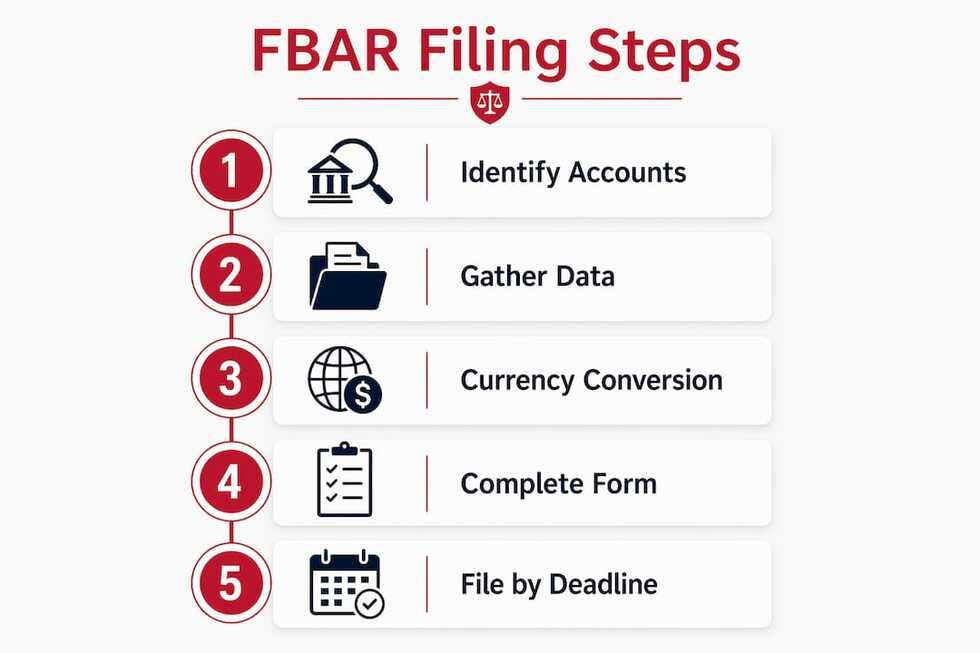
Pro Tip: Create a dedicated FBAR folder, either physical or digital, for each tax year. Store account statements, the Treasury exchange rate table, and a completed data summary sheet together. When your attorney or CPA requests information, you can deliver it in minutes rather than weeks.
Families with accounts across multiple jurisdictions benefit from a centralized tracking spreadsheet updated quarterly. Tools like Microsoft Excel or a secure cloud-based document management system work well for this purpose.
How does FBAR reporting integrate with trusts and wills?
Integrating FBAR obligations into a broader estate plan is where most high-net-worth families encounter serious structural problems. The core issue is jurisdictional mismatch. U.S. trusts are not universally recognized abroad, and local jurisdictions may treat them as transparent entities, ignore them entirely, or classify them differently for tax purposes. That misclassification can create dual-taxation exposure and FBAR non-compliance simultaneously.

Common estate planning mistakes that trigger FBAR problems
Mismatched beneficiary designations and cross-jurisdictional asset interactions are the two most frequent structural errors. A beneficiary designation that names a U.S. trust as the recipient of a foreign account may not be honored by the foreign institution. The account then passes outside the trust, creating an unplanned FBAR obligation for the individual beneficiary with no coordinated reporting structure in place.
A single will rarely suffices for families with global assets. Multiple jurisdiction-specific wills and specialized trust structures are necessary to address FBAR and tax complexities across borders. A Qualified Domestic Trust (QDOT) is one specialized instrument designed for non-citizen surviving spouses, allowing the estate tax marital deduction while keeping assets subject to U.S. tax jurisdiction. QDOTs carry their own FBAR considerations because the trustee holds financial interest in the trust's assets.
Estate instruments and FBAR responsibilities
| Estate Instrument | FBAR Filing Responsibility |
|---|---|
|
Revocable Living Trust |
Grantor files FBAR; trust assets treated as grantor's own |
|
Irrevocable Foreign Trust |
Trustee and potentially U.S. beneficiaries must file |
|
QDOT (Qualified Domestic Trust) |
U.S. trustee files FBAR for foreign accounts held in trust |
|
Estate During Administration |
Executor files FBAR for foreign accounts in the estate |
|
Individual Inherited Account |
Beneficiary files FBAR once account transfers to their name |
Coordinating FBAR filing among executors, trustees, and beneficiaries requires a written protocol established before death, not after. Each party must know which accounts they are responsible for reporting and for which tax year the obligation begins.
How do you file FBAR correctly and fix missed filings?
Correct FBAR filing follows a defined process. Errors in this process, particularly filing through the wrong channel or omitting required certifications, can convert a correctable oversight into a willful violation.
- Access the BSA E-Filing System at bsaefiling.fincen.treas.gov. FBAR is filed electronically through FinCEN, not through the IRS. Paper filings are not accepted.
- Complete FinCEN Form 114 with all required account data. Report the maximum value for each account, not the closing balance.
- Submit by April 15. The automatic extension to October 15 applies without any action required on your part.
- Retain confirmation of submission with the BSA tracking number for your records.
If you have missed prior year filings, the Streamlined Filing Compliance Procedures are the primary remedial path for non-willful filers. Streamlined procedures require filing 3 years of tax returns and 6 years of FBARs to potentially waive all late-filing penalties. This is a significant benefit. Without it, each missed year per account carries a non-willful penalty of up to $16,536.
Qualifying for Streamlined Filing Compliance Procedures requires more than submitting back returns and FBARs. You must also file Form 14653, a signed certification of non-willful conduct. Submitting amended returns and FBARs without this certification disqualifies you from penalty relief entirely.
The most common filing mistakes include reporting year-end balances instead of maximum values, omitting accounts held through foreign entities, and failing to report accounts where you hold only signature authority. Each of these errors can trigger an audit or penalty assessment.
Pro Tip: If you are using Streamlined Filing Compliance Procedures, do not attempt the process without a qualified tax attorney or international CPA. The certification of non-willful conduct is a legal statement. An error in that certification can expose you to greater liability than the original missed filing.
Key takeaways
Effective FBAR compliance in estate planning requires early coordination, precise documentation, and the right legal structure for every jurisdiction where your family holds assets.
| Point | Details |
|---|---|
|
Filing threshold and deadline |
File FinCEN Form 114 if aggregate foreign accounts exceed $10,000; deadline is April 15 with auto-extension to October 15. |
|
Entities with FBAR obligations |
Trusts, estates, and executors all carry independent FBAR filing duties, not just individual account holders. |
|
Jurisdiction-specific estate structure |
A single will is insufficient for global estates; use QDOTs, foreign wills, and coordinated trust structures. |
|
Remedial filing path |
Streamlined Filing Compliance Procedures can waive penalties for non-willful filers who submit 6 years of FBARs and Form 14653. |
|
Recordkeeping requirement |
Retain all FBAR-related account documentation for five years from the filing due date. |
What i've learned about FBAR after years of cross-border estate work
The families who get into serious trouble with FBAR are rarely careless. They are often highly organized, financially sophisticated people who assumed their existing estate plan covered everything. It does not. FBAR sits outside the estate planning framework most attorneys build. It is a Treasury obligation, not an IRS one, and that distinction trips up even experienced advisors.
What I have seen repeatedly is this: a family spends years building a well-structured revocable trust, a pour-over will, and a solid asset protection layer. Then a foreign account inherited from a parent, or a foreign brokerage account opened during an international business deal, falls outside the reporting architecture entirely. No one flags it. The FBAR goes unfiled for three or four years. By the time it surfaces during an audit or estate administration, the penalty exposure is larger than the account itself.
The other pattern I see is over-reliance on a single advisor. FBAR compliance for estates requires a team: an international tax attorney, a CPA with cross-border experience, and an estate planning attorney who understands how foreign jurisdictions treat U.S. trust instruments. No single professional covers all three competencies at the depth these situations demand.
My strong view is that FBAR compliance should be mapped during the initial estate planning engagement, not treated as an annual tax task. Every foreign account, every foreign entity, and every signature authority relationship should appear on an exposure map before the estate plan is drafted. That map becomes the foundation for both the legal structure and the annual compliance calendar. Families who build this architecture early avoid the remedial procedures entirely. Those who wait often pay for it.
— James

How Jamesburnslaw protects your estate across borders
Jamesburnslaw applies the FortressWall Methodology™ to estates ranging from $5M to over $100M, with a specific focus on families holding foreign financial accounts, international business interests, and cross-border trust structures. The firm's estate planning services address FBAR exposure mapping, jurisdiction-specific trust design, and coordinated compliance protocols that align your annual filing obligations with your long-term wealth protection architecture. If your estate includes foreign accounts, inherited assets from abroad, or trust structures that span multiple countries, the time to build a coordinated compliance strategy is before a penalty notice arrives. Contact Jamesburnslaw to schedule a consultation and map your full FBAR exposure today.
FAQ
What is the FBAR filing threshold for estates?
An estate must file FinCEN Form 114 if it holds financial interest or signature authority over foreign financial accounts with an aggregate value exceeding $10,000 at any point during the calendar year. The threshold applies to the combined total across all foreign accounts, not each account individually.
Does a u.s. trust have to file an FBAR?
Yes. Trusts are included in the IRS definition of U.S. persons and carry independent FBAR filing obligations when they hold financial interest or signature authority over qualifying foreign accounts. The trustee is responsible for filing on behalf of the trust.
What happens if you miss an FBAR filing?
Non-willful violations carry penalties up to $16,536 per account per year. Willful violations can cost the greater of $165,353 or 50% of the account balance, plus potential criminal penalties. The Streamlined Filing Compliance Procedures offer a penalty waiver path for non-willful filers who submit back filings and Form 14653.
Is FBAR the same as reporting on a tax return?
No. FBAR is filed separately through the BSA E-Filing System and processed by the Financial Crimes Enforcement Network, not the IRS. Filing your tax return does not satisfy the FBAR obligation, and amending a tax return does not automatically amend a prior FBAR.
Do inherited foreign accounts trigger FBAR obligations?
Yes. Once a foreign account transfers to a beneficiary's name, that individual holds financial interest and must file an FBAR if the aggregate threshold is met. The obligation begins in the tax year the account transfers, not the year the original owner died.

Comments
There are no comments for this post. Be the first and Add your Comment below.
Leave a Comment