
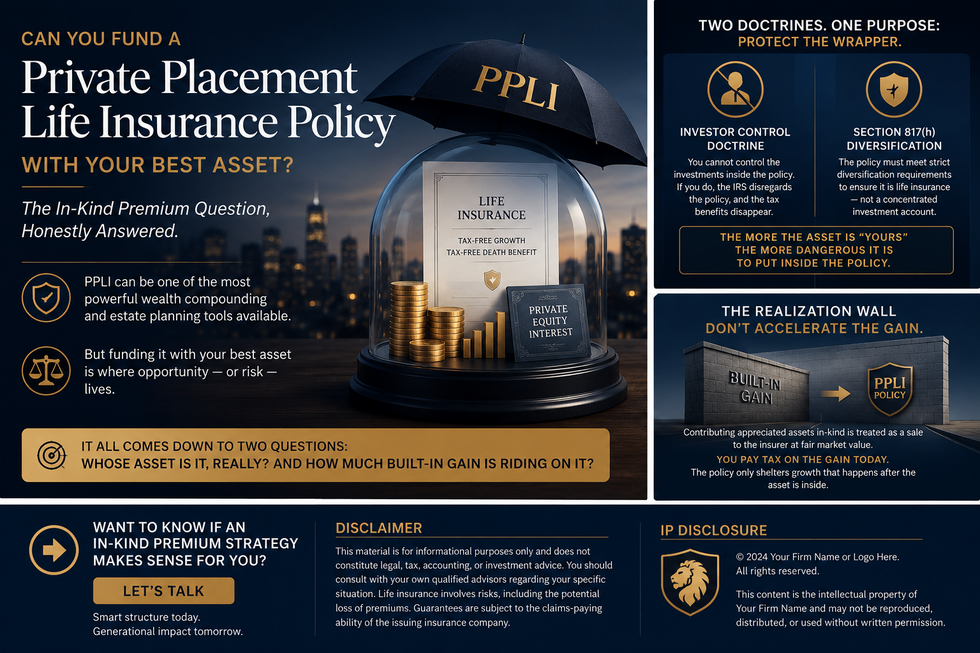
Every founder, fund principal, and early investor who learns about Private Placement Life Insurance (PPLI) eventually arrives at the same question, and they almost always arrive at it the same way. They have an asset they love — a slug of pre-IPO shares, a carried interest, a stake in a private company they helped build — and they have heard that PPLI is a "tax-free wrapper." So they ask the natural question: Can I just put that asset into the policy?
It is the right instinct and the wrong mechanics, and the gap between the two is where a great deal of money is made or lost. The honest answer is that you can fund a PPLI policy with property instead of cash — there is no law that forbids it — but whether doing so is brilliant or catastrophic depends almost entirely on two things most people never think to ask: whose asset is it, really, and how much built-in gain is riding on it. This article is about those two questions, because they are the questions that decide everything.
The dream, and the doctrine that guards it
The appeal of PPLI is real and worth stating plainly. Inside a properly structured policy, investment growth compounds without current income tax, and if the policy is held until the insured's death, the death benefit — including all of that accumulated growth — passes income-tax-free under Section 101 of the Internal Revenue Code. Pair the policy with an irrevocable trust and the same value can pass outside the taxable estate as well. For an asset expected to multiply many times over, that is a genuinely powerful result. It is not a loophole; it is the deliberate tax treatment Congress gives to life insurance, applied to sophisticated investments.
But the law guards that treatment with two doctrines that exist precisely to stop the wrapper from becoming a naked tax-avoidance device: the investor control doctrine and the diversification requirement of Section 817(h). Understand these two, and you understand why your favorite asset is usually the worst candidate for an in-kind contribution.
"Your own controlled PE" — what that actually means
When we tell clients that the danger lives in funding the policy with their own controlled private equity, the phrase sounds abstract. It is not. Let me make it concrete, because the IRS and the Tax Court have made it concrete.
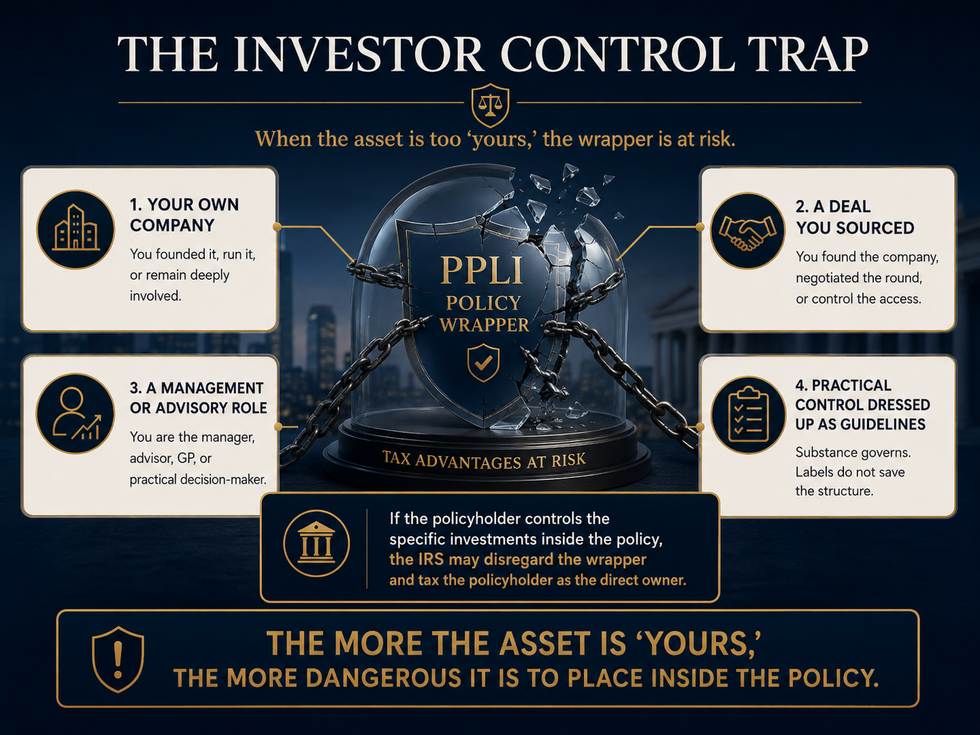
The investor control doctrine says, in essence, that the policyholder cannot be the real investment decision-maker over the assets inside the policy. If the policyholder picks the specific investments, directs the trades, or holds assets that are only available to them because of who they are, the IRS disregards the insurance wrapper entirely and taxes the policyholder as the direct owner of the assets. The leading case, Webber v. Commissioner (2015), involved exactly this: a venture investor who used his PPLI policy to invest in startups he sourced, negotiated, and effectively directed. The Tax Court treated him as the owner of the investments, and the tax-free wrapper evaporated.
So when we say "your own controlled PE," here is the factual concentration of what we mean — these are the fact patterns that trigger the doctrine:
- Your own company. You founded it, you sit on the board, you own a meaningful equity stake, and you propose to contribute those shares to a policy that will continue to hold them while you keep running the company. You control the asset before, during, and after. This is the clearest possible violation.
- A deal you sourced and negotiated. You found the private company, structured the round, set the terms, and have a seat or information rights. The "investment" inside the policy is an extension of your own deal-making, not an independent fund's decision.
- An interest available to you because of who you are. The opportunity isn't on any open market; it exists for you because of your relationships, your role, or your access. Revenue Ruling 2003-92 keys on exactly this — assets inside the policy generally must be available only through insurance-dedicated vehicles and not separately purchasable by, or tied to, the policyholder.
- A management or advisory role over the very assets. You are the manager, the general partner, the advisor, or the person whose judgment drives what the asset does. Even if a nominal third party signs off, your control is the substance.
- Practical command dressed up as "guidelines." You don't formally direct trades, but everyone understands that the manager invests where you point. Substance governs; the label does not save it.
The contrast — the version that survives — is an interest acquired and managed by a genuinely independent manager inside an insurance-dedicated fund, available only through insurance, where you set broad objectives but make none of the specific decisions and have no separate relationship to the underlying assets. The line is not about sophistication; it is about control. The more the asset is "yours" in the deepest sense, the more dangerous it is to put inside the policy.
The realization wall: why appreciated assets trigger gain at the door
Set the control problem aside for a moment and assume you have a clean, independently managed asset. There is still a second wall, and this is the one your instinct about "transfer for value" is circling.
Paying a premium with property rather than cash is, for tax purposes, a sale of that property to the insurer at fair market value. It is a realization event under Section 1001. If the asset has a low basis and a high current value — the classic founder-stock situation, held for years and worth many multiples of cost — contributing it in-kind recognizes that entire built-in gain immediately. You don't escape the capital gains tax by feeding the asset to the policy; you accelerate it. The wrapper only shelters growth that happens after the asset is inside.
(A clarifying note on terminology, because the two get conflated: the "transfer-for-value" rule of Section 101(a)(2) is a different trap. It can strip the income-tax-free character from the death benefit when an existing policy is sold or transferred for consideration — a live risk once trusts start buying or shifting policies among themselves. It is not the doctrine that taxes an in-kind premium; that is plain realization. Both matter, but they bite at different moments.)
This is why the math changes completely depending on embedded gain. A highly appreciated asset hits the realization wall hard. An asset appraised low today — early-stage, recently valued, genuinely depressed, with basis close to that low value — sails through, because there is little or no gain to recognize on the way in. That single distinction explains why the strategy that actually works is the "pennies today, fortune tomorrow" asset, contributed before the appreciation, so that the run-up happens inside the wrapper and exits tax-free at death.
"What if a trust contributes the premium?" — and other theories that get floated
Smart clients immediately look for a way around the realization wall. Here are the theories we hear most often, and an honest verdict on each.
Route it through a grantor trust. The appeal is real: transactions between you and your own grantor trust are disregarded for income tax (Revenue Ruling 85-13), so you can move appreciated assets to the trust without recognizing gain. But the trust then has to fund the policy, and the trust's onward transfer of that appreciated asset to the insurer is a transfer to a real third party. Gain is realized on that step — and because it's a grantor trust, the gain is taxed right back to you. The trust is genuinely valuable for the estate-tax and transfer-for-value dimensions, but it does not dissolve the entry gain. The insurer is not your alter ego.
Borrow against the asset and fund with cash. This works to avoid realization — borrowing isn't income — but it defeats the purpose. The appreciated asset stays outside the policy; only the loan proceeds go in. You've funded a policy, but not with the asset whose growth you wanted to shelter.
Have the insurance-dedicated fund buy the asset. Clean on realization if the fund acquires the position with cash on the open market through an independent manager — but you cannot sell your own appreciated stake to the fund without both recognizing gain and walking straight into the investor-control problem. This path captures the economics only for assets that are genuinely independent of you.
Use a Section 1035 exchange. Section 1035 allows tax-free swaps of one insurance contract for another. It does not allow you to swap an investment asset into a policy. Not available here.
Contribute through a partnership under Section 721. Contributing appreciated property to a partnership can be tax-free — but getting the partnership interest into the policy is itself a realization event, and the "investment company" rules of Section 721(b) can trigger gain on the contribution in the first place. No free lunch.
The pattern across all of these is the same: there is no clean way to move a highly appreciated asset into a PPLI policy without recognizing the gain. The realization is caused by handing property to the carrier in exchange for the contract, and no trust, exchange, or entity reliably erases that. This is not a drafting failure; it is the architecture of the Code.
So which asset actually wins?
The asset that delivers the "major future tax win" without a painful entry toll is the one appraised at a low, defensible value today, with real upside ahead. Early private equity, a freshly issued stake, a position carrying legitimate marketability and minority discounts — contributed in-kind while the gain is small, so that the eventual multiplication compounds inside the wrapper and leaves income-tax-free at death, ideally inside an irrevocable trust so it also escapes estate tax.
Three cautions ride along with that:
The appraisal does all the work, and cuts both ways. A defensibly low valuation is the engine; an aggressive lowball is a liability. If the IRS later revalues the asset upward, you have quietly overfunded the policy — creating modified-endowment and Section 7702 problems, possible gift-tax exposure if a trust is involved, and valuation penalties. The appraisal must be independent, contemporaneous, and able to survive a fight, and illiquid assets must be revalued on an ongoing basis.
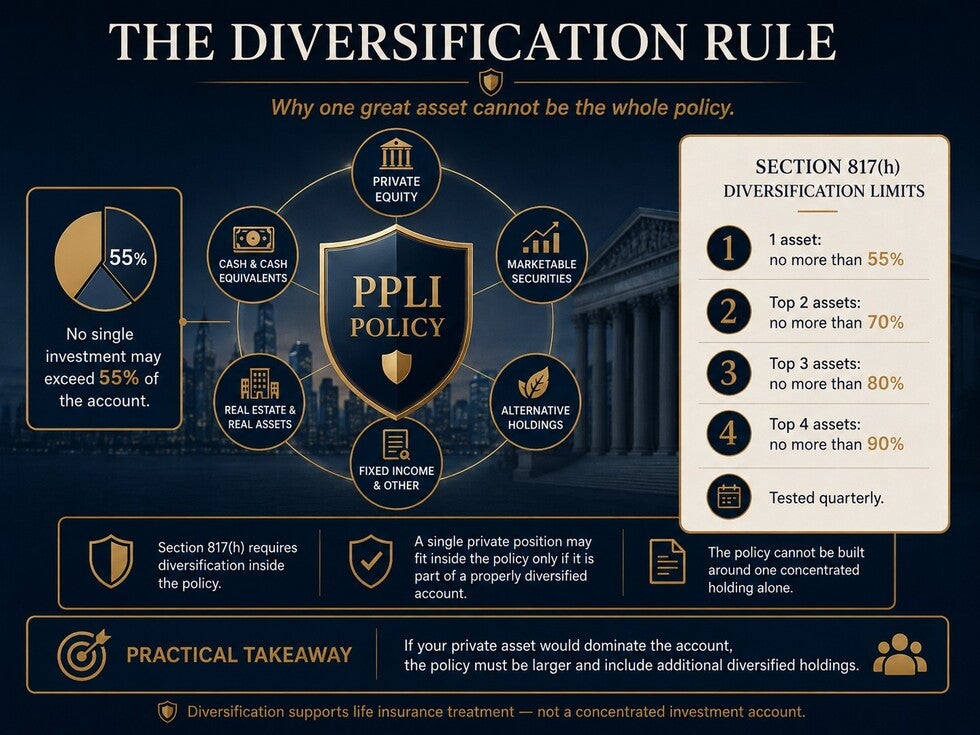
The 55% diversification rule means your one asset cannot be the whole policy. Section 817(h) caps any single investment at 55% of the account (with further limits at 70%, 80%, and 90% for the top two, three, and four holdings), tested quarterly. A single private position is permissible only alongside a diversified balance of other holdings. "It fits within 55%" is achievable, but it forces the policy to be larger and partly diversified — never a one-asset wrapper.
And control remains the gate. All of the above assumes an asset that is genuinely independent of you. Bring your own controlled deal into it and the cleanest valuation and the tidiest diversification will not save you.
The regulatory weather
PPLI is under a brighter spotlight than ever. The Senate Finance Committee's 2024 report cast it as a tax shelter for the ultra-wealthy, and the subsequent legislative proposal would have stripped the tax advantages — and pointedly treated any policy funded with in-kind premium as a disfavored "covered contract." Those curbs were left out of the legislation that ultimately passed, so current law is unchanged. But the direction of regulatory attention is unmistakable, and in-kind funding sits squarely in its sights. Structures built today should be built to withstand scrutiny that is clearly coming.
How we think about it
Our discipline on matters like this is simple: map the exposure before anything moves. Before a single asset is contributed, we want a clear picture of the asset's basis and defensible value, whether it is genuinely independent of the client's control, how it fits the diversification math, who the insured and the owner will be, and how the policy will ultimately be exited. We coordinate with the client's CPA, tax counsel, and PPLI advisor so the structure survives legal, tax, valuation, and reporting scrutiny — not just the marketing brochure. The goal is lawful structure with documented intent and control architecture that holds up, never secrecy or shortcuts.
PPLI can be one of the most powerful planning tools available to a high-net-worth family. It is also one of the easiest to ruin by funding it with the wrong asset, in the wrong way, at the wrong moment. The difference is entirely in the analysis done before the money moves.
Frequently Asked Questions
Can you fund a PPLI policy with assets instead of cash? Yes. No U.S. statute prohibits a foreign carrier in Bermuda or Barbados from accepting property as premium, or a U.S. citizen from owning foreign life insurance. The constraints are downstream — gain recognition at funding, the investor control doctrine, and the Section 817(h) diversification rules decide whether the contribution is efficient or self-defeating.
Does contributing an appreciated asset to PPLI trigger capital gains tax? Yes. Paying premium with property is a sale to the carrier at fair market value under Section 1001, so built-in gain is recognized at funding. The wrapper shelters only the appreciation that occurs after the asset is inside.
What is the investor control doctrine? If the policyholder controls the specific investment of the assets in the policy, the IRS disregards the wrapper and taxes the policyholder as direct owner. Webber v. Commissioner (2015) applied this to an investor who used his PPLI to fund startups he sourced and directed.
What counts as the client's own controlled private equity? Equity in your own company that you still control; a deal you sourced and direct; an interest available to you only because of who you are; a management or advisory role over the assets; or practical command disguised as "investment guidelines." Each triggers the doctrine.
Can a grantor trust contribute the premium to avoid gain? No. Transfers between you and your grantor trust are disregarded (Rev. Rul. 85-13), but the trust's onward transfer to the carrier is a sale to a third party — gain is realized and taxed back to the grantor. The trust helps with estate and transfer-for-value issues, not the entry gain.
What assets work best for in-kind PPLI funding? Low-embedded-gain assets with significant upside — early-stage private equity defensibly appraised low today — contributed before appreciation, independently managed, diversified to 55% or less, and held to death so the growth exits income-tax-free under Section 101.
What is the 55% diversification rule? Under Section 817(h), no single investment may exceed 55% of the account (with 70%, 80%, and 90% limits for the top two, three, and four holdings), tested quarterly. A single private position cannot be the entire policy.
What's the difference between realization and the transfer-for-value rule? Section 1001 realization taxes the gain when you pay premium with appreciated property. The Section 101(a)(2) transfer-for-value rule is separate — it can strip the income-tax-free character of the death benefit when an existing policy is transferred for consideration, which matters when trusts hold or shift policies.
Resources & Authority
The analysis above rests on the following primary authorities. Readers and advisors are encouraged to consult the source material directly.
- IRC § 1001 — Determination and recognition of gain or loss on disposition. law.cornell.edu/uscode/text/26/1001
- IRC § 817(h) — Diversification requirements for variable contracts. law.cornell.edu/uscode/text/26/817
- Treas. Reg. § 1.817-5 — Diversification tests (55/70/80/90) and look-through rules. law.cornell.edu/cfr/text/26/1.817-5
- IRC § 7702 — Definition of a life insurance contract. law.cornell.edu/uscode/text/26/7702
- IRC § 101 — Income-tax-free death benefit and the § 101(a)(2) transfer-for-value rule. law.cornell.edu/uscode/text/26/101
- IRC § 4371 — Federal excise tax on premiums paid to foreign insurers. law.cornell.edu/uscode/text/26/4371
- IRC § 721(b) — Gain on contribution to an investment company. law.cornell.edu/uscode/text/26/721
- Webber v. Commissioner, 144 T.C. 324 (2015) — investor control doctrine applied to PPLI. leagle.com
- Rev. Rul. 2003-91 — investor-control safe harbor. irs.gov (rr-03-91.pdf)
- Rev. Rul. 2003-92 — single publicly available fund causes owner treatment; in I.R.B. 2003-33. irs.gov (irb03-33.pdf)
- Rev. Rul. 85-13 — grantor/grantor-trust transactions disregarded for income tax.
- Rev. Rul. 2007-13 — transfer-for-value exception for transfers to a grantor trust treated as owned by the insured.
- U.S. Senate Committee on Finance, Private Placement Life Insurance: A Tax Shelter for the Ultra-Wealthy (2024). finance.senate.gov (ppli_report_final.pdf)
Call to Action
Before contributing a private asset to a PPLI policy, map the tax, control, valuation, and diversification risks first.
A Private Placement Life Insurance strategy can be powerful, but the wrong asset — especially a controlled or highly appreciated asset — can create immediate tax exposure or compromise the policy's intended benefits. At James Burns Law, we help high-net-worth families, founders, investors, and business owners evaluate whether PPLI fits within a broader estate, tax, asset protection, and wealth-transfer architecture.
Schedule a confidential planning consultation to determine whether an in-kind premium strategy is viable, defensible, and properly structured before anything moves.
Disclaimer
This material is provided for informational and educational purposes only and does not constitute legal, tax, insurance, investment, financial, or accounting advice. Reading this article or contacting the Law Office of James Burns does not create an attorney-client relationship. Private Placement Life Insurance, in-kind premium funding, irrevocable trust planning, valuation, investor control, diversification compliance, estate tax planning, and related tax issues are highly fact-specific and must be reviewed with qualified legal, tax, insurance, and investment professionals before implementation.
Tax laws, insurance rules, IRS guidance, valuation standards, and regulatory enforcement priorities may change. No representation is made that any particular strategy will produce a specific tax, investment, creditor-protection, estate-planning, or insurance result. Clients should not transfer, contribute, sell, pledge, or reposition any asset without first obtaining written advice from their own qualified advisors based on their specific facts and circumstances.
Intellectual Property Disclosure
This article, including its analysis, structure, terminology, explanations, examples, branding concepts, and related educational materials, is the intellectual property of the Law Office of James Burns unless otherwise stated. All rights are reserved.
No portion of this content may be copied, reproduced, republished, distributed, modified, scraped, used to train artificial intelligence systems, incorporated into derivative works, or used for commercial purposes without prior written permission. Limited excerpts may be quoted for commentary or educational reference only with proper attribution to the Law Office of James Burns and a link back to the original source.
The concepts discussed may involve proprietary planning frameworks, legal analysis, and professional methodology developed for use in advanced estate, tax, asset protection, and high-net-worth planning matters.
This article is general information about tax and estate-planning concepts and is not legal or tax advice. PPLI outcomes depend on specific facts, current law, valuation, and execution; no specific tax result is guaranteed. Anyone considering an in-kind contribution to a life insurance policy should obtain individualized advice and coordinate with qualified tax counsel and a CPA before acting.

Comments
There are no comments for this post. Be the first and Add your Comment below.
Leave a Comment