
I get a version of this question in almost every serious private placement life insurance conversation, and it usually comes from an advisor who's already done some homework. It goes like this: "My client has a low-basis building — or a big crypto position — sitting in an LLC. We can get a valuation discount on the LLC interest. Can we contribute that discounted interest into the PPLI policy in kind and skip the gain on the underlying asset?"
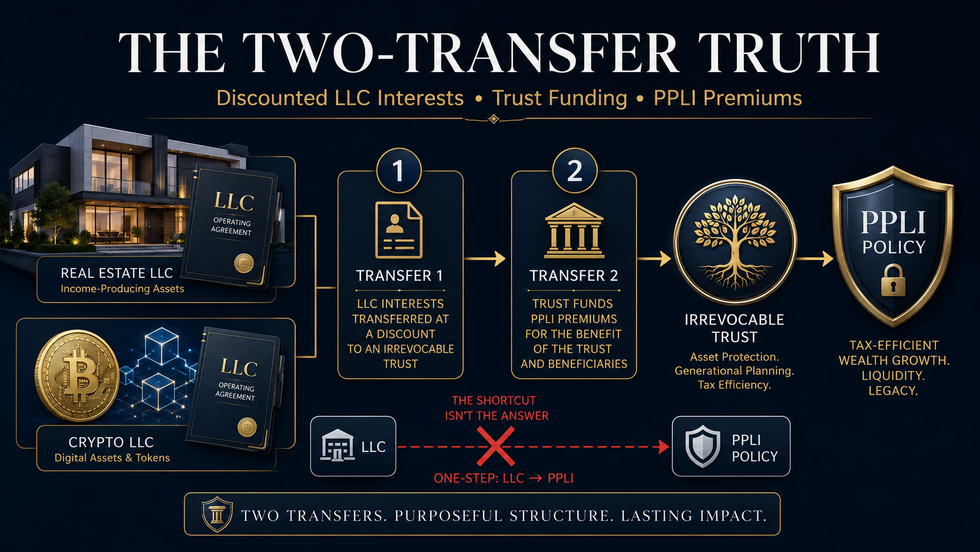
It's a smart question, and the instinct behind it is half right. The discount is real. The tax-free piece is partly real. But the two halves don't snap together the way people hope, and once you see why, the whole strategy — what it can genuinely do and where it hits a wall — comes into focus. The trick is something most people skip right past: putting an asset into a PPLI policy through an LLC isn't one move. It's two. And the two moves live under completely different tax rules.
Why it sounds perfect
I understand the appeal. The assets families most want to shelter — appreciated real estate, a concentrated crypto stack — are exactly the ones with low basis, big embedded gain, and (everyone hopes) a lot of runway left. PPLI offers tax-deferred growth and an income-tax-free death benefit. So the picture forms quickly: wrap the asset in an LLC, take a discount on the membership interest, contribute that discounted interest as premium, and it feels like you've slipped a highly appreciated asset into a tax-free environment at a marked-down value with no bill on the way in.
Every piece of that is plausible on its own. The problem is that they're describing two different transfers, and only one of them is actually tax-free.
The two-transfer truth
Here's what really happens when real estate or crypto goes into a policy through an LLC.
Move one — the asset into the LLC. Contributing property to a multi-member LLC taxed as a partnership is generally tax-free under Section 721. No gain. The LLC takes your basis (Section 723), and your outside basis in the new membership interest carries over too (Section 722). Clean.
Move two — the LLC interest into the policy. This is the one that funds the insurance, and it's a different animal. Handing the membership interest to the carrier in exchange for the policy is a sale at fair market value under Section 1001. A realization event. You recognize gain to the extent the discounted value of that interest exceeds your outside basis.
Section 721 covers move one. It does nothing for move two. All it did was change what you eventually sell — from "a building" to "a partnership interest" — and park the gain until that interest moves. The second it moves to the carrier, the gain wakes up. People hear "Section 721 is tax-free" and assume the tax-free quality rides along all the way into the policy. It doesn't. The realization is triggered by giving value to the carrier for the contract, and no amount of LLC wrapping changes that fact.
Yes, you can discount — and the discount actually helps you
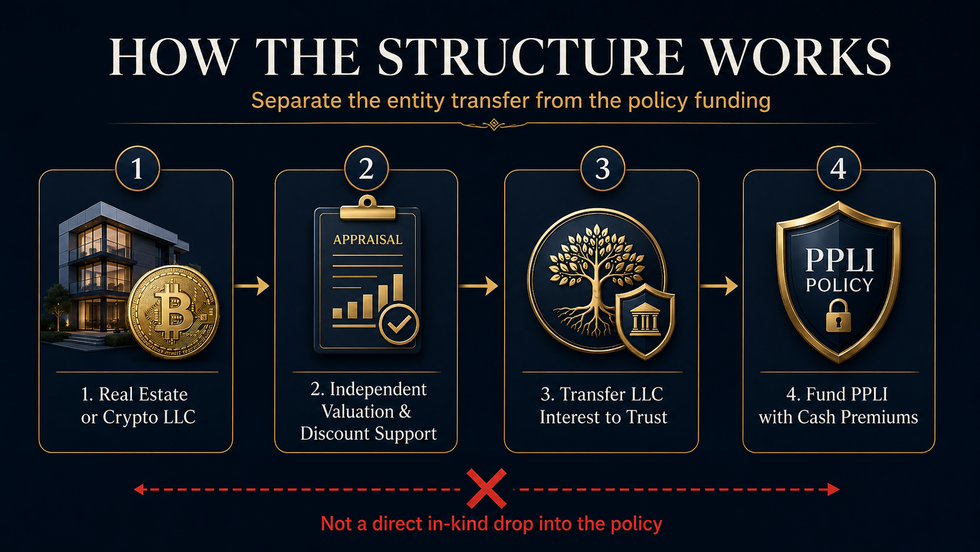
Let me give the strategy its due, because the discount is legitimate and worth using. You're not contributing the building or the coins. You're contributing a non-managing, minority membership interest in the LLC that holds them. That interest is illiquid and lacks control, so a qualified appraiser can apply discounts for lack of marketability and lack of control — often 20% to 40% when the operating agreement is drafted to support it, with real transfer restrictions and manager-managed governance.
And here's the part that cuts in your favor, which advisors sometimes miss: the discount lowers the gain you recognize. Gain on move two equals discounted fair market value minus outside basis, so a lower appraised value means a smaller amount realized and a smaller tax bill. It also trims the premium credited to the policy, so it's not free leverage — but as a way to soften the entry gain, it genuinely works.
What it can't do is erase the gain. Discount a $10 million economic interest down to $7 million and you've still got a large gain sitting over a near-zero basis. The discount narrows the toll; it doesn't remove the tollbooth. The only way move two throws off little or no gain is when basis already sits near the discounted value — recently acquired property, an asset that got a step-up at a death, or a position that simply hasn't run yet. Which is the same truth that governs all in-kind PPLI funding, and the one I keep coming back to with clients: the asset that goes in cleanly is the one that hasn't appreciated much so far. Get it in early, let it compound inside the wrapper, and let it leave income-tax-free at death.
Investor control is the real gate — not the arithmetic
Even when the gain math works, the strategy lives or dies on a doctrine that has nothing to do with valuation: investor control. The IRS won't respect the wrapper if the policyholder is the one really calling the investment shots inside it. In Webber v. Commissioner (2015), an investor who used his PPLI to fund startups he'd personally sourced and steered got treated as the owner of those investments, and the tax-free treatment fell apart.
This is exactly where a client's own real estate LLC is most dangerous, and I'm blunt about it when it comes up. If the client formed the entity, hand-picked the building, and runs it day to day, then contributes it to a policy that keeps holding it while the client keeps managing it — the client controls the very asset inside the wrapper, before, during, and after. That's the textbook violation. To survive, the client has to genuinely let go: an independent manager over the LLC, no ongoing investment direction from the client or the trust. With a building someone has personally owned and managed for years, that's hard, and it's the reason a lot of these structures fail in substance even when they look tidy on paper.
It's also where the wealth manager's role gets misunderstood. Advisors sometimes ask whether having the wealth manager buy the interest into the policy — rather than the client contributing it — sidesteps the gain. It doesn't. Gain follows the appreciated asset and the person who owns the built-in appreciation, not whoever pushes the button. If the policy buys the client's LLC interest for cash, the client is still selling an appreciated asset to the carrier. Same realization, same gain. What the wealth manager genuinely helps with is control — an independent manager directing the investment is part of how you cure the investor-control problem. It's a governance fix, not a tax fix.
There's exactly one way the wealth manager's involvement avoids the entry gain outright: fund the policy with cash, then have the independent manager buy real estate fresh — a new property, a real estate fund, REIT interests — at fair market value. Nothing appreciated gets disposed of, so there's no gain, and buying through an independent manager cures control at the same time. The trade-off is that you're building new real estate exposure inside the wrapper, not sheltering the specific low-basis building the client already owns. For a lot of families, that trade is worth it. For others, the existing building is the whole point. That's a conversation, not a formula.
Diversification and the operating-asset problem
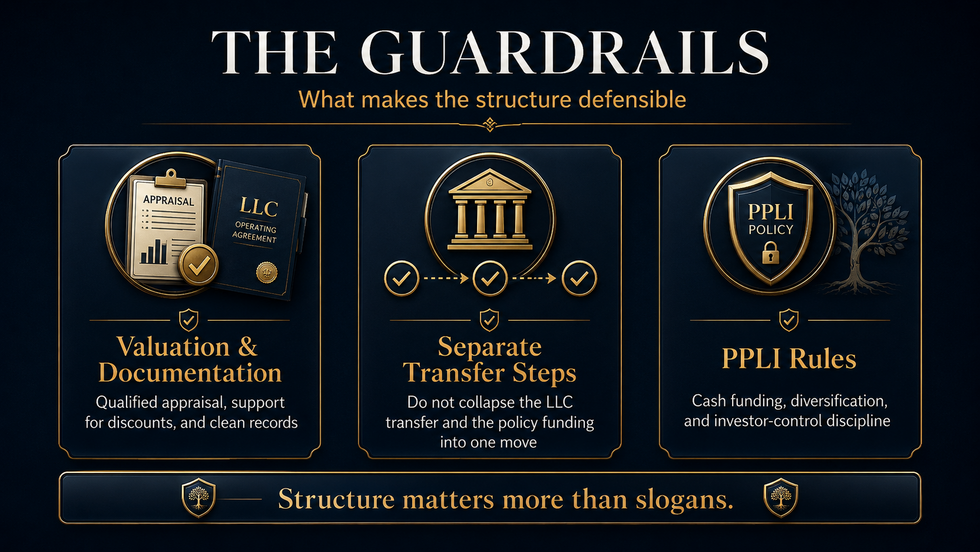
Two more guardrails shape what actually fits. First, Section 817(h) demands diversification: no single investment above 55% of the account, with 70%, 80%, and 90% caps on the top two, three, and four holdings, tested quarterly. A single-property LLC is one investment, and a client's own real estate LLC won't qualify for look-through to the underlying building — so the interest itself is capped at 55%, and the policy needs a diversified balance around it. Second, life insurance separate accounts are built for passive investments. A directly-managed rental property raises "operating business" questions that make most carriers nervous; the offshore carriers willing to look at it want the asset cleanly passive and independently run.
The crypto variant: more passive, but the discount mostly disappears
Swap a big crypto position in for the building and the picture shifts in ways worth understanding — this is increasingly where the questions come from, and it overlaps with digital asset estate planning more broadly.
The good news: crypto is more passive than rental real estate, so the operating-asset problem mostly evaporates — crypto is a natural investment asset for a segregated account — and the control optics soften, since there's no property to actively manage. The gain character is cleaner too: no depreciation recapture, no Section 751 "hot asset" complications.
The bad news: the valuation play largely goes away. Crypto is liquid and publicly priced, so an LLC holding it supports far less of a marketability discount than one holding illiquid real estate. The lack-of-control piece may survive; the marketability piece mostly won't. You lose much of the discount that made the real estate version attractive in the first place.
And crypto adds a trap at the step that's normally safe. An LLC holding mostly liquid, tradable assets can be treated as an "investment company," and under Section 721(b) a contribution that effects diversification can recognize gain on move one — the step that's supposed to be free. That has to be structured around carefully. Add crypto's volatility, which makes quarterly Section 817(h) testing and Section 7702 monitoring genuinely harder, plus the practical custody question — many carriers simply can't hold crypto in a segregated account — and here's the net: crypto removes the operating-asset problem but mostly removes the discount too, and adds a funding-stage trap. Investor control and the move-two entry gain stay right where they were.
This only works as a team sport
None of this is a solo act, and the order matters as much as the parts. In our practice, counsel quarterbacks: map the embedded gain and confirm control can actually be surrendered before anything moves. The carrier pre-clears the in-kind interest and confirms the policy qualifies as life insurance and can satisfy diversification. The LLC gets formed and the asset contributed under Section 721, with an operating agreement built to do double duty — support the discount and strip the policyholder's control. An independent appraiser values the membership interest. If an irrevocable trust owns the policy, the grantor gifts the discounted interest to that grantor trust — a disregarded transfer for income tax under Rev. Rul. 85-13, with the discount stretching the gift exemption — and the trust then contributes the interest to the carrier. That contribution is the moment the gain is recognized, computed and reported by the CPA, with cash set aside to pay it. The wealth manager builds the surrounding portfolio so the interest stays inside the 55% limit, and everyone monitors compliance until the policy is held to death and exits income-tax-free. Get the sequence wrong and you can lock in a structure that's expensive to unwind — which is the whole reason we map exposure before anything moves.
The honest bottom line
Discounting a real estate or crypto LLC interest and funding PPLI with it is a real strategy, not a myth — it's just narrower than the pitch. You avoid gain on the asset-into-LLC step. You do not avoid it on the interest-into-policy step unless basis already sits near the discounted value. The discount lowers the gain and the gift; it doesn't erase the gain. Investor control, not arithmetic, is the gate that usually decides whether the structure survives. And the cleanest path to real estate or crypto exposure inside a policy — cash in, independent manager buys fresh — sidesteps the gain entirely, at the cost of not wrapping the exact asset the client already holds.
Done right — embedded gain understood, control genuinely surrendered, the team moving in order — the future appreciation compounds inside and leaves tax-free, ideally outside the taxable estate. That's the prize, and it's worth doing carefully. If you're weighing it for a client, that's precisely the kind of thing we pressure-test in a Situation Readiness Briefing™ before a single document is drafted.
Frequently Asked Questions
Can you contribute a real estate LLC interest to a PPLI policy in kind? Yes. No law forbids it, and a non-managing LLC interest can be appraised at a discount. But contributing the interest to the carrier is a sale at fair market value under Section 1001 — a realization event — so embedded gain is recognized unless the interest's basis is already near its discounted value.
Does putting real estate in an LLC avoid the gain when it goes into the policy? No. Section 721 makes the real-estate-into-LLC contribution tax-free, but the separate transfer of the LLC interest into the policy is a taxable disposition. Section 721 defers the gain to that second transfer; it doesn't eliminate it.
Can you take a valuation discount on the LLC interest? Yes — lack-of-marketability and lack-of-control discounts apply to a minority, non-managing interest, often 20–40% with a properly drafted operating agreement. The discount reduces both the gift and the recognized gain, but it doesn't erase the gain.
Can the wealth manager buy the asset into the policy to avoid gain? No. Gain follows the appreciated asset and its owner, not who directs the trade. Selling the client's interest to the policy for cash is still a taxable disposition. The only gain-free path is to fund with cash and have an independent manager buy the asset fresh at fair market value.
Is crypto in the LLC better than real estate? It depends. Crypto is more passive (no operating-asset problem) and has cleaner gain character, but it supports far less marketability discount because it's liquid and publicly priced, and it can trigger Section 721(b) gain at funding if the LLC is treated as an investment company. The entry gain and investor-control issues are the same.
What is the investor control doctrine and why does it matter here? If the policyholder controls the specific investments inside the policy, the IRS disregards the wrapper and taxes the policyholder as owner (Webber v. Commissioner). A client's own, personally-managed real estate LLC is the highest-risk version; the asset must be independently managed.
What happens to future appreciation once the asset is inside? It compounds tax-deferred inside the policy and, if the policy is held until death, passes income-tax-free under Section 101 — outside the taxable estate if an irrevocable trust owns the policy. That post-contribution growth is the actual win.
Related reading and how we help
If this is on your radar, you may also want to read our companion piece on navigating U.S. vs. foreign PPLI carriers. On the planning side, the firm's most relevant services are Private Placement Life Insurance, Tax Planning (including capital-gains and structured installment-sale strategies under IRC §453), Asset Protection, the Irrevocable Life Insurance Trust, and Digital Asset Estate Planning for crypto-heavy families. When you're ready, the first step is always a Situation Readiness Briefing™.
Resources & Authority
The analysis above rests on the following primary authorities. Readers and advisors are encouraged to consult the source material directly.
- IRC § 721 — Nonrecognition on contribution of property to a partnership. law.cornell.edu/uscode/text/26/721
- IRC §§ 722–723 — Basis of a contributing partner's interest and of property contributed to the partnership. §722 · §723
- IRC § 721(b) — Gain on contribution to an investment company. law.cornell.edu/uscode/text/26/721
- IRC § 1001 — Determination and recognition of gain or loss on disposition. law.cornell.edu/uscode/text/26/1001
- IRC § 751 — Unrealized receivables and inventory ("hot assets"). law.cornell.edu/uscode/text/26/751
- IRC § 817(h) — Diversification requirements for variable contracts. law.cornell.edu/uscode/text/26/817
- Treas. Reg. § 1.817-5 — Diversification of variable contract investments (the 55/70/80/90 tests; look-through rules). law.cornell.edu/cfr/text/26/1.817-5
- IRC § 7702 — Definition of a life insurance contract. law.cornell.edu/uscode/text/26/7702
- IRC § 101 — Income-tax-free treatment of death benefits (and the § 101(a)(2) transfer-for-value rule). law.cornell.edu/uscode/text/26/101
- Webber v. Commissioner, 144 T.C. 324 (2015) — investor control doctrine applied to PPLI. leagle.com
- Rev. Rul. 2003-91 — investor-control safe harbor. irs.gov (rr-03-91.pdf)
- Rev. Rul. 2003-92 — single publicly available fund causes owner treatment; in I.R.B. 2003-33. irs.gov (irb03-33.pdf)
- Rev. Rul. 85-13 — transactions between a grantor and a wholly-owned grantor trust are disregarded for income tax.
- U.S. Senate Committee on Finance, Private Placement Life Insurance: A Tax Shelter for the Ultra-Wealthy (2024). finance.senate.gov (ppli_report_final.pdf)
This article is general information about tax and estate-planning concepts and is not legal or tax advice. PPLI outcomes depend on specific facts, current law, valuation, and execution; no specific tax result is guaranteed. Anyone considering an in-kind contribution to a life insurance policy should obtain individualized advice and coordinate with qualified tax counsel, a CPA, and a qualified appraiser before acting.

Comments
There are no comments for this post. Be the first and Add your Comment below.
Leave a Comment