

California capital gains tax on estates is defined as the state income tax applied to profits from selling inherited assets, charged at ordinary income rates up to 13.3% with no preferential treatment for long-term holdings. Most California estate owners and beneficiaries face a two-layer tax challenge: federal capital gains rules and California's uniquely aggressive income tax treatment. The good news is that a federal rule called the stepped-up basis can dramatically reduce or eliminate taxable gains when assets transfer at death. Understanding what is California capital gains tax on estates, and how to plan around it, is the difference between preserving generational wealth and surrendering a significant portion of it to the state.
What is California capital gains tax on estates?
California capital gains tax on estates is the state income tax owed when a beneficiary sells an inherited asset at a profit. California treats all capital gains as ordinary income, applying the same brackets used for wages and salaries. The top marginal rate is 13.3%, making California one of the most aggressive states in the country for capital gains taxation.
The real tax burden on heirs in California revolves around capital gains at sale rather than state estate taxes. This means the moment a beneficiary decides to sell an inherited stock portfolio, rental property, or business interest, the state treats that transaction as ordinary income. Careful basis management is not optional for California estate owners. It is the primary tool for protecting inherited wealth.

How does the federal stepped-up basis rule affect California estates?
The stepped-up basis is the federal rule that resets an inherited asset's cost basis to its fair market value (FMV) at the date of the original owner's death. This single rule is the most powerful capital gains tax tool available to California heirs. If a parent purchased a rental property in 1985 for $200,000 and it is worth $2,000,000 at death, the heir's new cost basis becomes $2,000,000, not $200,000.
The step-up applies to most capital assets including real estate, publicly traded stocks, and business interests. Assets that do not qualify include tax-deferred retirement accounts such as traditional IRAs and 401(k)s. Those accounts pass to heirs as ordinary income regardless of basis rules.
Assets that typically qualify for a stepped-up basis include:
- Real estate (residential, commercial, and rental properties)
- Publicly traded stocks and bonds
- Closely held business interests
- Brokerage accounts held in taxable accounts
- Collectibles and personal property with documented value
Assets that do not qualify include:
- Traditional IRAs and 401(k)s
- Annuities with deferred gains
- Assets transferred via gift before death
Pro Tip: Get a formal appraisal from a qualified appraiser on the date of death for every significant asset. Weak or missing documentation is the most common reason the IRS disallows a step-up, which forces the heir to calculate gain from the original purchase price instead.
Proper valuation documentation is not a formality. It is the legal foundation that supports the entire stepped-up basis claim. Without it, the IRS can challenge the FMV and recharacterize the gain, triggering a far larger tax bill than the heir anticipated.
How does California tax capital gains from estates versus the federal government?
The federal government and California treat capital gains from estate assets very differently. At the federal level, long-term capital gains (assets held over one year) receive preferential rates of 0%, 15%, or 20% depending on income. California offers no such preference.
California's lack of capital gains preference eliminates the federal benefit of holding assets over one year for lower rates. A California heir who holds an inherited stock for 13 months before selling pays the same state rate as one who sells in the first week. That distinction matters enormously for high-net-worth families planning the timing of asset sales.
| Tax Category | Federal Treatment | California Treatment |
|---|---|---|
|
Short-term gains |
Ordinary income rates up to 37% |
Ordinary income rates up to 13.3% |
|
Long-term gains |
Preferential rates: 0%, 15%, or 20% |
Ordinary income rates up to 13.3% |
|
Inherited assets (stepped-up basis) |
Gain calculated from FMV at death |
Gain calculated from FMV at death |
|
Primary residence exclusion |
Up to $500,000 for married couples |
Mirrors federal exclusion |
|
Combined top rate (long-term) |
20% federal + 3.8% NIIT |
Add 13.3% California = 37.1% combined |
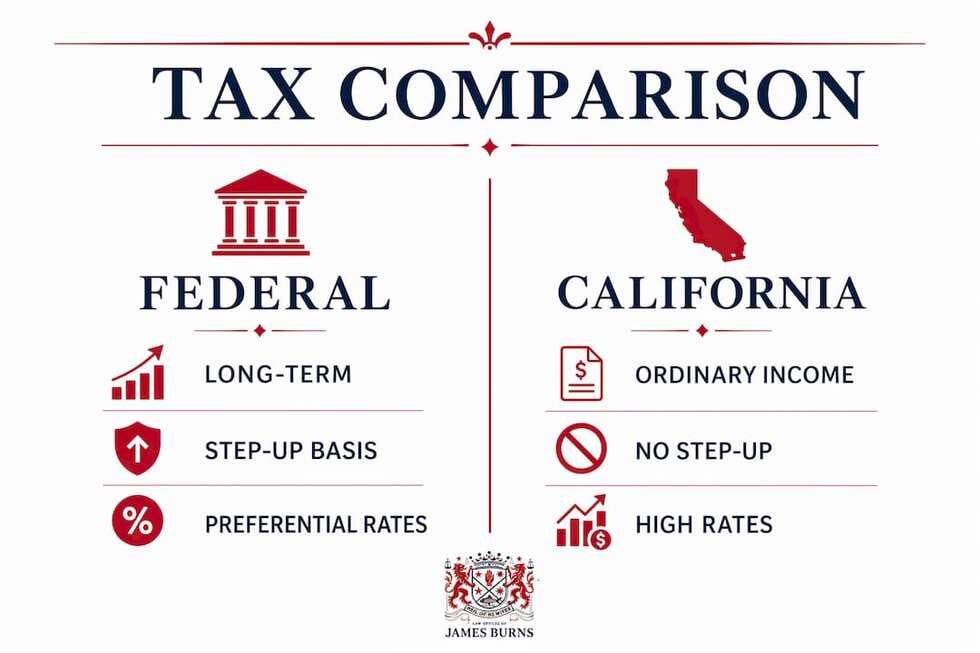
California residents face one of the highest combined capital gains tax rates in the country when state and federal obligations are stacked. A high-income California heir selling a large inherited asset could face a combined rate exceeding 37%. That is not a hypothetical. It is the real math for many families in the $5M to $100M estate range.
What are California estate tax rules and how do they impact inherited assets?
California does not impose a state estate or inheritance tax. Only the federal estate tax applies, and in 2026 it starts only for estates valued above $15 million. That threshold means most California families will not owe federal estate tax either.
The absence of a California estate tax does not mean inherited assets transfer tax-free. The capital gains tax on sale is the real exposure point. When Form 706 is filed for a taxable federal estate, the asset valuations recorded on that return directly establish the cost basis for heirs. Errors or undervaluations on Form 706 create downstream capital gains problems.
Key facts about California estate tax rules that every estate owner should know:
- No California estate tax. The state repealed its estate tax in 1982 and has not reinstated it.
- No California inheritance tax. Beneficiaries do not owe state tax simply for receiving assets.
- Federal estate tax threshold in 2026 is $15 million. Estates below this level owe no federal estate tax.
- Form 706 valuations matter. Even if no estate tax is owed, the valuations on Form 706 establish the stepped-up basis for heirs.
- Portability elections on Form 706 allow a surviving spouse to carry over unused federal exemption, which affects long-term estate tax exposure.
Joint ownership adds another layer of complexity. Under IRC 2040, only the decedent's share of a jointly owned asset receives a stepped-up basis. For non-spousal joint owners, this means only a partial step-up applies, leaving the surviving owner with a mixed basis that increases future capital gains exposure.
What practical capital gains tax strategies can California estate owners use?
California estate owners have several proven tools to reduce capital gains tax liability on inherited assets. The key is coordinating these tools before death, not after.
-
Document FMV at death with certified appraisals. Every significant asset requires a qualified appraisal dated at or near the date of death. Real estate, business interests, and closely held stock all need independent valuations. This documentation is the legal foundation for the stepped-up basis claim.
-
Time asset sales strategically. Selling inherited assets shortly after death, when the stepped-up basis closely matches the sale price, minimizes taxable gain. Waiting months or years allows appreciation to accumulate above the new basis, creating a larger taxable gain at California's ordinary income rates.
-
Use the Section 121 primary residence exclusion. Capital gains from a primary residence are excluded up to $250,000 for single filers and $500,000 for married couples at both the federal and state levels. Heirs who meet the ownership and use tests can apply this exclusion to inherited homes, significantly reducing or eliminating taxable gain.
-
Evaluate 1031 exchanges carefully for real estate. A 1031 exchange defers capital gains tax by reinvesting proceeds from a sold property into a like-kind replacement. However, California requires special reporting for 1031 exchanges involving out-of-state replacement properties and may tax the deferred gain before the federal sale event. California-to-California exchanges remain cleaner from a compliance standpoint.
-
Structure ownership before death. Irrevocable trusts, family limited partnerships, and proper titling of assets can control which assets receive a full step-up versus a partial one. Restructuring joint ownership between non-spouses before death can maximize the portion of the estate that qualifies for a full basis reset.
-
Coordinate federal estate tax planning with California income tax planning. The elections made on Form 706, including portability and alternate valuation date elections, affect both estate tax and the basis heirs receive. These decisions require coordination between an estate attorney and a California tax advisor.
Pro Tip: Irrevocable trusts do not automatically receive a stepped-up basis. Assets held in certain irrevocable trusts at death may be excluded from the gross estate, which means they also miss the step-up. Work with a California estate planning attorney before transferring assets into any irrevocable structure.
Common pitfalls California heirs face with capital gains on inherited estates
The most expensive mistakes in California estate capital gains planning are not dramatic. They are quiet documentation failures and structural oversights that surface only when an heir tries to sell.
-
Inadequate FMV documentation. Heirs who cannot prove the FMV at the date of death lose the stepped-up basis. The IRS then calculates gain from the original purchase price, which can be decades lower than current value.
-
Misunderstanding joint ownership rules. Only the decedent's share of a jointly owned asset receives a step-up for non-spousal owners. A sibling who co-owned a rental property with the decedent retains their original cost basis on their half, creating a split-basis situation that complicates the eventual sale.
-
Assuming retirement accounts get a step-up. Traditional IRAs, 401(k)s, and similar tax-deferred accounts do not receive a stepped-up basis. Every dollar withdrawn by the heir is taxed as ordinary income at both the federal and California state level.
-
Ignoring the "patience premium" gap. At the federal level, holding an inherited asset for more than one year after death produces no tax benefit in California. The state taxes short-term and long-term gains identically. Heirs who wait expecting a lower rate are waiting for a benefit that does not exist in California.
-
Forced sales from liquidity needs. When an estate lacks liquid assets to cover expenses, heirs may be forced to sell appreciated assets quickly. Those sales trigger capital gains tax at the worst possible time, often before a proper valuation strategy is in place.
Key Takeaways
California estate owners face capital gains tax as ordinary income on inherited asset sales, making stepped-up basis documentation and proactive planning the most critical tools for preserving inherited wealth.
| Point | Details |
|---|---|
|
California taxes all gains as ordinary income |
The state applies rates up to 13.3% with no preference for long-term holdings. |
|
Stepped-up basis resets cost basis at death |
Heirs inherit assets at FMV on the date of death, often eliminating taxable gain if sold promptly. |
|
No California estate or inheritance tax |
Only federal estate tax applies, starting above $15 million in 2026. |
|
Joint ownership creates partial step-up risk |
Non-spousal co-owners receive a step-up only on the decedent's share of the asset. |
|
Documentation is the foundation of every strategy |
Without a certified appraisal at death, the IRS can disallow the step-up and trigger larger gains. |
What I have learned about California capital gains tax and estate planning
California's treatment of capital gains is the single most underestimated threat I see in estate plans for high-net-worth families. Most clients come in focused on avoiding probate or minimizing federal estate tax. Those are real concerns. But the tax event that actually costs families the most money is the capital gains tax triggered when a beneficiary sells an inherited asset years after the estate settles.
The absence of a California estate tax creates a false sense of security. Families assume that because California does not tax the transfer of wealth at death, the state is not a major factor in their estate plan. That assumption is wrong. California is waiting at the point of sale, and it charges ordinary income rates on every dollar of gain above the stepped-up basis.
The families who protect the most wealth are the ones who treat valuation as a legal discipline, not a paperwork exercise. They hire qualified appraisers, file Form 706 even when no estate tax is owed, and coordinate the timing of asset sales with their California income tax exposure. They also structure ownership before death to maximize the portion of the estate that qualifies for a full basis reset.
My strongest advice: do not wait until the estate is in administration to think about capital gains. The decisions that matter most, including how assets are titled, how trusts are structured, and which assets are held in taxable versus tax-deferred accounts, must be made while the original owner is still alive and able to act. Once death occurs, the options narrow considerably.
— James
How Jamesburnslaw helps California estate owners manage capital gains tax
California's capital gains rules create real exposure for families with significant real estate, business interests, or investment portfolios. The right planning structure can mean the difference between a clean wealth transfer and a six-figure tax bill that no one anticipated.

Jamesburnslaw specializes in California estate planning and tax optimization for high-net-worth families, with a focus on estates ranging from $5M to over $100M. The firm's FortressWall Methodology™ addresses capital gains exposure directly, mapping each asset's basis position and building a coordinated plan that accounts for both federal and California tax rules. If you own real estate, a closely held business, or a significant investment portfolio in California, a consultation with Jamesburnslaw gives you a clear picture of your current exposure and the specific steps to reduce it.
FAQ
What is the capital gains tax rate on inherited assets in California?
California taxes capital gains from inherited assets as ordinary income at rates up to 13.3%. There is no preferential rate for long-term holdings, unlike the federal system.
Does California have its own estate tax?
California does not impose a state estate or inheritance tax. Only the federal estate tax applies, and in 2026 it applies only to estates valued above $15 million.
What is a stepped-up basis and how does it reduce capital gains tax?
A stepped-up basis resets an inherited asset's cost basis to its fair market value at the date of death. If the heir sells the asset shortly after inheriting it, the taxable gain is minimal because the sale price is close to the new basis.
Do inherited retirement accounts like IRAs get a stepped-up basis?
No. Traditional IRAs and 401(k)s do not receive a stepped-up basis. Every dollar a beneficiary withdraws from an inherited retirement account is taxed as ordinary income at both the federal and California state level.
Can a 1031 exchange defer capital gains tax on inherited California real estate?
A 1031 exchange can defer capital gains tax on inherited real estate, but California applies special rules to exchanges involving out-of-state replacement properties. California may tax the deferred gain before the federal sale event occurs, making in-state exchanges the cleaner option for California estate owners.

Comments
There are no comments for this post. Be the first and Add your Comment below.
Leave a Comment