

T.D. 10050 modernizes the federal rules governing Qualified Domestic Trusts, or QDOTs, for noncitizen surviving spouses. The most important operational point is simple: a bond or letter of credit must remain continuously effective, automatically renewable, and properly monitored. The applicable surety or bank has notice obligations under the regulation when the required security will not be renewed. The trustee should confirm the instrument-specific requirements directly from the regulation and governing documents. If the lapse causes the QDOT to cease satisfying the applicable statutory or regulatory requirements, the QDOT tax rules may treat the surviving spouse as having died on the cessation date for purposes of the deferred tax.
Legal Review Block
- Reviewed on: August 21, 2026
- Attorney: James G. Burns, Esq., LL.M.
- Credentials: TEP (Trust and Estate Practitioner); Member of STEP; Selected to Super Lawyers: 2022–2027 (6 calendar years); Top-Rated Lawyer (Avvo 2021); America's Most Honored Lawyers (2020)
- Primary authorities reviewed: T.D. 10050, RIN 1545-BQ88; 91 Fed. Reg. 42659; correction at 91 Fed. Reg. 46724; IRC §§ 2056(d), 2056A; 26 C.F.R. §§ 20.2056A-2, 20.2056A-4, 20.2056A-11, and 20.2056A-13.
Key Takeaways
- T.D. 10050 applies on and after July 10, 2026, including to QDOT-related administration and filings governed by the updated applicability provisions.
- A QDOT bond or letter of credit must be filed separately with the IRS Estate Tax Advisory Group, using the current address identified through IRS Publication 4235.
- For a bond, the surety has notice duties; for a letter of credit, the issuing or confirming bank has notice duties. Confirm the instrument-specific requirements, recipients, and timing directly from the regulation and governing documents.
- The trustee may qualify for a regulatory protection against a draw if every replacement-security and notice condition is satisfied within the prescribed period.
- If the lapse causes the QDOT to cease satisfying the applicable statutory or regulatory requirements, the QDOT tax rules may treat the surviving spouse as having died on the cessation date for purposes of the deferred tax. That is a potential acceleration of deferred tax, not automatically a penalty.
- The permanent, inflation-indexed $15 million federal exemption does not eliminate the special rule for a noncitizen spouse. A green card is not U.S. citizenship.
Mission Summary: The QDOT Deferral Is Only as Strong as Its Control System
A Qualified Domestic Trust is designed to preserve the federal estate tax marital deduction when property passes for the benefit of a surviving spouse who isn't a U.S. citizen.
Ordinarily, IRC § 2056(d)(1) disallows the marital deduction for property passing to a noncitizen surviving spouse. IRC § 2056(d)(2)(A) creates the exception: the property may qualify for the deduction if it passes into a QDOT meeting the requirements of IRC § 2056A.
That structure defers, not necessarily eliminates, the estate tax. Under IRC § 2056A(b), tax may become due when principal is distributed during the surviving spouse's lifetime or when property remains in the QDOT at the surviving spouse's death.
T.D. 10050 doesn't redesign the QDOT. It modernizes the operating instructions around the structure. It updates IRS office names, filing procedures, addresses, forms, and applicability dates. It also places renewed practical attention on the continuing security obligations attached to QDOT bonds and letters of credit.
The central lesson is a control-architecture lesson:
> A QDOT is not a document package. It's an ongoing compliance system involving the trust instrument, the U.S. trustee required under the QDOT regulation, the applicable surety or bank, the IRS, the estate tax return, annual administration, and the surviving spouse's changing citizenship status.
If one part of that system goes quiet, the tax deferral can become vulnerable.
A Clearly Labeled Hypothetical: The Bank That Never Called
Hypothetical only, not a real client outcome.
Assume a California resident dies with a $28 million estate. The surviving spouse is a lawful permanent resident but not a U.S. citizen. The estate plan directs qualifying marital property into a QDOT. To satisfy the security requirements, the trustee uses an irrevocable sight-pay letter of credit issued by a qualifying bank.
The trustee keeps the trust investments current. The annual statements are filed. The surviving spouse receives permitted income distributions. Everyone believes the QDOT is operating properly.
Then the bank's internal relationship manager changes departments.
The trustee never receives the bank's renewal confirmation. No one checks the expiration date against the trust's compliance calendar. The letter of credit quietly expires. No alternate bond is put in place. No timely notice reaches the trustee or the IRS before expiration.
The problem isn't merely that a piece of paper is outdated. The security instrument was part of the mechanism designed to assure collection of the deferred tax. If the QDOT ceases to meet the applicable requirements, IRC § 2056A(b)(4) can treat the surviving spouse as having died on the date of that cessation for purposes of imposing the QDOT estate tax.
On an eight-figure trust, that administrative silence can create an eight-figure tax event.
That's why T.D. 10050 matters. It gives trustees, banks, sureties, and advisors a clearer operating map. The rule doesn't replace oversight. It makes the failure points harder to ignore.
What Does T.D. 10050 Actually Change?
T.D. 10050, published July 10, 2026, in 91 Fed. Reg. 42659, modernizes the QDOT regulations under 26 C.F.R. Part 20.
The changes include:
- Replacing outdated references to IRS offices and officials.
- Identifying the Estate Tax Advisory Group, or a successor office identified through IRS publications, forms, instructions, or IRS.gov.
- Updating procedures for submitting security instruments.
- Clarifying filing locations and submission methods.
- Updating the definition of when asset values are “finally determined.”
- Updating procedures for extensions and Form 706-QDT administration.
- Establishing applicability on and after July 10, 2026, rather than tying the modernized provisions only to the decedent's date of death.
For bonds and letters of credit, the modernized rules require separate submission to the IRS Estate Tax Advisory Group. The instrument is not simply tucked into the estate tax return and forgotten.
The bond or letter of credit must generally be submitted separately on or before the later of:
- The filing date of Form 706 or Form 706-NA; or
- The due date of that return, including applicable extensions.
A separate extension may be available under Treas. Reg. § 301.9100-1, but the trustee and advisors shouldn't assume that an extension of the estate tax return automatically extends every QDOT security obligation.
The July 24, 2026 correction, published at 91 Fed. Reg. 46724, makes technical corrections to T.D. 10050. It updates a statutory reference, corrects a ZIP code, and makes other wording corrections. It does not change the central operational message: submit, monitor, renew, and document the security instrument correctly.
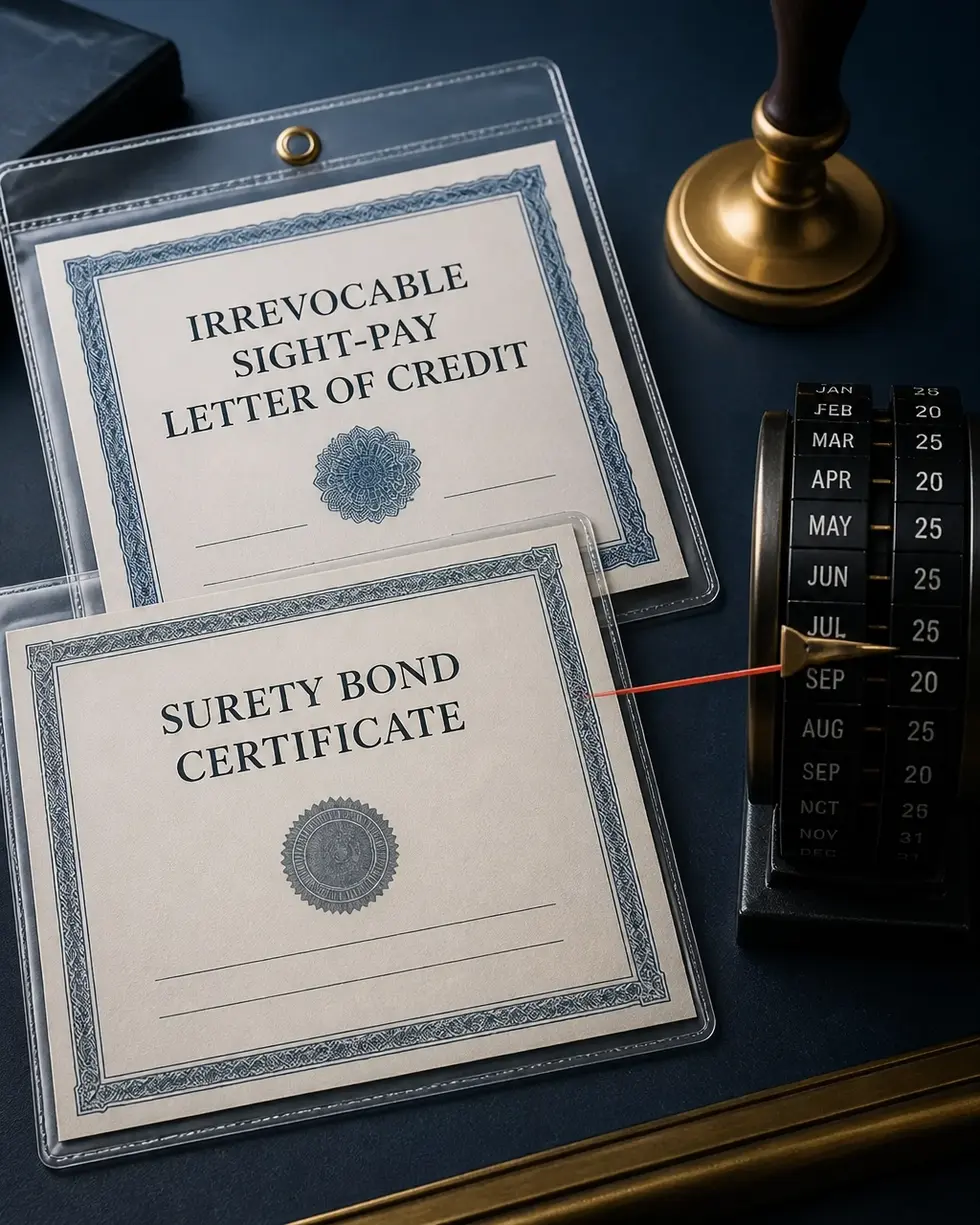
Who Has the Notification Duty?
The applicable surety or bank has the formal notice obligation when the required security will not renew, but the regulation should be read separately for bonds and letters of credit.
For a bond, the surety must provide the required notice of failure to renew to:
- the U.S. trustee required under the QDOT regulation; and
- the IRS Estate Tax Advisory Group, or its successor office.
For a letter of credit, the issuing or confirming bank must provide the required notice under the applicable regulatory and instrument language to the IRS and the U.S. trustee required under the QDOT regulation.
The notice must generally be sent at least 60 days before the expiration date, including expiration dates created by automatic renewal periods. The instrument must be automatically renewable for at least one year at a time and may not be canceled except as permitted by the governing rules, the regulation, and the instrument itself.
The trustee still has an independent practical responsibility. Don't wait for the issuing institution or surety to save the QDOT.
A trustee should:
- Maintain a copy of the current instrument.
- Track the original expiration date and each automatic renewal date.
- Confirm the applicable bank or surety has the correct trustee address.
- Confirm that the IRS submission address is current.
- Obtain written confirmation of renewal.
- Keep proof of mailing, delivery, and receipt.
- Establish an escalation process if the bank changes personnel or systems.
- Secure alternate security promptly if a nonrenewal notice arrives.
The 60-day notice is a minimum warning window. It isn't a substitute for an annual QDOT review.
What Happens if a Bond or Letter of Credit Lapses Silently?
A silent lapse is dangerous because the QDOT's tax economics depend on continued qualification.
Under IRC § 2056A(b)(4), if a QDOT ceases to meet the statutory and regulatory requirements, the QDOT tax rules may treat the surviving spouse as having died on the date the trust ceased to satisfy those requirements for purposes of the deferred tax.
That means the tax may be accelerated before the surviving spouse's actual death if the lapse produces a qualification failure.
Use precise language here:
- It is not automatically a “penalty.”
- It is not merely a late administrative fee.
- It is a potential acceleration of deferred estate tax resulting from a failure in the QDOT qualification and collection structure.
The final regulations also provide a limited, conditional protection against a draw. If the trustee receives notice that a bond or letter of credit will not be renewed, the trustee may qualify for a regulatory protection against a draw if every replacement-security and notice condition is satisfied within the prescribed period. That means the trustee should confirm who must notify the IRS, whether the notice must be received within 30 days after the trustee receives the nonrenewal notice, when the replacement security must become effective, and whether the alternate arrangement becomes effective immediately before or upon expiration under the regulatory standard.
That safe harbor depends on action. A trustee must move.
A trustee should not assume that:
- The bank will renew automatically.
- The IRS will call before the deadline.
- The estate tax return filing extension protects the bond.
- The surviving spouse's green card status is enough.
- The permanent $15 million exemption removes the need for a QDOT.
- A replacement instrument can be negotiated after expiration without consequences.
When Do the New Rules Apply?
The updated provisions under Treas. Reg. §§ 20.2056A-2(e), 20.2056A-4(e), and 20.2056A-11(e) apply on and after July 10, 2026.
The applicability date is not limited to decedents who die after July 10. That distinction matters.
Trustees of existing QDOTs should review the applicability provisions and updated procedures immediately with QDOT counsel, particularly if:
- The estate tax return is being prepared or amended.
- A bond or letter of credit is being submitted.
- The trustee is changing banks or sureties.
- The QDOT has a pending security renewal.
- A Form 706-QDT filing or related reporting event may be required under the facts.
- The surviving spouse may naturalize.
- The trust has foreign beneficiaries, foreign assets, or cross-border administrative contacts.
The correction published July 24, 2026, is effective on that date. For current administration, use the corrected forms and address details, and verify the appropriate IRS destination through current IRS guidance.
Can a Spouse Avoid the QDOT Requirement by Naturalizing?
Sometimes, potentially, but timing, residence history, citizenship date, filing posture, and election posture must be documented carefully.
Under IRC § 2056(d)(4), the surviving spouse may be treated as a U.S. citizen for this purpose if:
- The spouse becomes a U.S. citizen before the day the federal estate tax return is filed; and
- The spouse was a resident of the United States at all times after the decedent's death and before becoming a citizen.
A green card or lawful permanent resident status does not equal citizenship. The spouse must satisfy the statutory naturalization and residency conditions.
The return-timing rules also require care:
- If the return is filed early, the statute treats it as filed on the last date prescribed by law.
- If the return is filed late, the filing date is generally the date it is actually submitted.
That can affect whether naturalization occurs in time.
Clearly Labeled Hypothetical: Naturalization Before Filing
Hypothetical only, not a real client outcome.
Assume a noncitizen surviving spouse lives continuously in the United States after the decedent's death. The executor expects to file Form 706 in December 2026. The spouse completes naturalization in October 2026.
If all statutory conditions are satisfied, the spouse may be treated as a U.S. citizen for purposes of the marital-deduction rule, potentially eliminating the need for QDOT treatment for the relevant transfer. But the executor and tax counsel must verify the actual filing date, residence history, citizenship date, election posture, and the treatment of the property under the governing documents.
Do not treat the exception as automatic. Coordinate the estate attorney, immigration counsel, CPA, and trustee before assuming QDOT treatment is unnecessary or that an existing QDOT can simply be ignored.
Warning Signs in an Existing QDOT
Treat these items as indicators that a control review is overdue:
- The trustee cannot locate the original bond or letter of credit.
- The instrument has an expiration date within the next 120 days.
- The bank's contact person has changed.
- The trustee's address differs from the address in the instrument.
- The IRS address was copied from an old form or prior filing.
- The instrument was attached to Form 706 but not separately submitted.
- No one can prove when the IRS received the instrument.
- The trust has changed trustees without reviewing security requirements.
- The QDOT owns assets outside the United States.
- The surviving spouse has begun or completed naturalization.
- Potential Form 706-QDT filing obligations or related reporting events are being handled without an event-driven compliance calendar.
- Advisors describe a potential lapse as “just a paperwork issue.”
- The trust's records don't show renewal confirmations.
- The family assumes the $15 million exemption makes the QDOT unnecessary.
QDOT Control Architecture: Risk Exposure Mapping → Control Architecture → Layered Defense
The Law Office of James Burns approaches QDOT administration through three connected lenses.
Risk Exposure Mapping
Map the points where the deferral can fail:
- Noncitizen-spouse status.
- Estate tax return timing.
- QDOT election timing.
- Trust qualification.
- Status of the U.S. trustee required under the QDOT regulation.
- Bond or letter of credit expiration.
- IRS filing location.
- Applicable bank and surety communications.
- Principal distributions.
- Form 706-QDT reporting.
- Naturalization timing.
- Death or incapacity of the surviving spouse.
- Cross-border assets and records.
Control Architecture
Build a system that assigns responsibility:


Layered Defense
Use more than one safeguard:
- Written expiration calendar.
- Annual trustee certification.
- Direct bank or surety confirmation.
- Independent tax counsel review.
- Backup security plan.
- Documented IRS delivery evidence.
- Citizenship-status review.
- Annual family and advisor meeting.
The system should not depend on one person remembering one date.
What the $15 Million Exemption Does, and Doesn't Do
The One Big Beautiful Bill Act of 2025 made the federal basic exclusion amount $15 million per person for 2026, with inflation indexing after 2026 and no scheduled sunset under the current law.
That change is important, but it doesn't solve the noncitizen-spouse problem.
The exemption and the QDOT rules answer different questions:

Do not collapse the $15 million exemption, the marital deduction, and QDOT deferral into one concept. They are separate parts of the federal transfer-tax system.
Tactical FAQ
What is a QDOT?
A QDOT is a Qualified Domestic Trust that can preserve the federal estate tax marital deduction for qualifying property passing to a noncitizen surviving spouse. The trust must satisfy statutory and regulatory requirements under IRC §§ 2056(d) and 2056A.
Why does a noncitizen spouse need a QDOT?
Under IRC § 2056(d)(1), the marital deduction generally isn't available for property passing to a surviving spouse who is not a U.S. citizen. A QDOT can provide an exception under IRC § 2056(d)(2)(A) if the trust meets the required conditions.
Does a QDOT eliminate estate tax?
No. A QDOT generally defers estate tax on qualifying property. Under IRC § 2056A(b), tax can arise on certain principal distributions and on property remaining in the QDOT when the surviving spouse dies.
What is the new bond-notification rule?
The modernized regulations impose instrument-specific notice duties. For a bond, the surety must provide the required notice. For a letter of credit, the issuing or confirming bank must provide the required notice. The notice generally must go to the IRS and the U.S. trustee required under the QDOT regulation at least 60 days before expiration, including automatic renewal periods, subject to the exact regulatory and instrument language.
Who must send the notice?
The surety sends the notice for a bond. The issuing or confirming bank sends the notice for a letter of credit. The trustee should still monitor the instrument independently, confirm the information is current, and verify the exact notice recipients and method from the regulation and governing documents.
Where should a QDOT security instrument be filed?
T.D. 10050 directs trustees to submit the bond or letter of credit separately to the IRS Estate Tax Advisory Group or successor office. Use current IRS instructions and Publication 4235 to identify the correct address.
Should the bond be attached to Form 706?
The modernized procedure generally requires separate submission rather than attaching the bond or letter of credit to Form 706 or Form 706-NA. Keep proof of separate delivery and receipt.
What happens if the letter of credit expires?
If the lapse causes the QDOT to cease satisfying the applicable statutory or regulatory requirements, the QDOT tax rules may treat the surviving spouse as having died on the cessation date for purposes of the deferred tax. That is a tax-acceleration issue, not simply a paperwork penalty.
Is there a safe harbor after a nonrenewal notice?
There may be a limited, conditional regulatory protection against a draw. The trustee should confirm whether the required IRS notice must be given and received within 30 days after the trustee receives the nonrenewal notice, whether every replacement-security condition has been satisfied, and whether the alternate arrangement becomes effective immediately before or upon expiration.
Does the $15 million exemption eliminate the need for a QDOT?
No. The $15 million federal exclusion and the noncitizen-spouse marital deduction rule are separate. The QDOT requirement can apply even where the family's estate tax analysis includes the higher exemption.
Can naturalization eliminate the QDOT requirement?
Potentially, for the relevant transfer, if all statutory conditions are satisfied. Under IRC § 2056(d)(4), the spouse must become a U.S. citizen before the estate tax return is filed and must have been a U.S. resident continuously after the decedent's death and before naturalization. The executor and tax counsel should verify the filing date, residence history, citizenship date, and election posture.
Does a green card count as citizenship?
No. Lawful permanent residence is not U.S. citizenship. Review immigration status and naturalization timing separately from the estate tax exemption analysis.
Action Steps for Trustees and Advisors
Start with the existing instrument, not a summary.
- Locate the current bond or letter of credit. Confirm the trust name, trustee, amount, issuing institution, effective date, and expiration date.
- Read the renewal language. Verify automatic annual renewal, noncancellation language, notice method, and the required recipients.
- Confirm both addresses. Make sure the applicable bank or surety has the trustee's current address and that IRS submissions use the current Estate Tax Advisory Group information.
- Review Publication 4235. Use current IRS guidance rather than relying on an old closing file.
- Check separate filing evidence. Confirm the instrument was submitted separately from Form 706 or Form 706-NA when required.
- Build a 120-day alert. Don't wait for the 60-day notice window.
- Create a backup plan. Identify who will arrange alternate security if renewal fails.
- Review Form 706-QDT obligations. Coordinate the trustee and CPA regarding distributions, tax events, annual statements, and any filing obligations triggered by the facts and applicable rules.
- Confirm the status of the U.S. trustee required under the QDOT regulation. Recheck the trustee after every resignation, merger, relocation, or institutional change.
- Review citizenship timing. If naturalization is possible, coordinate the immigration and estate tax calendars.
- Document every transmission. Preserve mailing receipts, courier records, IRS acknowledgments, and bank confirmations.
- Run a family transition review. Address incapacity, death, remarriage, relocation, and changes in the surviving spouse's citizenship.
For California families, this review should also fit inside the broader fiduciary structure. A trustee administering a trust from Orange County or elsewhere in Southern California must coordinate federal QDOT requirements with the governing trust instrument, California fiduciary administration, tax reporting, and any international assets. California Probate Code § 16000 requires a trustee to administer the trust according to its terms and applicable law. That makes the administrative calendar part of the fiduciary control system: not an optional back-office task.
Founder Insight
An Estate Plan Is a Control System, Not a Document Package
In my experience, sophisticated families rarely suffer from a complete absence of planning. More often, the plan exists but loses coordination.
The trust was signed. The estate tax return was filed. The bank issued the letter of credit. The family moved on.
That's exactly when the risk begins to hide.
A QDOT requires disciplined continuity. The trustee must know what the instrument says, the bank must know whom to notify, the CPA must know what filings are due, and the family must know whether citizenship status could change the analysis.
Treat the QDOT like a control system. Map the exposures. Assign responsibility. Add a second layer of review. Then test the system before a deadline forces the issue.
Evaluate Your Readiness
Request a Situation Readiness Briefing to map the control, probate, tax, incapacity, and family-transition exposures in your current structure.
The review should answer:
- Is the QDOT still operating within its statutory and regulatory requirements?
- Is the bond or letter of credit current and independently verified?
- Has the security instrument been submitted using the modernized procedure?
- Does the renewal calendar protect against a silent lapse?
- Could naturalization change the QDOT analysis?
- Are the trustee, CPA, immigration counsel, and estate counsel working from the same timeline?
Request a Situation Readiness Briefing through the firm's scheduling page.
You can also use the firm's Planning Command Center to organize the questions and documents for the review.
Related Law Office Resources
Continue the review through these related resources:
- Estate Planning in California
- General Estate Planning Information
- Asset Protection Planning
- California Private Retirement Plans as a Protection Dome
- Common Multi-State Estate Planning Mistakes
- Why Smart People Make Expensive Estate Planning Mistakes
- Orange County Estate Planning When an Attorney Retires or Passes Away
Resources & Authorities
Primary Federal Authorities
- Treasury Decision 10050, 91 Fed. Reg. 42659 (July 10, 2026)
- T.D. 10050 Technical Correction, 91 Fed. Reg. 46724 (July 24, 2026)
- 26 C.F.R. § 20.2056A-2: Requirements for Qualified Domestic Trust
- 26 C.F.R. Part 20: Estate Tax Regulations
- IRC § 2056: Marital Deduction and Noncitizen Spouse Rules
- IRC § 2056A: Qualified Domestic Trust
- IRC § 301.9100-1: Extensions of Time for Elections
- IRS Publication 4235: Collection Advisory Offices Contact Information
- IRS Form 706 Information
- IRS Form 706-NA Information
- IRS Form 706-QDT Information
- One Big Beautiful Bill Act, P.L. 119-21
California Fiduciary Authority
Planning Command Center
For an organized diagnostic starting point, visit the Law Office of James Burns Planning Command Center.
Technical Summary
The Definitive Framework for QDOT Bond and Letter of Credit Compliance: T.D. 10050 modernizes QDOT procedures under IRC § 2056A and 26 C.F.R. Part 20. The regulations apply on and after July 10, 2026, including to QDOT administration and estate tax filings occurring on or after that date.
Core Legal Logic: IRC § 2056(d)(1) generally disallows the federal estate tax marital deduction for property passing to a noncitizen surviving spouse. IRC § 2056(d)(2)(A) permits the deduction for qualifying property passing to a QDOT. IRC § 2056A imposes deferred estate tax on certain principal distributions and property remaining at the surviving spouse's death.
Security Rule: Under 26 C.F.R. § 20.2056A-2(d)(1)(i), a qualifying bond or irrevocable sight-pay letter of credit must be automatically renewable at least annually and may not be canceled. For a bond, the surety has the relevant nonrenewal notice duties; for a letter of credit, the issuing or confirming bank has the relevant nonrenewal notice duties. The trustee should verify the exact recipients, timing, and method from the regulation and instrument, including notice to the U.S. trustee required under the QDOT regulation and the IRS Estate Tax Advisory Group.
Safe Harbor: The regulations may provide a limited, conditional protection against a draw if the trustee satisfies every replacement-security and notice condition within the prescribed period. The trustee should confirm whether the required IRS notice must be received within 30 days after the trustee receives the nonrenewal notice and whether the replacement security becomes effective immediately before or upon expiration.
Firm Position: A QDOT should be administered as a control architecture, not treated as a completed document. Map the risk exposure, assign responsibility among trustee, the applicable bank or surety, CPA, immigration counsel, and estate counsel, and maintain layered defenses against expiration, filing, citizenship, distribution, and incapacity failures.
Internal-Link Anchors
- QDOT and noncitizen spouse estate planning
- California estate planning control system
- Advanced asset protection planning
- Orange County estate planning review
- Multi-state estate planning coordination
- California Private Retirement Plan protection dome
- Situation Readiness Briefing
- Planning Command Center
Bio
James G. Burns, Esq., LL.M., is the founder of the Law Office of James Burns, serving high-net-worth individuals, families, entrepreneurs, and business owners with advanced estate planning, asset protection, and wealth-transfer planning. He holds the TEP designation, is a member of STEP, and has been selected to Super Lawyers from 2022 through 2027, a six-calendar-year span. He was recognized as a Top-Rated Lawyer by Avvo in 2021 and named among America's Most Honored Lawyers in 2020. The firm brings approximately 25 years of experience to complex legacy and control-system planning.
Legal, Tax, and Professional Disclosures
This article is for general educational and informational purposes only. It is not legal advice, tax advice, immigration advice, accounting advice, or financial advice. It does not create an attorney-client relationship with the Law Office of James Burns or James G. Burns.
QDOT qualification, bond and letter of credit requirements, estate tax treatment, naturalization timing, and filing obligations depend on the specific trust instrument, facts, dates, citizenship history, residency history, assets, and tax filings. Consult qualified estate counsel and a CPA before acting. Naturalization questions require immigration-counsel review, and QDOT-specific situations require direct attorney/CPA confirmation.
CPA/attorney flags: Confirm all federal tax calculations, Form 706 or Form 706-NA filing positions, Form 706-QDT obligations, security amounts, instrument-specific bank or surety language, and naturalization timing with qualified tax and legal professionals. Immigration questions require immigration counsel. Foreign assets and cross-border matters may require additional jurisdiction-specific review.
All original text, frameworks, tables, and visual concepts in this article are intellectual property of the Law Office of James Burns unless otherwise attributed. Government publications, statutes, regulations, and public-source materials remain subject to their respective public and governmental use rules.

Comments
There are no comments for this post. Be the first and Add your Comment below.
Leave a Comment