

The Real Work Isn't Drafting Documents
AI is remarkable at typing. It can generate a revocable trust template in seconds. It can populate boilerplate language, suggest clauses, and format documents that look polished and professional.
But here's what AI cannot do: it cannot tell you where your plan actually fails.
The real work in estate planning isn't creating paperwork. It's identifying the structural weaknesses that only surface when pressure shows up: when someone dies unexpectedly, when a family member contests the trust, when a business needs emergency succession, or when a spouse is incapacitated at a hospital bedside.
AI can explain how something should work. It cannot tell you where it actually breaks.
That's judgment. And judgment is still human.

The Hallucination Problem: When AI Invents the Law
Since ChatGPT became widely available in late 2022, courts across the United States have documented a disturbing pattern: attorneys submitting AI-generated legal briefs containing completely fabricated case citations, invented statutes, and nonexistent judicial opinions.
Mata v. Avianca (S.D.N.Y., 2023)
The most infamous case. Attorney Steven Schwartz used ChatGPT to research a personal injury case and submitted a brief citing six cases that didn't exist. When opposing counsel couldn't locate the citations, Schwartz asked ChatGPT to verify them: and the AI confirmed they were real. They weren't. Judge Kevin Castel imposed sanctions and publicly admonished both Schwartz and his colleague for "abandoning their responsibilities."
Johnson v. Dunn (N.D. Ala., July 2025)
An attorney submitted a motion containing AI-generated citations to cases that never existed. The court imposed sanctions and required the attorney to disclose AI use in all future filings.
Iovino v. Michael Stapleton Associates (W.D. Va., July 2025)
Similar pattern. AI-generated hallucinations in legal briefs. Sanctions imposed. The court emphasized that "inadvertent reliance on AI" does not excuse the attorney's duty to verify.
Ader and Jennie Decisions (New York, 2024-2025)
Multiple New York attorneys have faced disciplinary action for AI-generated fabrications. Courts have consistently held: the human is responsible, not the tool.
The common thread? Every attorney trusted the output looked correct. None verified it.
Ethics Rules Haven't Changed: AI Just Makes Violations Easier
The legal profession's ethical framework anticipated this problem, even before AI existed.
California Rules of Professional Conduct, Rule 1.1 (Competence): An attorney must "apply the learning and skill necessary for competent representation." Using AI without understanding its limitations: or verifying its outputs: violates this rule.
ABA Model Rules of Professional Conduct, Rule 1.1: Requires "the legal knowledge, skill, thoroughness and preparation reasonably necessary for the representation." Clicking "generate" isn't preparation.
Proposed New York Certification Requirement: New York is considering rules requiring attorneys to certify that any AI-generated content has been verified for accuracy before submission. This isn't hypothetical: it's the direction legal practice is heading.
The takeaway: AI doesn't change your ethical obligations. It just creates new ways to breach them.
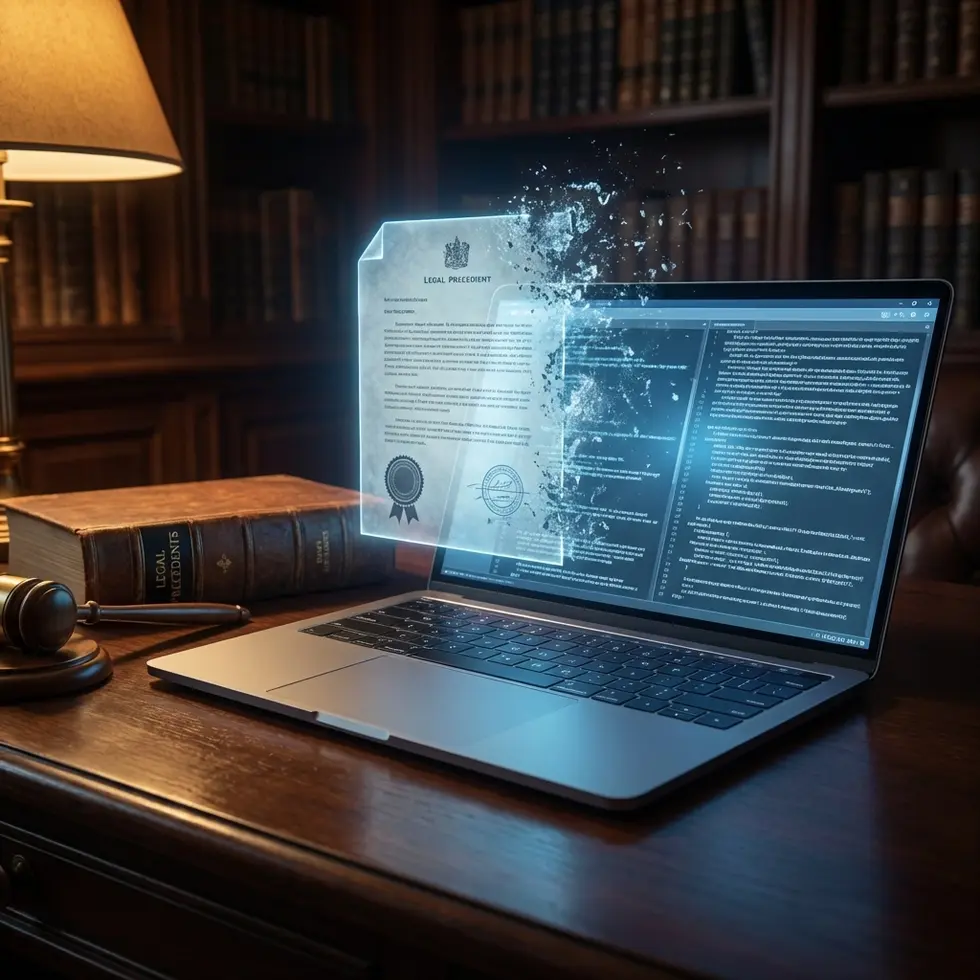
Where AI Fails in Estate Planning: Practical Examples
Estate planning isn't a template exercise. It's a risk-control discipline. Here's where AI routinely fails:
Example 1: The Hallucinated Legislative Change
An attorney uses AI to draft a trust and asks it to incorporate "recent California changes to Proposition 19." The AI confidently generates language referencing a 2024 amendment that doesn't exist. The attorney doesn't verify. The trust is executed. Two years later, the client dies: and the family discovers the trust contains provisions based on imaginary law. The plan fails. The family litigates.
This isn't hypothetical. This pattern mirrors documented hallucination cases.
Example 2: The Unfunded Trust
AI generates a beautiful revocable living trust: all the right clauses, all the right language. But the AI doesn't know that the client's primary residence was never re-titled into the trust. It doesn't know the brokerage accounts still list individual beneficiaries that conflict with the trust terms. It doesn't know the business interest requires a separate succession framework.
The document looks perfect. The plan is worthless.
We see this constantly. Families arrive with "complete" trusts that bypass nothing because the funding was never done correctly. Learn more about why families with complete trusts still end up in probate.
Example 3: The Incapacity Crisis
A client's spouse has a stroke. The hospital needs authorization for medical decisions. The family produces an AI-drafted healthcare directive: but it lacks the specific HIPAA authorization language required by the hospital's legal department. Or the witness signatures don't comply with California requirements. Or the directive references an outdated statutory form.
The document exists. It doesn't work when it matters.
This is the question that collapses family security at the hospital bedside: Are you ready to answer it?
Example 4: The Beneficiary Conflict
AI drafts a trust that distributes assets equally among three children. But the client's IRA still names only the eldest child as beneficiary: a designation made twenty years ago during a different marriage. The AI doesn't know. The attorney using AI without verification doesn't catch it. The family discovers the conflict after death.
The result? Litigation. Resentment. The clause that destroys inheritance was hiding in plain sight.
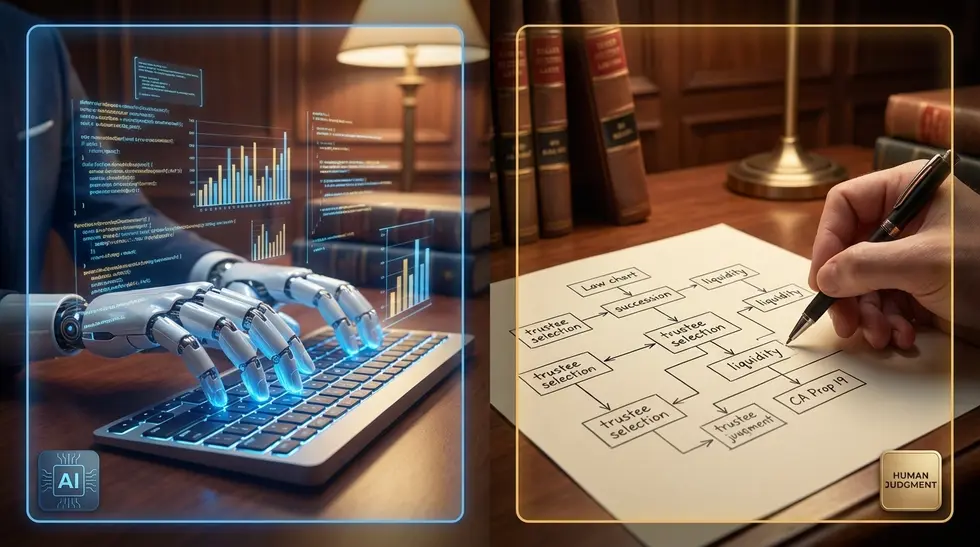
What AI Actually Does Well
Let's be fair. AI is genuinely useful for:
- Document drafting acceleration: First drafts generated in minutes instead of hours
- Data organization: Client intake, asset inventories, beneficiary tracking
- Research acceleration: Surfacing relevant statutes, cases, and secondary sources quickly
- Inconsistency detection: Flagging mismatched names, dates, or provisions within documents
- Pattern recognition: Identifying common planning structures that might fit a client's situation
These are administrative and analytical functions. They replace typing and data entry. They don't replace thinking.
AI Doesn't Just Type—It Reasons and Predicts (But Not Like a Lawyer)
AI systems reason statistically. They analyze patterns in text and data to explain concepts, predict typical outcomes, and auto-draft structures that resemble common solutions. That's useful. But it's not the same as human legal judgment, which blends law, ethics, and situational awareness at the exact pressure points where real plans fail.
What AI can do well:
- Explain general legal concepts and typical mechanics in plain language
- Predict likely outcomes based on patterns in similar fact sets
- Draft, summarize, and cross-check documents for internal consistency
- Surface potential clauses and options seen in similar matters
- Flag obvious inconsistencies across dates, names, and beneficiaries
What an experienced estate attorney does:
- Apply jurisdiction-specific rules to live facts and objectives, including California community property, Proposition 19 reassessment triggers, and local probate practices
- Stress-test structures against real pressure points: death, incapacity, business disruption, liquidity needs, divorce, creditor risks
- Integrate the trust with titles, beneficiary designations, business interests, insurance, and tax posture—and verify funding and execution
- Anticipate human dynamics and governance: trustee selection, succession, incentives, no-contest strategy, and communication across generations
- Exercise ethical judgment and professional responsibility; verify facts, law, and implementation before anyone signs
Concrete example: when AI misses a subtle California trap
- The AI sees a blended-family, high-net-worth couple and predicts that a pair of Spousal Lifetime Access Trusts (SLATs) could reduce estate exposure and protect assets. It drafts attractive SLAT templates and standard funding steps.
- What it misses: in California, funding a SLAT from community property without a valid transmutation agreement that meets Family Code 852(a)'s "express declaration" requirement can defeat the structure, invite later character challenges, and create inclusion risk. It also overlooks the reciprocal trust doctrine, trustee independence, and distribution standards that prevent look-through control.
- The human fix: document a compliant transmutation, sequence separate-property funding, avoid reciprocal design, consider an independent fiduciary, and coordinate beneficiary designations and business interests. Then confirm situs, tax reporting, and governance protocols. See our 3-step planning process for how we implement and verify end-to-end integration: https://www.jamesburnslaw.com/the-law-office-of-james-burns-3-step-estate-planning-system-securing-your-legacy. For trustee role design, start here: https://www.jamesburnslaw.com/trustee-duties-in-california-and-what-happens-if-a-trustee-breaches-those-duties. For why judgment—not documents—creates durable outcomes, see: https://www.jamesburnslaw.com/the-last-advantage-the-wealthy-still-control
The Judgment Layer: Where Plans Actually Collapse
AI cannot perform the following functions:
Anticipating family dynamics. A blended family with competing interests between a surviving spouse and children from a prior marriage requires structural protections AI cannot design. Understanding trustee duties is just the beginning.
Identifying jurisdiction-specific traps. California's community property rules, Proposition 19 reassessment triggers, and local probate court practices require knowledge AI doesn't have: and often hallucinates.
Stress-testing under pressure. What happens if the successor trustee is incapacitated too? What if the business can't be sold quickly? What if a beneficiary has creditor problems? AI doesn't ask these questions.
Coordinating across entities. A comprehensive plan involves the trust, the will, the business succession documents, the retirement accounts, the life insurance policies, and the real estate titles. AI drafts documents in isolation. Attorneys integrate systems.
Exercising professional judgment. The client says they want equal distribution. But one child is a spendthrift and another is facing divorce. Equal distribution might be exactly wrong. AI follows instructions. Attorneys counsel clients on what they actually need.
This is the last advantage the wealthy still control: access to judgment, not just documents.
Why Estate Planning Feels Like Home Improvement Shopping
If you've ever said, “I want to talk to a few lawyers first,” you're not wrong—you're human. Most people think they're:
- Comparing products
- Comparing prices
- Reducing risk
What's really going on is understandable:
- Uncertainty and fear of being taken advantage of
- The service looks like a commodity (everyone lists “revocable trusts, wills, powers of attorney”)
- The outcome is abstract or delayed (benefits show up at death or incapacity)
- It's hard to tell professionals apart when the websites sound the same
Traditional estate planning marketing makes this worse by selling documents and “packages.” That reinforces the commodity mindset and hides the only thing that protects your family at pressure points: seasoned judgment and proper implementation.
How we work is different:
- Judgment-first, bespoke planning anchored in California realities and family governance
- A repeatable, verified implementation framework so the plan works when it's tested
- Integration across trusts, titles, beneficiary designations, business continuity, liquidity, and tax posture
See how our 3-step planning system secures your legacy, why trustee design and governance matter more than templates, and how our judgment advantage moves you beyond commodity planning. Want a quick overview of services? Start here: https://www.jamesburnslaw.com
Frequently Asked Questions
Can I use AI to create my own estate plan?
You can use AI to create documents. But documents aren't plans. Without verification, funding, coordination, and judgment review, AI-generated estate planning documents often fail when they're needed most.
Has AI actually caused estate planning failures?
Documented AI hallucinations have affected hundreds of legal matters. While most publicized cases involve litigation filings, the same risks apply to transactional documents like trusts and wills.
What should I ask my attorney about AI use?
Ask whether they verify AI-generated content, how they ensure jurisdiction-specific compliance, and what human review process they use before any document is finalized.
Is AI making estate planning cheaper?
AI reduces administrative costs. But the value in estate planning isn't administrative: it's strategic. The cost of a failed plan far exceeds the savings from a cheap one.
What's the biggest AI risk in estate planning?
The document looks perfect but contains structural failures invisible to the client. Without professional review, you won't know until it's too late.
The Bottom Line
AI doesn't replace lawyers. It replaces typing.
The real work isn't drafting documents. It's knowing where the plan collapses when pressure shows up.
AI can explain how something should work. It can't tell you where it actually breaks.
That's judgment and experience. And judgment and experience are still human.
Schedule Your Plan Review
If your estate plan was drafted with AI assistance: or if you're unsure whether it's been properly verified: schedule a consultation. We'll stress-test your plan against real failure points and ensure it actually works when your family needs it.
Schedule a consultation with James Burns
Disclaimer: This article is for informational purposes only and does not constitute legal advice. Estate planning outcomes depend on individual circumstances, jurisdiction-specific law, and proper implementation. Consult a qualified attorney before making any legal or financial decisions.
Sources Used:
- Mata v. Avianca, Inc., No. 22-cv-1461 (S.D.N.Y. 2023)
- Johnson v. Dunn, No. 2:24-cv-00541 (N.D. Ala. July 2025)
- Iovino v. Michael Stapleton Assocs., (W.D. Va. July 2025)
- California Rules of Professional Conduct, Rule 1.1
- ABA Model Rules of Professional Conduct, Rule 1.1
- Damien Charlotin, AI Hallucination Tracker (2025)
- InsideTechLaw, AI-Generated Caselaw Errors (2025)

Comments
There are no comments for this post. Be the first and Add your Comment below.
Leave a Comment