

Historical bill analysis — April 9, 2026 version. This article examines proposed language. Its legislative-status references reflect the August 31, 2026 review. Verify the current bill history and enacted statutes before relying on any proposed change.
Legal Review Block
- Reviewed on: August 31, 2026
- Attorney: James G. Burns, Esq., LL.M.
- Credentials: TEP (Trust and Estate Practitioner), Member of STEP; Selected to Super Lawyers: 2022–2027; Top-Rated Lawyer (Avvo 2021); America's Most Honored Lawyers (2020)
- Firm experience: More than 25 years serving families, business owners, and high-net-worth individuals
Version reviewed: AB 2658 as amended April 9, 2026. The proposed trust provisions concern Probate Code sections 100 and 102. This discussion explains that version. Confirm the law currently in force with counsel before implementation.
Review California Probate Code sections 100 and 102 and IRC section 1014(b)(6) separately from the bill proposal. Ownership, community-property characterization, estate inclusion, and federal basis requirements each need analysis.
Mission Summary
The April 9, 2026 version of California AB 2658 proposed amendments to Probate Code sections 100 and 102 concerning a spouse's transfer of that spouse's one-half community-property interest to a trust. The proposed language would preserve community character unless both spouses agreed otherwise in writing.
That distinction matters for CaliforniaLaw, WealthDefense, AssetProtection, ProbateAvoidance, and Tax Optimization Strategies. Under IRC § 1014(b)(6), qualifying community property may receive a “double step-up” in basis at the first spouse's death. For HighNetWorth families, business owners, and real estate investors, preserving community character can affect future capital-gain exposure and family control.
A bill proposal does not establish authority to complete a transfer. Apply the California statutes in force at the time of the transaction, and obtain separate tax review from qualified tax counsel or a CPA.
Direct Answer
The April 9, 2026 version of AB 2658 proposed amendments concerning a spouse's transfer of that spouse's one-half community-property interest into a trust. The proposed language would preserve community character unless both spouses agreed otherwise in writing. Any basis adjustment under IRC section 1014(b)(6) requires separate federal tax analysis.
Key Takeaways
- The April 9, 2026 bill text is a proposal; confirm enacted law before using its provisions.
- If enacted, it would amend Probate Code §§ 100 and 102 to permit one spouse to fund a trust with that spouse's one-half interest in community and quasi-community property.
- The bill would preserve community character unless both spouses agreed otherwise in writing.
- The potential tax prize is the community-property double step-up under IRC § 1014(b)(6).
- Until AB 2658 is enacted, current California community-property, trust, consent, and characterization rules govern.
The California Trap Behind the Bill
Hypothetical only
A married couple owns a California investment portfolio, several rental properties, and a closely held business interest. Much of the property was acquired during marriage and is believed to be community property.
One spouse wants to create a separate trust for children from a prior marriage. The spouse transfers what they believe is their one-half interest in the community property into that trust.
The estate plan may accomplish one goal: directing that spouse's share to the intended beneficiaries.
But another question immediately appears:
Did the transfer preserve the property's community character, or did it create a separate-property problem?
If the transfer were treated as converting community property into separate property, the surviving spouse's half could potentially lose the special basis treatment available under IRC § 1014(b)(6). That is the risk AB 2658 would address.
This discussion concerns the April 9, 2026 proposal. Confirm the current bill history and enacted statutes before acting.
What does AB 2658 actually change?
As amended April 9, 2026, AB 2658 would make two related changes.
First, it would clarify that a spouse or registered domestic partner could establish a trust and transfer into it that person's one-half interest in:
- Community personal property;
- Quasi-community personal property; and
- Community real property, through the proposed amendment to Probate Code § 102.
The purpose would be to direct the disposition of that spouse's half at death.
Second, the bill would provide that the transferred community-property interest remains community property unless both spouses agree otherwise in writing.
That proposed rule is important because a trust transfer does not answer every characterization question by itself. Ownership, title, the trust instrument, the spouses' agreements, tracing records, and applicable California family-property rules may all matter.
The bill would not allow one spouse to transfer the other spouse's half. It would concern only the transferring spouse's claimed one-half interest.
Why does community character matter so much?
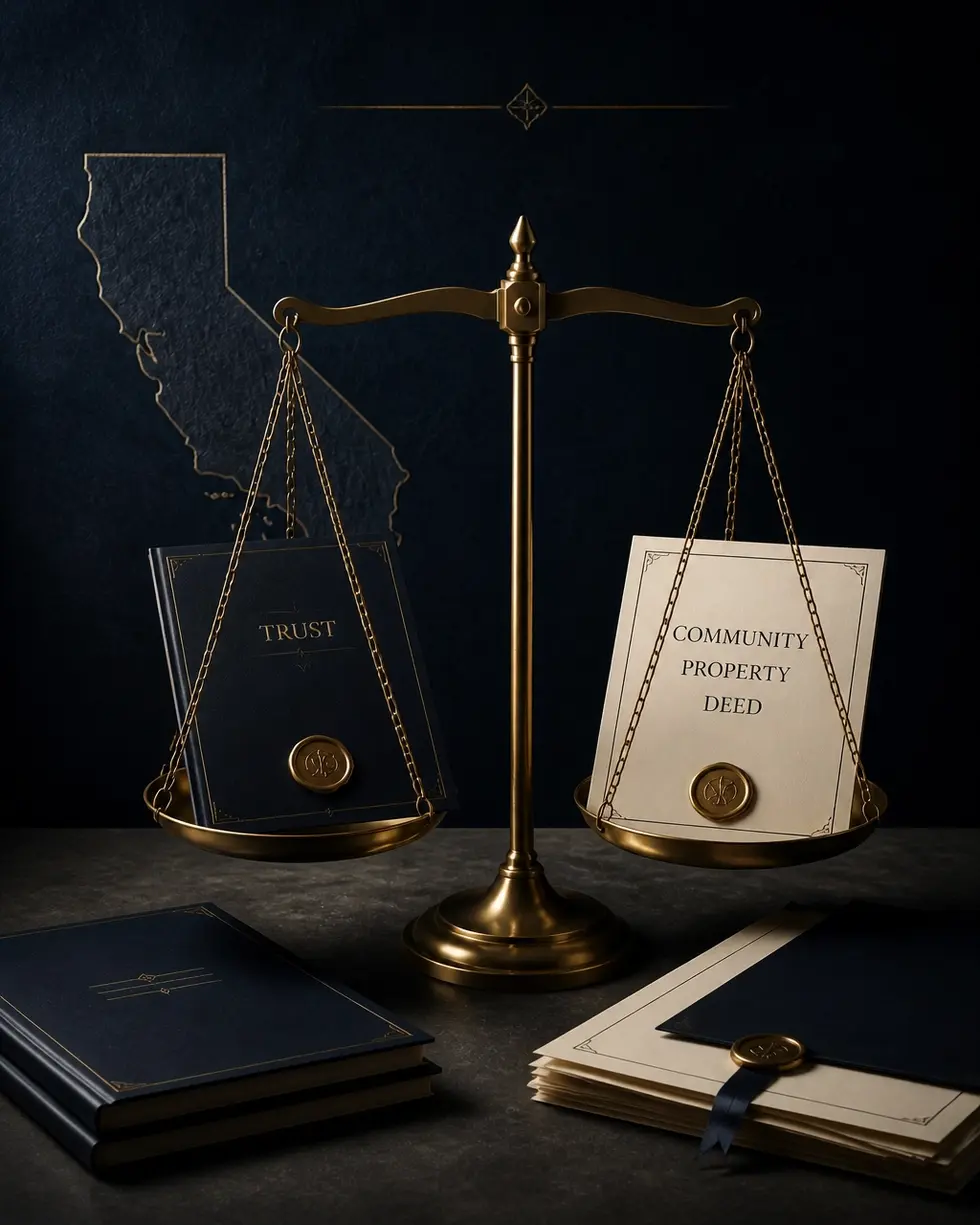
The reason is federal income-tax basis.
Under IRC § 1014(a), property acquired from a decedent generally receives a basis equal to its fair market value at the date of death, subject to statutory exceptions.
Section 1014(b)(6) extends that treatment to the surviving spouse's one-half share of community property when at least one-half of the entire community interest is includible in the decedent's gross estate.
That is the basis for the commonly used phrase “double step-up.” In a qualifying case:
- The decedent's half may receive a basis adjustment.
- The surviving spouse's half may also be treated as acquired from the decedent.
- The entire community asset may therefore receive a basis adjustment based on its date-of-death value.
Simple illustration
Assume a community-property investment portfolio has:
- Total adjusted basis: $2 million
- Date-of-death value: $10 million
- Proper community-property characterization
- At least one-half of the community interest includible in the decedent's gross estate
If the requirements of IRC § 1014(b)(6) and related rules are satisfied, both halves may receive a basis adjustment based on the $10 million value, not merely the deceased spouse's half.
CPA flag: This is only an illustration. The double step-up applies only if the asset is actually community property under applicable law, the estate-inclusion requirement is satisfied, and the trust and characterization rules are met. Do not quantify a projected tax result without CPA confirmation.
If AB 2658 were enacted, its community-character preservation language would be designed to support that analysis when one spouse funds a trust with their half.
Who would benefit most?
Blended families
A spouse may want their share to benefit children from a prior marriage while still protecting the surviving spouse's use or access to other assets. Separate trusts could offer more precise direction than a single joint distribution structure.
AB 2658 would not guarantee a particular result. It would, if enacted, provide clearer statutory support for the separate-trust approach.
Business owners
Business interests often carry concentrated value, voting rights, buy-sell restrictions, and valuation issues. A spouse may want to direct their half of an interest without unintentionally changing its community character.
The trust, business agreement, marital-property agreement, and tax reporting would need to work together. Do not treat the bill as a substitute for reviewing entity documents.
Real estate investors
Real estate may involve title records, debt, depreciation, separate contributions, refinancing, and commingling. A trust transfer must be coordinated with deeds, lender requirements, insurance, property-tax concerns, and the couple's characterization records.
For these families, the central issue is not simply “Which trust should we use?” It is “Which rights, interests, and controls are actually being transferred?”
What stays the same?
AB 2658 would not erase current California law.
Current Probate Code § 100 provides that, at the death of a married person or registered domestic partner, one-half of the community property belongs to the survivor and the other half belongs to the decedent. It also addresses written agreements for non-pro rata divisions.
Current Probate Code § 102 addresses the surviving spouse's ability to require restoration of certain transferred property in specified circumstances.
California's broader transmutation rules also remain relevant. Family Code § 852 generally requires a written express declaration for a valid change in the character of property between spouses.
A trust does not automatically solve:
- Lack of funding;
- Ambiguous ownership records;
- Improperly drafted community-property provisions;
- Undisclosed separate-property claims;
- Commingling or tracing problems;
- Conflicts with beneficiary designations;
- Business-entity restrictions; or
- Tax-reporting obligations.
An estate plan is a control system, not a document package. The documents must agree with the conduct.
What are the traps and open questions?
Bill language can change during the legislative process. Compare the version discussed here with the current bill history and enacted statutes before implementing a plan.
If enacted, practitioners would still need to address drafting questions, including:
- How the trust should identify the spouse's one-half interest;
- How title should be handled for real property;
- How the trust should coordinate with a joint trust or existing separate trusts;
- Whether a particular transfer changes control without changing character;
- How retirement assets, business interests, debt, and gift-tax rules interact with the structure; and
- How the IRS would analyze the specific facts.
The April 9, 2026 amendment struck the earlier elder-theft study language. That deleted language should not be described as an operative part of the amended community-property trust proposal.
For a broader asset-protection framework, see the Five Gate Strategy series by Mark Morris. Cross-border structures require separate tax, reporting, and legal analysis.
Two planning hypotheticals
Hypothetical only: Blended family and separate trusts
Facts: A California couple has $12 million in community investment accounts and real estate. One spouse has children from a prior marriage.
Current law: The couple should not assume that one spouse can safely transfer a separately claimed half into an individual trust with no effect on characterization or consent. Counsel must review the trust, title, marital agreements, account records, and California law currently in force.
If AB 2658 were enacted: The bill would provide clearer statutory authorization for transferring that spouse's one-half interest into a trust and would state that the interest remains community property unless both spouses agree otherwise in writing.
The tax result would still require separate analysis under IRC § 1014(b)(6).
Hypothetical: One spouse's share for prior-marriage children
Facts: A business owner wants their half of community property to benefit children from a prior marriage, while preserving the surviving spouse's rights in the survivor's own half.
Current law: The owner should review existing trusts and beneficiary designations now. Waiting for legislation could leave the current plan exposed to probate, incapacity, characterization, or beneficiary-designation problems.
If AB 2658 were enacted: The owner might have clearer statutory support for using an individual trust to direct their half at death without an automatic loss of community character.
That would not eliminate the need for careful drafting, informed spousal consent where otherwise required, or CPA review.
Warning Signs
Watch for these statements:
- “AB 2658 lets you do this now.” It does not.
- “Putting community property into a trust automatically preserves its character.” Not necessarily under current law.
- “A spouse can transfer the whole asset without the other spouse.” The proposal concerns only the transferring spouse's one-half interest.
- “The double step-up is automatic.” It is not.
- “A written agreement is optional.” The bill's proposed exception depends on community character being preserved unless both spouses agree otherwise in writing.
- “The bill eliminates all tax and business-entity issues.” It does not.
For a private planning intake and exposure review, use the James Burns command site and bring your current trust, deeds, account statements, beneficiary designations, and marital-property agreements.
Tactical FAQ
How should this bill analysis be used?
This article reviews the April 9, 2026 bill version. It does not certify the current enactment status. Check the official bill history and the statutes currently in force before relying on a proposed change.
What would AB 2658 do?
If enacted, it would amend Probate Code §§ 100 and 102 to clarify that a spouse may fund a trust with that spouse's one-half interest in community and quasi-community property for disposition at death.
Would the transferred property remain community property?
Under the bill as proposed, yes, unless both spouses agreed otherwise in writing. That proposed rule would apply only if AB 2658 were enacted in substantially the same form.
Does current Probate Code § 100 allow one spouse to do this?
Current § 100 provides rules concerning each spouse's one-half interest at death and written non-pro rata agreements. It does not mean that every unilateral trust transfer is automatically valid or free from characterization questions.
What does current Probate Code § 102 address?
Current § 102 provides a restoration remedy for certain transfers involving property in which the surviving spouse had an expectancy, if specified statutory requirements are met.
What is the double step-up?
It is the common description for the potential basis adjustment of both halves of qualifying community property under IRC § 1014(b)(6). The result depends on community-property status, estate inclusion, and other tax rules.
Is the double step-up guaranteed if AB 2658 passes?
No. A qualified CPA must confirm the facts, valuation, estate inclusion, basis history, and applicable federal tax rules.
Does AB 2658 remove spousal-consent requirements?
No. The proposal would not erase all consent, joinder, fiduciary-duty, title, or transmutation requirements under current law.
Would the bill apply to quasi-community property?
The proposed amendments address quasi-community personal property and community property. Counsel would need to classify the asset under applicable California law before relying on the proposed language.
What should couples do before the bill is enacted?
Review existing trusts, titles, beneficiary designations, marital agreements, and property records under current law. Do not delay necessary planning while waiting for a pending bill.
Does an existing joint trust need to be replaced?
Not automatically. The correct response depends on how the trust holds community property, whether separate direction is needed, and whether the existing documents coordinate with current California law.
What was the Aging and Long-Term Care Committee referral about?
Earlier text addressed a study concerning theft from elders and dependent adults in long-term care facilities. The April 9, 2026 amendment struck that language.
What should California couples do now?
Use the law that exists today.
- Inventory community, separate, and potentially quasi-community assets.
- Review whether each trust is properly funded.
- Confirm how real estate and business interests are titled.
- Examine beneficiary designations for retirement accounts, insurance, and investment accounts.
- Review marital-property agreements and any transmutation documents.
- Ask whether the surviving spouse's rights and the deceased spouse's testamentary wishes are both addressed.
- Have a CPA evaluate any projected basis or capital-gain result.
- Monitor AB 2658, but do not implement a plan based on legislation that has not been enacted.
Request a Situation Readiness Briefing. We will map the control, probate, tax, incapacity, and family-transition exposures in your current structure.
You can also review the firm's Estate Planning services, Asset Protection services, and California Private Retirement Plan information. A California Private Retirement Plan is a protection structure under applicable law; it should not be described as a tax-deferral strategy.
For related reading, see the firm's analysis of step-up in basis in California and probate friction.
Resources & Authorities
Primary authorities
- AB 2658, 2025–2026 Session : official bill text, April 9, 2026 version
- California Probate Code § 100
- California Probate Code § 102
- California Family Code § 852 : transmutation requirements
- California Family Code § 761 : community property and trusts
- 26 U.S.C. § 1014 : basis of property acquired from a decedent
- California Legislative Information bill-search portal
Status and practitioner commentary
- CalMatters Digital Democracy : AB 2658 status page
- LegiPlex : California legislative tracking portal
-
Beverly Hills Bar Association : August 2026 Trusts & Estates update
Cited as practitioner commentary, not as legal authority.
Related asset-protection framework
About James G. Burns
James G. Burns, Esq., LL.M., is the founder of the Law Office of James Burns. For more than 25 years, he has advised high-net-worth individuals, families, entrepreneurs, and business owners on estate planning, asset protection, wealth transfer, and legacy preservation.
He is a Trust and Estate Practitioner (TEP) and a member of STEP. He was selected to Super Lawyers from 2022 through 2027, received an Avvo Top-Rated Lawyer designation in 2021, and was recognized among America's Most Honored Lawyers in 2020.
Date Last Reviewed: August 31, 2026
Editorial update: October 15, 2026. Heading length and disclosure formatting were corrected. The historical legislative review date above is preserved; this update does not certify current bill status.
Disclaimer
This article is for general educational purposes only. It is not legal, tax, investment, accounting, financial, or other professional advice and does not create an attorney-client relationship.
Historical proposal: This article discusses the April 9, 2026 bill version. It does not certify the current enactment status. Verify the official history, enacted text, and effective date before relying on any proposed change.
The discussion of IRC § 1014(b)(6) is general and does not predict a tax result. Consult qualified California legal counsel and a CPA before transferring property, changing its characterization, revising a trust, or relying on a projected basis adjustment.
IP Disclosure
© 2026 Law Office of James Burns. Original explanatory content belongs to the firm unless otherwise stated. Third-party names, publications, statutes, and links are identified for attribution or reference only. No affiliation, endorsement, or ownership of third-party marks is claimed.

Comments
There are no comments for this post. Be the first and Add your Comment below.
Leave a Comment